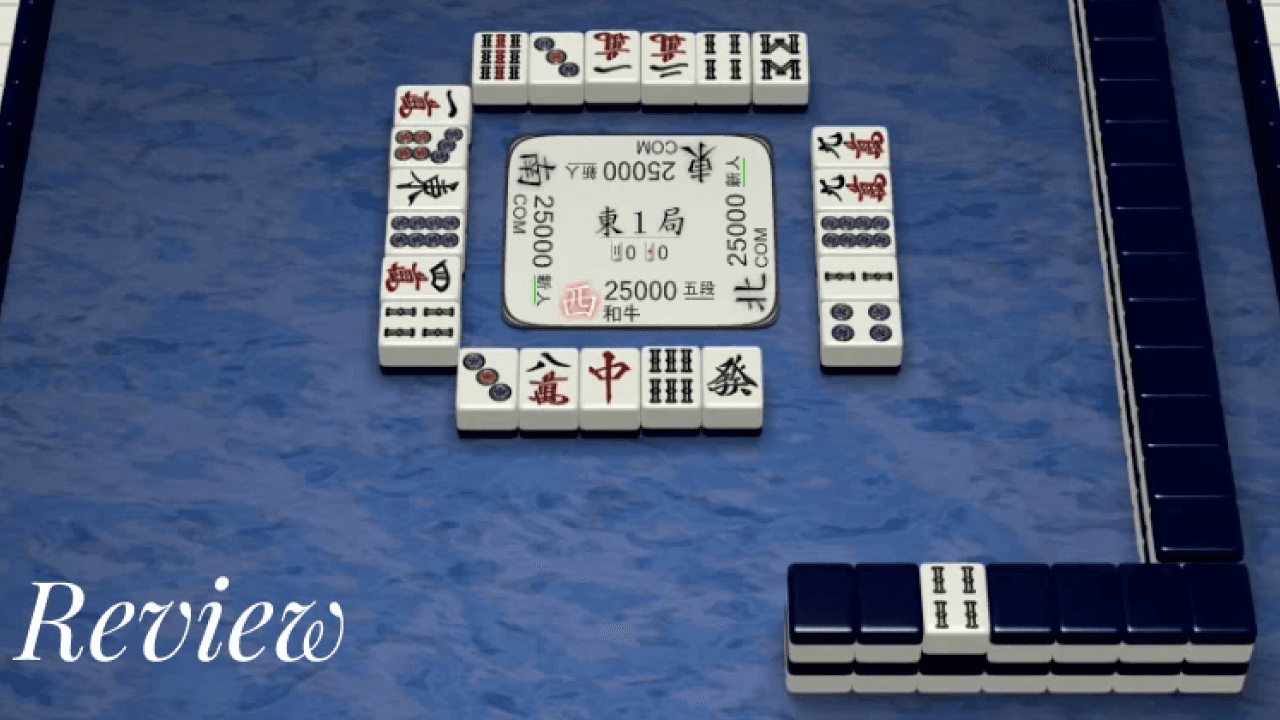
is Japan's most competitive online mahjong server, now available in English. But its rules differ significantly from standard rulesets. The strategies that rank you up online can sabotage you offline. Understanding why requires understanding how Tenhou was designed.
Note: The title of this article was changed to avoid confusion. I apologize for the earlier click-baity title. If you're 7th Dan or higher, ignore this. But if you've played hundreds of games and you're stuck in the lower dans, keep reading.
"Nicolas, stop playing like this is Tenhou."
Through my 17 years of playing mahjong, that is the one piece of advice in common that almost every single professional mahjong player has given me.
Nicolas, stop playing like this is Tenhou ~Every Mahjong Pro
I have played Tenhou for over a decade, regularly hung out with 10d and Tenhou'i (max rank) players, and I am also a Phoenix (houou) table player myself. Needless to say, I love the game as much as the next guy.
I also regularly play High Rate Tonpuusen in real life against players who are 10 Dan+ in Tenhou. Under both League rules and Kabukicho Rules.
From left to right, Higa Hidehito (10 dan, inspiration for the character of Hyuga in Tetsunaki no Kirinji), yours truly, Mabou Doufu (front, 10 dan), Doppo (the third Tenhoui), Yuusei (10 dan, brother to Asapin, the first Tenhoui)
If you think spamming Tenhou games will make you strong: no. (Although it will surely help you rank up)
Disclaimer: I don't believe online mahjong is better than offline mahjong, in the same way I don't believe playing offline mahjong is inherently better than playing online.
Mindlessly grinding "until you get used to it" hurts your game.
I stopped hurling my mouse. Now you can play Tenhou on mobile
There is a right way to use Tenhou for improvement.
First, let me demystify Tenhou and explain why it is not "the standard."
Then I'll explain how to use it properly, and why ignoring it entirely also hurts your game.
Tenhou is not "the standard" measure of Mahjong Skill
When I got the final table of the Shinjin'ou tournament for 日本プロ麻雀協会 (NPM) pros, many people watching the finals live online criticized me on Twitter for "playing too much like this is Tenhou." Hopefully, I can prevent you from going down that road as well.
I have plenty of local, competitive, and online mahjong experience. I play a wide range of players from all backgrounds and skill levels. That's why I can offer a more balanced view on the online vs offline dilemma.
What is Tenhou? Who made it?
Tenhou.net is an online Japanese mahjong platform developed by c-egg, run by Shingo Tsunoda.
It allows you to play Japanese mahjong online against other human players, divided into different rooms based on ranking and skill level (more on that later).
The interface is clean and functional; designed to be "the" mahjong console.
Can I play Tenhou in English?
Yes. I worked on the English translation project. You can learn more about how to play Tenhou in English here.
The player base is mainly Japanese, but plenty of English speakers play there.
You can play Tenhou in English
Tenhou has remained the favorite among serious players for over a decade. Why?
Why is Tenhou different from other online mahjong servers?
Normally, mahjong rules award a closely-mirrored "" (or point spread, called "uma") to players from 1st to 4th place: 1st place gets a lot of points, then each other placement gets gradually fewer points. Tenhou's point system, instead, places a bigger emphasis on not placing 4th.
Each time, the penalty for 4th gets bigger and bigger, but the rewards for 1st and 2nd stay the same. 3rd has no penalty or reward
Have you ever wondered why? Or whether this is normal?
The problem with online mahjong
Back in the 00s, when online gaming started being a thing, online mahjong games had a design problem: Mahjong is generally a game about taking 1st place.
Most rulesets in real life emphasize this strongly by awarding to 1st place. The penalties for other placements are usually not that far apart.
So in mahjong, players are expected to take big risks to seize 1st place, even when many times that yields a risk of losing many points.
Even in Tournaments, you will need to get mostly all 1st places to reach the final table.
This is solid in real life, where you can guarantee people will sit around until the end of the game. This was not the case for online mahjong, where players had all to win and nothing to lose.
As soon as one player fell too much behind, they would disconnect and quit the game.
This is the equivalent of playing Online Poker Tournaments, calling as soon as you get to the table, then leaving after losing. Over and over.
This behavior disrupts the game. It cheapens everything. Mahjong is only fun when all four players are trying their best to win.
Mahjong is only fun when all four players are trying their best to win. ~NPMahjong
Tsunoda thought he could fix this; and he did.
Why is getting 4th place so bad in Tenhou?
Tsunoda's solution: punish 4th place severely.
Real-life rules put the biggest reward on 1st place. Tenhou was the first to put the biggest penalty on 4th place instead.
Not only is the penalty for 4th place much bigger than the reward for 1st place; the gap between 4th and 3rd is abysmal. Soul-crushingly distant.
For a 5 dan player, the 2nd-to-3rd gap is 30 points. The 3rd-to-4th gap is 105 points: almost 4 times larger. This was unheard of in any other mahjong setting.
You rank up not by winning more, but by avoiding 4th when behind.
This clever system guaranteed that sticking around until the end was in the best interest of all players wanting to rank up.
Not only that. Tenhou was one of the first Online Mahjong games to adopt , which was more of a novelty used mainly for gambling in mahjong parlors at the time, and not so widely adopted online. Nowadays it's common to see red dora in games, but this wasn't so common back then. This, too, was on purpose. Having so many dora in the game gave the player in 4th a good fighting chance, and plenty of hope that they could climb back to 3rd to avoid the penalty.
Yes, Tenhou's ruleset wasn't meant "to make the game more skill-based." It was made to make the players stick around so they could try to seize 3rd place as a last resort escape when their efforts to get 1st place failed.
Tenhou's rules weren't made to make the game more skill-based, they were made to make the players stick around
Now, don't get me wrong. Avoiding 4th place is no simple task, especially when none of the 4th players will give up so easily.
(Incidentally, another funny quirk in the rules: after riichi you can make a closed that changes how the hand reads, or its yaku, as long as the wait stays the same. Not to add more excitement to the game, but because admittedly "it was too troublesome to program those cases out of the game.")
Do Tenhou ranks matter?
Now that we got out of the way the fact that "Tenhou rules are by no means the standard in Japan," let's answer a more significant question.
"How do I improve my mahjong further?" is the common question that players throw around. Usually "play a lot of (online) mahjong (on Tenhou)" is the answer that they are given.
So, if the rules are so different, do Tenhou ranks even matter?
Yes... But, with a word of warning.
If you're going to invest thousands of hours in a mahjong game to get stronger, you might as well choose Tenhou. It is, after all, the most competitive.
Thousands of players log in every day, and your Tenhou rank is usually considered a reliable indicator of strength. This is why thousands of players usually choose it to advance their game and to show others their level of skill. But why?
Because ranking up gets more and more difficult as you move forwards. Correlation doesn't imply causation, but it is a fact that stronger players can get to higher ranks much more easily than weaker players.
Achieved Tenhou ranks are usually treated as a reliable indicator of strength ~NPMahjong
The truth is that adapting to Tenhou rules can even be more difficult than playing other rulesets, as it requires you to become an even more stoic player. You won't nearly get the same feeling of satisfaction from avoiding 4th place as you would from getting 1st place, even though the reward is bigger. But you have to.
Now, let's get to the main point of this article.
How can Tenhou possibly harm your game?
Addiction and placebo effect. After all, who needs to study if you played 30 games today, right? No.
It is possible for weaker players to reach 6 Dan ranks by spamming games, and for stronger players with fewer games online to find themselves stuck at 6 Dan for a while.
Two players at 6 dan can be far apart. One can hold a stable dan of 5 and the other a stable dan of 8. The Tenhou rank calculator shows the stable dan your own placement rates hold.
These gaps are even bigger for lower ranks.
It is possible, and not too difficult, to reach a 6 Dan rank spamming games. Two players at 6D can be far apart in skill
Most intermediate players will fall into the trap of using Tenhou exclusively as their only means to learn. In some extreme cases, giving up offline mahjong altogether. Then, they might mistakenly believe that their rank accurately reflects their skill, and then forget that this "Tenhou Pride" is dragging them down in other aspects that they will have no interest to improve upon.
For those players, Tenhou will remain more of an addiction than a tool towards improvement. Whatever good results they get, they will be nothing more than a sweet placebo.
There is a point to be made that a player who can consistently reach tables is, beyond doubt, definitely much stronger than someone who can't climb to 6 Dan no matter how much time and effort they put in.
To anyone rejecting online or offline mahjong, I suggest that you try out both and expand your mahjong world. That is the best thing you can do to round up your game.
You should still try to climb online. It is easier to claim you are a strong player when you have a high rank online. It is a lot harder to prove that you are a strong "offline" player unless you won a lot of highly competitive tournaments, you made a lot of money playing, or you have a lot of mahjong theory in your arsenal and you are practically a mahjong scholar with a solid understanding of game theory and statistics.
It is easier to claim you are a strong player when you have something to show for it.
Also, speaking of statistics, always mind where those statistics come from. Tenhou is usually the main source for mahjong data, but due to the nature of its rules sometimes those numbers aren't exactly what you need offline. Thanks to the large sample size they are reliable in general, but take them with a grain of salt.
In the end, no matter what side of the argument you are on, whether it is online or offline, you need something to show for yourself if you want to claim you are stronger than others.
Playing mahjong online vs offline
For some reason they are shuffling by hand on an auto table
The main problem I see with people who play "only Tenhou" is that when they switch to offline games they immediately get destroyed. Veteran players run circles around them.
I have rarely seen the opposite pattern happen (someone who is strong offline getting crushed online), but I have witnessed that other pattern frequently with online players.
And I'm not talking about your typical, casual "local mahjong club" players. I am speaking from my experience working at the most expensive mahjong parlors. I am talking about Phoenix Table players making their mahjong parlor debut after plenty of preparation online.
The following differences are too often overlooked:
- Offline, you need to be constantly aware of all your calling opportunities; the game will not stop for you
- Even during your own turn, you need to keep up the pace; you cannot use your "time bank" freely, you don't even have a time bank
- You need plenty of experience to remain focused and calm; you are not at home and you are faced with actual human beings present, some of which will even compete for your attention
- You have to mind the way you arrange your tiles, conceal your expression, and make sure that you do not give away more information about your hand than you must
- All point and hand calculations must be done by yourself, in your head, while keeping all the above in mind as well
- If there is money on the line as well, all the more...
Tenhou counts your points for you. A parlor won't, so learn how riichi scoring works before you sit down.
It is impossible to commit a in Tenhou, but in real life, there is no helper, no "auto-win," there is not one single safety net.
This is not an issue at all in casual, friendly offline games where everyone is nice. When you start to play more competitive mahjong (and I am not talking about a local tournament, but any game where the stakes are high), these things will add up, and you will unavoidably make a lot more mistakes than you would have made online. And that's how people beat you: mistakes.
Now, how many more mistakes will vary from player to player. Some players will drop a Dan level at most. Some others, even more.
Real life mahjong too fast for Kirinji
The first Volume of the manga "Tetsunaki no Kirinji" is funny because it is real.
Many of these players will even blame it on others after they lose.
- "Other people are bad at defending, they keep feeding into obvious hands, nobody does that on Tenhou."
- "I didn't deal in even once but I still lost, that's not how it's supposed to work. That guy who fed the entire game should have lost. But he got a lucky big hand in the end. And nobody stopped him. I have such bad luck"
- "They have terrible manners, they won't even give me time to call or think."
- "I can't read these lunatics. They are not playing by tile efficiency. They stink."
Hold it right there
Let me tell you right now, that if you've ever felt that way, the problem is not other people: the problem is you.
The reason you lose isn't that the others are bad, or irrational, or even because the others are good. The only reason you lose is that you're not better than everybody else at that specific rule-set.
The problem is never other people, the problem is always you.
They are different games
Now, it doesn't take a lot of mental clarity to realize that for different point bonuses you have to play differently. But you would be surprised how many people don't care.
Tenhou has unique qualities that are not replicated by any other mahjong tournament, league, event, or parlor.
Tenhou has unique qualities that are not replicated by any other mahjong tournament or event
Therefore, it is foolish to assume that you can duplicate your exact same playing patterns from Tenhou and win offline against anyone who is decent.
The Tenhou "Trial and Error" (or "get used to it") method will surely help you perfect some skills, but it will kill your opportunities to perfect other important aspects while you stick to "playing Tenhou" as your only means of improvement.
What mahjong skills will Tenhou help you perfect?
If you don't study the game and you base your improvement exclusively on "if I rank up, I am playing better; if I rank down, I am playing worse," you will most likely unconsciously improve on the following fronts by default:
- Maximizing hand win percentage
- Minimizing feed percentage
- Perfecting defensive discard order
- Point difference judgment
Everyone seems to get good at these four by constantly playing on tables. If you do get to that point, that is great.
You might think these skills are good enough to beat almost anyone, so who needs to study mahjong, right? While yes, they're useful additions to your toolbox, if you continue to focus only on these 4 points you'll become a weak, unbalanced player.
Why? Because you will always be missing these other important skills that you must study from theory (or by playing a wider range of rulesets). Especially if you ever have to play a table where Tan Yao isn't allowed as an open Yaku.
Riichi mahjong skills you will need to study
Players who wish to advance further will have to study the following on their own.
- Maximizing average hand value, chasing more complex Yaku combinations delaying your average win turn
- Standard push-pull judgments (under different types of ), as well as snap-judgments
- Playing around other people's hands (calculated aggression, mawashi), especially in mahjong with bonuses
It is not enough to know that "if I have a 50-50 chance for 1st and 4th, I should not go for it." You need to know and understand why. And why sometimes it's better to go for it.
Understand why your win conditions are the way they are.
The importance of speed in Tenhou comes with the sacrifice that you'll win fewer monster hands (not counting the ), since you won't chase yaku as often as in other rulesets. A higher hand win rate is more important than having a high average hand value at a later average win turn. A lower feed rate is more important. Getting and avoiding direct hits is preferred, as these will set and close great distances with other players.
In comparison, under most mahjong rulesets, you'd usually prefer to have over winning directly off a single player.
Now, do take those statements with a grain of salt as well, as everything is relative. For example, if we're speaking compared to mahjong parlors, where a is almost 3 times better than a (for rea$ons we can't go over in this post), and compared to competitive mahjong where cheap hands are more unusual even though there are usually fewer at play, yaku are chased more often, and the average win turn is later in the hand.
It is all natural because Tenhou's system puts such central focus on minimizing , and a smaller focus on playing every hand for 1st place. (If you're good enough to realize that and adjust, more power to you.)
Now, some people will say that this is wrong, and that these skills are all transferable. Then again, I'm sure that those people happened to have studied the game, held mahjong discussions, asked others for opinions, and read some strategy. So, in the end, even they climbed up not by "playing a lot of games" but by studying why the decisions they are taking are correct.
In your usual offline rule-set, placing 1st and 4th one time each will almost always net you a positive score, so you would usually take a lot more coin flips. Any 50-50 showdown in a four-player game would be favorable towards you. That is not the case for Tenhou. You should not take coin flips. You will not take coin flips. You will learn not to take coin flips. Other people will tell you not to take coin flips. But you need to think and understand why that is.
50-50 chances for 1st and 4th are favorable in most mahjong rulesets, but not for ranking on Tenhou
If you don't learn the why behind "this is a better choice in Tenhou," you will avoid beneficial gambles over and over until it becomes an addiction, a bad habit, second nature. Eventually, you will become unable to take large risks for large returns.
I have seen it happen over and over. Solid Tenhou players with a system, getting crushed long-term in "normal mahjong" because they tend to avoid risks even with the odds could be in their favor. Only because instead of thinking, they stick to their system. After all, if it helped them rank up online, it must be a good system, right?
It can take a lot of de-programming to get over all the misconceptions you can drag from simplifying your view of mahjong through Tenhou:
"pushing while is a sin," "3rd is a lot better than 4th," "speed is vital," "avoid coin flips," "insta-riichi is always boss"
etc...
All these misconceptions disappear in the highest levels of play in Tenhou where everyone is good enough to realize how silly most of them are. But these "maxims" have become predominant in lower-level circles because they are simple, algorithmic rules to follow if your only goal is out-ranking your closer mahjong circle.
The road to 6 Dan is simple and straightforward.
Playing some "normal mahjong" now and then will force you to think about your decisions. It will also help you develop a number sense for your odds. This will, in turn, increase your knowledge of when (and why) to push certain hands under certain conditions.
In Tenhou, until , you can probably get away with not thinking about it too much, because the scales are highly tilted towards defending in almost every doubtful case. Rarely will you be making a mistake in lower tables by choosing to fold. Fancy "hand acrobatics" are discouraged for less advanced players (as they would probably end up making mistakes), even though they make for more than half of the hands elsewhere, where you can't afford to take apart your hands and .
The road to 6 Dan in Tenhou is simple and straightforward. Mahjong starts afterwards.
How do I make the most out of Tenhou?
For one, read mahjong theory, participate in mahjong strategy discussion on Discord, or get your games reviewed by stronger players, and then use Tenhou as a means of output, not as a method of learning.
Use Tenhou for output, not for input. If you're getting better, your Tenhou stats will reflect that.
If you are getting better, your Tenhou stats will reflect that. There will be no need to mindlessly spam games.
Also, if you are not using Tenhou for output, you are missing out. Where else can you get access, immediate access, to a competitive environment that is always willing to play any time of the day? How else can you take in the necessary amount of games a month required to gauge performance?
There is a reason why most of the strongest offline mahjong players also play in Tenhou.
But my Tenhou stats are bad. Should I quit Tenhou?
No.
Instead, you probably should stop putting it on a pedestal and assuming it is the "standard" and that anyone cares how bad (or good) of a rank you have.
Tenhou rules are atypical.
The reason why strong players do well in Tenhou is precisely because strong players are good at adapting to all sorts of rules.
The reason why strong players do well in Tenhou is precisely because strong players are good at adapting to all sorts of rules.
This is what you should aim to become: a player who can adapt to all rules and situations. Not follow simple algorithms like "If A then B."
A high rank in online mahjong doesn't automatically make you a strong player, like consistently beating your local mahjong club doesn't make you a professional.
There is something to be said about people who cannot achieve a high rank in Tenhou, no matter how much time and effort they put in. If you cannot reach at least tables, no matter what you do, then nobody should consider you a strong player.
Tenhou theme song
Time for the unofficial Tenhou theme song:

Rounding up
I've seen plenty of 9-10 dan players go broke easily in high stakes games against people who aren't even that much better than them, but are used to having a better "sense" for different types of showdowns.
One-Trick-Ponies are real and they exist in most online games. There's nothing bad about that. It depends on what your goal is with playing the game.
This is why you should not play purely by relying on "sense" or "feeling" but by understanding proper game theory, statistics, and strategy. If you still want to play "only by experience," try mixing in some other rulesets as well for good measure.
It's easy to lose against weaker people if you don't play perfectly according to the numbers according to your rules. It happens frequently in "Tetsunaki no Kirinji," and how does the main character manage to succeed? By swiftly adapting.
You must still use Tenhou as a means to practice, and you can also use these other resources for improving.
Use Tenhou as a means of output and gauging, not as your only means of studying. Studying comes from books, game reviews, and discussion with stronger players.
If you have no stronger players in your circle, join us on Discord, or ask a professional mahjong player to review your games one-on-one.
Most professional players are found in Japan and do not offer this service directly, especially to foreigners. But if you wish, I can do it for you when you pledge to my Patreon. (That Patreon page is where I post the juicy content as well. All you need to do is pledge as little as 1 dollar a month to access tons of game reviews, translations, and mahjong content, and you support my efforts for the Mahjong world.) You can also book a review directly.
What's your highest Tenhou rank? What do you do to improve? Let me know.
Was this article helpful?