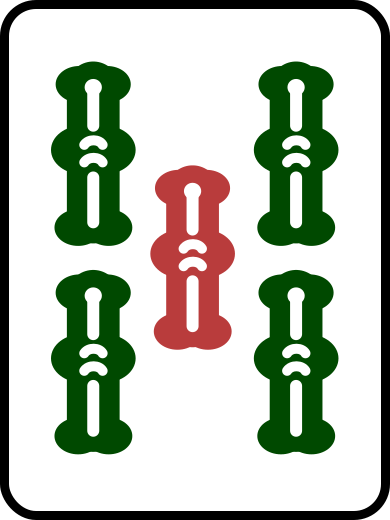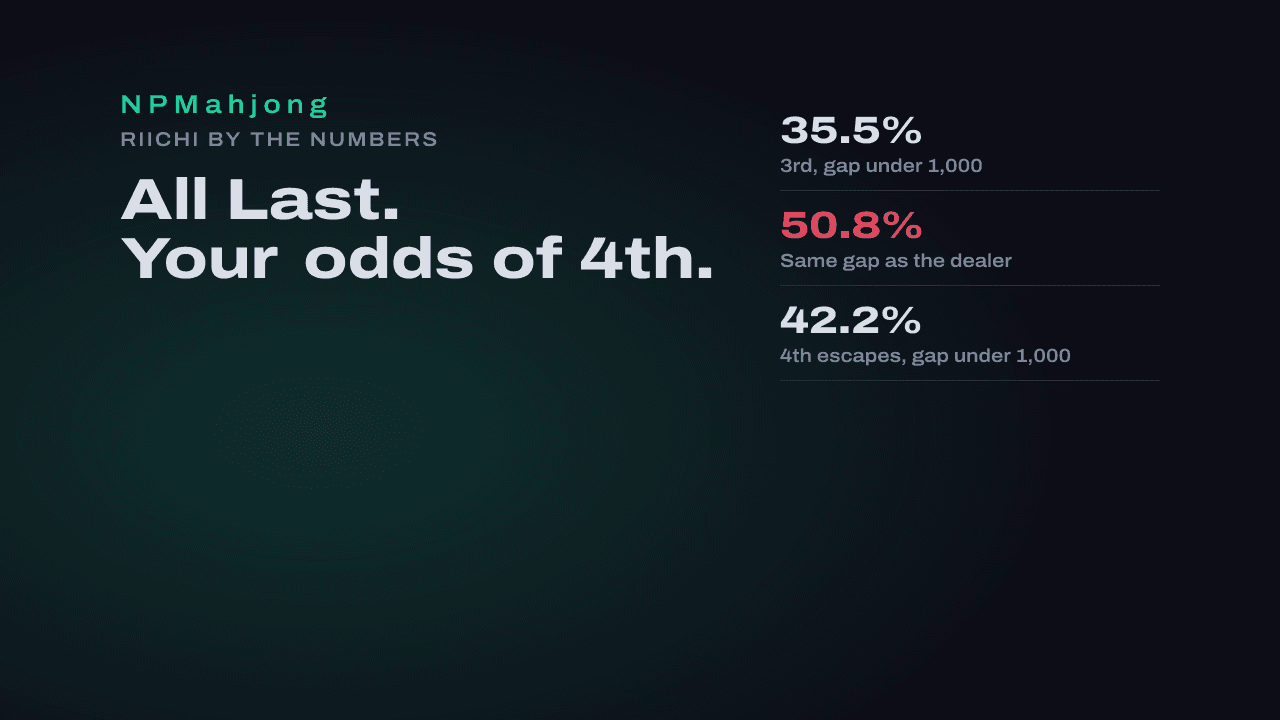
, you're 3rd, 600 points above 4th. In Tenhou's top room, with neither you nor 4th the dealer, that spot finishes 4th 35.5% of the time. Say you play that hand better: you fold one tile earlier, or take the cheap instead of the pretty one. Most of the time it changes nothing. Once in a while it turns a 4th into a 3rd.
Do that in one game out of twenty and your average placement moves by 0.05. From 2.50 to 2.45. It sounds like rounding error. British Cycling built a philosophy on improvements that size. Its performance director, Dave Brailsford, called the approach marginal gains, and the claim was that enough small ones add up to something large. In mahjong you don't have to take that on faith. The rank formulas are public, so you can price a 0.05 exactly.
One percent at a time
Brailsford was British Cycling's performance director from 2003. During the London 2012 Olympics he explained the idea on BBC Breakfast, as BBC Sport reported: "The whole principle came from the idea that if you broke down everything you could think of that goes into riding a bike, and then improved it by 1%, you will get a significant increase when you put them all together." The examples he gave were small on purpose: sleeping in the right position, taking the same pillow when traveling, washing hands properly so riders got ill a little less. Britain won seven of the ten track cycling golds in London, matching Beijing 2008. His Team Sky went on to win the Tour de France six times between 2012 and 2018.
In a 2019 column for The Guardian, republished on Yahoo Sport, Tim Lewis wrote that "some of the golden aura that surrounded marginal gains has vanished." He wrote that "it became hard not to feel that Team Sky succeeded because they threw money at everything", and quoted what Bradley Wiggins told Eurosport in 2017 about Brailsford's favorite idea: "But I always thought it was a load of rubbish." A 2018 parliamentary committee report concluded that Team Sky had crossed an "ethical line" with its use of therapeutic use exemptions. Team Sky and Wiggins denied wrongdoing, and no anti-doping rule was found to be broken. Nobody knows how much each 1% was worth in cycling. Tenhou publishes its formulas, so in mahjong you can work it out.
What 0.05 means at the table
Average placement is your 1st rate times 1, plus your 2nd rate times 2, and so on to 4th. A player who finishes each place a quarter of the time averages 2.50, the room average by definition. Move 5% of your games up one place and you're at 2.45.
For scale, the Nodocchi Phoenix database puts the middle half of regulars, players with 500 or more Houou games, between 2.48 and 2.53 average placement (read 2026-10-23).
The same 0.05 can come from different places. Take the two cleanest versions:
- Fewer 4ths. 25/25/25/25 becomes 25/25/30/20: five 4ths in a hundred become 3rds.
- More 1sts. 25/25/25/25 becomes 30/20/25/25: five 2nds in a hundred become 1sts.
Both average 2.45. The rank systems don't price them the same.
On Tenhou's R, every 0.05 is equal
Tenhou's rating moves by a fixed formula in the manual: game-count factor × (placement result + (table average R − your R) ÷ 40). The placement result in four-player dan games is +30, +10, −10, and −30. Those four numbers are 50 − 20 × your place, so your expected placement result is 50 − 20 × your average placement.
At 2.50 that's 0. At 2.45 it's +1.0 a game. It doesn't matter which games improved. The game-count factor is 1 − 0.002 × games played under 400 games, and 0.2 from 400 on, so a veteran's R drifts up by 0.2 a game from the 0.05. More useful is where R settles. Against a fixed table average, R stops moving where the placement result and the correction cancel: the table average plus 40 times your expected result. A 0.05 better average placement raises that resting R by 40 points.
On dan points, the source decides
points aren't symmetrical, and that's where the two versions part. In a Houou every rank gets +90 for 1st, +45 for 2nd, and 0 for 3rd. The 4th-place loss grows with your dan: −135 at 7-dan, −150 at 8-dan, −165 at 9-dan. The Tenhou rank calculator uses these tables, and so does every number below.
At 7-dan the expected points per game are:
- Unchanged: 0.25 × 90 + 0.25 × 45 + 0.25 × 0 − 0.25 × 135 = 0.
- Fewer 4ths: 0.25 × 90 + 0.25 × 45 + 0.30 × 0 − 0.20 × 135 = 22.5 + 11.25 − 27 = +6.75.
- More 1sts: 0.30 × 90 + 0.20 × 45 + 0.25 × 0 − 0.25 × 135 = 27 + 9 − 33.75 = +2.25.
Same average placement, three times the points. Mahjong Soul splits them the way Tenhou does. At Master 1 in the Jade room, a hanchan pays +125, +60, −5, and −180 in placement points after , leaving out the raw-score part that the rank-up guide explains. There the unchanged record earns 0, fewer 4ths earns +8.75 a game, and more 1sts +3.25.
| Per record | Even record | Fewer 4ths | More 1sts |
|---|---|---|---|
| 1st / 2nd / 3rd / 4th % | 25 / 25 / 25 / 25 | 25 / 25 / 30 / 20 | 30 / 20 / 25 / 25 |
| Average placement | 2.50 | 2.45 | 2.45 |
| Tenhou 7-dan, per game | 0 | +6.75 | +2.25 |
| Games to 8-dan | never | 208 | 623 |
| Mahjong Soul Master 1, per game | 0 | +8.75 | +3.25 |
| Games to Master 2 | never | 160 | 431 |
Tenhou's stable-dan formula agrees. Stable dan is the rank where your record breaks even forever, and the manual gives it in Houou as ((1st rate × 60 + 2nd rate × 30) ÷ 4th rate − 20) ÷ 10. The unchanged record is a stable 7.00. Fewer 4ths makes it 9.25. More 1sts makes it 7.60. One 0.05 is worth more than two whole dan when it comes out of 4th place, and just over half a dan when it comes from the top.

Why this interest doesn't compound
Marginal gains often gets sold as compound interest: 1% better every day. Compound interest pays interest on your interest. The rank ladder does the reverse: every promotion raises the 4th-place loss, so the same record earns less at each new dan. The fewer-4ths record makes +6.75 a game at 7-dan, +3.75 at 8-dan, and +0.75 at 9-dan. Mahjong Soul's ladder shrinks too: +8.75 at Master 1, +5.75 at Master 2, +2.75 at Master 3.
A 0.05 buys a higher resting point, the stable dan. The ladder carries you there and stops, and the next dan needs the next 0.05.
1,000 games, simulated
Expected values hide the swings. A 7-dan with a 25/25/25/25 record has a standard deviation of about 84 points a game, so luck can carry anyone a long way in either direction. The Tenhou rank calculator's simulation code shows what survives the noise: 10,000 runs of 1,000 Houou hanchan each, starting at 7-dan with 1,400 points, with demotion, promotion, and the bigger 4th-place loss at each dan all applied.
| Share of runs | Even record | Fewer 4ths | More 1sts |
|---|---|---|---|
| Reached 8-dan at least once | 52.5% | 98.7% | 77.1% |
| Finished at 8-dan or higher | 20.1% | 95.5% | 47.1% |
| Finished below 7-dan | 57.7% | 1.0% | 27.7% |
Look at the even record. Luck promotes half of the unchanged players at some point, and most of them fall back. More than half finish below where they started. The fewer-4ths player finishes at 8-dan or higher in 95 runs out of 100. At the calculator's 25 minutes a hanchan, those 1,000 games are about 417 hours of play.
You won't see it in your record
This is the hard part, and the reason marginal gains needs faith even when you can price it. A 25/25/25/25 record has a standard deviation of 1.12 places per game. After 1,000 games, the margin on your measured average placement is 1.96 × 1.12 ÷ √1,000, about ±0.07. A real 2.45 player lands between about 2.38 and 2.52 in 19 runs out of 20. After 100 games the margin is ±0.22, more than four times the improvement you're chasing.
Brailsford couldn't measure what a pillow was worth either. Judge a marginal gain by the habit. The number won't tell you for a thousand games. For a 0.05 that comes from 4th place, the habits are folding the hand that can't win, checking the score before South 4, and taking the cheap when 4th sits 600 points behind you.
Fix the big leaks first
Brailsford could improve a hundred things in parallel because each one had its own measurement. Mahjong gives you one noisy number for everything, so the order matters. A leak like a rate two bands above the Houou middle is no marginal gain. Fix that first, the way the bottleneck stat post lays out. Lewis argued that money bought Sky its big gains while the small ones got the credit, and in mahjong the big gain is the deal-in.
In the Houou logs, a declared on turn 8 averages 5,869 points on a ron, and a clean fold costs 1,120. One deal-in with a 1,000-point hand costs about five careful folds. Do that every few games and it's a big leak that looks like bad luck.
Price your own 0.05
Put your real placement rates into the Tenhou rank calculator or the Mahjong Soul rank calculator, then move five points from 4th to 3rd and run it again. The gap between the two answers is what your next 0.05 is worth.

Want to know where your 4ths come from? Send your logs for a game review: it starts from your placement record and works back to the decisions behind it.
Was this article helpful?