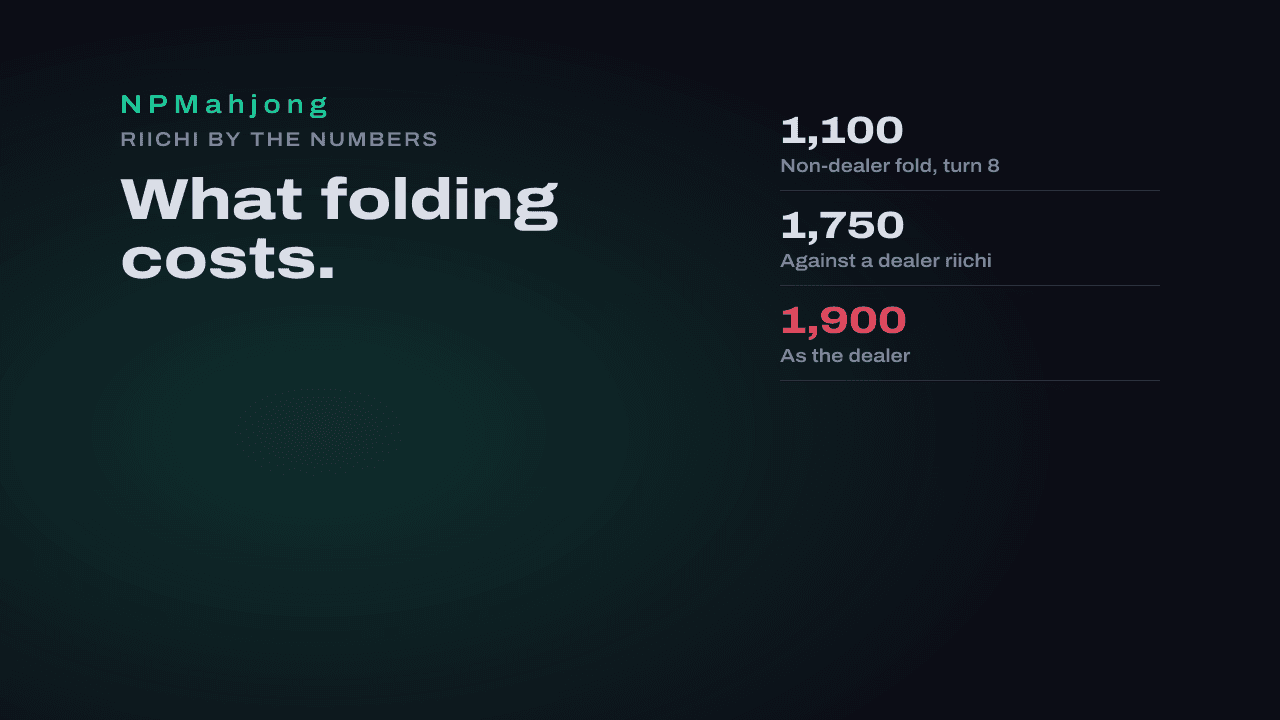
Folding isn't free. A goes up, you fold as a non-dealer, and from turn 8 you lose 1,124 points on average. Fold as the dealer and the bill is 1,886.
Those numbers come from Tenhou logs 2016–2020, analysis by chienshyong (fork of Euophrys/houou-analysis). They cover Houou-level 4-player , the room on Tenhou, so your table may differ. They still do something most advice skips: they put a price on . Once folding has a price, you can weigh it against what pushing costs and what it buys.
What the fold price counts
The analysis stops each hand at a set turn and notes who has declared riichi and who's dealer. Then it waits for the result. Every player who didn't declare riichi, didn't win, didn't deal in, and wasn't at a draw goes into the average. That's the result a clean fold gets you.
The turn counter starts at zero, so turn 8 is your ninth discard. The money a folded player loses comes from three places:
- A tsumo. The riichi player, or anyone else, wins by and you pay your share. The dealer pays double.
- A draw. You pay to the tenpai players.
- A elsewhere. Someone wins off another player and you pay nothing. These hands pull the average toward zero.
Deal-ins aren't in it. Read the fold price as the cost of folding well: safe tiles, no ron. Folding badly costs more.
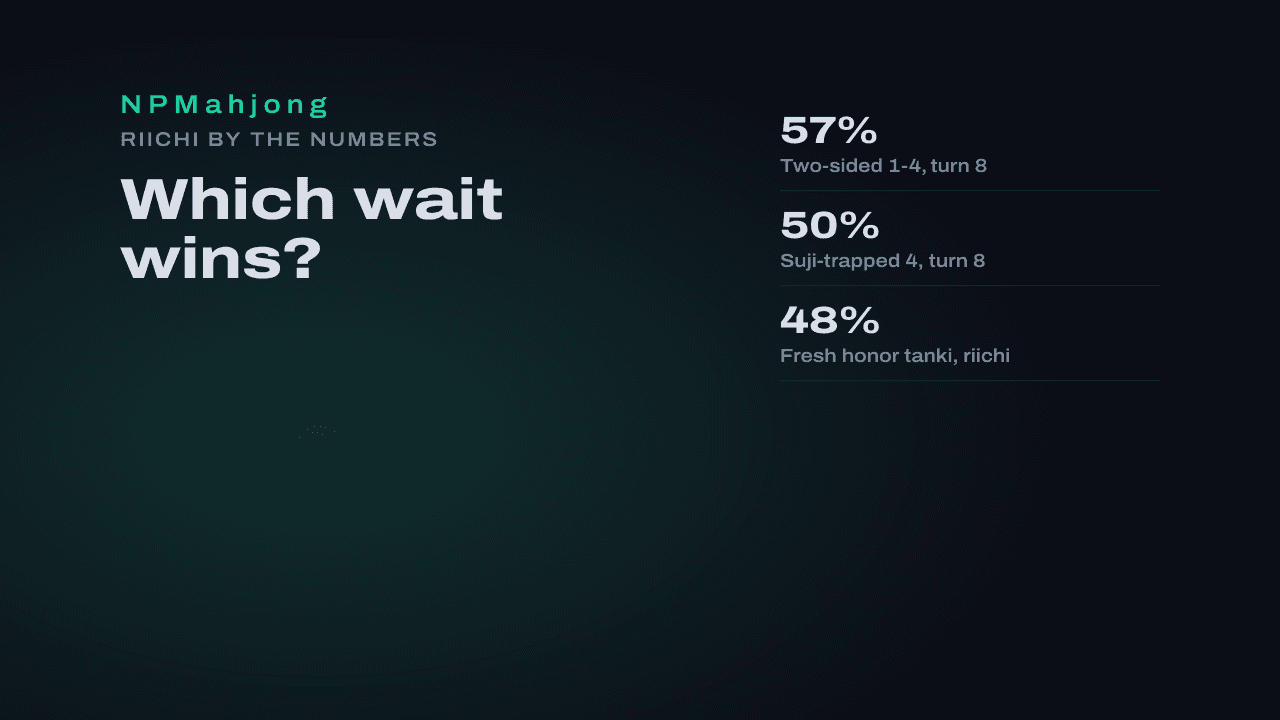
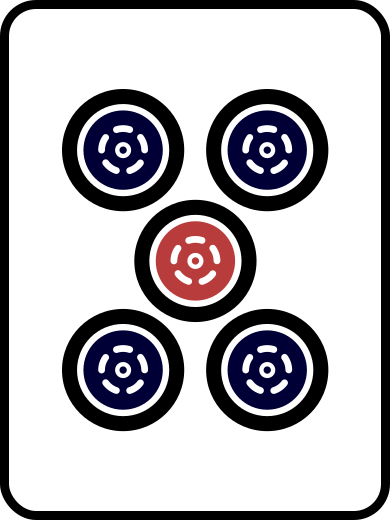
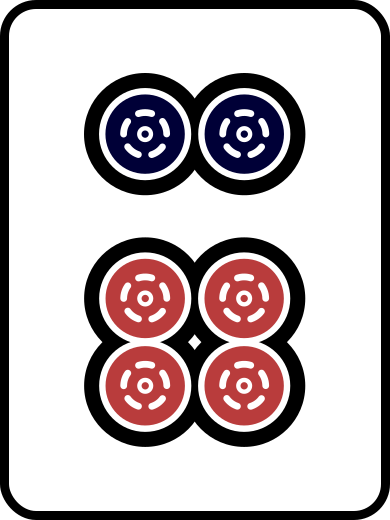
Take a hand I use in lessons. East 2, you're South with a 2,000-point hand: , no , tenpai on a wait at turn 7. West riichis. Your draw is a 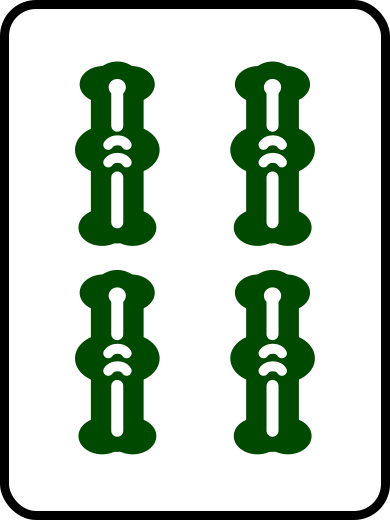 , a fresh middle tile, and the only safe tiles in your hand are the two that make your wait. Most players fold here, cut the wait, and pay the 1,100 fold price plus their own hand. Run the numbers instead: a two-sided tenpai against a non-dealer riichi wins about half the time, deals in about a fifth, and the hand is worth 2,000 plus the riichi stick on the table. Pushing the 4s is right by a wide margin. The fold feels safe. It costs more.
The fold price by turn and seat
Here's the price of folding against a single riichi, from turn 4 to turn 16.
| Turn | Dealer vs a non-dealer riichi | Non-dealer vs a non-dealer riichi | Non-dealer vs the dealer's riichi |
|---|---|---|---|
| 4 | -1,950 | -1,090 | -1,870 |
| 6 | -1,930 | -1,110 | -1,790 |
| 8 | -1,890 | -1,120 | -1,750 |
| 10 | -1,850 | -1,150 | -1,680 |
| 12 | -1,790 | -1,190 | -1,620 |
| 14 | -1,670 | -1,230 | -1,520 |
| 16 | -1,450 | -1,250 | -1,360 |
Three things stand out.
The dealer pays the most. A dealer pays double on every tsumo, so a fold at turn 8 costs 1,890. A non-dealer folding against a non-dealer pays 1,120. The dealer also gives up the dealership, and this table doesn't price that.
A dealer riichi costs a non-dealer almost as much. Fold against the dealer at turn 8 and you pay 1,750.
The prices drift in opposite directions. The dealer's price falls from 1,950 at turn 4 to 1,450 at turn 16. The non-dealer's creeps up from 1,090 to 1,250. The likely reasons: late in the hand, fewer draws remain for a tsumo that bills the dealer double, and more hands end in a draw, where every folded player pays money.
As the dealer I fold less, and not only because of the 1,900. The dealership is the thing. Every hand I keep is a hand where my wins pay 1.5 times and my tsumo collects from three. My rule follows the tables in Nemata's 現代麻雀技術論, which I've found hold up at the table: as the dealer, a tenpai with a two-sided wait pushes against a non-dealer riichi every time, and the only reasons to fold are a tile that's plainly the wait or a score where I can't afford the deal-in. A one-sided wait is the hard case. Early in the hand I push it. From the middle turns on it needs 3,900 or more behind it, and in the last few turns it needs that much even to cut a tile that's only 10% to deal in. Against another player's dealer riichi the same one-sided hand needs a , because the deal-in is 1.5 times too.
A second riichi makes folding cheaper
A second riichi feels like double trouble. For the player who folds, it's a discount.
| You are | On the table at turn 8 | Fold price | Snapshots |
|---|---|---|---|
| Non-dealer | No riichi, no calls (you don't win the hand) | -1,200 | 163,629 |
| Non-dealer | One non-dealer riichi | -1,120 | 132,446 |
| Non-dealer | Two non-dealer riichis | -930 | 4,637 |
| Non-dealer | Dealer riichi | -1,750 | 95,225 |
| Non-dealer | Dealer riichi and a non-dealer riichi | -1,300 | 11,728 |
| Dealer | No riichi, no calls (you don't win the hand) | -1,620 | 50,844 |
| Dealer | One riichi | -1,890 | 61,088 |
| Dealer | Two riichis | -1,710 | 4,463 |
Facing two non-dealer riichis, a non-dealer's clean fold costs 930 instead of 1,120. The two riichi players often settle it between themselves. One deals into the other, and you pay nothing.
Now look at the first row. A non-dealer who reaches turn 8 with no riichi and no calls on the table, then doesn't win the hand, loses 1,200 points on average. Folding against one non-dealer riichi costs 1,120. For a non-dealer, a clean fold costs about what any hand you don't win costs. The price of folding is the win you give up, not the points you pay.
A deal-in costs about five folds
The other side of the ledger is the deal-in. In the same Houou logs, a non-dealer riichi declared on turn 8 that won by averaged 5,423 points, or 7,632 with . Weighted by how often each happened, that's 5,869. A dealer riichi from turn 8 averaged 7,581 on a ron, 10,935 with , and 8,179 combined. Neither figure counts or riichi sticks.
Divide and you get the trade:
- One deal-in into a non-dealer riichi costs about 5.2 clean folds.
- One deal-in into a dealer riichi costs about 4.7 clean folds.
That ratio is why folding is the default with a weak hand. It's also why folding isn't automatic with a good one.
What pushing buys you
When you're tenpai and a riichi comes, you can chase it. Declare riichi on top of theirs, an riichi, or push your hand without one. The chase-riichi analysis in the same logs tracks 352,211 riichis, 53,179 of them second riichis, and sorts them by how many tiles the wait has left from the riichi player's own hand.
| Your wait | Chases | Chase wins | Chase deals in | First riichi wins | First riichi deals in |
|---|---|---|---|---|---|
| 9 or more tiles (three-sided and wider) | 421 | 60% | 10% | 68% | 8% |
| 5 to 8 tiles (two-sided) | 3,465 | 48% | 16% | 56% | 10% |
| 4 or fewer tiles (, , , ) | 1,525 | 32% | 21% | 42% | 14% |
| Any honor in the wait | 353 | 43% | 22% | 53% | 12% |
Chasing costs a two-sided wait 8 points of win rate and adds 6 points of deal-in rate compared with going first. A narrow chase deals in about one time in five. The real deal-in rates run higher still, because a ron on the riichi tile itself isn't counted.
When a chase wins, it pays well. A non-dealer chasing a non-dealer riichi from turn 8 averaged 6,621 points on a ron and 8,258 on a tsumo, or 7,295 across all its wins. A dealer chasing a non-dealer averaged 9,066 and 11,673.
When folding beats pushing: the rough math
Put the three prices together. Call your hand's average win W, the riichi hand's average deal-in L, and the fold price F. If you push, you win, you deal in, or something else happens: a tsumo, a ron elsewhere, a draw. Treat that last group as costing about what a fold does. Then pushing beats folding when:
win rate × (W + F) is bigger than deal-in rate × (L − F)
Try it with Houou inputs for a non-dealer chasing a non-dealer riichi around turn 8. W is 7,300, L is 5,870, and F is 1,120.
- Two-sided wait: 0.48 × 8,420 = 4,040 against 0.16 × 4,750 = 760. Pushing comes out about 3,300 points ahead.
- Narrow wait: 0.32 × 8,420 = 2,690 against 0.21 × 4,750 = 1,000. Still about 1,700 ahead.
Run it backward to find the break-even hand. A narrow-wait chase needs a hand worth about 2,000. A two-sided chase breaks even at about 440 points, less than the cheapest hand in the game.
The part you can carry to the table is a ratio. Divide (L − F) by (W + F) and you get how many times its deal-in rate your push needs to win.
| Your hand is worth | vs a non-dealer riichi | vs a dealer riichi |
|---|---|---|
| 2,000 | 1.5× | 1.7× |
| 3,900 | 0.9× | 1.1× |
| 7,700 | 0.5× | 0.7× |
| 12,000 | 0.4× | 0.5× |
The narrow-wait chase above wins 32% and deals in 21%, a ratio of 1.5. That's the 2,000-point break-even again. A cheap hand against a dealer riichi has to win 1.7 times as often as it deals in, and few narrow waits do.
This sketch is rough on purpose. It ignores riichi sticks, , and placement. It treats every non-win, non-deal-in result as a fold, which flatters folding: a tenpai hand collects noten payments at a draw instead of paying them. The deal-in rates miss the riichi tile, which flatters pushing. And it uses average danger, while your real risk sits in the one tile you're about to throw. Plug your own numbers into the push-or-fold calculator.
Away from tenpai, the inputs change fast. Your win rate drops, and you'll throw more than one dangerous tile before you get there. None of the tables here measure that case.
My rule for an hand against a riichi is the one every Japanese strategy book teaches, because it holds up: one tile. Push one dangerous tile from a good iishanten and see what you draw. If the next discard would be a second dangerous tile, fold.
What "good" means has a number. Count the tiles that put you in tenpai and multiply by five sixths: that's your chance of tenpai per turn, in percent. Eighteen tiles is 15%. Nemata's analysis of the Houou-era data puts the lines here. At 10% a turn, two plain two-sided blocks, pushing a tile against a non-dealer riichi loses money unless the hand is worth around 18,000, so that hand folds. At 20% a turn, the kind of iishanten where a call also gives you tenpai, you need to match the riichi player's value, around 7,000, to push one tile in the middle turns. Above 20%, a three-block or four-block shape with 30% to 50% tenpai per turn, play it like a tenpai hand: push anything short of a plainly deadly tile. And if someone throws a tile you can call for tenpai, call it. A cheap tenpai beats a rich iishanten against a riichi.
The hand I fold most often looks good at a glance: iishanten, a dora, both shapes two-sided, but every tile I'd need to cut is a 4, 5 or 6 the riichi player hasn't shown a for. That's a 10% hand throwing two live middle tiles to reach tenpai. Two is one too many.
What to take to your next game
- Price the fold before you pay it. About 1,100 as a non-dealer against a non-dealer, about 1,750 against the dealer, about 1,900 as the dealer.
- Push a tenpai two-sided wait against a non-dealer riichi unless the tile you'd push is the problem.
- Fold cheap, narrow-wait hands against a dealer riichi. The 1.7× bar is hard to clear.
- Treat a second riichi as a discount on folding. It costs less than facing one.
- Fold cleanly. Every price here assumes you didn't deal in. Throw first, then .
In the logs I review the folding mistake is almost never the fold itself. It's the tiles. Players decide to fold, then throw a suji tile from a terrible hand when they still hold a , or cut a live honor because "honors are safe," or stop counting and miss a . The fold price in this post assumes you folded cleanly. The real price most players pay is the deal-in on turn three of a fold they'd already decided on.
One count fixes most of it. Before you decide, count your safe tiles. Three by the middle of the hand, or two in the last turns, and you can fold all the way to the draw. Fewer than that and a "fold" is a push with worse tiles, so decide the push properly instead. And judge the decision, never the result. A reckless push that happens to win was still reckless, and a clean fold that gets tsumo'd on was still right.
Tables like these help most when you can't read anything else at the table. For when to trust them and when to trust your reads, see mahjong statistics vs Japanese riichi players. For win rates by exact wait and turn, use the wait win rate tool. Look up any unfamiliar term in the glossary.
Get your folds checked
Your fold price depends on how cleanly you fold and how often you fold the hands you should push. Both show up in your logs. Send me your games for a review and you'll get the hands where folding or pushing cost you points, with what to play instead.
Was this article helpful?