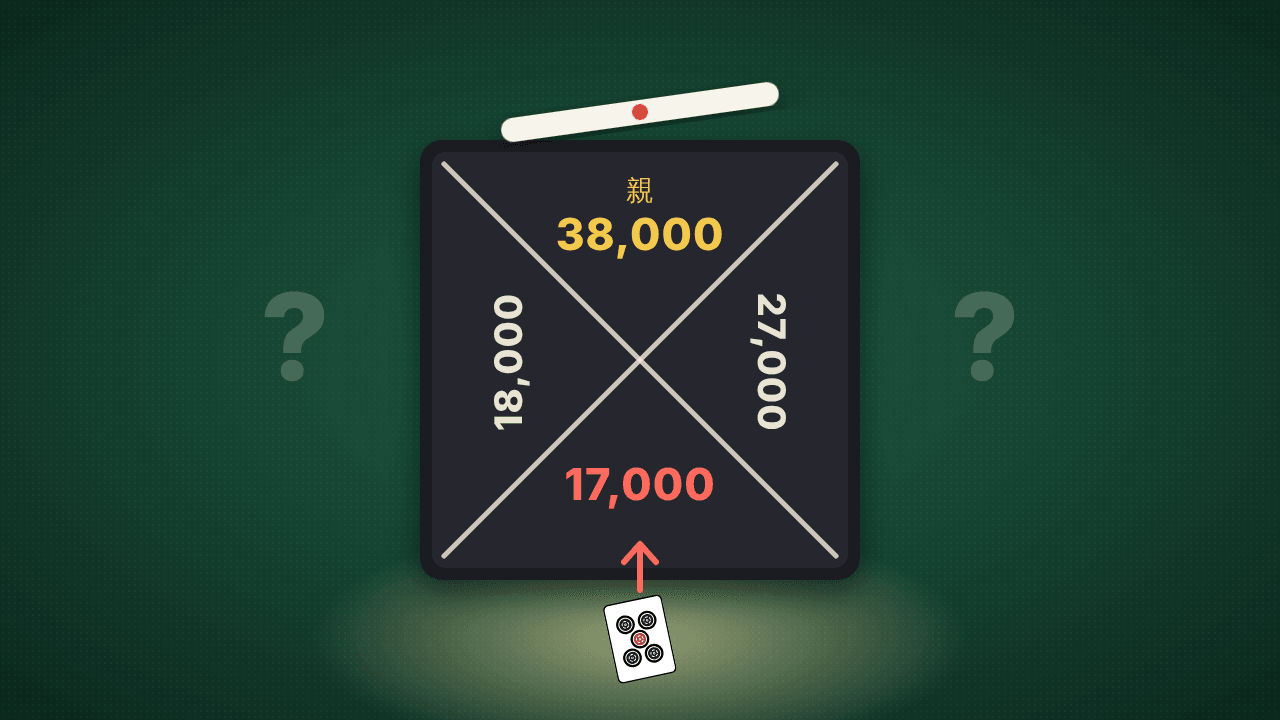
, and the dealer is running away with it. The dealer has 38,000 and declares . Behind them sit 27,000, 18,000, and 17,000. Each of the three looks at the stick on the table and has the same thought: somebody should answer this, and it shouldn't be me.
If you push and deal in, you pay alone. If you push and win, the threat ends for everyone. Game theory calls that the volunteer's dilemma. On Tenhou you mostly aren't in one: 4th pushes for their own placement, and 3rd folds and roots for the dealer. Under rules where the dealer keeps dealing, you are, and the hand that can end it should push.
From the prisoner's dilemma to the volunteer's
Everyone knows the prisoner's dilemma. Merrill Flood and Melvin Dresher designed it at the RAND Corporation in 1950, and Albert W. Tucker named it. Two players, and betraying the other pays better whatever the other one does. It fits mahjong badly. Against a dealer who keeps dealing, folding doesn't always pay better. If everyone folds, everyone pays.
The better fit came 35 years later. In December 1985 the Munich sociologist Andreas Diekmann published "Volunteer's Dilemma" in the Journal of Conflict Resolution. His game has N players and a collective good that one volunteer can provide. Volunteering costs the volunteer. Free-riding pays more, as long as somebody else volunteers. If nobody does, everyone loses. No move is best every time, and the mixed equilibrium, where each player volunteers only some of the time, leaves the group badly off. Diekmann tied it to the "diffusion of responsibility" psychologists had seen in bystanders, and more players make it worse: "an increase in N players will decrease the likelihood that at least one person volunteers."
In 1993 Diekmann gave the players different costs, in the International Journal of Game Theory. The equilibrium math then says the players with the cheapest push, the "strong" ones, should volunteer less often than the weak ones. A later paper calls that "a result contradicting many empirical observations." Diekmann's own experiments agreed: the mixed equilibrium "apparently contradicts the empirical data," and Schelling's focal point, where players settle on the obvious choice, fit better.
Mahjong is the unequal-cost version, with the costs printed on the scoreboard. So skip the mixed strategy and find the obvious volunteer.
On Tenhou, the scoreboard picks the volunteer
Start with Tenhou's stop rule. Tenhou's manual lists rasu-oya top no jidou agari-yame and jidou tenpai-yame (ラス親トップの自動和了り止め、自動聴牌止め): when the All Last dealer is 1st, a dealer win or a dealer tenpai at the draw stops the game automatically. Its note on how a game ends names the condition, genten ijou no top (原点以上のトップ): 1st on 30,000 or more.
This dealer sits 1st on 37,000 after the stick, so the stop applies. They're in , so they're tenpai, and almost every ending, a win by anyone or a draw, ends the game. The one exception: if 3rd or 4th hits the dealer directly for 7,100 to 8,000, nobody is left on 30,000 and the game goes to West.
Now price each seat at 7-dan in , where the manual pays 1st +90, 2nd +45, 3rd 0, and 4th -135. Ask each trailing seat three things: what folding gets them, what a deal-in costs, and what a win buys.
| Seat | If you fold | Deal in to the dealer | Win |
|---|---|---|---|
| 2nd, 27,000 | 2nd, almost always | 2nd up to 8,700, 3rd at 9,600, 4th above | 1st on a 4,500+ hit, a off anyone, or a 1,600/3,200 tsumo |
| 3rd, 18,000 | 3rd, unless 4th wins or ends tenpai with you noten | 4th at any size: -135 | Usually ends the game, still 3rd |
| 4th, 17,000 | 4th, unless 3rd deals in or you end tenpai with 3rd noten | Still 4th: nothing lost | Passes 3rd: +135. A 7,100 to 8,000 hit on the dealer goes to West |
Read the bottom two rows together. The player in 3rd pays 135 for any deal-in to the dealer, even the cheapest 1,500, because 18,000 minus 1,500 is 16,500, under 4th's 17,000. A dealer , on the other hand, bills 3rd and 4th the same amount and ends the game with 3rd still 3rd. So does the dealer's tenpai draw, as long as 4th is . The player in 3rd is quietly rooting for the dealer.
For 4th it's the other way round. Any win passes 3rd: a 1,000 plus the stick is 2,000, and the smallest closed tsumo, 300/500, nets 2,100. Even reaching at the draw does it: with the dealer and 4th tenpai and the other two noten, the noten pair each pay 1,500, and 4th finishes on 18,500 against 3rd's 16,500. From 4th a deal-in usually changes nothing, so your deal-in rate stops mattering (All Last math has the numbers).
So the volunteer is 4th, pushing for their own placement. The 2nd seat folds unless the hand in front of them can take 1st. The 3rd seat folds every tile and doesn't try for tenpai unless the tile is safe.
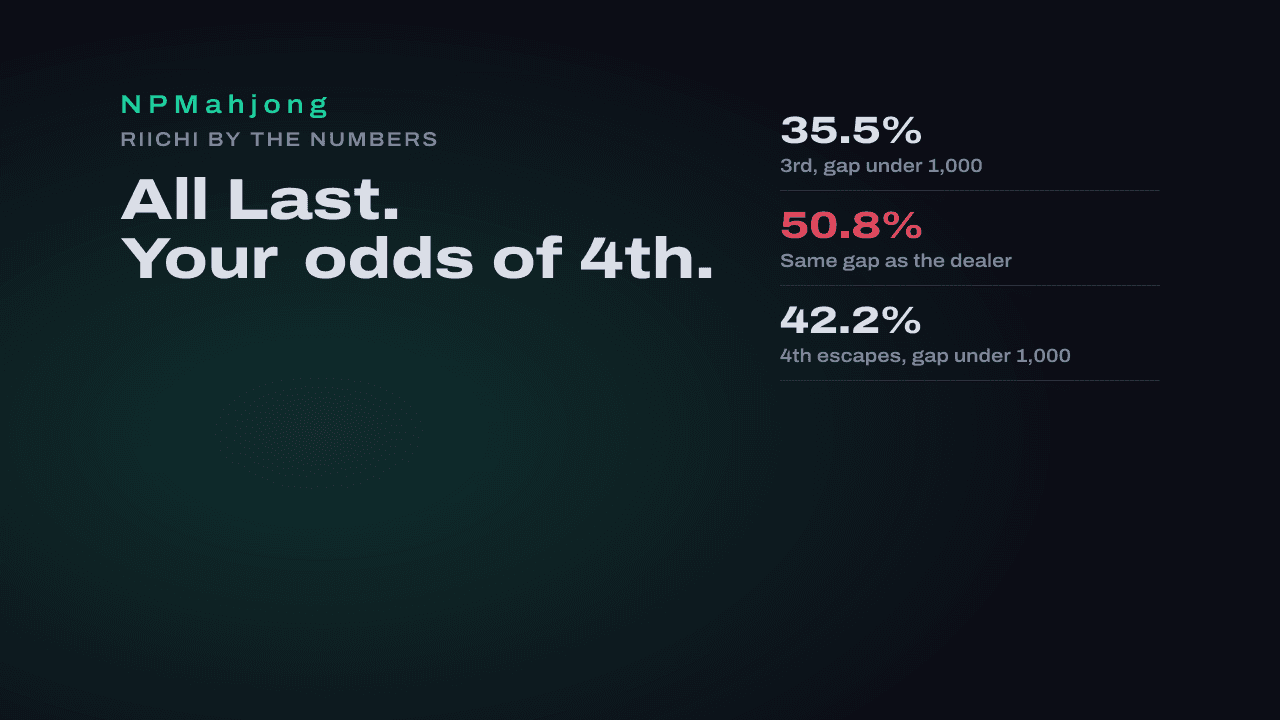
The base rates show what's at stake between the bottom two. In Tenhou logs from 2016 to 2020, counting every All Last start and not just the ones with a dealer riichi, 3rd starting 1,000 to 1,900 above 4th with neither of them dealing still finishes 4th 33.2% of the time, and 4th climbs out 38.6% of the time.

Where the dilemma is real: when the dealer keeps dealing
Take the same gaps to a European tournament (EMA games start at 30,000, so every score is 5,000 higher). The EMA's 2025 riichi rules give the dealer no automatic stop: East remains East after a win or a tenpai draw. Your final score is your points minus 30,000, plus an of +15,000, +5,000, -5,000, or -15,000, and it goes into your overall tournament score. Every point counts, whatever your seat.
Now the dealer's riichi is a shared problem. A tsumo costs each trailing player 4,000 tournament points, and the dealer deals again. Any win ends the game, for all three at once. A deal-in costs only the player who makes it. It's Diekmann's game almost line for line: one volunteer is enough, and if nobody steps up, everybody pays the tsumo.
With all three waiting on someone else, a dealer in 1st can run off three wins in a row against a table that defends perfectly, unless the session clock ends the game first. Diekmann's abstract calls it diffusion of responsibility.
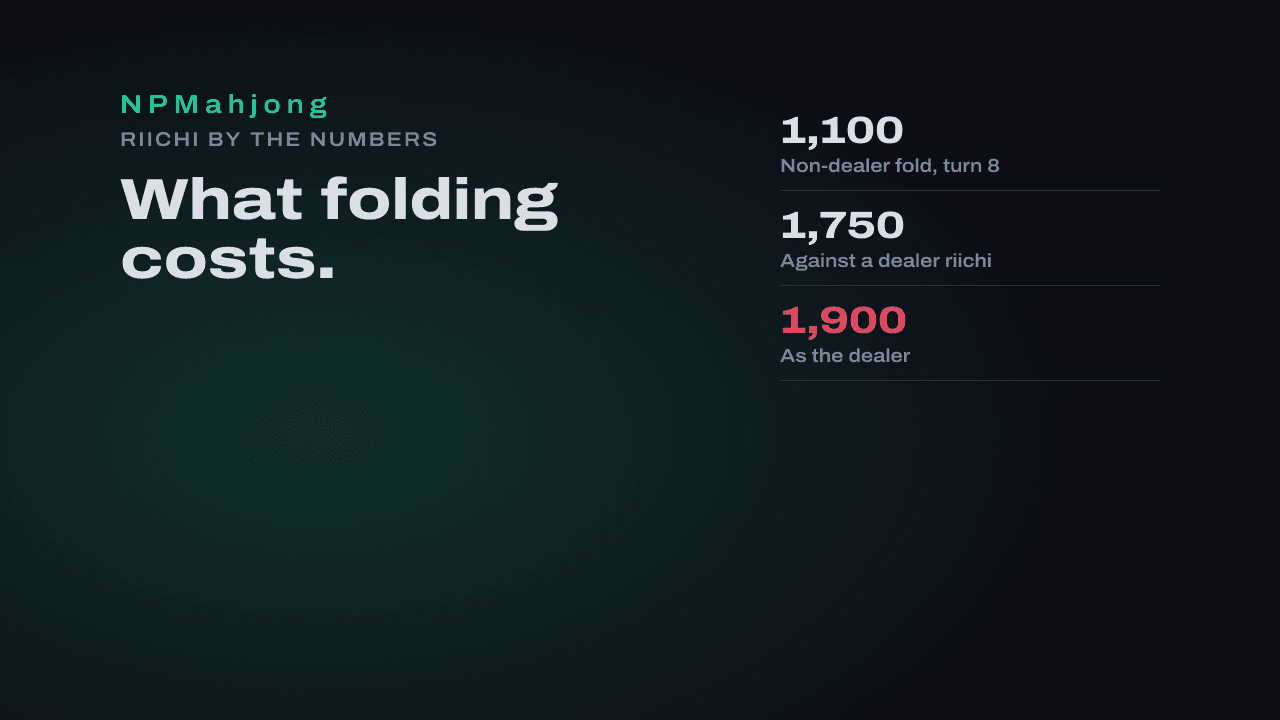
The way out is the obvious volunteer: whoever has the hand that can end it. A live two-sided tenpai pushes, whatever its seat. In the fold price data, a dealer riichi from turn 8 on Tenhou averaged 8,179 points when it won by , before and sticks. Tenhou plays with red fives and the EMA rules don't, so it's a Tenhou price. Either way, pushing costs real points. So does folding, when it means paying for the next tsumo.
When nobody has a tenpai worth pushing, the next best volunteer is the player whose deal-in moves them the least: the one with the widest cushion to the seat below. In this hand that's 4th, who can't fall, or 2nd, 9,000 clear of 3rd. Not 3rd, who sits 1,000 above 4th. The EMA rules also let organizers put an all-last sheet on the table, with every score written down before the last hand. Everyone at the table can run that check.
Sashikomi or kingmaking
Change the format once more. A semifinal where only 1st at each table goes through, under rules where the dealer keeps dealing. From 23,000 and 22,000, 3rd and 4th need at least a to reach 1st, and say neither is close to one. They still discard, and their discards decide whether the dealer or 2nd wins the table.
This is a kingmaker scenario: "an endgame situation where a player who is unable to win has the capacity to determine which player among others will win." It's "usually considered undesirable," and games fight it with everything from hidden scores to tournament rules. Catan's tournament rules prohibit players from "intentionally giving another player a win."
, dealing in on purpose, sits right on this line. As the zugzwang post sets out, the accepted version settles something for the player who feeds: a dealership, the game, or their own placement. The leader who throws 1,000 points to a cheap open hand to end the game is playing their own hand.
The other version settles nothing for the feeder. The 4th-place player, out of the running, deals in to 2nd's haneman so 2nd goes through instead of the dealer: a friend, a teammate, or someone they'd rather face in the final. Anything smaller ends the game with the dealer still on top. The EMA rulebook doesn't name sashikomi. It forbids passing information or hints on opponents' strategy, says players "should enact fair play," and leaves the penalty for "deliberate obstructive behaviour" to the referee. None of it settles a feed that helps nobody but the player fed. To tell the two versions apart, ask whose result the tile serves.
What the model misses
Mahjong isn't simultaneous. Diekmann's players choose at once, blind. At the table you see the river. Once 4th throws two fresh tiles into the riichi, the other two know who has volunteered and can fold.
You can't volunteer a hand you don't have. Most of the time the dilemma resolves itself: whoever is tenpai pushes, and the rest fold.
The table is one ruleset at one . At 4-dan on Tenhou the 4th-place penalty is -90, not -135, and in a league without the automatic stop the dealer keeps going. Price your own row before you lean on mine.
The drill: three questions before your first discard
At the start of every All Last, and again when someone declares riichi, answer three questions for each seat, yours first.
- Does a dealer win end the game under these rules?
- What does a deal-in cost this seat in placement and in points, and what does a win buy?
- So who is the volunteer?
If the answer to 3 is "me," push your hand and don't wait for help. If it's someone else, fold unless your own hand can change your placement. Run your scores through the All Last calculator first, so you know the smallest win that moves each seat.

If you want help building the habit, book a coaching session and we'll go through your last ten All Lasts seat by seat.
Was this article helpful?