Máquè (麻雀) is the Chinese word for sparrow, and it's usually given as the game's original name. The oldest mahjong sets anyone has found date to around 1870. The first commercial electric telegraph, Paddington to West Drayton, was installed in 1838 and in service by 1839 (Science Museum Group). Morse sent "What hath God wrought" on 24 May 1844, 26 years before those sets (Wikipedia). The game you play is younger than the telegraph, and the "ancient Chinese game" on the box is a 1920s sales line.
The best single source in Japanese is the Heibonsha World Encyclopedia entry on mājan (マージャン), signed by its author, 手塚晴雄. One page covers the origin and the name, including both sparrow theories. Most of this post leans on it.
What the name says
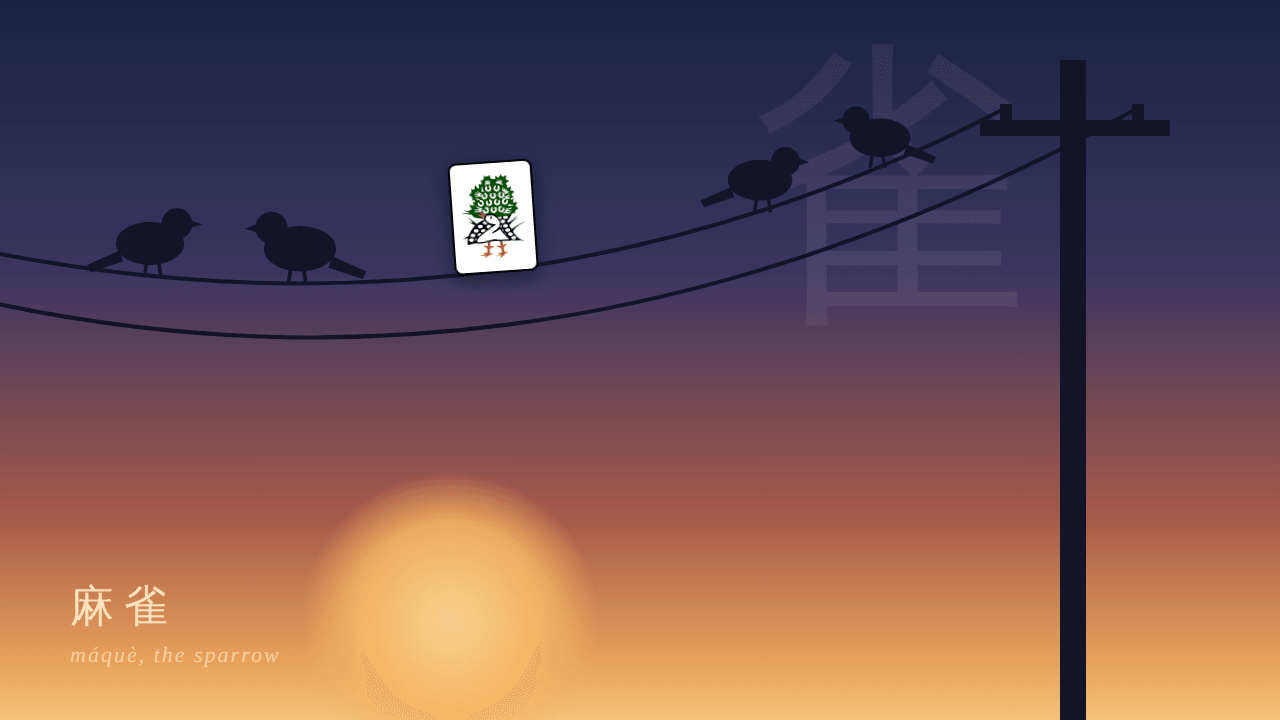
In Mandarin, máquè (麻雀) means sparrow. Wiktionary's entry says it "was the original name of the game of mahjong, and this term is retained in many non-Mandarin Sinitic languages." Mandarin today keeps máquè for the bird and calls the game májiàng (麻将). Cantonese and Hokkien still call the game by the sparrow name.
That májiàng is where the English word comes from, and it's still the sparrow. Wiktionary's entry for mahjong derives májiàng from máquè "with a Wu diminutive suffix." English Wikipedia calls májiàng "a nasal erhua form of the original name." Say mahjong and you're saying sparrow with a small ending on it.
Why a sparrow? Nobody has a document that settles it. The Heibonsha entry gives two theories. One says the character què (雀, sparrow) went in because a sparrow with spread wings and a raised head looks like a finished hand. The other says tiles made of bamboo and bone chirp like sparrows when you shuffle them. English Wikipedia carries the chirping version too, under "It is said."
A third theory skips the bird. Japanese Wikipedia says máquè is thought to come from mǎdiào (馬弔, also written 馬吊), the card game it grew out of, by a shift in pronunciation. It adds that in the Ningbo dialect "little sparrow" (麻雀兒) and májiàng (麻將) sounded the same, so the two got mixed up. Even the order is disputed. Japanese Wikipedia finds the first printed máquè pái (麻雀牌, mahjong tiles) in an 1892 book published in Shanghai, and the first printed májiàng in a 1909 book. Heibonsha says mǎdiào was already called májiàng and the 将 was later swapped for 雀.
The tiles reached Japan in 1910, when 名川彦作, a teacher, brought a set home after five years teaching English in Sichuan. Some accounts say 1909. Japanese kept both halves of the name. It writes the game with the sparrow characters, 麻雀, but says mājan, borrowed from Mandarin májiàng. Wiktionary calls the written form "an orthographic borrowing" and the sound a loan from 麻将. The bird survives in everyday words too. Japanese reads 雀 as suzume when it means the sparrow and as jan in mahjong words: janshi (雀士) is a mahjong player and jansō (雀荘) is a parlor. Read literally, a jansō is a sparrow house. I used to work in one.
Where the game came from
Mahjong grew out of cards. Heibonsha traces it to mǎdiào, a card game born in the Song dynasty and completed in the Tianqi years of the Ming, 1621 to 1627. The tiles came later.
The modern game took shape in the 19th century, and the sources disagree on the decade:
- Japanese Wikipedia's strongest theory credits Chen Yumen (陳魚門), a Ningbo man, who combined a card game with a domino game in the Tongzhi years, 1862 to 1874.
- Heibonsha credits the same man, in the first years of Guangxu, which began in 1875.
- English Wikipedia names two disputed origins, Ningbo and Fujian. It cites Yifan Shen's 1914 guide, which placed the game's birth in Ningbo about thirty years before it was written, and notes that the earliest surviving tile sets date to around 1870, from Fuzhou, Shanghai, and Ningbo.
Every version lands between the 1860s and the 1880s.
| Year | Event |
|---|---|
| 1838 to 1839 | First commercial electric telegraph, Paddington to West Drayton, installed and in service |
| 1844 | Morse sends "What hath God wrought" |
| 1862 to 1880s | Mahjong takes shape, most likely in the Ningbo area (Chen Yumen theory, Shen's 1914 guide) |
| c. 1870 | Earliest surviving tile sets |
| 1892 | Máquè pái (麻雀牌, mahjong tiles) first appears in a book, published in Shanghai |
| 1910 | Tiles reach Japan with 名川彦作, back from five years teaching in Sichuan (some accounts say 1909) |
| c. 1920 | Babcock's red book |
| Early 1920s | Abercrombie & Fitch sells the first American sets |
The suits still show the card-game ancestry. Japanese Wikipedia's page on the tiles gives the commonly accepted reading: are coins with a hole, are the strings that thread them, and count the money.
Confucius never played it
Japanese Wikipedia opens its list of origin theories with one more: that Confucius invented the game around the 6th century BC. It lists it and moves straight on. National Geographic calls it "a famous but debunked theory." Historian Annelise Heinz, quoted by the Hagley Museum, puts the game in the mid to late 1800s, "not the age of Confucius, as American marketers advertised."
That pitch was written for Americans. Joseph Park Babcock took up the game after Standard Oil sent him to Suzhou in 1912, according to his Wikipedia page. His Rules of Mah-Jongg, the "red book," came out around 1920, and he trademarked the spelling "Mah-Jongg." Abercrombie & Fitch sold the first American sets in the early 1920s. Barry Popik's citation file has the store's New York Times ad from 12 December 1922: "Ma Jung, the ancient Chinese Game." A 2010 New York Times piece on the same page says the sets sold so well that Ezra Fitch "had representatives scour China for as many sets as could be found." National Geographic adds that the fad among white Americans was over by the end of the 1920s.
By 1923 the British press was pitching it against bridge. Popik's page also reprints the Oxford English Dictionary's early citations. One is a Daily Mail item from 23 June 1923 calling it "the wonderful Chinese game which threatens to oust Bridge." Another is a 1923 book by Chiang Lee: "Mah Jong, or Mah Tsiong (Sparrows), as it is pronounced in the city of Ning Po where it received its name and modern form, has been in vogue in China as a card game for about eight centuries." The book got the sparrow right and matched the leading theory on the city. The eight centuries were the card game's.
The bird on the 1-sou is usually a peacock
You'd expect a sparrow on the 1 of bamboo. Japanese Wikipedia's tile page says the bird is most often a peacock, with long-tailed roosters, phoenixes, chicks, and sparrows on some sets, and cranes or sparrows on some antiques. English Wikipedia says "traditionally, a peacock or sparrow."
The tile page says the design became a bird as the tile art was simplified over time, and the reason it settled on that shape isn't recorded. There's a theory that an earlier design looked like a bird. The page calls its truth unclear.
Read the table in its own language
The tile faces still read like a 19th-century money game. Every tile carries man (萬), ten thousand. The kanji on your 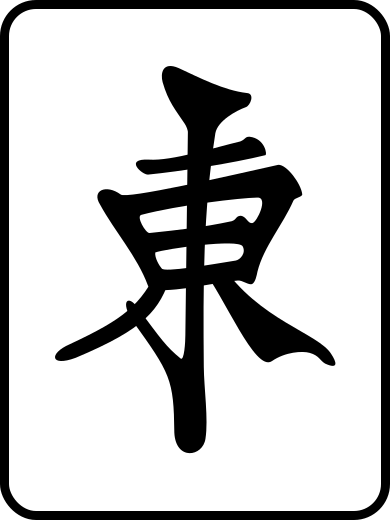 is (東), and it just means east.
Open the glossary and search 雀. The pair in every hand you build, the (), is written with the same 雀. itself is younger still: the rule as you play it today was first written down in a 1952 newspaper.

Was this article helpful?