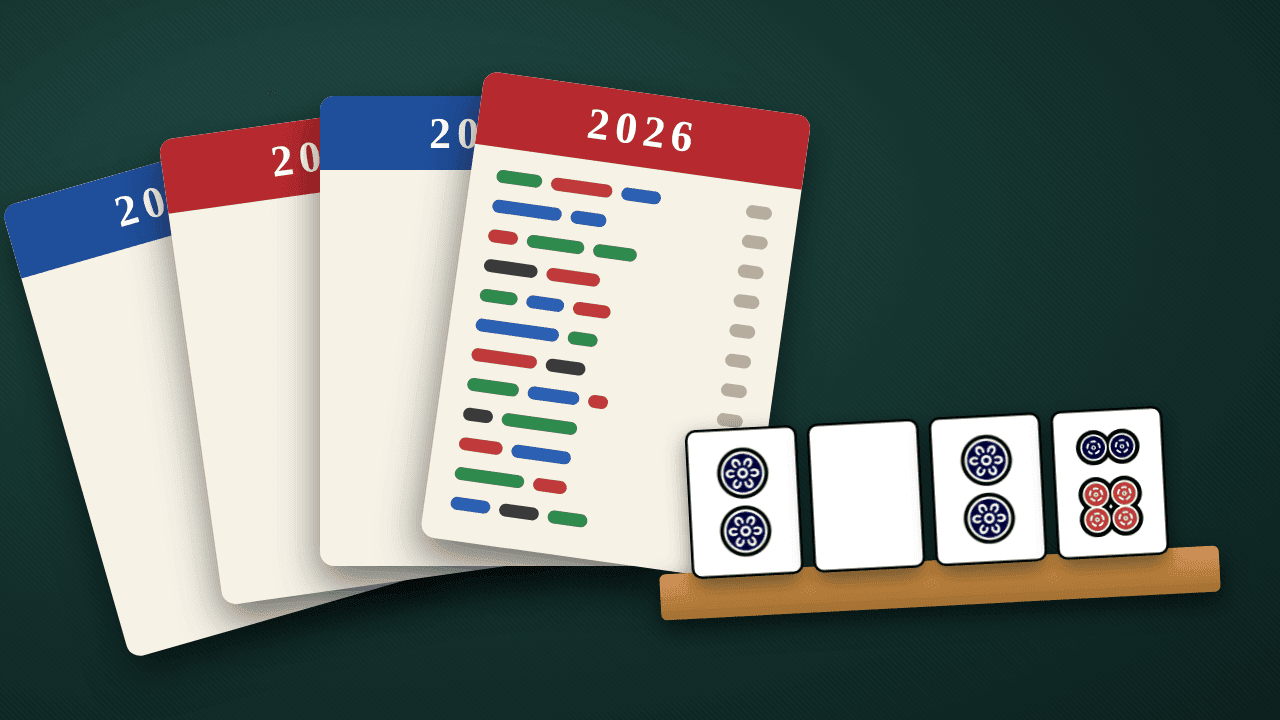
Every spring a new card goes out in the mail, and the winning hands of American mahjong change with it. The National Mah Jongg League prints it, and Tom Sloper's mahjong FAQ puts the mailing in March and April, "around April 1st." Once everyone at your table has the new one, last year's hands no longer win.
"No other form of Mahjong in the world requires a card," Annelise Heinz, a historian at the University of Oregon, told OPB's Think Out Loud in July 2026. I play , the Japanese game, as a pro in Osaka. It has no card, no jokers, and no Charleston. American mahjong has all three.
A league founded to end the confusion
Mahjong hit America as a fad. Heinz told OPB it peaked in 1923 and 1924, when it was played in the White House and talked about in newspapers from Texas to Nebraska. Meanwhile the rules splintered. The League's own history page says players kept adding new combinations and dropping old ones until "every group had its own combinations, leading to a fair amount of confusion."
The fix came in 1937. "A number of Mah Jongg enthusiasts met in New York City to standardize the game so that all Mah Jongg players would play the same hands and rules," the page says, and the National Mah Jongg League was founded at that meeting. It started with 32 members. It now counts over 350,000.
Heinz's book, Mahjong: A Chinese Game and the Making of Modern American Culture, came out from Oxford University Press in 2021. On OPB she described the founders as "different individuals who all happen to be Jewish women in the New York area," relatively wealthy and entrepreneurial. She says they weren't setting out to build a Jewish organization. They wanted the game back at the height it had reached fifteen years earlier. After World War II, though, the League's version spread through Jewish community and charity networks, and Heinz says it didn't settle into what we now call American mahjong until the early 1960s.
In 2010 New York's Museum of Jewish Heritage ran an exhibit on that history. Lilith magazine quoted its curator, Melissa Martens: Jewish women embraced the game as an "acceptable" pastime that had been "vetted" as American. They played it in their living rooms, in community centers, and in synagogues, and used it to raise money for Jewish causes.
"Each year, proceeds from sales of the League's Official Rule Cards go directly to charitable organizations across the country," says the League's charities page. Heinz adds that the League once gave away all of the earnings and now gives part.
What the card does
The card is a list of hands. Your 14 tiles must match one of them exactly, and nothing else wins. Hands are grouped in sections, and each carries a value from 25 to 50, per Sloperama's NMJL rules FAQ. Some are marked C for concealed, so you can't call discards to expose their sets. One section is built from the digits of the year, with the standing in for zero.
I won't print this year's hands. The card is the League's product, and its proceeds fund the charities above. Buy it from the League, which Sloper calls the best place to get it. He also warns that counterfeit cards sell on Amazon and Temu with mistakes in them, and that the League sells on Amazon under its own name. Rival cards, such as Marvelous Mah Jongg's, come out in January and play by NMJL rules.
The card even changes color. It's blue in odd years and red in even ones, per Sloper's card FAQ.
Hands pay by their value. A 25-point hand won on a discard costs the discarder 50 and the other two 25 each. Win by drawing the tile yourself and everyone pays double. Win without a single joker and the whole payment doubles again, except for hands in the Quints and singles-and-pairs sections. In Sloperama's example, a 25-point jokerless hand on a discard collects 50 cents from each bystander and a dollar from the player who threw it.
Jokers: wild, with rules
An American set has 152 tiles, laid out in eight rows of 19: the 136 standard tiles, 8 flowers, and 8 jokers. Jokers arrived in 1961. Before that the flowers were wild, and their number moved between 8 and 24. Sloperama's history says flowers and jokers settled at eight each on the 1971 to 1972 card.
The back of the card limits jokers to pungs, kongs, quints, and sextets: three, four, five, or six identical tiles. A joker can never be a pair or a single. A set holds only four copies of each suit tile, wind, and dragon, so a quint of any of them needs at least one joker. A discarded joker is dead and nobody can claim it. And on your turn, once you've drawn or called a tile, you can swap the real tile for a joker sitting in anyone's exposed set, then use the joker yourself.
The Charleston
Before the first draw, everyone passes tiles. Sloperama ties the name to the dance of the Roaring Twenties, and he teaches it as two dances. The first is required: pass three tiles right, three across, then three left, and on that pass you may hand on, unseen, up to three of the tiles you just received. After that any player can stop. If nobody does, a second round runs the other way: left, across, right. Last comes an optional courtesy pass of up to three tiles with the . You can't pass a joker, and you can't accept one.
What a riichi player would notice at an American table
| American (NMJL) | Riichi | |
|---|---|---|
| Tiles | 152, with 8 flowers and 8 jokers | 136, no flowers or jokers |
| What wins | Only a hand on this year's card | Four sets and a pair, or a special hand, with a yaku |
| Calling a run | Not allowed | , from the player on your left |
| Wild tiles | 8 jokers | None. and red fives only add value |
| Before the first draw | The Charleston | Nothing. You play the hand you're dealt |
| Discards | Into the middle of the table | In order, in rows of six in front of you |
| A win on a discard | Discarder pays double, others pay too | Discarder pays everything |
Two of those rows change how you think. Sloperama's guide to sets imagines an American player's first look at a Japanese game: "They place their discards in orderly rows! (Everybody will know what you've discarded!)" In riichi everybody is meant to know. Your river is public evidence, and opponents read your wait from it. The suji guide shows how the rows get read.
No Charleston means no trading away a bad deal. You keep the hand you're dealt and fix it one discard at a time, toward any shape that wins. The tile efficiency trainer drills that choice.
Riichi's card is the yaku list
Riichi has a list too: the , the patterns a hand needs before it may win. The difference is that a riichi hand needs only one, and one of them is open to any . Declare riichi with a closed ready hand and you have your yaku. Nobody mails you a new list in April.
The printable cheat sheet is two pages: every yaku, the score tables, and the calls. Keep it beside you the way you'd keep the card on the rack.

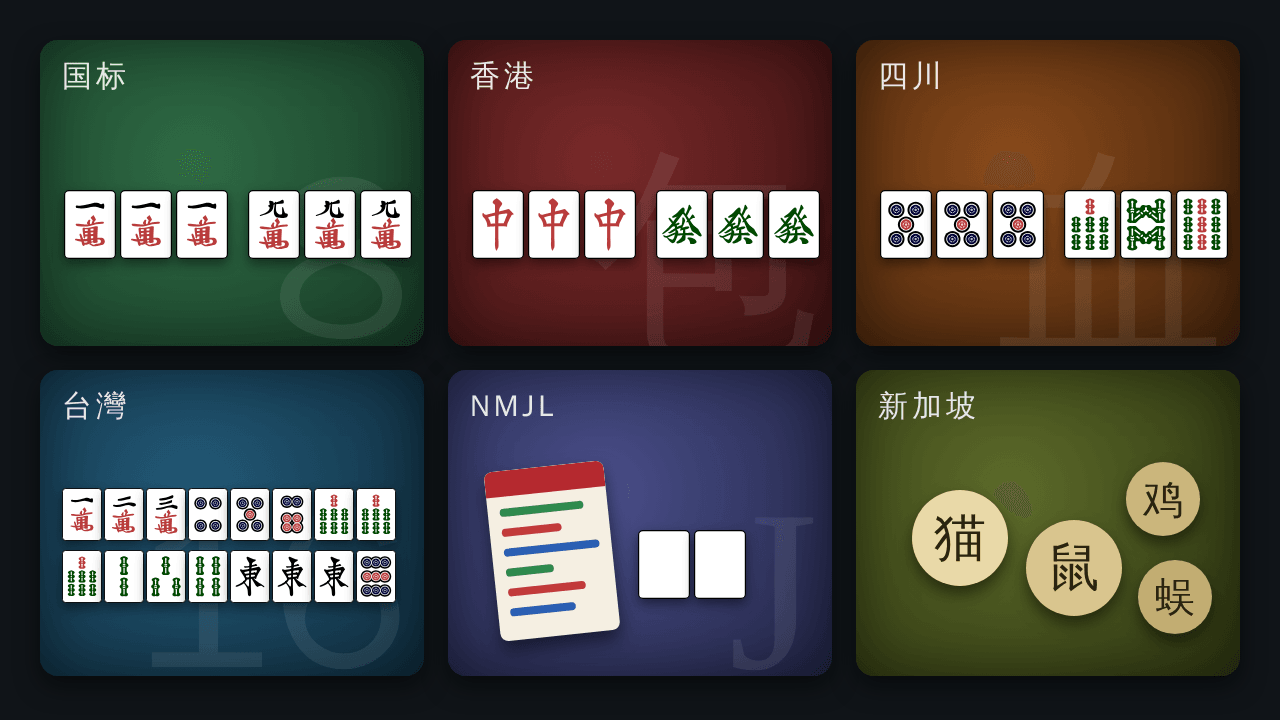
American mahjong is one of more than 40 variants Heinz counts around the world. Five of the others sit beside it in six games that aren't riichi, including a Sichuan game that keeps going after someone wins and a Singapore set where the cat eats the rat.
Was this article helpful?