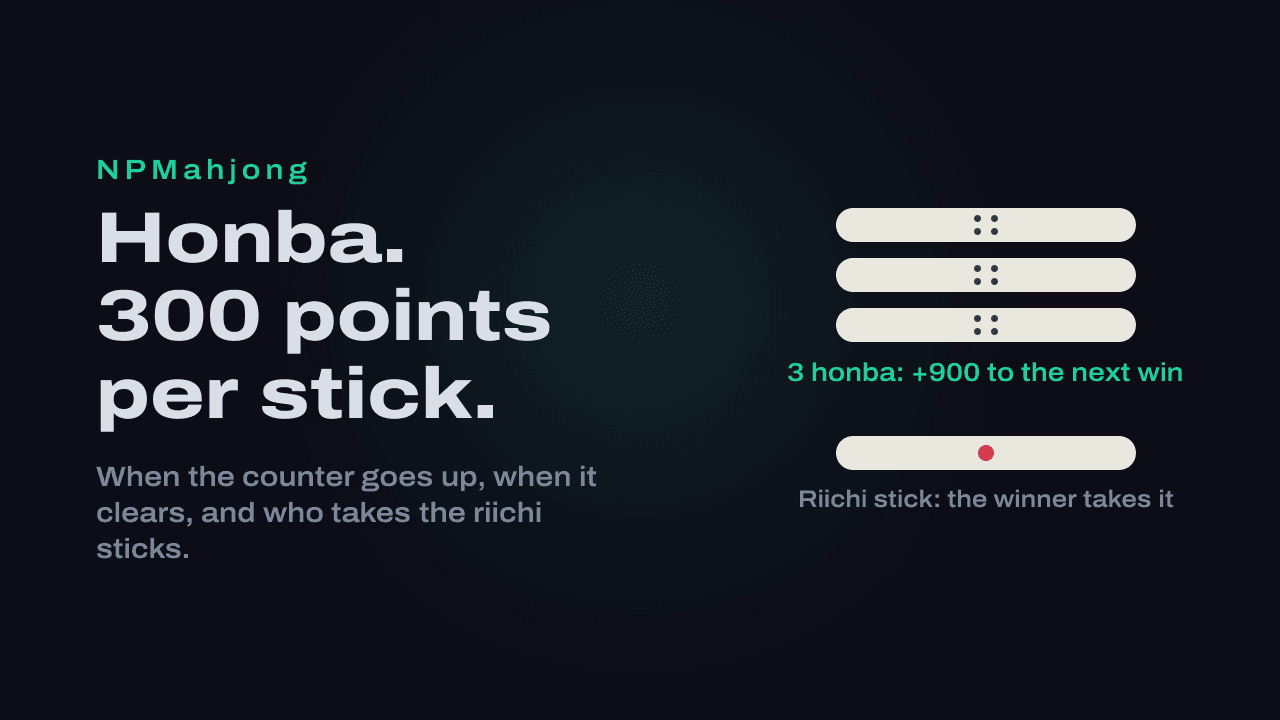
A (本場) is a counter that sits beside the dealer. Each one adds 300 points to the next win. It goes up when the dealer keeps the deal and after every drawn hand, and it only clears when a wins. sticks sit on the table beside it: 1,000-point deposits that wait until somebody wins and takes them all.
| How the hand ended | Next dealer | Honba |
|---|---|---|
| The dealer won | Same dealer | Up by 1 |
| A non-dealer won | The next player | Back to 0 |
| Exhaustive draw, dealer | Same dealer | Up by 1 |
| Exhaustive draw, dealer | The next player | Up by 1 |
| Abortive draw | Same dealer | Up by 1 |
When the counter goes up
Every hand adds a honba except a non-dealer win. That covers two cases.
- The dealer keeps the deal. That's (連荘), and it happens when the dealer wins or is when the wall runs out.
- A hand ends with no winner. Every draw adds one, even when the deal passes. A draw with the dealer tenpai still adds only one.
Look at the fourth row. A draw with the dealer passes the deal and still adds a honba. The counter counts hands since the last non-dealer win, whoever is dealing.
At a live table the dealer marks each honba with a 100-point stick on their right, the (積み棒). Online clients show the number next to the round. The round name carries it too: East 2 with one honba is 東二局一本場, nikyoku ippon-ba.
When the counter clears
Here's a run of four hands, starting from zero.
- East 1, 0 honba. The dealer wins by . They keep the deal.
- East 1, 1 honba. The wall runs out and the dealer is noten. The deal passes, and a honba still goes on.
- East 2, 2 honba. A non-dealer wins and collects the 600 from the two honba.
- East 3, 0 honba. The counter starts over.
If the East 2 dealer had won step 3, they'd have kept the deal, and the next hand would be East 2 with 3 honba.
Renchan: when the dealer stays
Keeping the deal by being tenpai at a draw, not only by winning, is tenpai renchan (聴牌連荘). Tenhou, Mahjong Soul, the M-League, and the World Riichi Championship (WRC) and European Mahjong Association (EMA) rules all play it. A non-dealer win, or a noten dealer at an exhaustive draw, passes the deal to the player on the dealer's right. What a draw pays is in the tenpai guide.
There's one exception at the end of the game. On Tenhou and Mahjong Soul, if the dealer of the last hand wins or is tenpai, sits in first, and has 30,000 points or more, the game ends there. That's agari-yame, or tenpai-yame when it ends on a draw. The M-League, WRC, and EMA don't use it, so their last dealer keeps dealing.
An abortive draw, such as nine different () or four riichi, also keeps the dealer in the seat on Tenhou and Mahjong Soul. Nobody pays noten penalties.
How much a honba pays
Who pays the 300 depends on how the hand ends.
- Ron: the discarder pays all of it, 300 per honba.
- Tsumo: each of the three payers adds 100 per honba. The winner still collects 300 per honba.
| Win | Base payment | Honba | Total |
|---|---|---|---|
| Ron | 2,000 from the discarder | 900 from the discarder | 2,900 |
| Tsumo | 500, 500, and 1,000 from the dealer | 300 from each payer | 2,900 |
The dealer's own wins add the same 300 per honba. So do . The han and fu stay the same. Only the payment goes up.
Every ruleset in this guide pays 300 per honba. The scoring guide has the full payment tables.
Riichi sticks
When you declare riichi, you put a 1,000-point stick in the middle of the table. That's the (供託), and it's a different stick from the honba's tsumibou. The tsumibou is a marker that costs nobody anything. The riichi stick is your points.
- The winner takes every riichi stick on the table, their own included.
- After a draw the sticks stay put and wait for the next winner. They don't go back to the players who put them out.
- Sticks left at the end of the game go to the player in first on Tenhou and Mahjong Soul. EMA gives them to first too, split on a tie. Under the WRC rules they go to nobody.
- If a player wins by ron on the tile you declare riichi with, your riichi never takes effect and you keep the stick.
- On Tenhou and Mahjong Soul, when two players ron the same tile, the honba and the riichi sticks go to the winner closest to the discarder in turn order. If the dealer is one of the winners, the dealer keeps the deal.
A worked example: South 1, 2 honba
Say it's South 1 with 2 honba and one riichi stick left from the last hand. You're a non-dealer and you win a 3 han 30 fu hand.
By ron, the discarder pays 3,900 + 600 = 4,500. Add the 1,000 stick and you collect 5,500.
By tsumo, each non-dealer pays 1,000 + 200 = 1,200 and the dealer pays 2,000 + 200 = 2,200. With the stick you collect 5,600. The score calculator adds honba and sticks for you.

Why the sticks matter more than the honba
Three hundred points is small. Outside , a single honba rarely changes a decision, and in All Last the all-last conditions tool counts them for you. Riichi sticks do change decisions. With three sticks on the table, a 1,000-point ron collects 4,000, more than a 3 han 30 fu hand pays from the discarder. Folding can hand the whole pile to someone else. With several sticks waiting, take the fast cheap hand.
Was this article helpful?