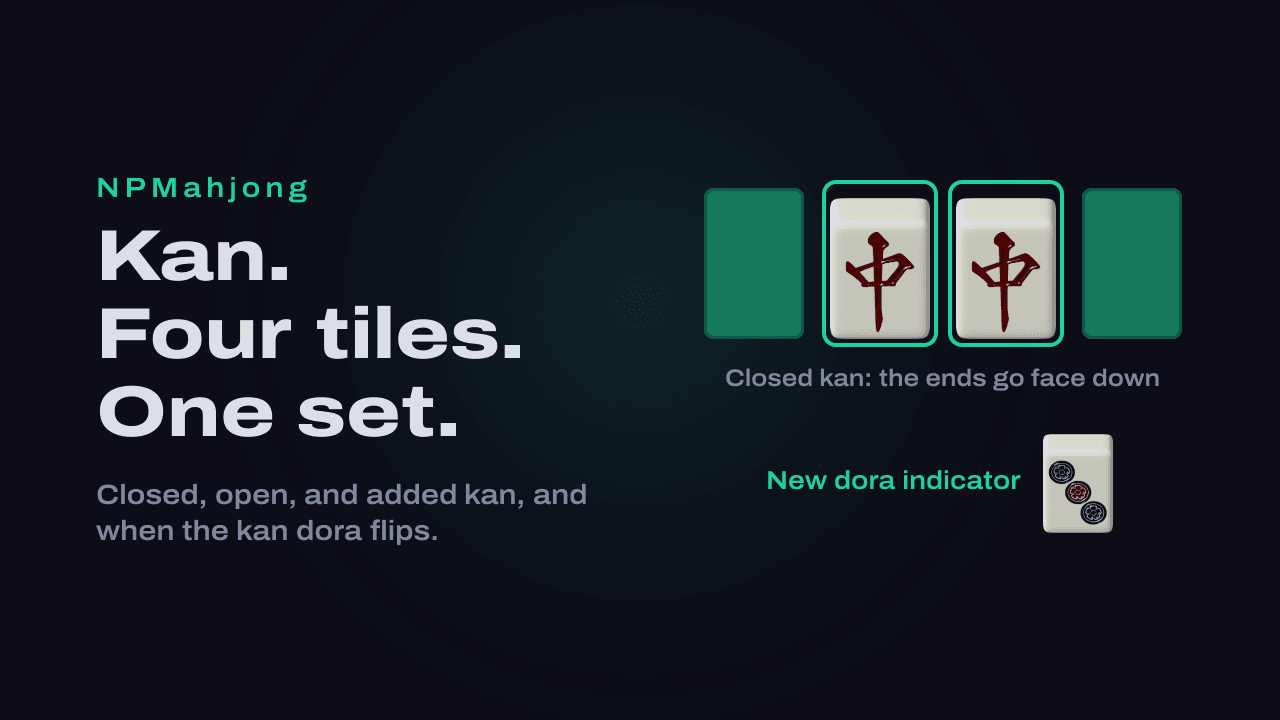
A (槓) is four identical tiles declared as one set. It counts as a triplet for every yaku and scores more fu than one. You draw a from the , so you still finish with four sets and a pair. The catch is the new indicator it flips for the whole table. That dora is why a kan needs a reason.
| Kind | The fourth tile | Your hand after it |
|---|---|---|
| Closed kan (, 暗槓) | From your own hand | Still closed |
| (daiminkan, 大明槓) | Any player's discard | Open |
| (kakan, 加槓) | A tile from your own hand, added to a | Already open |
What happens when you declare a kan
The steps are the same for all three kinds. Only the dora timing moves.
- Say "kan" and show the set.
- Draw the replacement tile (嶺上牌, ) from the dead wall.
- Turn over a new dora indicator, around the replacement draw or after your discard. See when the kan dora turns over.
- Discard, unless the replacement tile wins.
The dead wall always keeps 14 tiles. Each kan takes one from it, so the last tile of the live wall moves over to refill it. The hand ends one draw sooner for every kan made.
Closed kan: ankan
You hold all four copies. Declare the kan and show the set. At a live table you turn the two end tiles face down, and the set sits as 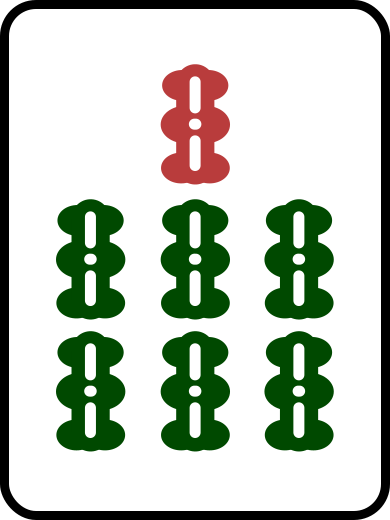 .
A closed kan is the only kan that keeps your hand closed. You can still declare and win with , and or keep their closed . For sanankou and suuankou it counts as a concealed triplet.
You can only declare it on your own turn after drawing a tile, from the wall or as a replacement. You can't declare it on a turn where you've just called or pon.
Kan after riichi
Riichi locks your hand, with one exception: a closed kan made with the tile you just drew. Tenhou and Mahjong Soul allow it only when your winning tiles stay the same. The WRC and EMA rules are stricter: the kan tiles can't be read as part of a run in any reading of the hand either.
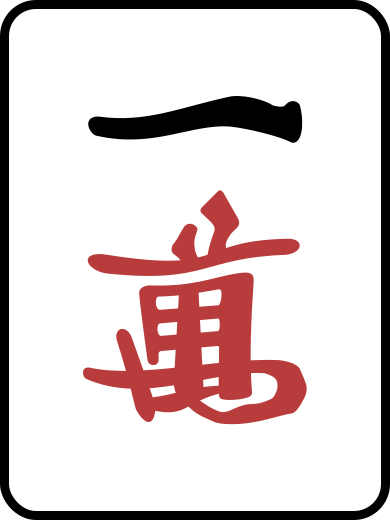
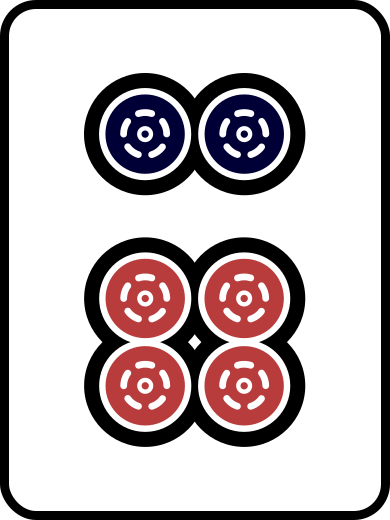
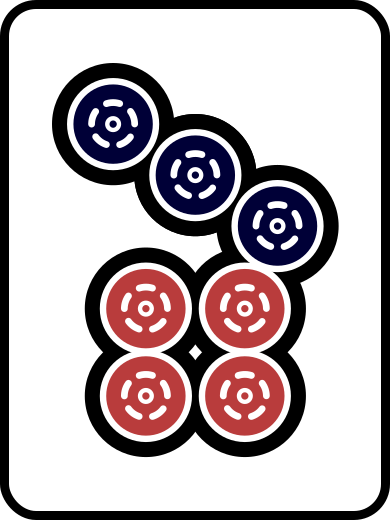
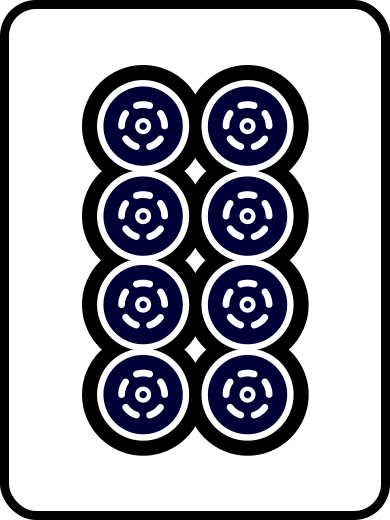
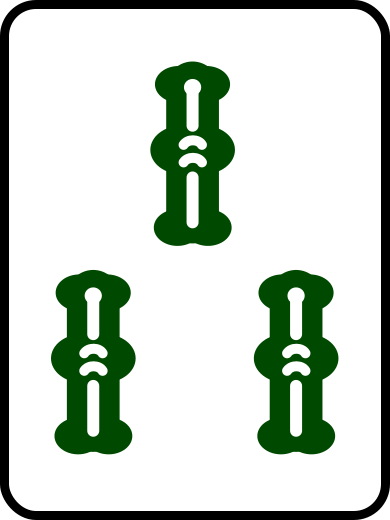
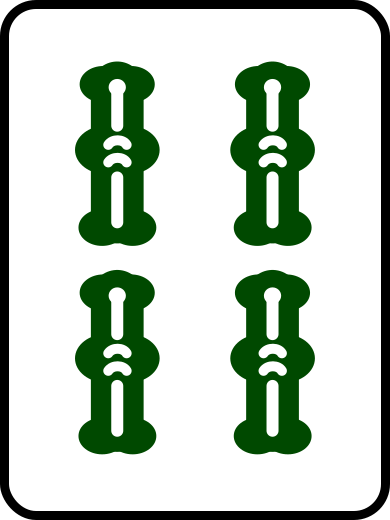
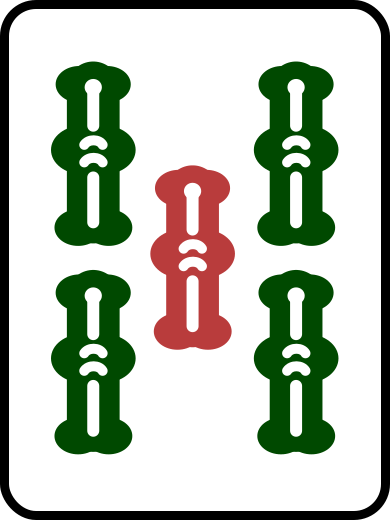
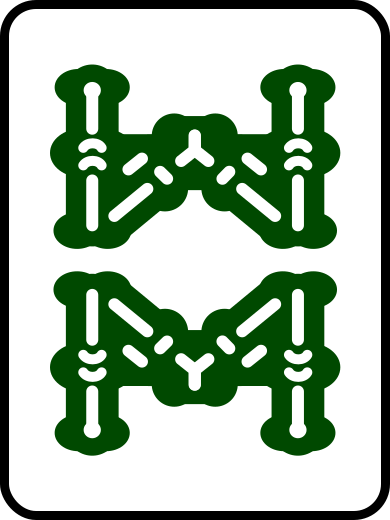
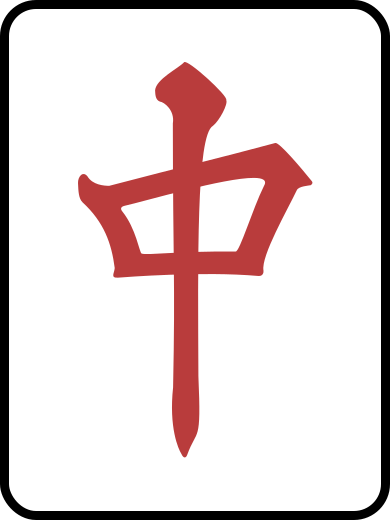
You're in riichi waiting on 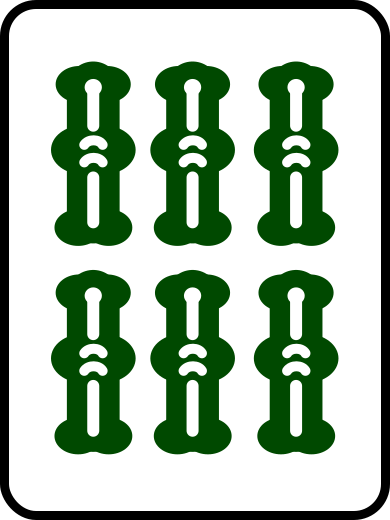 or
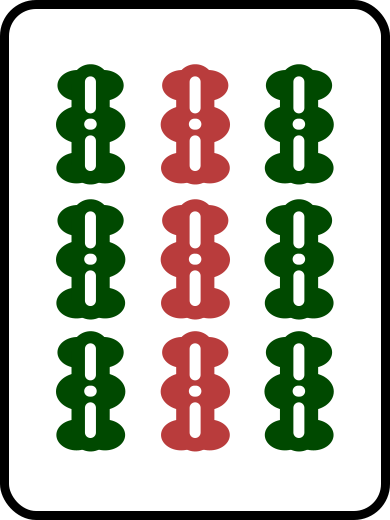 , and you draw the fourth . The three red dragons were already a triplet, so a kan changes nothing about the wait. You can declare it under every ruleset here.
Two things are never allowed after riichi. You can't make a kan with a fourth tile you already held while keeping the tile you just drew. That's okurikan. And you can't make a kan that drops one of your winning tiles.
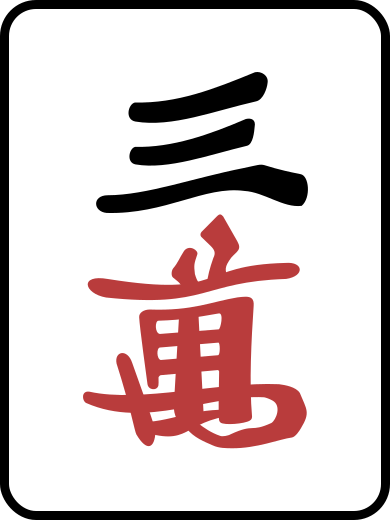
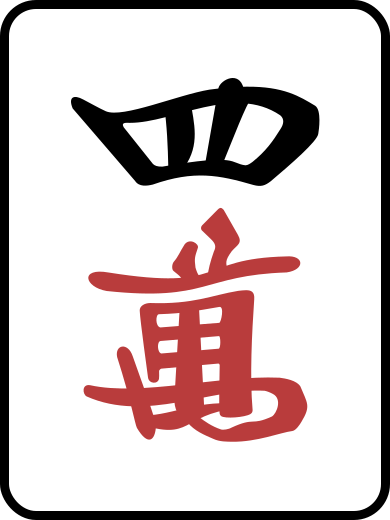
This hand waits on 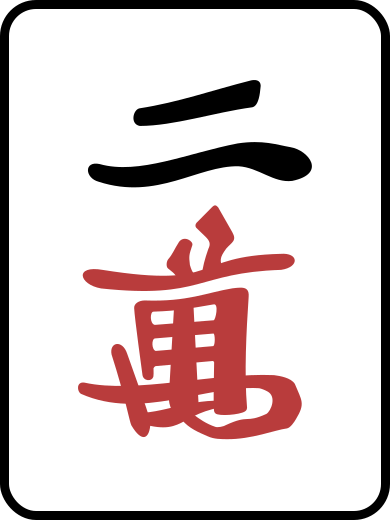 , , or
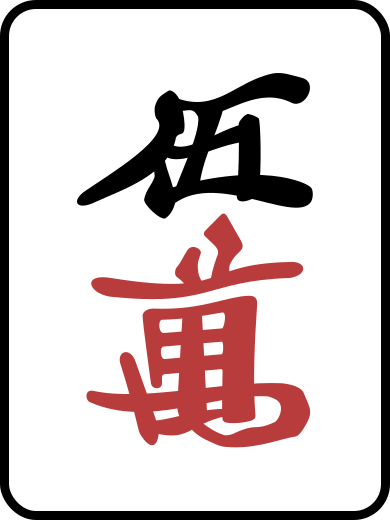 . A kan of 4 man leaves only the 3 man wait, so you can't declare it.
Open kan: daiminkan
You hold three identical tiles and any player discards the fourth. Unlike chi, the discard can come from any seat. Call "kan", take the tile, and lay the set out like a pon with the called tile turned toward the player who threw it.
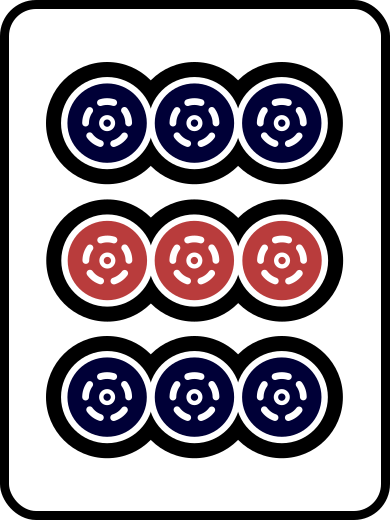
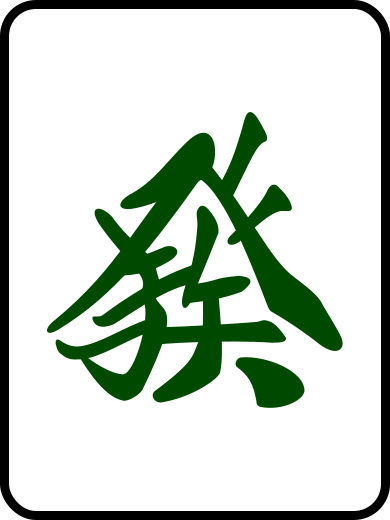
This hand called the fourth 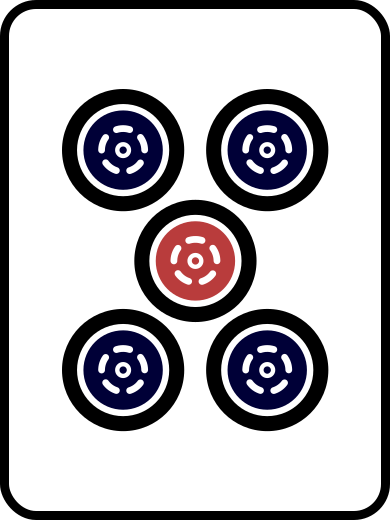 for an open kan. The triplet gives it a yaku, and it waits on or .
An open kan opens your hand. If you were closed, you can't declare riichi anymore, and the closed-only yaku are gone too. For yaku it counts as an open triplet.
It's the weakest of the three. You give up a to turn a triplet you already had into a kan, and you hand everyone a new dora. The course lesson on when to kan goes through the few cases where it pays.
Added kan: kakan or shouminkan
You already have an open pon, and the fourth tile reaches you: you just drew it, or it was sitting in your hand. On your turn you add it to the pon, set on top of the sideways tile. Not on a turn where you just called. The other name is shouminkan (小明槓).
You can't call a discard to turn your pon into a kan.
Robbing the kan: chankan
The added tile is exposed for a moment, and another player can win on it. That's , a 1-han yaku. Your kan doesn't go through, and you pay as the discarder. A player in can't rob it.
A closed kan can't be robbed, with one exception. Mahjong Soul and the EMA 2025 rules let a player waiting on win on a tile from a closed kan. Tenhou, the M-League, and the WRC don't.
When the kan dora turns over
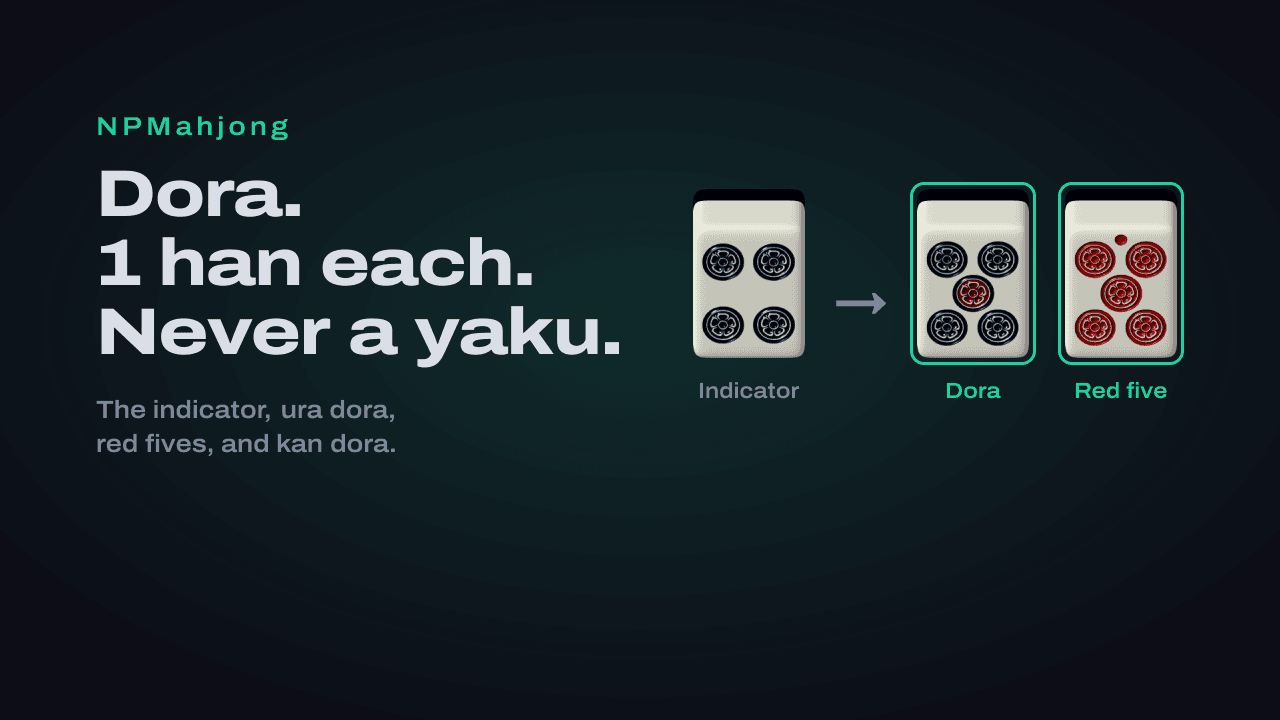
Every kan turns over one more dora indicator, next to the ones already showing. The dora page explains how to read an indicator. Rulesets only disagree on when it flips.
| Ruleset | Closed kan | Open or added kan |
|---|---|---|
| Tenhou, Mahjong Soul | Right away | After the player who made the kan discards |
| M-League, WRC, EMA | Right away | Right away |
On Tenhou and Mahjong Soul, if you make a second kan before discarding, the pending indicator turns over just before you draw the second replacement tile.
A riichi winner also turns over one ura dora indicator under each indicator. Two kans plus the first indicator means three ura dora chances.
Winning on the replacement tile
If the replacement tile completes your hand, you win by tsumo and add , 1 han. Any kan counts, and you need no other yaku. The tsumo still gets its 2 fu.
doesn't survive your own kan. If you declare riichi, make a closed kan on your next draw, and win on the replacement tile, you score riichi, menzen tsumo, and rinshan kaihou, but not ippatsu.
What a kan is worth in fu
A kan pays four times the fu of the same triplet. An added kan counts as an open kan.
| Set | Simples | Terminals or honors |
|---|---|---|
| Open triplet | 2 | 4 |
| Closed triplet | 4 | 8 |
| Open kan | 8 | 16 |
| Closed kan | 16 | 32 |
A closed kan of dragons is 32 fu on its own. Add the 20 base fu and 10 for a closed , and you're at 62. With no other fu in the hand, that rounds up to 70. With 3 han, 70 fu is a . The scoring guide has every table, and the fu quiz drills the counting.
Four kans: the cap and the abortive draw
A hand can have at most . in one hand is sankantsu, 2 han, open or closed. Four kans by one player is suukantsu, a .
Four kans by two or more players ends the hand as an abortive draw on Tenhou and Mahjong Soul. The M-League, WRC, and EMA rules have no abortive draws. Once four kans are on the table, nobody can declare a fifth.
You also can't declare a kan on the last tile of the live wall, and nobody can call the of the hand except to win on it.
Before you call kan
The lesson on how a hand is played puts the kan next to chi and pon, and the glossary has the one-line version. Before you call, check whether your hand stays closed, whether the kan gives it anything the triplet didn't, and whether anyone has declared riichi. A closed kan in a quiet game is usually fine. Against a riichi, an open kan rarely is.
Was this article helpful?