
is a , open or closed. You make four kans in one hand. After the fourth, one tile is left in your hand, and it waits for its pair.
The name players use is suukantsu (四槓子). This site's glossary also lists it as Four Kans, and the EMA 2016 rules use the same English name.
Four kans, one tile
A is four of a kind: a closed kan, an on a discard, or a you upgrade with the fourth tile. Suukantsu counts all three. Every kan sets four tiles to the side and takes a replacement from the , so four kans leave sixteen tiles on the table and one in your hand.
That last tile is the whole wait. The hand is always a for the pair. Draw the match yourself, or take it off a discard. When the match is the fourth kan's , the win is also rinshan kaihou, though a yakuman gains nothing from it.
is sankantsu: 2 . The fourth kan turns it into a yakuman.
The glossary entry is the short form: four quads in one hand.
Three kans and a triplet
You called kan on a discarded 4 man: 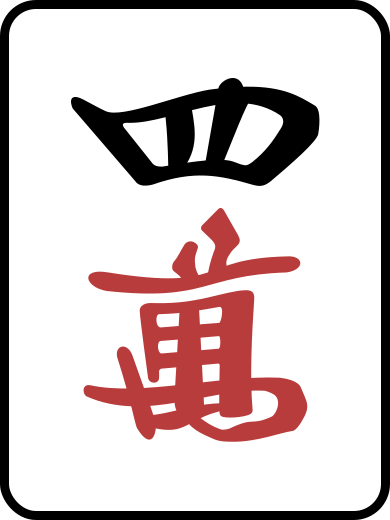 . You called pon on 7 pin and added the fourth tile later:
 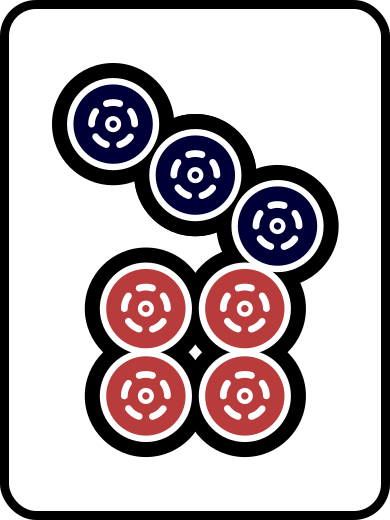 . You drew four 9 sou and made a closed kan:
 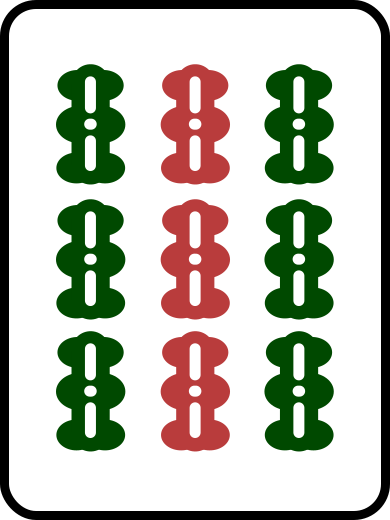 . These four tiles are still in your hand.
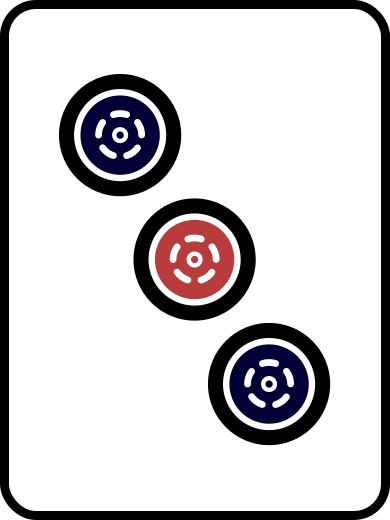
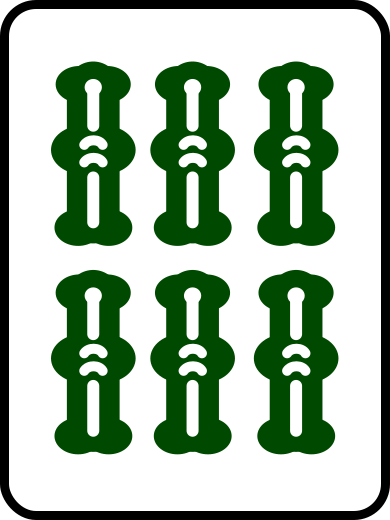
The hand waits on alone, a single wait for the pair.
Win it now and the hand is sankantsu and toitoi: 4 han. The calls made it open, so there's no closed bonus. The fu are the base 20, plus 8 for each open quad of simples, plus 32 for the closed quad of 9s, plus 4 for the concealed 6 sou triplet, plus 2 for the single wait. 74 rounds up to 80, and 4 han 80 fu is paid as a . A ron collects 8,000. The dealer collects 12,000.
Four kans
Same calls. Now you draw the fourth 6 sou and make a closed kan: . One tile is left in your hand.
It still waits on . Win it, by ron or by tsumo, and that's suukantsu. A non-dealer ron collects 32,000. The dealer collects 48,000. On a tsumo, a non-dealer collects 8,000 from each other non-dealer and 16,000 from the dealer. A dealer collects 16,000 from each player.
The fourth kan took the same wait from 8,000 to 32,000. That's four times the mangan. Those payments have no and no sticks, and add nothing once the hand is a yakuman. The scoring guide lists both limits.
Four kans split among players
Four kans only stay in play when one player owns all of them. Split them across the table and the hand can end with no winner. The draw is called (四開槓), or suukan sanra (四槓散了).
- Tenhou: its rules list 四槓散了 among the abortive draws, and every abortive draw is a repeat hand for the dealer.
- Mahjong Soul: the Japanese FAQ ends the hand when several players make four kans between them. The ranked rules repeat the dealer's hand, with no payments and no .
- EMA 2016: no abortive draws at all. Section 3.3.10 lets play go on after a fourth kan, and no one may declare a fifth.
So once one player holds three kans, a fourth from anyone else ends the hand on Tenhou and Mahjong Soul. That player loses the yakuman chance, and nobody pays.
No pao for the fourth kan
Feeding the fourth kan costs you nothing extra on Tenhou or Mahjong Soul. Tenhou's rules say 「四槓子のパオなし」, no for four kans. Tenhou did charge the feeder once: its change log drops 「四槓子の包」 on 2007/03/01. Mahjong Soul's ranked rules apply pao to and only, and add that a kan called on a discard carries no liability. The EMA 2016 rules write their liability rule, section 3.3.9, around dragons and winds. Every ron on suukantsu is paid by the discarder alone. The daisangen page covers how pao works where it does apply.
With suuankou
Make all four kans closed: , , , and , each declared from your own draws. The hand is the same single wait.
Four closed kans are four concealed sets, so the win is suuankou on a single wait as well as suukantsu. Even a ron keeps it, because the discard only makes the pair.
- Tenhou: two yakuman. Its rules stack yakuman and pay the single-wait as a single. A non-dealer ron collects 64,000. The dealer collects 96,000.
- Mahjong Soul: three yakuman. The single-wait suuankou is a double there, plus one for suukantsu. A non-dealer ron collects 96,000. The dealer collects 144,000.
- EMA 2016: one yakuman. "Yakuman are not cumulative", so the hand pays 32,000, or 48,000 for the dealer.
Single or double
Suukantsu is one yakuman everywhere this page covers. Tenhou lists 四槓子 among its yakuman and pays every one of them as a single. The yaku table in Mahjong Soul's game client scores four kans as one yakuman. It doubles only four hands: the single-wait suuankou, the 13-sided , the nine-sided , and big four winds. The EMA 2016 rules pay every yakuman once. The yakuman page has the full table of payments.
Open or closed
Open kans count. The EMA 2016 entry reads "Hand with four kongs", with no concealed condition. Mahjong Soul's FAQ defines it as a win with four kans made, and the yaku table in its client gives it the same value with calls as without. That's the row on this site: yakuman, open or closed.
Common mistakes
- Counting four of a kind held in the hand. Only a declared kan counts, and the EMA rules say so: four identical tiles make a kong only when you declare it.
- Playing on after four kans split between players. Tenhou and Mahjong Soul end the hand as a draw.
- Charging the feeder. Tenhou and Mahjong Soul have no pao for suukantsu.
- Paying a double. Suukantsu alone is one yakuman. It reaches two or three only with a closed suuankou.
- Forgetting the single wait. Four kans leave one tile, so the wait is always on the pair.
What sits with it
On Tenhou and Mahjong Soul, any other yakuman the tiles hold stacks on . Suuankou comes with four closed kans. Kans of all three dragons add daisangen. All honors or all terminals fit when every kan and the pair qualify. Under the EMA 2016 rules, a hand with two yakuman still pays one.
Price a suukantsu
The score calculator pays one yakuman at 32,000 or 48,000 on a ron, and two at 64,000 or 96,000. Three kans and toitoi is 4 han 80 fu: 8,000.
Open the score calculator