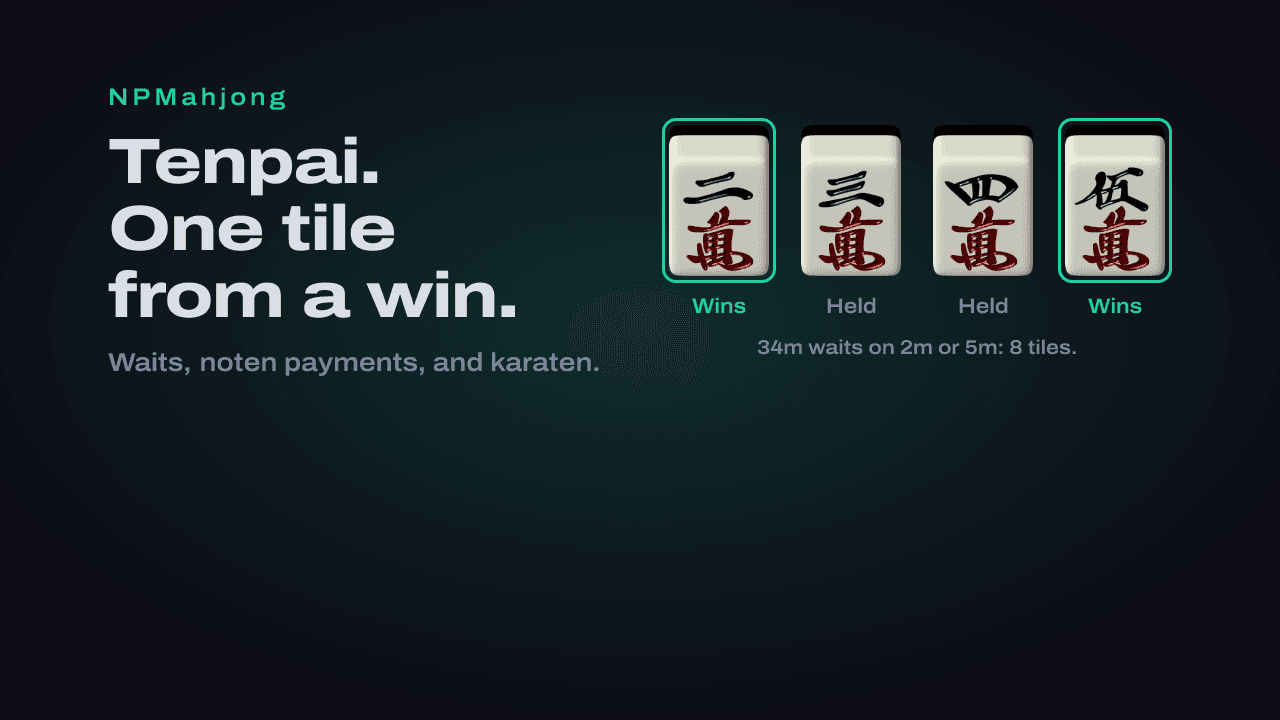
(聴牌) means your hand is one tile from a win. Win on the right tile, by tsumo or , and the 14 tiles make four sets and a pair, , or . The tiles that finish it are your wait. Anyone who isn't tenpai when the wall runs out is (ノーテン), and pays the players who are.
| Situation | Tenpai | Noten |
|---|---|---|
| You want to declare | You can, with a | You can't |
| The wall runs out | You collect from the noten players | You pay the tenpai players |
| You're the dealer at the draw | You keep the deal | The deal passes |
What does tenpai mean in mahjong?
This hand is tenpai.
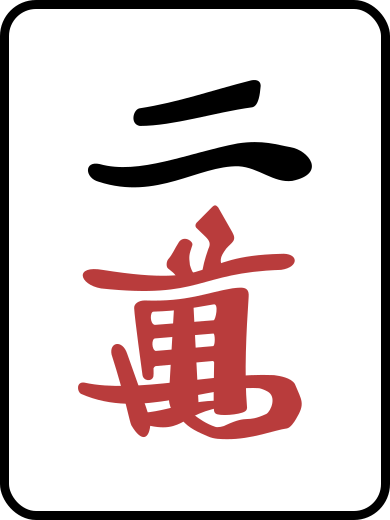
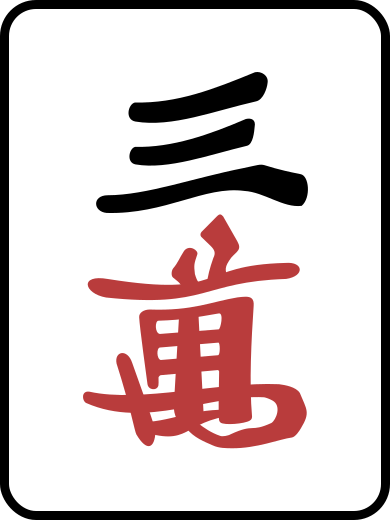
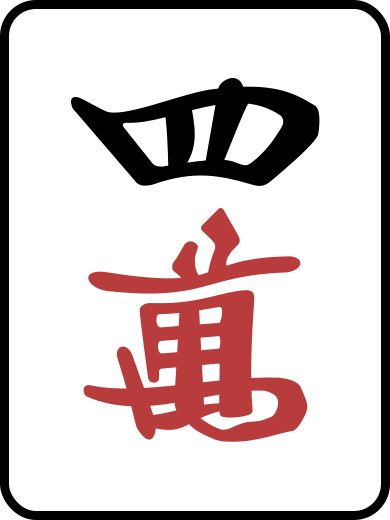
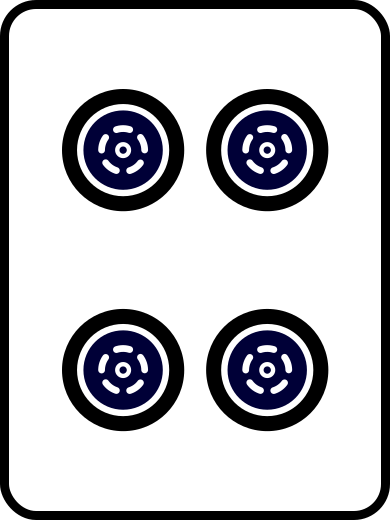
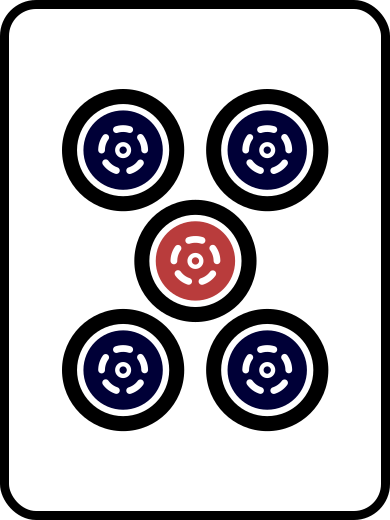
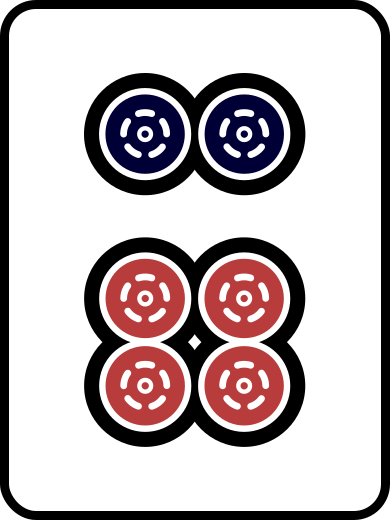
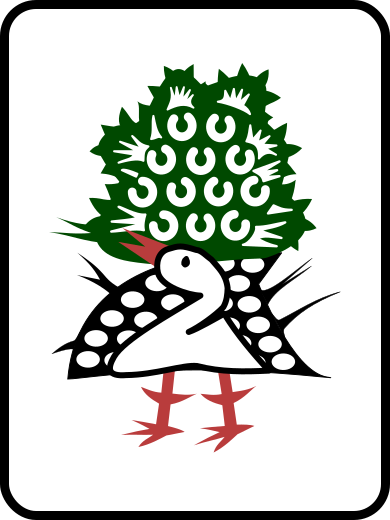
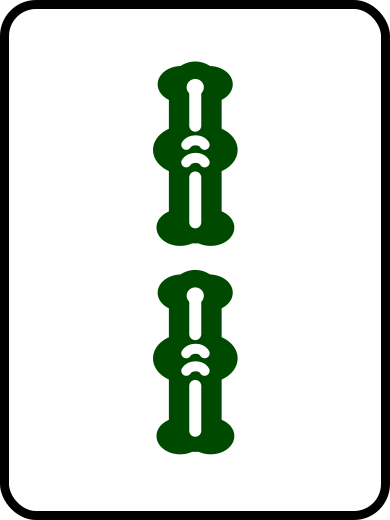
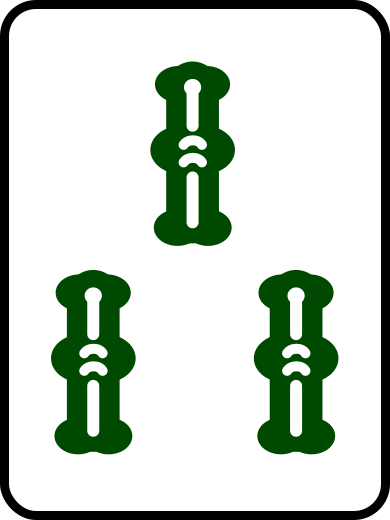
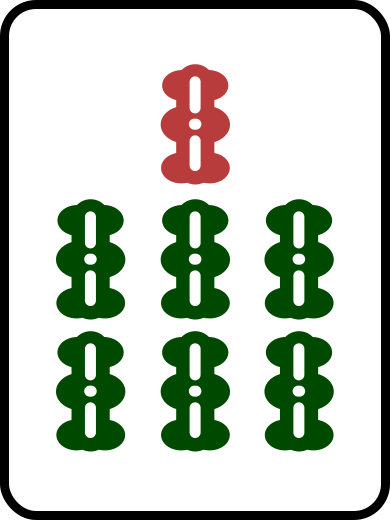
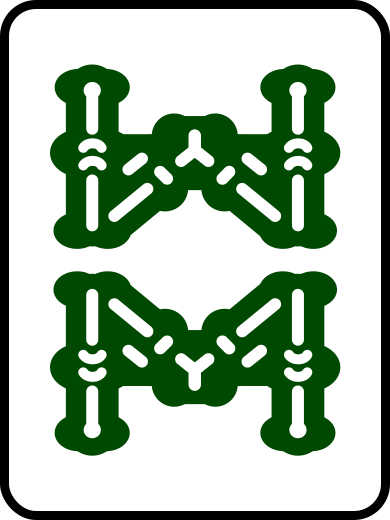

The 234m, the 456p, and the 123s are finished sets, and the white dragons are the pair. The 78s needs one more tile: a 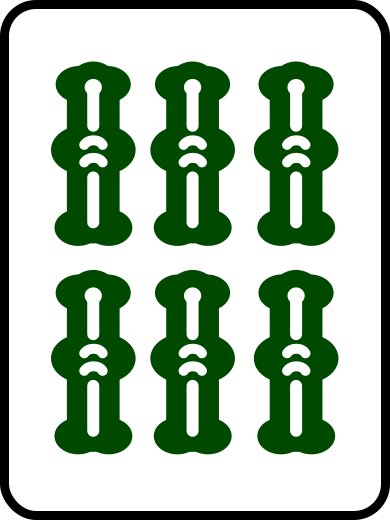 or a
or a 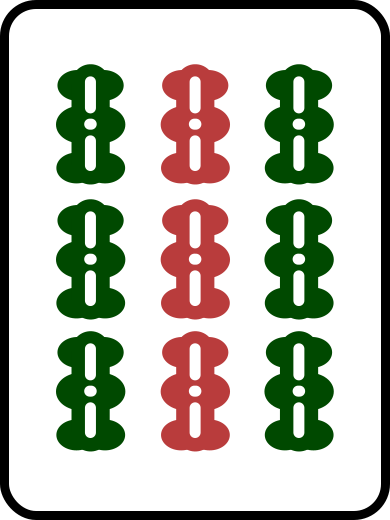 . Either one wins.
A hand one useful tile away from tenpai is 1-shanten (, iishanten). Shanten counts how many tiles you still need to reach tenpai.
Tenpai is about shape. It doesn't promise a win. An open hand with can be tenpai and unable to win, and a hand can be tenpai and unable to ron. The furiten hand still counts as tenpai when the wall runs out. On Tenhou and Mahjong Soul, so does the open hand with no yaku.
The common waits, counted
Most tenpai hands wait on one of these shapes, or on two of them at once. The Left column counts the copies outside your hand before you see a single discard.
| Wait | Shape | Left |
|---|---|---|
| 11 | ||
| 8 | ||
| 6 | ||
| 4 | ||
| 4 | ||
| 4 | ||
| 3 |
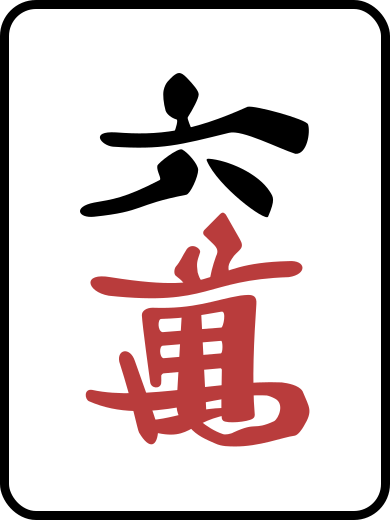
- Sanmenchan (three-sided) is usually five in a row. This one wins on
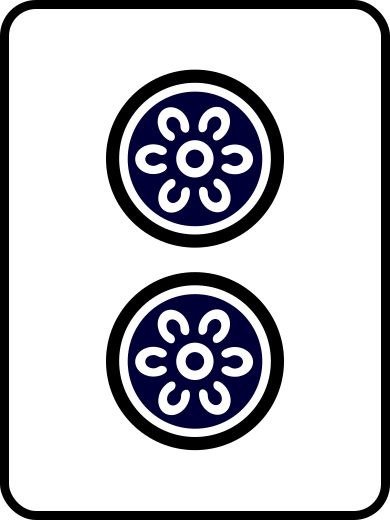 , , or
 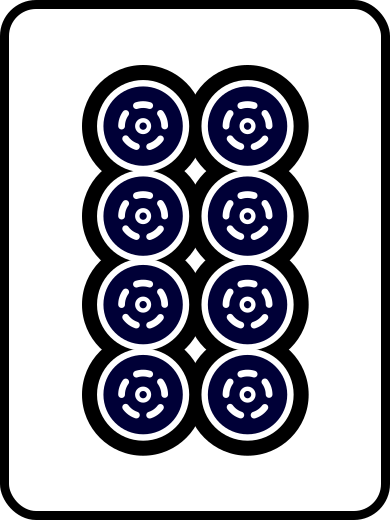 . 34567p reads as 34 plus 567, waiting on the 2 or the 5, or as 345 plus 67, waiting on the 5 or the 8. You hold one 5p, so the 5p has three copies left.
 - Ryanmen (two-sided) is two in a row with room on both sides. 34m wins on or
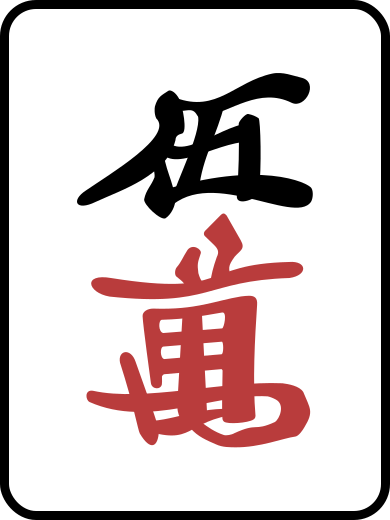 .
. - Nobetan is four in a row. 3456s wins on or : a lone 3 plus 456, or 345 plus a lone 6. Either end makes the pair, so it's two single waits in one shape.
- Shanpon (two pairs) waits on both pairs. 3377p wins on
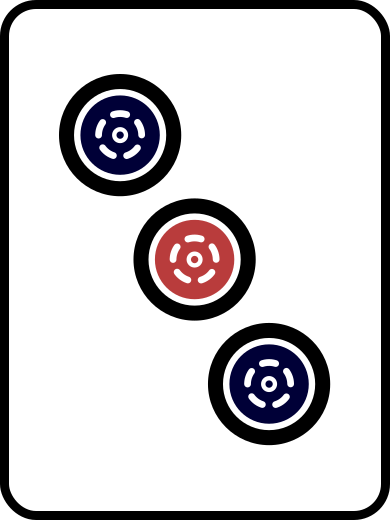 or
or 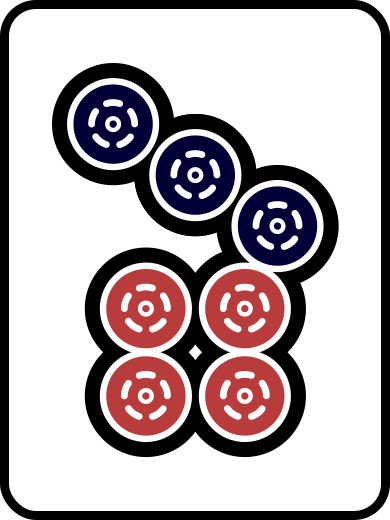 . The tile you win on turns one pair into a set, and the other stays the pair. Two copies of each are left: four in all.
 - Kanchan (middle) waits on the middle tile. 46m needs the .
- Penchan (edge) sits at the edge. 12s can only take the , and 89 only the 7.
- Tanki (single) waits on a lone tile to make the pair. 9p wins only on the
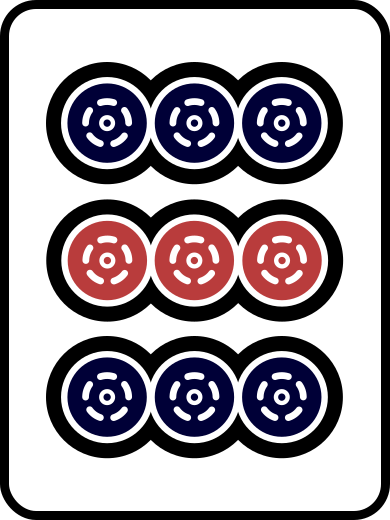 . You hold one copy, so three are left.
How to count your tiles left
A wait is worth its tiles, not its kinds. Start with 4 for each tile you wait on. Take away the copies in your hand. Then take away every copy you can see: the rivers, open calls, and the indicator.
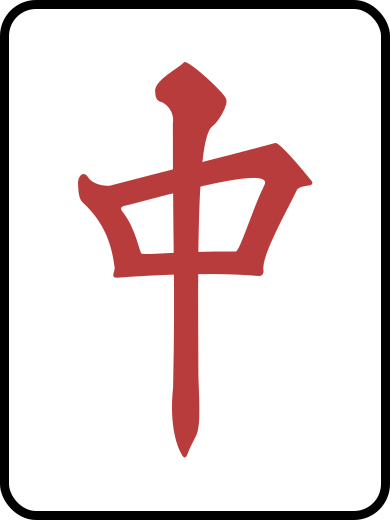
This hand waits on , , and . You hold one 5p, so 11 copies are outside your hand. Now the dora indicator is a , and two sit in the rivers. That leaves 4 + 2 + 2 = 8 tiles. Three kinds, and the same 8 tiles as a plain ryanmen with nothing visible.
Open this hand in the hand analyzer with those three tiles marked as visible. It takes them off the count for you.
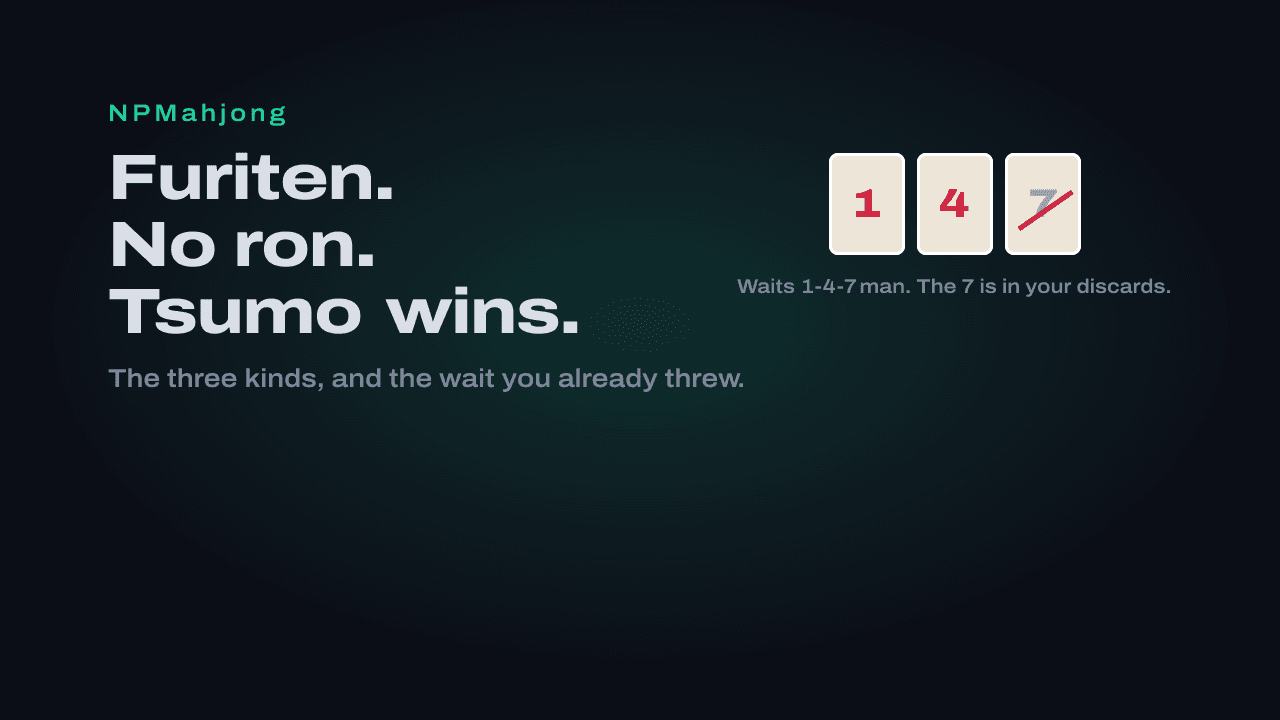
Before you count on a ron, check your own river too. If any of your winning tiles is in your discards, you're furiten and can only win by tsumo.
Tenpai and riichi
You declare riichi from a closed tenpai hand: no , no , no . An open hand can be tenpai, but it can't declare riichi. The riichi page has the other conditions.
Staying tenpai without declaring is (黙聴). You can still change your wait, and you don't put out the 1,000-point stick.
Yaku guide
Riichi
1 han, closed only. Declare on a closed tenpai hand and put out a 1,000-point stick.
Noten payments at an exhaustive draw
When the wall runs out and nobody wins on the final discard, the hand ends in an exhaustive draw (, ryuukyoku). Tenpai players show their hands. The noten players pay them 3,000 points in all, split by how many are tenpai. That's the standard four-player split, and both Tenhou's ranked tables and the EMA rules pay it.
| Tenpai players | Each tenpai player | Each noten player |
|---|---|---|
| 1 | +3,000 | −1,000 |
| 2 | +1,500 | −1,500 |
| 3 | +1,000 | −3,000 |
| None, or all four | 0 | 0 |
On Tenhou and Mahjong Soul, a at the draw replaces the tenpai payments.
What one tenpai is worth
At four players, reaching tenpai before the draw moves your score by 2,500 to 3,000 points, whatever the others do. That's more than a 2 30 fu ron, which pays 2,000.
| Others tenpai | You're noten | You're tenpai |
|---|---|---|
| 0 | 0 | +3,000 |
| 1 | −1,000 | +1,500 |
| 2 | −1,500 | +1,000 |
| 3 | −3,000 | 0 |
Three players
Tenhou's ranked three-player tables pay 2,000 in all. One tenpai player collects 1,000 from each of the other two. Two tenpai players each collect 1,000 from the third. The sanma guide covers the rest of the three-player rules.
The dealer keeps the deal on tenpai
A dealer who is tenpai at the draw deals again. That's (連荘). A noten dealer passes the deal to the next player. Tenhou, Mahjong Soul, and the EMA rules all play it this way. In the last hand at four players, Tenhou and Mahjong Soul end the game instead when the tenpai dealer is top with at least 30,000. Tenhou's ranked tables and the EMA rules also add a honba after every exhaustive draw, whoever deals next.
For the dealer, tenpai at the draw is worth more than the payment. It buys another hand as dealer, where a ron pays 12,000 instead of 8,000.
Formal tenpai: no yaku, still paid
(形式聴牌, keishiki tenpai) is tenpai with no yaku, usually in an open hand. It can't win on an ordinary discard. On Tenhou and Mahjong Soul, it counts like any other tenpai at the draw.
You called chi on . This is the rest of your hand.
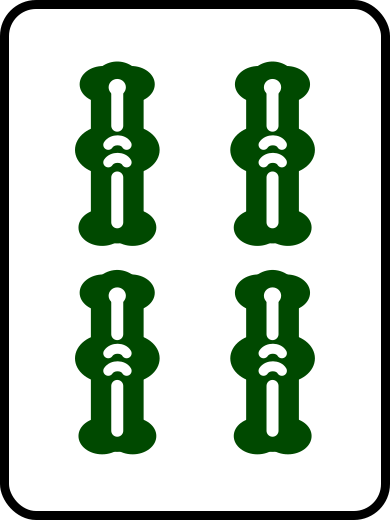
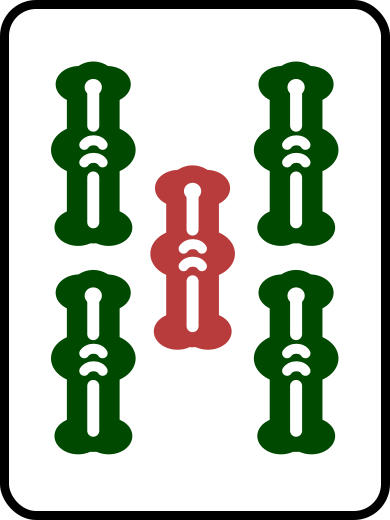
It waits on and , with no yaku on either. The 789p and the 9s pair rule out , and three suits rule out a flush. There's no honor set, no matching runs across the suits, and no straight. Unless a yaku comes with the winning tile, like on the very last draw, it can't win. Hold it to the draw and it collects like any tenpai hand: 3,000 at a four-player table if you're the only one.
That's why players call chi or pon late in a hand only to reach tenpai. At four players, the call is worth 2,500 to 3,000 points at the draw. It also leaves you fewer tiles to fold with if someone declares riichi.
Karaten: a wait with nothing left
(空聴) is a tenpai shape with no winning tile left to draw. It comes in two kinds, and the rules treat them differently.
All four copies in your hand
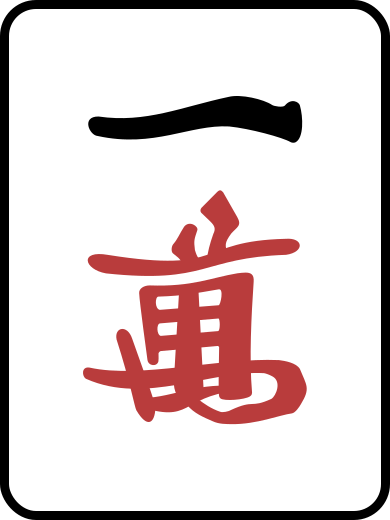
It looks tenpai: three 6s, three 9s, and a lone 9s waiting to become the pair. But a fifth 9s doesn't exist. The only wait is a tile you hold all four of.
Neither Tenhou nor Mahjong Soul counts it as tenpai at the draw. Tenhou allows a wait on the fifth copy only when your concealed hand doesn't hold all four. Mahjong Soul rules out a single wait on a tile you hold four of. Type it into the hand analyzer and it flags the hand as karaten and counts it as 1-shanten.
Tenhou looks at the concealed hand only. Call pon on three 9s, keep the fourth for a single wait, and Tenhou counts that hand as tenpai at the draw.
Every copy visible elsewhere
Say your kanchan waits on the 5m, and all four 5m are already in the rivers and calls. Nothing is left to win on, but the hand still counts as tenpai at the draw. The EMA rules say so outright. Tenhou's and Mahjong Soul's rules name only the four-in-your-hand case as an exception.
Tenpai and furiten
Furiten (振聴) blocks ron, not tenpai. With a winning tile in your own discards, you can't ron any of your winning tiles. You can still win by tsumo, and you still collect at the draw. Tenhou and Mahjong Soul both let you declare riichi while furiten. That riichi can only win by tsumo.
Practice reading waits
- The wait quiz deals tenpai hands, one suit or mixed. Mark every winning tile, then see the split behind each one.
- The hand analyzer lists every wait, takes the tiles you've seen off the count, and flags karaten.
- The score tracker settles noten payments in a home game. Mark who's tenpai at the draw and it splits the payment.
- The scoring guide counts han and fu for the hands that do win.
The glossary has short cards for tenpai, noten, keishiki tenpai, karaten, and nobetan.
Next time a hand ends in a draw, look back at your last tenpai and count it. How many tiles did your wait have left?
Was this article helpful?