Every mahjong parlor in Japan has a regular who'll tell you the game keeps the brain young. Health mahjong classes sell the same idea to retirees. The claim gets repeated so often that most players assume someone proved it.
One team did test it. In 2014 researchers at the Hong Kong Institute of Education published a randomized trial of mahjong in people who already had dementia. It's a careful study, and it's small. What it found is narrower than the parlor version, and more useful.
The Hong Kong trial, in numbers
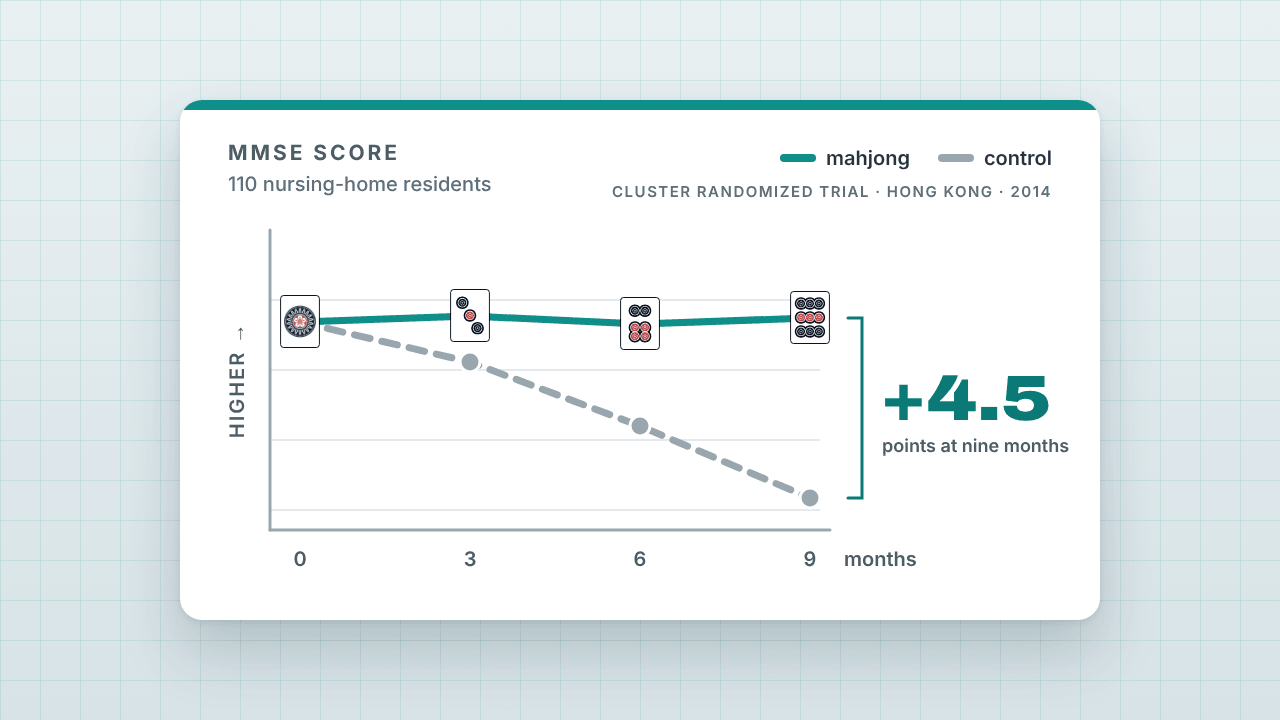
Sheung-Tak Cheng's team ran a cluster randomized trial: whole nursing homes were assigned to one activity, not individual residents. The paper in the American Journal of Geriatric Psychiatry reports 110 residents with dementia, most of them not on dementia drugs. Press coverage at the time put them in nine Hong Kong nursing homes and the sessions at one hour each.
Each home got one of three activities, three times a week for 12 weeks: mahjong, tai chi, or simple handicrafts as the control. The researchers tested everyone before the start, right after the 12 weeks, and again at six and nine months.
The primary measure was the MMSE, the Mini-Mental State Examination. It's a 30-point screening test that takes five to ten minutes: the date, the place, three words to recall, a count backward by sevens, two pentagons to copy. A score of 24 or more counts as normal, 19 to 23 as mild impairment.
| Activity | Schedule | Gap vs control at 9 months | 95% confidence interval | Effect size (d) |
|---|---|---|---|---|
| Mahjong | 3 times a week, 12 weeks | +4.5 points | 2.0 to 6.9 | 0.48 |
| Tai chi | 3 times a week, 12 weeks | +3.7 points | 1.4 to 6.0 | 0.40 |
The gap didn't come from the mahjong group improving. The control group declined, as people with dementia do, and the mahjong and tai chi groups held close to where they started. The difference kept growing after the sessions had stopped: the abstract describes treatment effects that increased over time, out to the nine-month test, six months after the last game.
The secondary tests split. Mahjong players also held up on delayed recall and forward digit span. Tai chi matched it on digit span but not on delayed recall. Neither activity did anything for immediate recall or backward digit span.
Mahjong and TC can preserve functioning or delay decline in certain cognitive domains.
The same trial produced a second paper in International Psychogeriatrics that measured dementia severity with the Clinical Dementia Rating. The mahjong group's total score drifted more slowly than the control's over the nine months. Piece by piece, neither mahjong nor tai chi moved the cognitive part or the daily-functioning part on its own. The authors read that as a small, general slowing rather than a repair of any one skill.
The 2020 pilot in mild cognitive impairment
A 2020 study in Frontiers in Neurology tried the same dose one step earlier, in people with mild cognitive impairment rather than dementia. Zhang and colleagues randomized 69 residents of a nursing home in Nanchong, China, mean age 74.3. Fifty-six finished: 28 who played mahjong for an hour three times a week for 12 weeks, and 28 who carried on as normal.
The mahjong group improved on all three tests, the MoCA-B, a trail-making test, and a questionnaire on daily activities. Read the between-group columns, though. At 12 weeks the two groups differed on the daily-activities questionnaire, 15.6 against 19.9, where lower is better. On the two cognitive tests they didn't. The authors call it a pilot and note they ran no long-term follow-up. It's a reason to run a bigger trial, not a result to quote at the table.
What the trials don't say
Read the limits as plainly as the results.
Small and open label. 110 people in the main trial. Everyone knew who was playing mahjong, including the staff who ran the homes.
Nursing-home residents with dementia. Both studies tested people already in decline, living in institutions, doing little else. A 45-year-old playing three a night on Mahjong Soul is a different population, and no trial covers them.
Slowing, not prevention. The outcome was a smaller drop on a screening test over nine months. Nobody measured whether anyone avoided dementia, and nobody has followed mahjong players for the decades that question needs.
Tai chi came close. The 0.8-point difference between the two activities sits well inside both confidence intervals. The fair reading is that a scheduled group activity, run three times a week, beat handicrafts. Mahjong is one such activity. It happens to be one that four people with no shared language can sit down to.
If someone sells you a mahjong class as dementia insurance, they're selling past the evidence. If they sell it as a reason to leave the house three times a week and think hard for an hour with three other people, the evidence is on their side.
What the tiles ask of the brain
The researchers picked mahjong for the same reason you'd pick it. Thirteen tiles in hand, three opponents' discards to track, a score to count in and , and three players whose calls change your plan. That's working memory, arithmetic, attention, and social reading in one sitting, which is why the Hong Kong team filed it under complex cognitive activity and tai chi under physical.
The table also trains something the trials didn't measure: temper. Three bad in a row push most players into decisions they'd never make calm. If you want the brain benefits, that part is a cost. Losing with a clear head is a skill, and tilt is where it fails.

Japan's version: 健康麻雀
Japan didn't wait for the trial. (kenkō mājan) strips the parlor of the three things that gave the game its reputation. The Japan Healthy Mahjong Association puts the rule in its slogan: 賭けない、飲まない、吸わない. Don't bet, don't drink, don't smoke. A 2025 feature for retirees describes it the same way and pitches it as a head game for any age.
It's official enough to have a national tournament. ねんりんピック, the National Health and Welfare Festival, is a yearly event for people aged 60 and over, run by the Ministry of Health, Labour and Welfare with the host prefecture. Shizuoka City's team notice traces it back to the first festival in Kobe in fiscal 1988 and puts the 2025 edition in Gifu over October 18 to 21, with about 600,000 participants and spectators expected. Gifu Prefecture's briefing for the 2018 Toyama festival lists the five cultural events: go, shogi, haiku, senryu, and healthy mahjong. In 2025 Shizuoka sent three players to go, three to shogi, and four to healthy mahjong in Ogaki. Osaka Prefecture's call for its 2025 team listed shogi, healthy mahjong, and karuta for residents aged 60 and over.
So the seniors' version of the game sits in the same bracket as go and shogi, with prefectural qualifiers, a team captain, and a flag bearer. That's a long way from the smoke-filled parlor, and most of the distance was covered by taking the money off the table.
If you're playing for your brain
Take the trial's dose and nothing more. Three sessions a week, about an hour, at a table, with people. Online play keeps the tile logic and drops the room; the trial never tested a screen, and the social half is part of what it measured. Keep score by hand, since counting fu is the arithmetic. And leave the money at home, which is the one rule Japan already wrote.
In Osaka that means a no-rate parlor or a health mahjong room. The Osaka guide lists them by area, and one directory it cites counts 32 health mahjong venues across the prefecture. Pick one, say 初めてです at the counter, and play your hanchan.

Was this article helpful?