Every game at a Japanese mahjong parlor starts with a fee, and the parlor collects it whoever wins. That one fact explains most of what happens inside a jansou. It's why staff sit down at your table, why they play the way they do, and why chasing money there is a losing game even for strong players.
I've been a member of the 日本プロ麻雀協会 (Japan Professional Mahjong Association) since 2017. Before that, I worked in an Osaka parlor as a "member," the staff who pour the drinks, run the floor, and fill empty seats. This is what that job taught me, with the facts checked for 2026.
What is a Japanese mahjong parlor?
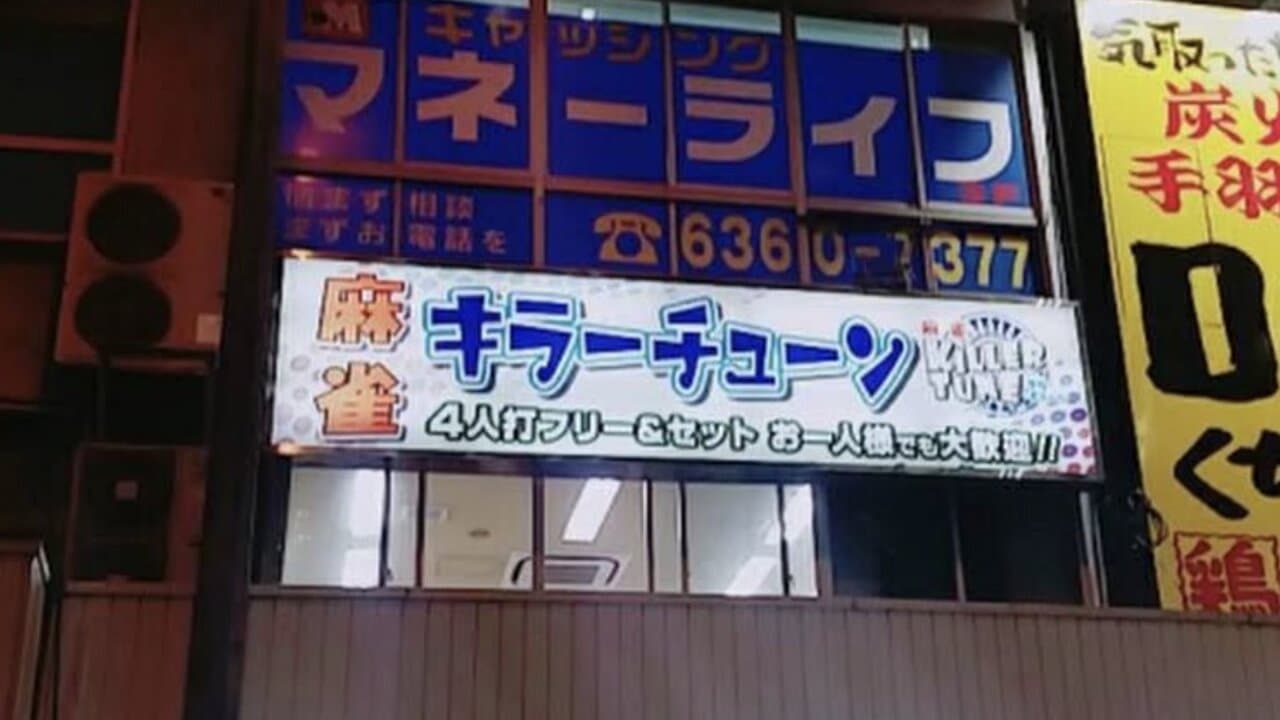
A (jansō, often written jansou) is a shop that rents you a seat at an automatic mahjong table. The machine shuffles and builds the walls, and many models deal the starting hands too. If you've never sat at one, the mahjong table guide shows how they work.
Parlors run under a police license. The 風営法 (Entertainment Business Act) files them in the same category as pachinko halls, and that brings rules you'll notice. Nobody under 18 gets in. Shops can't open between midnight and 6 a.m. except where a prefecture allows a later close. Japan had 6,513 licensed mahjong parlors at the end of 2024, down from 7,597 in 2020, according to the National Police Agency.
You'll choose one of two ways to play:
- Set (セット). Bring your own group of four and rent a table by the hour. Taiyo Chemicals, the maker of Amos automatic tables, puts the usual price at ¥1,000 to ¥1,600 per table per hour. Split four ways, that's about ¥400 each. The shop hands you and score sheets, and the house rules are whatever your group agrees on.
- Free (フリー). Walk in alone and staff seat you with strangers. You pay per game, usually ¥300 to ¥500 per . "Free" describes how you join. It has nothing to do with the price.
The room itself has changed since I first wrote about parlors in 2013. Back then plenty of shops smelled of cigarettes. Since April 2020, the revised Health Promotion Act has banned smoking indoors by default. Most shops now send smokers to a sealed smoking room, and only rooms limited to heated tobacco may keep tables inside. The exception is a shop that registers as a smoking shop (喫煙目的店). Marchao's Umeda branches in Osaka do, so smoking at the table is allowed there and nobody under 20 gets in. Health mahjong (, kenkō mājan) shops go further: no betting, no alcohol, and no tobacco at all.
For where to play and what to say at the counter in my city, read how to play mahjong in Osaka.
What a parlor member does all day
(member) is the parlor word for floor staff. When I worked as one in Osaka in 2016, most of the job was service:
- greeting every customer on the way in and out
- seating new arrivals at the right table
- bringing drinks on request, plus hot or cold towels
- collecting game fees
- washing cups, and looking after bags and coats
- keeping an eye on the whole floor: who's waiting, which table just finished, how many members are free
The other half of the job happens at the table. Members play in two ways, and they're different jobs with different goals.
Plenty of pros work as members, too. It's one of the few jobs where mahjong is the work itself. If you're wondering how pros pay the bills, read what a professional mahjong player is.
A shift was twelve hours. I got away with eleven so I could catch my last train. The floor filled up between six and eight in the evening, when the salarymen clocked out, and that's when every member was at a table. One regular stayed three days straight. He'd nap in a chair while we waited for a fourth, wake up when a seat opened, and sit back down.
Daisō: the substitute you're not supposed to notice
When a customer has to step away for a phone call or the bathroom, they ask for (daisō). Some regulars shout "pinchi!" instead. A member takes the seat and plays until you're back. Points won or lost during the substitution are yours, not the shop's.
A good daisō is invisible. The member isn't there to win your game. A sub doesn't call or , and doesn't declare . Some shops don't let the sub call either. The job is to keep your hand flexible, stay out of everyone's way, and lose as few points as possible. That's harder than it sounds, because reaching stops being the goal.
Two things customers rarely know:
- You can release your sub. Tell them 「好きに打っていいですよ」 (suki ni utte ii desu yo, "play it however you like"). Depending on how strict the shop is, the member may then play to win, calls and risks included.
- Members covering for members play normally. If a sub suddenly starts calling tiles, they're probably filling in for a colleague.
If your sub wins a hand while you're gone, or leaves you a nice tenpai, thank them on your way out. It makes a member's shift.
Filling seats: where a member earns their keep
When a free table is one player short, a member sits down as the fourth player. Staff call this (honsō). Some customers love playing against members. Others don't. Either way, this is what makes or breaks a member: perfect manners, a game that keeps moving, some warmth at the table, and steady results, all at once.
Keeping the seat ready to hand over
A member often gives up the seat when a customer walks in, as long as the game is still early. That means East round, dealer turn still to come, and everyone's score still close to where it started. So many members play East 1 to East 3 quietly. Win a early and you're stuck in that seat. Deal into 12,000 and no customer wants it. Low-risk, low-return choices keep the scores flat and the seat easy to pass on.
I was the exception. I loved playing and had no plans to leave, so I'd start as East or South. That got my dealer turn out of the way early and made the seat less tempting to a newcomer. Then I aimed for big hands. On a busy night that's selfish: the customer who can't join my table either waits or gets a new table filled with other members. My colleagues didn't mind. Most of them were happy to let me take every open seat.
Why the shop wants one big hand, not three small ones
Parlors earn per game, so game length is revenue. A dealer who wins three small hands in a row in the South round drags the game out, and the shop loses fees it would have earned from the next game. One big dealer win is better for everyone behind the counter. Staff notice this. Customers mostly don't.
The rules members play under
Most shops give members play restrictions, (seiyaku), to head off arguments with customers. They vary from shop to shop. These are the common ones I listed in 2016, and parlor job guides list the same kind:
- No winning the last hand if it doesn't improve your placement. Winning your way into fourth is agarasu, and members don't do it.
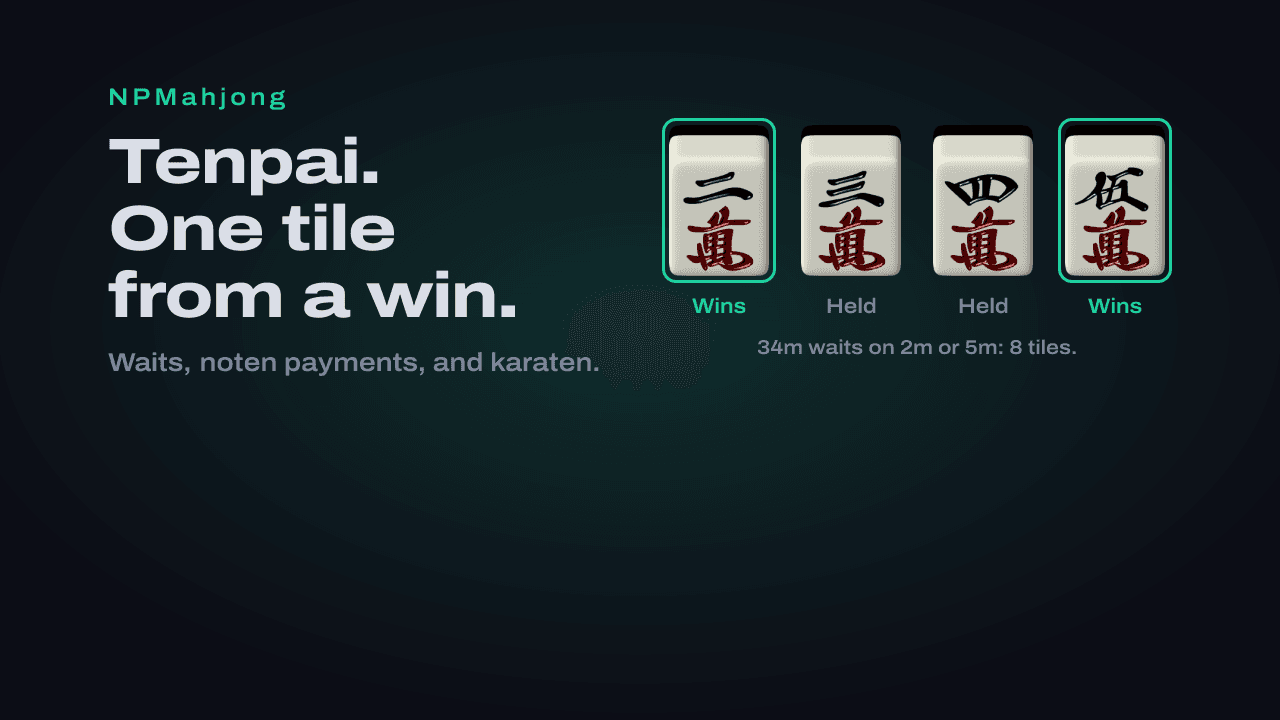
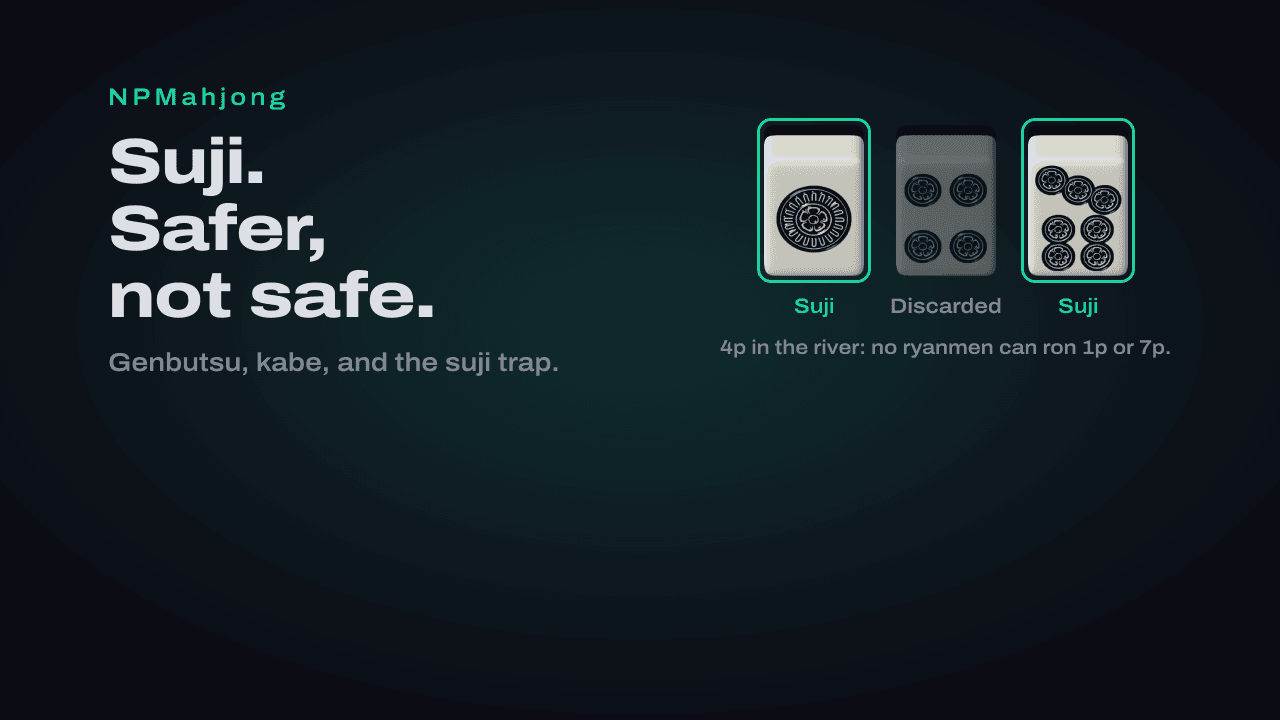
- No waiting on the of your own riichi discard. Declare riichi on a 4 and you can't wait on the 1 or the 7.
- No discarding the third dragon after someone has called two . That would make you liable for their big hand. If you might be forced to discard it after riichi, you can't riichi.
Some shops add one more: no on a mangan. You declare riichi so the table knows.
Members keep these quiet, because a customer who knows them can play around them, and the game stops being fun for everyone. Ask a member and they'll usually say they don't have any restrictions. That's rarely true.
How a mahjong parlor makes money
The shop's income is the game fee (, bada). It comes off the of every game, whatever happens on the table. Some shops split it evenly. Some charge by placement. Some make the winner pay extra, and a few make the winner pay for the whole table.
Think about the table, not your share. At ¥500 a player, four players hand the shop ¥2,000 every game. A hanchan takes about 40 minutes. Ten games in a night move ¥20,000 from the table to the counter, and nobody at the table won it.
A player whose average placement is exactly 2.50 breaks even on the score and still pays the fee every game. Anyone worse than 2.50 loses twice. That's the whole business model, and it works.
The math: why even strong players lose at rate shops
Some free shops let players settle the score in money, at a (レート) such as ¥50 or ¥100 per 1,000 points. It's illegal. Article 185 of the Penal Code covers any money wager. In 2021 the Tokyo Summary Court fined a former chief of the Tokyo High Public Prosecutors Office ¥200,000 for playing mahjong for money with reporters, at the ¥100-per-1,000 rate common in parlors, according to press reports.
Set the law aside and the numbers still don't work. I first ran them in 2013, and the fees haven't moved: a 2023 parlor guide still puts them at about ¥400 a game at ¥50 per 1,000 and about ¥600 at ¥100 per 1,000.
Take a strong player. They finish first 30% of the time, second 30%, third 20%, and fourth 20%. That's an average placement of 2.30 held over thousands of games, which very few people anywhere manage. Give them typical finishes of 35,000, 30,000, 20,000, and 15,000 points, with a 25,000 start, a 30,000 return, and the usual .
At ¥50 per 1,000 points with a 5-10 , those placements are worth +¥1,750, +¥250, -¥750, and -¥1,250. Weight them:
(1,750 × 30 + 250 × 30 - 750 × 20 - 1,250 × 20) ÷ 100 = +¥200 a game.
The fee is ¥400. This player loses ¥200 every game they play.
| Shop | Uma | Result before the fee | Fee | Net per game | Net per 100 games |
|---|---|---|---|---|---|
| ¥50 per 1,000 points | 5-10 | +¥200 | ¥400 | -¥200 | -¥20,000 |
| ¥100 per 1,000 points | 10-20 | +¥550 | ¥600 | -¥50 | -¥5,000 |
Higher stakes narrow the gap without closing it. At about a game and a half per hour, the same player still loses around ¥75 an hour, and that's someone stronger than nearly everyone they'll sit with.
Your online record won't save you either. A 2.2 average against Tenhou's lower lobbies doesn't carry over to a real table. Parlor games run faster than online ones, and there's no time bank. You're tracking every discard so you don't miss a call or call a tile you don't need. You count your score out loud, and you keep your hands from giving anything away. If you play online, the Tenhou pro tips cover what transfers and what doesn't.
Members feel the math first
At rate shops, a member who fills a seat usually plays with their own money and pays the game fee on every game. Losses come out of their pay. Staff call those losses (auto, "outs"). Lose more than a month's wages and you're auto ōbā, "out-over." A member who quits under that weight has "flown away" (, tobi).
Run the fee against the wage. Parlor jobs pay close to minimum wage, and Osaka's minimum rises to ¥1,231 an hour today, October 1, 2026. A member filling seats at a ¥600-a-game shop, a game and a half an hour, pays ¥900 an hour in fees before a single point changes hands.
When I worked as a member, staff called someone who finished every month in profit 純黒 (junkuro, "pure black"). They were rare enough that members talked about them the way online players talk about reaching Tenhou-i. The usual member lost a bit less than they paid in fees each month and called it a decent month.
Why I send everyone to no-rate
No-rate (, nōrēto) means exactly that. You pay the shop for the game, and the score is only the score. You keep everything that makes a parlor worth visiting: the automatic tables, the pace, strangers who play well, and staff who know the rules cold. You lose the part that guarantees you go home poorer.
I spent many days at Shibuton, a no-rate free parlor in Shibuya. In 2013, registering earned you a ¥1,000 ticket and bringing a friend earned another, and first place cost only ¥200 a game. On a good day that was 10 hanchan without spending a yen. Win an event and you might get a free meal, too. The shop has moved and changed its system since then. It reopened in Dōgenzaka in April 2023, and its 2026 listings still show no-rate free play with the fee set by your placement. Check the current table at the counter.
No-rate shops also differ in small ways. At most free shops you announce your score and skip the yaku list. Shibuton asked players to name every yaku, because its tables mixed beginners with regulars. Read the house rules at the counter, and keep the riichi mahjong glossary open if the vocabulary is new.
There are more no-rate shops than when I started. One parlor directory, 雀サクッ, lists 129 no-rate parlors nationwide, and new ones keep opening. In 2013 I wrote that if mahjong is going to be a mind sport, it has to cut its ties to gambling. That still holds. Every game you play at a no-rate shop tells the industry what players want.
As a pro, no-rate is where I still get the three things a parlor is for: practice at speed against strangers, players I'd never meet online, and a table where I can teach without anyone's money on the line.
Visiting Japan? Sit down with someone who's worked the floor
I moved to Japan in 2016, I live in Osaka, and I've played since 2009. I speak English, Japanese, and Spanish, so the rules, the etiquette, and the parlor slang come across in your language.
If you're coming to Japan and want to play at a real parlor table, or learn what's happening around you while you do, book a parlor visit in Osaka. Somewhere else in Japan? Get in touch with your dates, your city, and your level.
Playing online until then? Send me your game logs for a review.
Was this article helpful?