Start at a no-rate parlor. You'll play real mahjong on an automatic table, staff will explain the house rules, and nobody wins or loses money on the result. Osaka has them in Umeda, Namba, Nippombashi, Shinsaibashi, Temmabashi, and Honmachi.
Most English guides to playing mahjong in Japan cover Tokyo, and most are years old. I moved to Japan in 2016, I live in Osaka, and I've played since 2009, so this one covers my city: where to go, which rules you'll meet, and how to behave once you sit down.
My first Osaka parlor was a free-play shop in Umeda, in 2011, before I moved here. I'd only played online and with friends, and I figured a real table would be easier: more time to think, opponents' hands easier to read. It was the opposite. Everyone played faster than anyone online. My hands shook for the first seven . The automatic table dealt everyone 13 tiles, so as dealer I kept almost forgetting my first draw. I called one wrong . My first win was 3 70 fu, and I started counting it out loud until someone at the table kindly reminded me that's already a .
I won the first three games, played for twelve hours, and walked out ahead. I decided it would always be this easy. The next day I lost big. The old man on my left from that first session, who won with , and a on the and stayed polite the whole time, is still the best picture I have of an Osaka parlor.
Where to play mahjong in Osaka: the short answer
- Pick a no-rate shop (, nōrēto). It's the legal, low-pressure way in.
- Book a class if you're new to riichi. Several no-rate shops run beginner classes (, mājan kyōshitsu) next to open play.
- Expect Japanese. One venue in this guide, in Toyonaka, has an English-speaking owner. The rest run in Japanese. The phrase list near the end covers what you'll need.
- Ask "three or four?" Kansai plays a lot of with its own rules. Know which table you're joining before you sit.
- Want a pro at the table? I run no-rate sessions and parlor visits in Osaka for visiting players, in English.
If you need a refresher on the vocabulary, keep the riichi mahjong glossary open in another tab.
Is playing mahjong for money legal in Japan?
Playing for money is illegal in Japan. Article 185 of the Penal Code fines anyone who gambles up to ¥500,000. The one exception covers stakes "provided for momentary entertainment," and it doesn't stretch to cash: Japanese law treats any money wager as gambling, whatever the amount.
Parlors themselves are legal businesses. They run under a police license as amusement businesses (category 4 of the 風営法, the Entertainment Business Act). That license covers the tables and the fees. It doesn't make betting legal. The same law bans opening between midnight and 6 a.m., so no parlor in this guide stays open all night. Marchao's four-player Umeda shop, for one, closes at midnight.
You'll still see the word "rate" (). It means how much money each 1,000 points is worth. ¥10 per 1,000 points, for example, has its own nickname: ten-ichi. Enforcement is real. In May 2020 the head of the Tokyo High Public Prosecutors Office resigned after admitting he'd played mahjong for money with reporters, and prosecutors later moved to a summary indictment.
For a visitor the choice is simple. Play no-rate. Every venue in the table below lists no-rate play. This isn't legal advice, only the safe default.
My own take: don't do anything illegal, and know that a rate table gives you nothing in return. There's no competitive edge in it. More and more no-rate parlors seat strong, competitive players these days. Rate tables are also a lot less patient with beginners, and if you have visible tattoos, stay away from them altogether.
Free, set, or no-rate: the five kinds of mahjong venue
Japanese parlors (, jansō) sort themselves by how you join a table and what's at stake. One shop often offers several of these at once.
Free play (フリー)
You walk in alone and staff seat you with strangers. When a table is short a player, a staff member called a (member) sits in. You pay a fee per game or per hour.
"Free" describes how you join. It says nothing about money. That's why no-rate shops spell it out: Hibana in Shinsaibashi calls itself a "no-rate free" parlor and states that exchanging money based on results is prohibited.
Set (セット)
You rent a table by the hour for your own group of three or four. Some shops call it (kashitaku). This is the easiest option if you're traveling with friends who already play.
No-rate (ノーレート)
Free play or set play with no money on the result. You pay the shop for time or games, and the score is only the score.
Health mahjong (健康麻雀)
The name is a promise: no betting, no drinking, no smoking. One parlor directory lists 32 health mahjong venues across Osaka Prefecture. Some run as members-only salons with fixed hours.
Classes (麻雀教室)
Group lessons, usually with a teacher at the table. Temmabashi Kaikan's classes are taught by pro players. If you've only played online, a class is the fastest way to learn the physical side: building walls, counting points by hand, and calling at speed.
Mahjong parlors in Osaka: areas and venues
Two of these I can vouch for. Lucky Rabbit in Honmachi, where I built the website, so read that as a friend's recommendation, not a neutral one. And GALJAN in Soemoncho, which has pros on staff. If you only have one evening, pick one of those two.
The rest showed activity in 2025 or 2026 on their own sites or their parlor-directory listings, and I've included only what those sources state. I haven't played at all of them. Hours, prices, and rules change, so check the source before you go.
| Venue | Area | What they offer | Players | Good to know |
|---|---|---|---|---|
| まーじゃんラキラビ (Lucky Rabbit) | Honmachi | No-rate free play, set, beginner classes | 4 | Non-smoking; you can watch before you play. My pick |
| GALJAN | Namba (Soemoncho) | No-rate free play, set | 3 and 4 | Pros on staff; optional monthly subscription |
| つどい麻雀 菜の花 (Nanohana) | Umeda | No-rate free play, set, classes | Not stated | Non-smoking floor, a few minutes from Osaka Station |
| 健康麻雀 にまめ (Nimame) | Umeda | No-rate play, set, classes | 3-player | Fully non-smoking; welcomes beginners and solo players |
| ノーレートフリー雀荘ひばな (Hibana) | Shinsaibashi, Nagahoribashi | No-rate free play, classes | Not stated | No betting, no alcohol, no smoking; pro guest days |
| 麻雀喫茶がくちゃん (Gakuchan) | Nippombashi, near Namba | No-rate free play, set, health mahjong, classes, café | 3 and 4 | Non-smoking; opened August 2025 |
| 天満橋会館 (Temmabashi Kaikan) | Temmabashi | No-rate set, health mahjong, classes | 4 | One minute from Temmabashi Station; pro instructors |
| 豊中の健康マージャン (Toyonaka) | Hotarugaike, Toyonaka | No-rate free play, beginner classes | 4 | Owner Yayoi-san speaks English; one minute from Hotarugaike Station |
How the areas split
Umeda sits on of Osaka and Umeda stations. If you're staying in Kita, Nanohana and Nimame are walking distance from the station complex.
Namba and Nippombashi make up Minami, the south side of the center. GALJAN sits in Soemoncho, just north of Dotonbori. Gakuchan is near Nippombashi Station, about a kilometer east. Marchao's and Ponta's three-player-only shops are here too.
Shinsaibashi sits between the two. Hibana is four minutes on foot from Shinsaibashi Station's exit 6 or from Nagahoribashi.
Temmabashi and Honmachi are quieter business districts. Temmabashi Kaikan and Lucky Rabbit both lean toward lessons.
Toyonaka is 15 minutes north of Umeda on the Hankyu Takarazuka line. The health mahjong parlor at Hotarugaike is the one place in this guide where you can ask your questions in English: the owner, Yayoi-san, speaks it. Its site asks foreign visitors to book a day ahead through the reservation form.
Kansai sanma: three-player mahjong, Osaka style
Osaka plays a lot of , three-player mahjong. One Japanese sanma guide says that in Kansai it has overtaken four-player as the main game, and a parlor search turns up many sanma-only shops. Marchao, a national chain, runs dedicated three-player shops in both Umeda and Namba next to its four-player ones. Mahjong House Ponta runs three-player-only shops in Namba, Umeda, Sennichimae, and Tenma.
3-player riichi mahjong rules: the online standard
Most visitors learn sanma on Tenhou or Mahjong Soul. These rules hold on both sites:
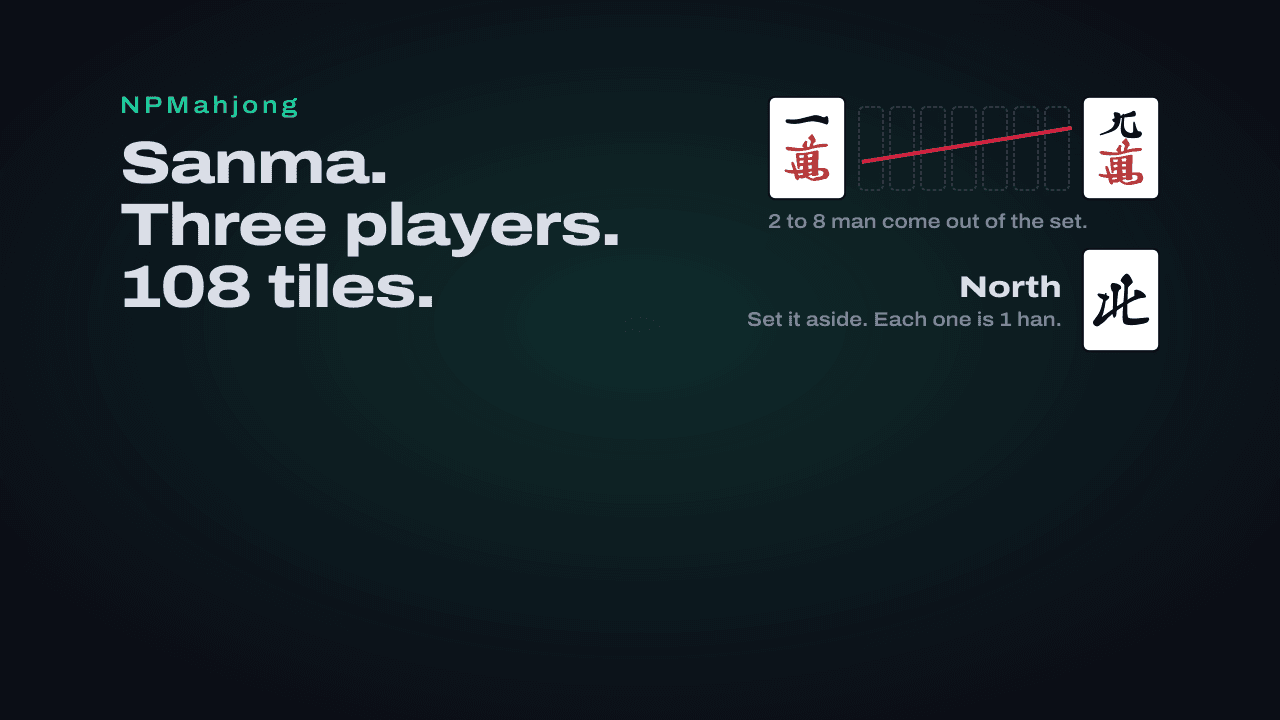
- 108 tiles. The 2 through 8 of characters () come out of the set.
- No . You can only call pon and .
- North is a bonus tile. Pull it out of your hand, set it aside as a dora, and draw a replacement ().
- The dora wraps from 1 to 9 in characters. With 2 to 8 gone, a 1-man indicator makes the 9-man dora, and a 9-man indicator makes the 1-man dora.
- More starting points. Everyone starts with 35,000.
| Rule | Tenhou | Mahjong Soul |
|---|---|---|
| Start / return | 35,000 / 40,000 | 35,000 start |
| Placement | +20 / 0 / -20 | Varies by rank |
| Red fives | Not stated for sanma | One red 5-pin, one red 5-sou |
| Not stated in the manual | Yes |
means a self-drawn win pays less than the same hand by . A mangan is 8,000 by ron but 2,000 + 4,000 = 6,000 by tsumo, because nobody pays the missing fourth player's share.
How Kansai parlors change the rules
If your only sanma is online, expect surprises at a Kansai table. A Kansai sanma rules blog describes north-pulling as the minority rule in the region. Many shops instead add their own flower tiles, which you set aside and replace from the , and keep north as a value tile for everyone. Marchao's three-player Namba shop puts four flower tiles in the set. Ponta has its own special tiles too.
Kansai shops also pay full points on a tsumo, with none of the tsumo loss Mahjong Soul uses. And the scoring is louder. At both Marchao's Namba three-player shop and Ponta, every 5 is a dora. The same Kansai blog counts up to 20 dora tiles in play once you add red fives, pulled bonus tiles, regular dora, and , and says most wins end up at mangan or more.
| Rule | Four-player at Marchao γ | Three-player at Marchao η | Three-player at Ponta |
|---|---|---|---|
| Game length | East-South (hanchan) | Not stated on the rule page | Not stated on the rule page |
| Starting / return points | 25,000 / 30,000 | 35,000 / 40,000 | 35,000 / 40,000 |
| Red fives | One per suit | Every 5 is dora | Every 5 is dora |
| Flower tiles | Not listed | Four | Yes (special tiles) |
| Open and late yaku | Both allowed | Both allowed | Neither; one yaku must be fixed in advance |
| Tsumo loss | Not applicable | None | Full points on tsumo and ron |
| Fu | Not stated | No fu counting | Every hand scores as 40 fu |
Two Ponta rules stand out for riichi players. may use four identical tiles as two pairs. And bonuses (, shūgi) come from both opponents, on tsumo or ron.
Kansai sanma rules vary from shop to shop, and sometimes between two branches of one chain. Read the rule card before your first hand. If you play Tenhou, forget its sanma instincts until you've read it.
If you come from four-player, or from online sanma, treat Kansai sanma as a different game with the same tiles: more dora than you can count, no fu, and a hand that looks cheap on Tenhou is a mangan here. The sanma guide covers the three-player fundamentals before you add the Kansai layer.
Note on these two chains: their pages describe free play and set play but don't say whether games are no-rate. Ask at the counter before you sit. Marchao's Umeda shops also call themselves smoking shops (喫煙目的店), so people smoke at the table there and nobody under 20 gets in.
What happens when you walk in
Here's the usual first visit to a free-play parlor, pieced together from beginner guides and posted house rules.
- Tell the staff it's your first time. Say whether you want free play or set, and three or four players.
- Get the rules. Staff walk you through the house rules or hand you a rule card. Many shops also post them online.
- Wait to be seated. You sit in the waiting area until a seat opens. If a table is short, a staff member fills the seat.
- Greet the table. Say as you sit. If you can't count points yet, say so now. The table will help.
- Pay the fee. Shops charge per game or per hour. Some free-play shops ask the winner of each game to pay a little more.
- Need a break? Ask a staff member to play your seat with (daisō). Losses during a daisō are yours. If you've already declared riichi, the stand-in only draws and wins, so nothing goes wrong.
- Say when you're done. Tell staff (rasuhan) before your final game starts, so they can plan the table.
Fully automatic tables shuffle and build the walls for you. If you've never sat at one, the mahjong table guide shows how they work.
The etiquette Osaka parlors enforce
House rules at Mahjong ZOO, Marchao, and Ponta overlap closely. These are the ones they print. Break them and you get a warning. Repeat it and some shops ban you.
- Don't draw early (, saki-zumo). Wait until the player before you has discarded. All three rule cards list it.
- Don't slam tiles (, kyōda). That covers discards and draws.
- No table talk (, shamisen). Comments about your own hand count, even as a joke.
- Say riichi before or as you discard. Not after.
- Keep your hand standing. Laying your tiles face down (, fusehai) is banned at Marchao, even after riichi. Mahjong ZOO allows it only after riichi or on a single-tile wait.
- Don't look at other hands, including from behind a player.
- Long phone call? Ask for a daisō. Don't make three players wait.
One more that no rule card prints, and that gets you a look from the whole table: open your winning hand with both hands. Even on a , where the one tile looks silly to pick up with two hands, do it anyway. Flipping it with one hand is a real breach.
Japanese phrases for the parlor
You can get through a whole session with these. Staff hear them every day.
- 初めてです (hajimete desu): It's my first time here.
- ノーレートですか? (nōrēto desu ka?): Is this no-rate?
- 三麻ですか、四麻ですか? (sanma desu ka, yonma desu ka?): Three-player or four-player?
- ルールを教えてください (rūru o oshiete kudasai): Please explain the rules.
- 点数計算ができません (tensū keisan ga dekimasen): I can't count points.
- (yoroshiku onegaishimasu): Let's have a good game.
- 代走お願いします (daisō onegaishimasu): Please play my seat for a moment.
- ロン / ツモ (ron / tsumo): Win on a discard / win on a draw.
- ラス半です (rasuhan desu): This is my last game.
- (arigatō gozaimashita): Thank you for the game.
Pros and events in Osaka
You don't need Tokyo to sit near a pro.
- Pros on staff. GALJAN lists pro players among its staff. Temmabashi Kaikan's classes are taught by pros, including 松井一義 of the 麻将連合 pro organization.
- Guest days. Hibana hosts pro visits: 村上淳 in May 2025, 土田浩翔 in June 2025, and 仲林圭 in April 2026. Check its schedule page for the next one.
- M-League on the big screen. M-League's 2025-26 national viewing tour stopped in Osaka Prefecture on January 27, 2026, at United Cinema Kishiwada. Every stop had three M-League players commentating, and under-18s couldn't attend the Osaka screening. Watch m-league.jp for next season's dates.
- Qualifiers. Lucky Rabbit hosted Mahjong Saikyosen 2026 Osaka-block qualifier sessions in May and July 2026.
Curious what a mahjong pro does all day? Read what a professional mahjong player is.
Visiting Osaka? Play with a pro
I've been a member of the 日本プロ麻雀協会 (Japan Professional Mahjong Association) since 2017, and I live in Osaka. I speak English, Japanese, and Spanish, so the rules and the etiquette come across in your language.
If you're coming to Osaka and want to play a few games or learn riichi properly at a real table, see the in-person sessions and parlor visits. Have a question first? Get in touch with your dates and your level.
Can't make the trip? Send me your online game logs instead, and I'll review them in English.
Was this article helpful?