You draw a 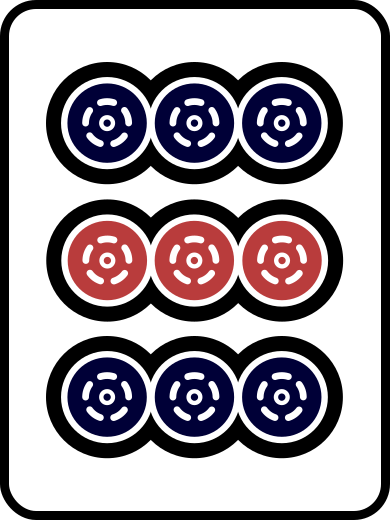 you don't need and cut it. Two draws later you draw another 9p. Then the third. Anyone who has sat at an automatic table knows the feeling, and in a Japanese parlor the explanation you'll hear is , the flow.
The flow has nothing to do with it. The machine does. An automatic table stacks the wall in the order the tiles fall into its drum, and the makers have fought that order since the first table went on sale in 1976. Japanese players have a word for how well a table mixes: . Two Japanese sources go into it. The online game Maru-Jan has a page on 撹拌率 because it copies the bias on purpose, and ABEMA Times ran a 2020 piece on how the AMOS maker finally raised it.
Forty-four years of "the tiles aren't mixed"
ABEMA Times published its piece in October 2020, 44 years after the first automatic table. It opens with the complaint parlors have heard since 1976: 牌が偏っている、混ざっていない. The tiles are biased. They aren't mixed. Players said the machine mixed worse than hands did.
The company in the article is Taiyo Giken (大洋技研), which makes the AMOS tables. It made tiles before it made tables, built its first machine in 1988 as the last of 14 makers, and is one of two still standing. Its head of engineering, Ohno, gave ABEMA the whole problem in one sentence.
What falls in first gets stacked first, however much you stir it.
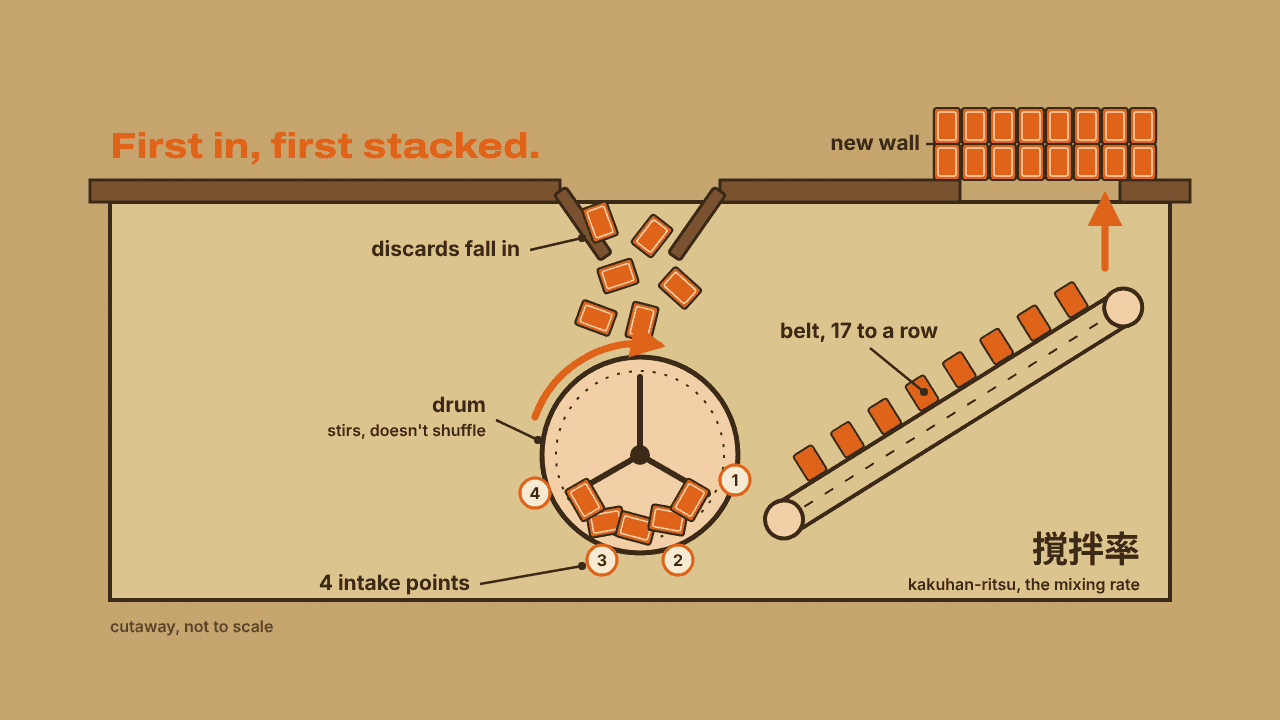
How the machine builds the wall
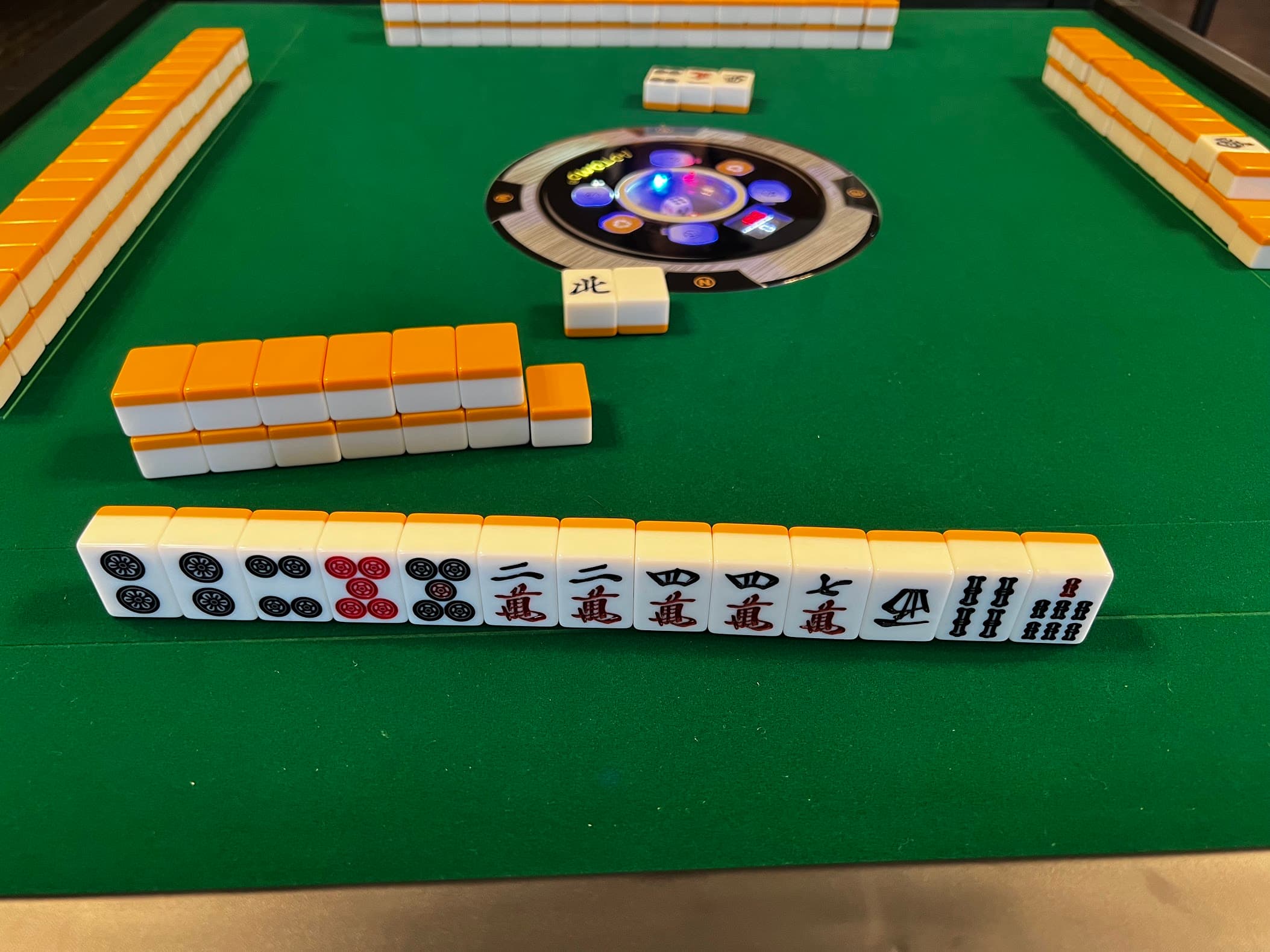
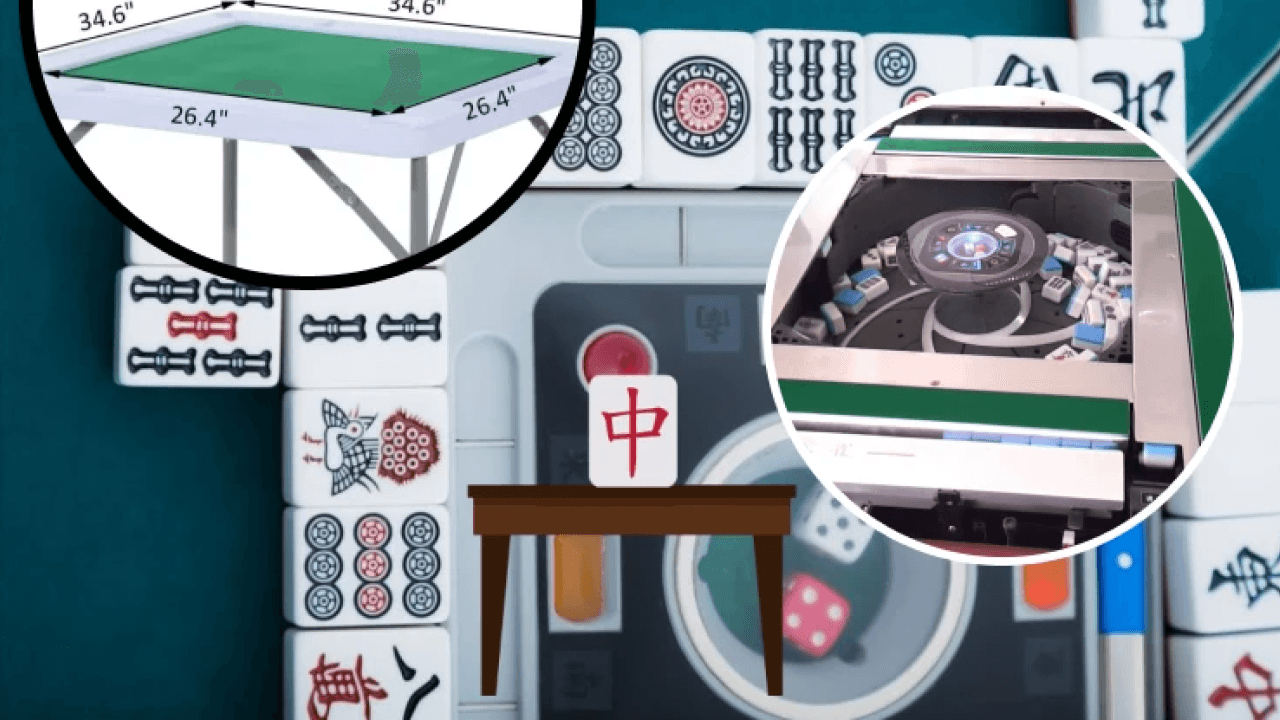
ABEMA describes the mechanism. Press the button, the center of the table opens, and the tiles drop into a drum that turns like a washing machine's. The drum sorts them and feeds them out one at a time onto a belt, which lines up 17, drops a level, and lines up 17 more. Four stacks of 17 by 2 and the wall is done.
Then comes the part a player cares about. The tiles come out in roughly the order they went in. ABEMA's example: if the discards go down the hole first and the players' hands last, the honors everyone cut early cluster in the bottom row and the rest in the . In extreme cases on an auto-dealing table, the article says, a hand came up in the same shape as the one before. Top pros asked for a fix for years.
Maru-Jan's page adds two details. The machine picks the fallen tiles up at four intake points, stacks the bottom row from the left end, then stacks the top row the same way. And because the table runs two tile sets, the tiles that fell two hands ago come back as the newest wall. The 9p that haunts you didn't follow you from this hand. It came from the hand before last, when its copies went down the hole close together.
Three biases Maru-Jan says the machine creates
Maru-Jan set out to reproduce the real automatic table down to its flaws, and it says it partnered with the table maker 大洋化学 to copy the mixing. Its page lists the plays it says work on an automatic table and inside Maru-Jan, with the note that none is guaranteed and that it takes no responsibility if you try them and lose.
| What Maru-Jan says | When it says so |
|---|---|
| In a or other wait, waiting on the tile you just drew wins more often | Only if the tile is a . Otherwise the chance drops |
| The indicator's twins are sometimes sleeping in the , so avoiding the indicator tile as a wait is a strategy | When you can't decide between waits at |
| When everyone at the table pons all hand, the same tiles get set still clumped, and the wall two hands later leans hard toward pairs | Two hands after a pon-heavy hand |
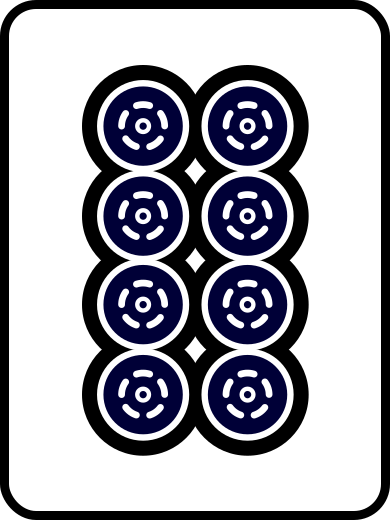
Here's the first one as a hand. You're for with six pairs and a lone  , and you draw a fresh
  .
.

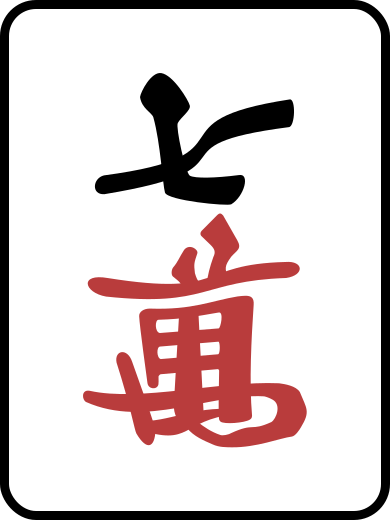
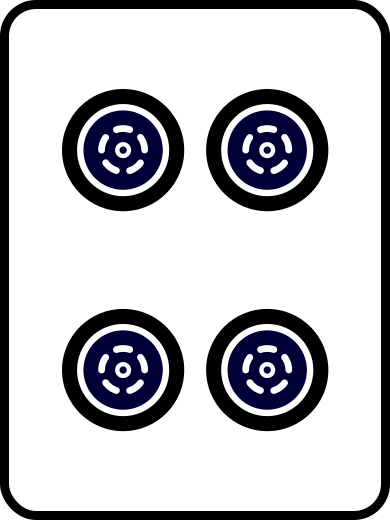
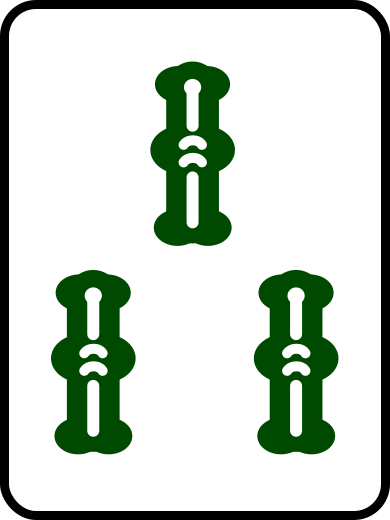

Cut the 1s and wait on the 8p you just drew, or cut the 8p and wait on the 1s. Standard theory picks by what you can see: how many copies are left, how likely an opponent holds the tile, how safe it is for you to sit on it. When those come out even, Maru-Jan's tiebreaker is the tile that arrived last.
The third claim is the one its staff talk about most. One developer who learned on hand-built walls says the automatic table made them watch the table more, because the tiles clump and a comes up often. They change the order they cut from and shift toward waits that look like they're still in the wall. Another says the worst feeling is a from the same wall. You cut a tile that's plainly useless and think "if I throw this, I'm drawing it again." Then you do.
The 2 mm fix in the AMOS REXX III
Taiyo Giken tried the obvious fix first. Ohno told ABEMA they randomized the stacking order in software and the mixing problem didn't go away. A bigger drum would have helped, and the table had no room for one. The answer came from a different complaint. President Ito wanted dealt tiles to come up the right way round, because characters and honors are hard to read upside down.
The solution was to move the magnet already embedded in every tile about 2 mm up from center and put a checkpoint on the stacking path. A tile that arrives the right way up passes. An upside-down tile gets kicked back to the middle of the drum. At 3 mm, Ito says, you'd feel the difference in your hand. The side effect is the point: a tile that fell in first no longer stacks first if it's upside down. One engineer, Furuta, calls it mixing in 3D. The idea took about two years, and the REXX III was announced on October 19, 2020.
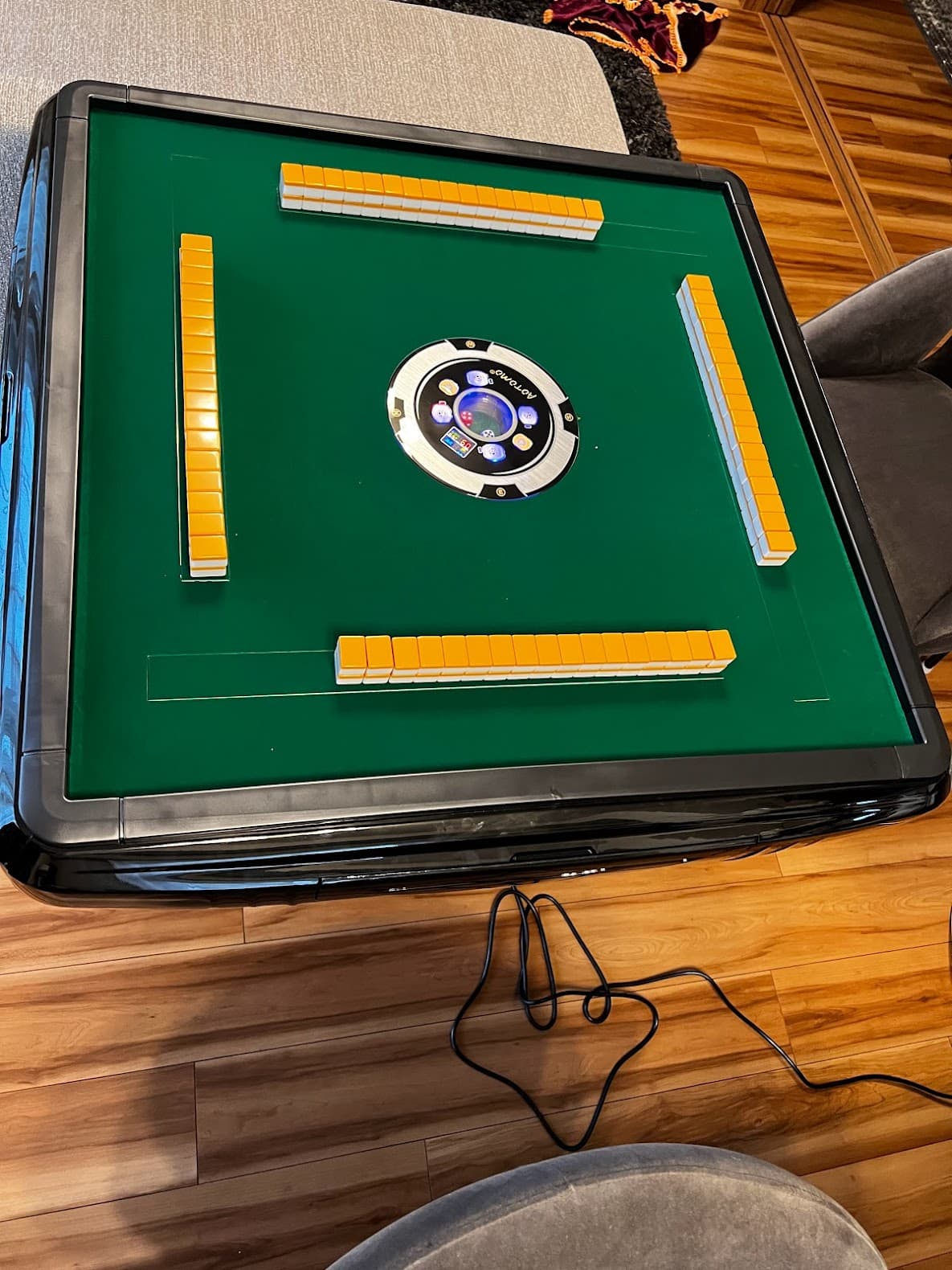
So the newest parlor machine has a fix its maker stands behind. Older parlor tables and the home models, like the Aotomo I play on, are a different question, and the answer sits in each maker's spec sheet, not in this post.
What to change at a physical table
Three adjustments, all labeled as what Maru-Jan's staff say works, none of them proven.
- Chiitoitsu tanki. Between two single waits that are even on safety and visible copies, keep the tile you drew last, and only if it's fresh.
- The dora indicator. When your choice of wait is otherwise a coin flip, don't wait on the indicator tile. Maru-Jan says its twins tend to sit in the .
- Two hands after a fest. If the last hand but one was all calls, expect pairs. Value a or chiitoitsu shape one notch higher, and lean toward waits that look live from the discards.
The rule that sits above all three: a tiebreaker breaks ties. It never takes a worse shape over a better one, and it never moves your push or fold line against a . The math from the logs doesn't know which table you're sitting at.
And start a tally. Every chiitoitsu tanki you pick at your regular table, note which tile you chose, whether it was the one you drew last, and whether it won. Neither source gives that count. After a season you'll have one for your own machine.
This is mechanics, not nagare
Maru-Jan says it plainly on the same page: the stacking is random in principle, and the bias can't be aimed at one player. A pattern in where tiles land is set before the hand begins. It doesn't know who's winning. The page goes on: mahjong is a four-player game, so 25% tops is what the odds hand you, strong players take 1st about 30%, and over thousands of games it suspects everyone drifts toward 25%. That 30% matches the top-player rate behind the losing streak math.
Online, none of this applies. Tenhou and Mahjong Soul deal from a random number generator, so the tile you cut has no twin waiting by design. The one online table where it does apply is Maru-Jan, because it chose to copy the machine.
Where the advice breaks is in the size of the effect. Neither source measures it, and I can't point you to anyone who has. Maru-Jan writes "sometimes" next to every claim. Taiyo Giken's own engineer calls the bias real and says its newest table fixed it. Every table you'll play on sits between those two statements, and the honest label for each is plausible, unmeasured. The bias also changes by machine. One Maru-Jan developer says whether a table stacks from one point or from two or more shifts the pattern a lot, so a habit tuned on one table can do nothing on the next.
A hand-built wall is no refuge. ABEMA points out why the machine exists: a skilled stacker can build a wall that deals them a hand one tile from a huge win. The machine traded a cheat for a bias, and the bias is the better deal.
Next time the 9p comes back, skip the flow. Write down the tanki you picked, and keep your push and fold lines where the numbers put them. If you're shopping for a table, read the automatic table buyer's guide before you read a spec sheet. And if your real-table habits need a second pair of eyes, book a coaching session and bring the tally.
Was this article helpful?