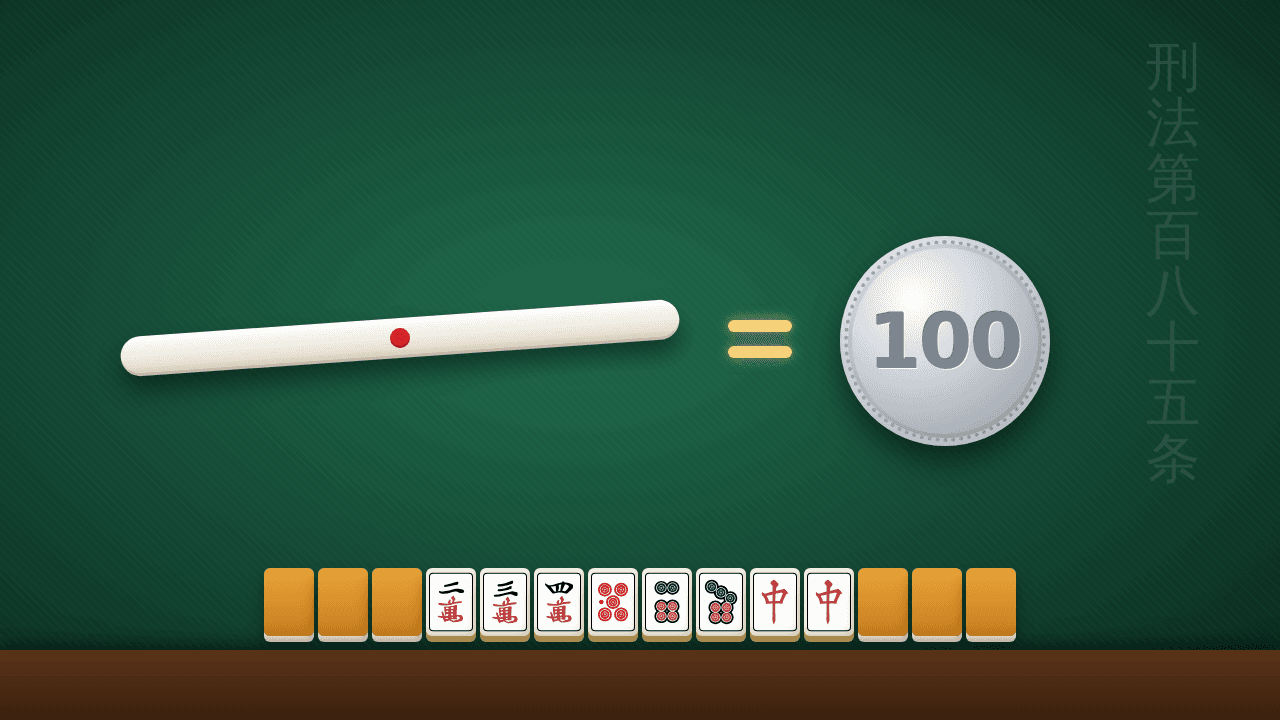
Playing mahjong for money is a crime in Japan, and the size of the stake doesn't change that. Article 185 of the Penal Code covers anyone who gambles. Its one exception, for stakes "provided for momentary entertainment," doesn't stretch to cash, and the Supreme Court said so in 1948 about a game played for small money.
Rate parlors exist anyway. In 2020 a senior Justice Ministry official told the Diet that ¥100 per 1,000 points, a top prosecutor's rate, was "not necessarily a high rate" by the standards of society. Ten months later a summary court fined that prosecutor ¥200,000. Both are true at once.
What the Penal Code says
Article 185 reads, in the current text on e-Gov: anyone who gambles is punished with a fine of up to ¥500,000 or a petty fine (賭博をした者は、五十万円以下の罰金又は科料に処する). Then the proviso: not if the stake was only something provided for momentary entertainment (ただし、一時の娯楽に供する物を賭けたにとどまるときは、この限りでない).
Article 186 is the heavier one, aimed at repeat players and at whoever runs the table. Gambling jōshū to shite, habitually (常習として), carries up to three years in prison. Opening a gambling place, or gathering gamblers, for profit carries three months to five years.
Why "momentary entertainment" doesn't cover cash
The exception is narrow. A Tokyo law firm's summary of the case law lists what courts have accepted: food, drink, cigarettes, and snacks used up on the spot. Money falls outside it. The firm cites a 1924 Great Court of Cassation ruling and a 1948 Supreme Court ruling, and notes that the amount doesn't matter.
The 1948 case is on the Supreme Court's own database. The defendant played cards for money and argued that the stakes were small. On October 7, 1948, the court answered that the players had contested the gain or loss of money on chance, so it can't be said the game was merely for momentary entertainment and no crime (單に一時の娯樂のためにしたもので罪となるべきものではないとはいえない). Small money is still money.
A lawyer asked by Bengo4.com in March 2020 said the same about parlor play: at any rate, it counts as gambling on paper. Whether anyone gets punished depends on the stakes, the frequency, and whether it's among friends. Free play among strangers, he added, looks more like gambling than a private set table. The crime is complete either way. Those factors only shape whether prosecutors act.
The stakes courts have let through under the proviso are things the players consume on the spot, like food and drink.
What the parlor license covers
A parlor is a legal business. The fūeihō, the Entertainment Business Act (風営法), lists "mahjong parlors" (まあじやん屋) by name in article 2(1)(4), next to pachinko, and article 3 requires a license for each shop from the prefectural public safety commission. The license comes with rules, and four matter to a customer.
- Hours. Article 13 bars licensed businesses from operating between midnight and 6 a.m. A prefectural ordinance can allow later hours in designated areas.
- Age. Article 22(1)(5) forbids letting anyone under 18 in as a customer, and article 18 requires a sign saying so at the entrance.
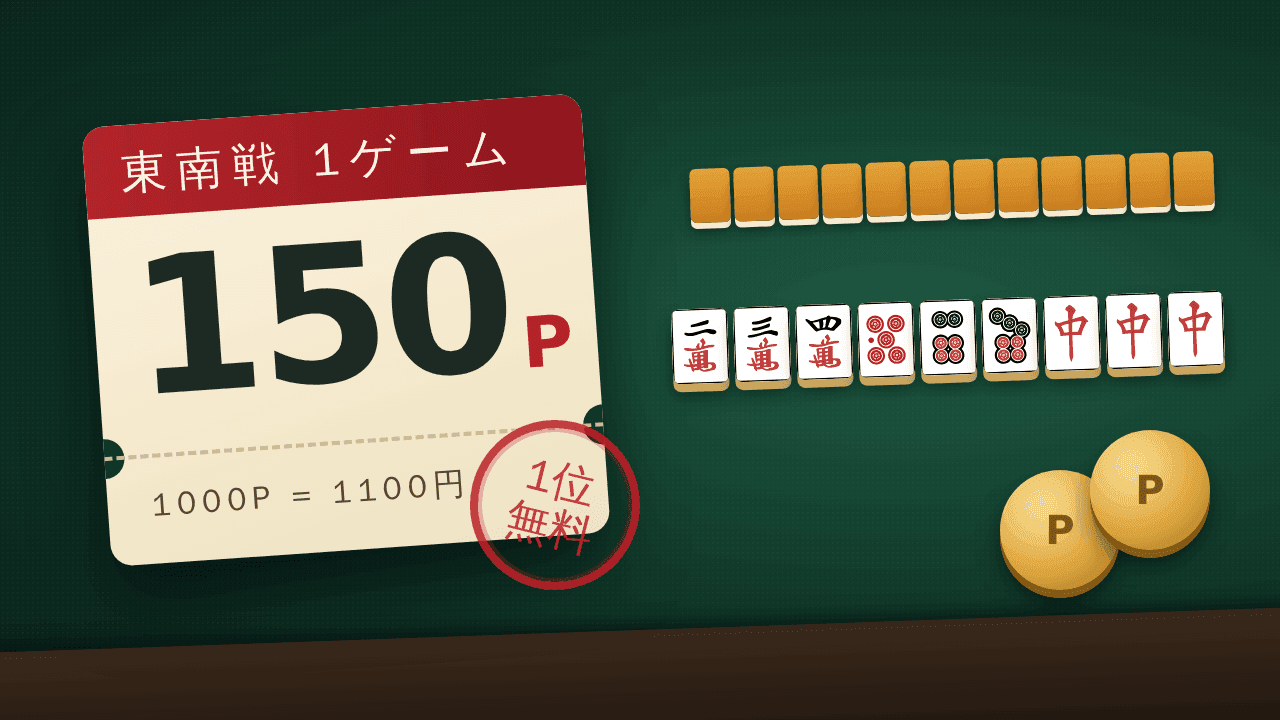
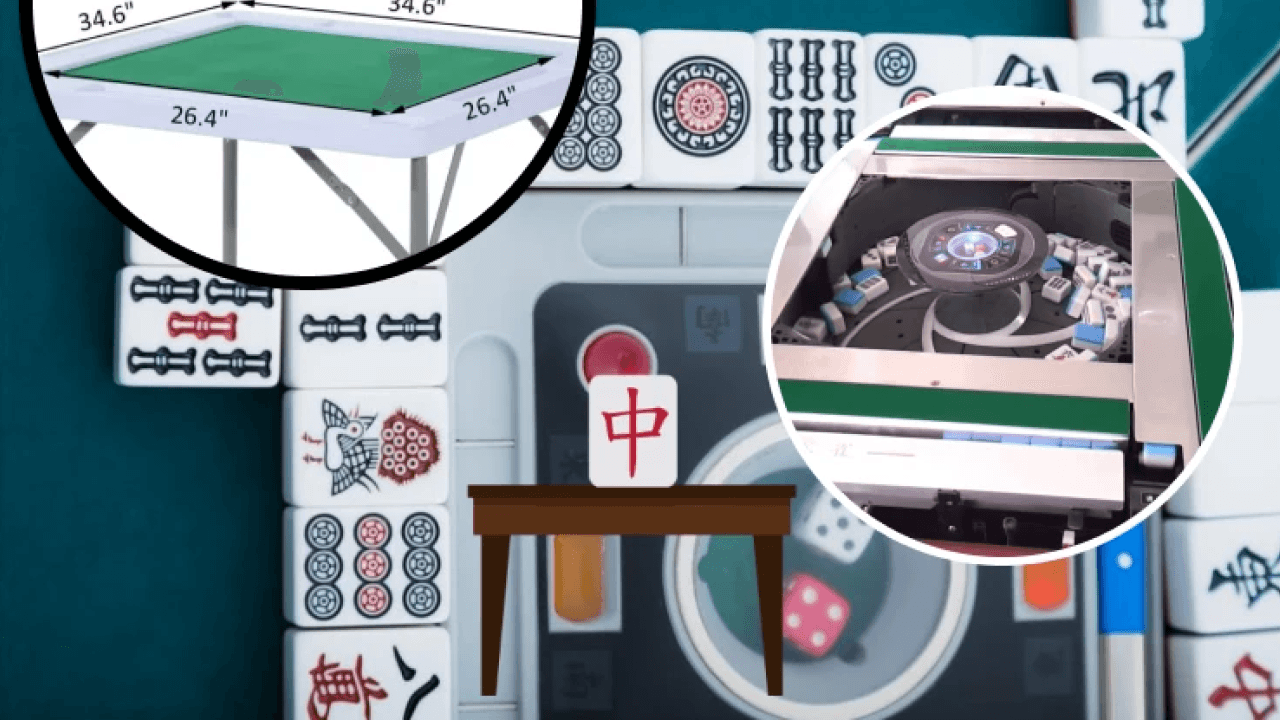
- Fees. Article 19 makes the shop follow national standards on fees. The enforcement rules, article 36, cap a mahjong parlor at ¥600 per customer per hour on an automatic table and ¥500 on a manual one, or ¥2,400 and ¥2,000 per table per hour, plus consumption tax.
- No prizes. Article 23(2) says a mahjong parlor may not hand out prizes based on the results of play.
That last rule is stricter than pachinko's. A pachinko hall may give prizes, as long as they aren't cash or securities and it doesn't buy them back (article 23(1)). A mahjong parlor may not reward the result at all. The license covers the tables and the fees. Nothing in it makes a bet legal.
The words for the rate
News about mahjong gambling cases gives the stake as a rate: the yen value of 1,000 points. The Bengo4.com piece above names three. Ten-go (テンゴ) is ¥50, ten-pin (テンピン) is ¥100, and ryanpin (リャンピン) is ¥200. Even at ten-go or ten-san (テンサン), the lawyer says, the crime is formally complete.
Betting at any of these rates is gambling under article 185, and so is betting less. Many no-rate shops state in writing that money can't change hands. If a shop won't say it's no-rate, ask, or leave.
The prosecutor's ¥100 game
Kurokawa Hiromu (黒川弘務) was head of the Tokyo High Public Prosecutors Office. In April and May 2020, during the COVID-19 state of emergency, he played mahjong four times at a Sankei Shimbun reporter's home, with that reporter, a second Sankei reporter, and a former Asahi Shimbun reporter, four players in all, according to Bunshun's reports from July 2020 and March 2021. The rate was ten-pin (テンピン), ¥100 per 1,000 points.
The Prosecutor-General, on the ministry's recommendation, gave him a kunkoku, an official reprimand (訓告) that isn't formal discipline, and he resigned that May. In the Diet on May 22, criminal affairs bureau chief Kawahara Takashi explained the decision: betting on mahjong is of course not permitted, but looking at the actual state of society, it was a rate that can't necessarily be called high (もちろんかけマージャンは許されるものではございませんが、社会の実情を見ましたところ必ずしも高額とまでは言えないレート).
Four days later Kawahara told the upper house that the ministry had confirmed two sessions, around May 1 and May 13, and that about ¥10,000 to ¥20,000 in cash had changed hands among the players at each. He added that Kurokawa had been playing for money once or twice a month for about three years. The day after that, pressed on which rates were acceptable, he said it was hard to say any rate was fine or any rate was not.
The criminal side ran on a separate track:
- July 10, 2020. Tokyo prosecutors found that gambling had taken place but suspended prosecution of Kurokawa and the three newspaper staff, citing that the gambling wasn't highly speculative and that they'd already suffered social sanctions (Bunshun).
- December 2020. The Tokyo No. 6 Prosecution Review Commission voted that Kurokawa's case warranted indictment, given that his post required him to restrain and deter illegal acts (Bunshun).
- March 18, 2021. Prosecutors filed a summary indictment for simple gambling (Bunshun).
- March 25, 2021. The Tokyo Summary Court ordered a ¥200,000 fine (Bengo4.com).
A summary order comes from a summary court on the prosecutor's request, before any public trial, and can impose only a fine of up to ¥1 million or a petty fine. Once final, it has the same effect as a final judgment (Code of Criminal Procedure, articles 461 and 470). It's still a criminal penalty, for playing at the rate the ministry had called "not necessarily high."
Online doesn't change the law
Online play for money runs into the same articles. In February 2024 Kyoto police arrested seven people running Mahjong (DORA麻雀), an online mahjong site that played for money, on suspicion of running a gambling place for profit. In March six customers were reported sent to prosecutors for habitual gambling, according to Bunshun's account by a writer who had played on the site himself. Maru-Jan, which sells points for real yen, publishes a lawyer's opinion on whether its points fall inside the proviso. The Maru-Jan guide covers it.
Play no-rate
I worked as parlor staff before I turned pro. My advice is short: play no-rate. The law above is why. How to play mahjong in Osaka lists no-rate venues and the phrase to ask at the counter.
If you want the competition without the stake, the WWYD problems train the same decisions with nothing riding on them.
Was this article helpful?