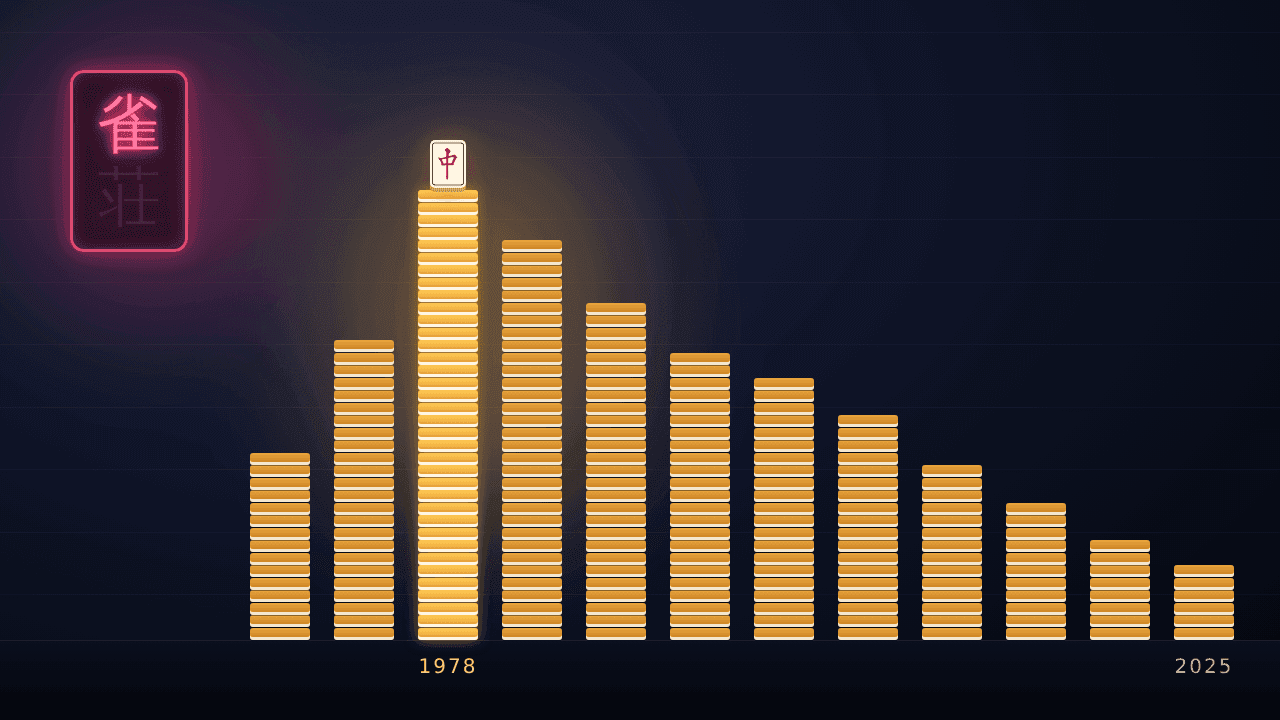
Japan had 36,173 licensed mahjong parlors at the end of 1978. At the end of 2025 it had 6,351. That's 29,822 shops gone, 82% of the peak, and the count fell every year in between: 47 declines in a row.
The numbers come from the police. A mahjong parlor, or (雀荘), needs a license from the prefectural public safety commission, and the National Police Agency publishes the national count once a year. Its latest report, dated April 2026, puts the end-of-2025 figure at 6,351, down from 6,513 a year earlier. The older years sit in the agency's white papers, five years to a table. The table below links every one back to 1968.
What the police are counting
The license comes from the fūeihō, the Entertainment Business Act (風営法). Article 2(1)(4) names the business outright, "mahjong parlors, pachinko parlors" (まあじやん屋、ぱちんこ屋), along with other premises where customers play games that may stir shakōshin, a gambling spirit (射幸心). Article 3 makes the license per premises. So the count is premises holding a mahjong license at year end. It says nothing about tables, players, or how busy a shop is.
The law has been rewritten since the series starts. The 1976 white paper still uses the older name, the Fūzoku Eigyō-tō Torishimari-hō, or Entertainment Business Control Act (風俗営業等取締法), and the 1991 white paper dates the current act from 1985. Through every rewrite, mahjong parlors kept their own line in the table, so the series runs unbroken for 58 years. What the law means for a player is the subject of whether betting on mahjong is legal in Japan.
The climb to 1978
In 1968 Japan had 14,722 mahjong parlors. Four years later it had 22,690, and the 1973 white paper counted the tables as well: 135,311 in 1970 and 181,087 in 1972, close to eight per shop. The police set the parlor count beside the pachinko count and read both the same way: "pachinko's popularity settling in, mahjong's still rising" (パチンコに対する人気の定着とマージャンに対する人気の上昇). They saw in it the public's response to "games with a strong gambling element" (ギャンブル性の高い遊技).
The biggest single-year jump came in 1975: a net 3,854 more parlors, up 14.5%. Growth slowed to 1,684 in 1977 and 1,220 in 1978. Then it stopped. The 1980 white paper put it in one line: mahjong parlors, "rising since 1962" (37年以来増加を続けていた), had hit their ceiling. The 1979 count was 35,907, down 266.
How the slide ran
The decline came in three speeds.
- 1979 to 1991: fast after a slow start. Two small drops, then the count lost more than 1,000 a year in six years and fell from 36,173 to 23,719.
- 1992 to 2000: slow. Annual drops stayed between 1.4% and 2.4%, and the count only fell below 21,000 in 1998.
- 2001 to 2024: fast again. Drops of 3 to 7% a year. The biggest in number was 991 in 2005. The steepest in percent was 2015, down 750 (7.2%). The count passed under 10,000 that year.
The last few years are the slowest since 2000. The 2025 drop of 162 is the smallest of the whole 47-year decline, and at 2.5% the smallest in percent since 2000. One year doesn't make a floor.
Pachinko went the other way. In 1978 there were 10,418 pachinko halls against 36,173 mahjong parlors, 3.5 to 1. The 1985 white paper notes pachinko halls growing every year from 1981. By the end of 2011 the pachinko and pachislot halls numbered 12,323 against 12,054 mahjong parlors. The police tables have counted the two together since the 2001 figure. Pachinko is shrinking faster now: its halls fell from 8,458 to 6,464 between 2021 and 2025, while mahjong went from 7,312 to 6,351.
Selected years since 1968
Each row traces to a police table. Where two editions overlap, they agree on the shared years. The full series, with the source for each stretch of years, is at the end of this post. The 1971 figure excludes Okinawa, which returned to Japan in May 1972. For 1972 to 1974 the 1976 white paper lists Okinawa separately (37, 40, and 51 parlors); the figures here add them in, which matches the 1973 edition's 1972 total.
| Year | Parlors | Change |
|---|---|---|
| 1968 | 14,722 | |
| 1972 | 22,690 | +2,523 |
| 1975 | 30,392 | +3,854 |
| 1978 | 36,173 | +1,220 |
| 1979 | 35,907 | -266 |
| 1985 | 29,445 | -715 |
| 1991 | 23,719 | -940 |
| 2000 | 20,098 | -359 |
| 2005 | 16,030 | -991 |
| 2011 | 12,054 | -633 |
| 2015 | 9,626 | -750 |
| 2020 | 7,597 | -315 |
| 2024 | 6,513 | -221 |
| 2025 | 6,351 | -162 |
Players per parlor, 1982 and 2019
The other long series is a survey. The Rejā Hakusho, or Leisure White Paper (レジャー白書), has asked about mahjong every year since 1982, according to a note.com analysis of the survey. That first year is its high point: 21.4 million players, per the 1983 edition as quoted by the parlor directory Jan Navi. The same page lists 5.1 million for 2019. In 2020 the figure fell to about 4 million.
Now divide. In 1982, 21.4 million players over 33,124 parlors is 646 players per parlor. In 2019, 5.1 million over 7,912 is 645. A police license register and a consumer survey, 37 years apart, give almost the same answer. On those two endpoints, players and parlors fell by almost the same factor, about 4.2.
Read the survey loosely, though. It moves in jumps a register never makes: the same table shows 6.5 million for 2013, 8.7 million for 2014, and 6.0 million for 2015. Divide those by the parlor counts and you get anywhere from about 600 to 840 players a parlor. Don't hang a single year on it.
What the license count leaves out
I worked as floor staff in an Osaka parlor, what the trade calls a (メンバー). On the floor, the number that matters is open seats. A free table needs four players at once, and when there aren't four, staff sit down to fill the chair. Inside a Japanese mahjong parlor covers how that works and how the game fee keeps the lights on.
The register also doesn't say which shops play for money and which play no-rate. The parlor guide quotes one directory listing 129 no-rate parlors nationwide.
Some mahjong never touches a parlor. You can play online on Maru-Jan, Tenhou, or Mahjong Soul, and a 2022 research note from Ricoh's think tank estimated about 2.5 million people who watch mahjong without playing it, from an M.League survey.
Every year since 1968
The licensed count at the end of each year, with no gaps.
| Year | Parlors | Change |
|---|---|---|
| 1968 | 14,722 | |
| 1969 | 16,322 | +1,600 |
| 1970 | 17,630 | +1,308 |
| 1971 | 20,167 | +2,537 |
| 1972 | 22,690 | +2,523 |
| 1973 | 23,927 | +1,237 |
| 1974 | 26,538 | +2,611 |
| 1975 | 30,392 | +3,854 |
| 1976 | 33,269 | +2,877 |
| 1977 | 34,953 | +1,684 |
| 1978 | 36,173 | +1,220 |
| 1979 | 35,907 | -266 |
| 1980 | 35,711 | -196 |
| 1981 | 34,669 | -1,042 |
| 1982 | 33,124 | -1,545 |
| 1983 | 31,547 | -1,577 |
| 1984 | 30,160 | -1,387 |
| 1985 | 29,445 | -715 |
| 1986 | 28,599 | -846 |
| 1987 | 27,809 | -790 |
| 1988 | 26,543 | -1,266 |
| 1989 | 25,768 | -775 |
| 1990 | 24,659 | -1,109 |
| 1991 | 23,719 | -940 |
| 1992 | 23,162 | -557 |
| 1993 | 22,828 | -334 |
| 1994 | 22,449 | -379 |
| 1995 | 21,953 | -496 |
| 1996 | 21,523 | -430 |
| 1997 | 21,160 | -363 |
| 1998 | 20,788 | -372 |
| 1999 | 20,457 | -331 |
| 2000 | 20,098 | -359 |
| 2001 | 19,487 | -611 |
| 2002 | 18,584 | -903 |
| 2003 | 17,850 | -734 |
| 2004 | 17,021 | -829 |
| 2005 | 16,030 | -991 |
| 2006 | 15,247 | -783 |
| 2007 | 14,555 | -692 |
| 2008 | 13,920 | -635 |
| 2009 | 13,343 | -577 |
| 2010 | 12,687 | -656 |
| 2011 | 12,054 | -633 |
| 2012 | 11,450 | -604 |
| 2013 | 10,882 | -568 |
| 2014 | 10,376 | -506 |
| 2015 | 9,626 | -750 |
| 2016 | 9,176 | -450 |
| 2017 | 8,736 | -440 |
| 2018 | 8,276 | -460 |
| 2019 | 7,912 | -364 |
| 2020 | 7,597 | -315 |
| 2021 | 7,312 | -285 |
| 2022 | 7,061 | -251 |
| 2023 | 6,734 | -327 |
| 2024 | 6,513 | -221 |
| 2025 | 6,351 | -162 |
Sources. 1968-72: 1973 white paper; 1972-74: 1976 white paper; 1975-79: 1980 white paper; 1980-84: 1985 white paper; 1985-87: 1988 white paper; 1988-90: 1991 white paper; 1991-95: 1996 white paper; 1996-2000: 2001 white paper; 2001-05: 2006 white paper; 2006-10: 2011 white paper; 2011-12: 2013 white paper; 2013-17: 2018 white paper; 2018: 2019 white paper; 2019-20: NPA report for 2021; 2021-25: NPA report for 2025.
Sit down at one of the 6,351
If you're coming to Japan, the shops are still there, and the best ones for a visitor are the no-rate kind. How to play mahjong in Osaka lists the no-rate shops by area, with what to say at the door.
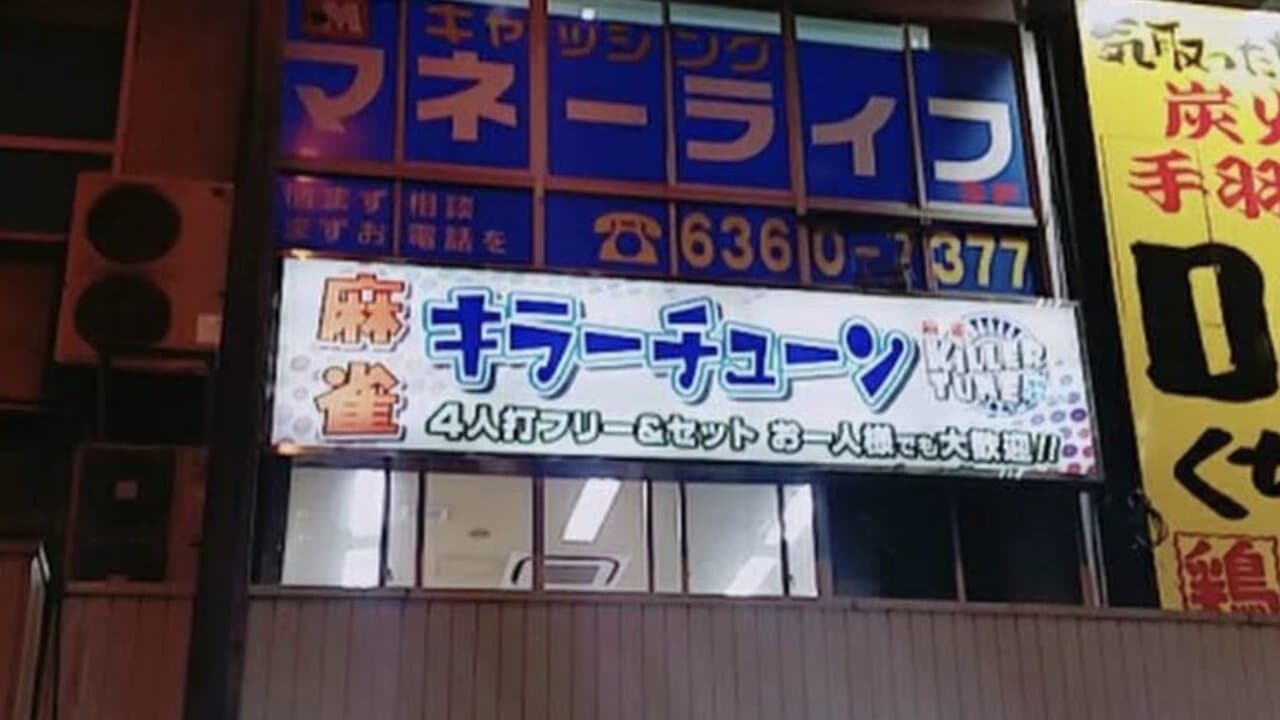
Coming with a friend or two? Book a no-rate parlor visit in Osaka and I'll play at your table. Until your trip, send me a game log and I'll review it.
Was this article helpful?