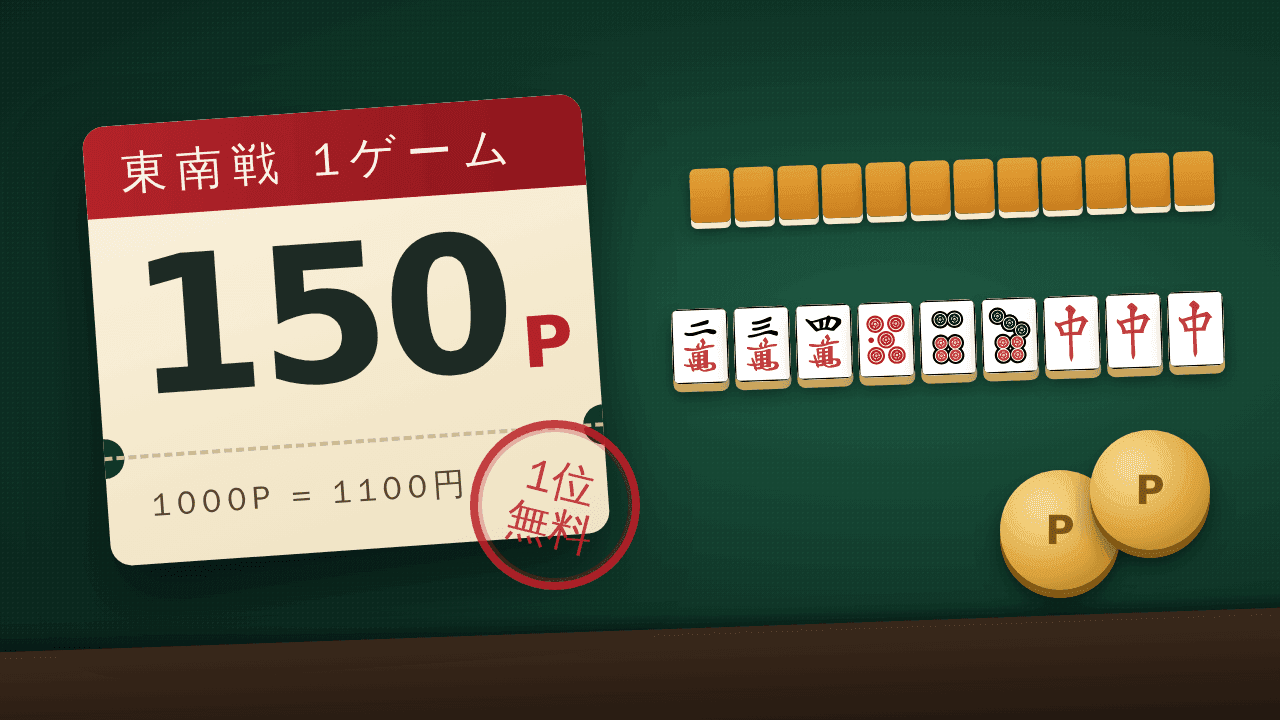
Would you pay for every single you play? On Maru-Jan, you do. Tenhou sells a month of its rooms. Mahjong Soul sells characters. Maru-Jan sells you the game itself: 150 points, about 165 yen at the standard pack price. Take 1st and the next one is free. The game company SignalTalk launched it in April 2004.
The site and the payment page are Japanese only, which is probably why you've never heard of it. I read the Japanese so you don't have to. Everything below comes from the official site, which I checked on October 23, 2026, unless a link says otherwise.
What a game costs
The fee page lists the price per game in points, then the price of the points.
| Table | Points per game | Yen per game |
|---|---|---|
| East-only () | 80 | 88 |
| East-South (hanchan) | 150 | 165 |
| Three-player () | 100 | 110 |
| Ten'i-taku and Senbatsu-taku (天位卓, 選抜卓), pro league tables | 200 | 220 |
| Jun'i-taku (順位卓), placement table | 250 | 275 |
The official site sells 1,000 points for 1,100 yen and scales up to 10,000 points plus a 2,000-point bonus for 11,000 yen. At the big pack a hanchan drops to 137.5 yen. Whatever you do, don't buy points in the app. It's the most expensive way in. The smallest pack there is 360 points for 480 yen, so a hanchan costs you 200 yen.
The official site takes credit cards, Amazon Pay, Google Pay, au PAY, and prepaid cards sold at FamilyMart, Lawson, and Ministop. You can play on PC, Mac, iOS, Android, Amazon Fire TV, and Android TV.
And now the weird part. On the normal tables, whoever finishes 1st plays the next game for free. If they stop instead, they get the fee back. Maru-Jan's realism page sells this as tension. You pay to sit down, and 1st makes it free.
So what does a game really cost you? No need to take out your calculator. If you take 1st 25% of the time, a quarter of your games are free, and you pay 150 × 0.75 = 112.5 points per hanchan on average. Maru-Jan's own mixing-rate page says strong players take 1st about 30% of the time. At 30% it's 150 × 0.70 = 105 points. The better you play, the less you pay to play.
Now compare that with Tenhou. There, 660 to 1,000 yen buys an ID 30 days of the paid tier, as the where-to-play guide lists. At 165 yen a hanchan, the same money buys 4 to 6 Maru-Jan games. Even at a 30% 1st rate a hanchan still costs about 115 yen, so nine games run about 1,040 yen. That's more than a whole month at Tenhou's top price.
The table where you bet the points
The Royal Battle table, added in September 2016, plays for points on top of the fee. On the ×20 table, the Royal page says every 100 points of score moves 2 Maru-Jan points. Everyone starts on 25,000 and is scored against 30,000, with for placement and for the top. So a top on 50,000 earns 1,200 points, not just the 400 its 20,000-point gain is worth. A 3rd on 20,000 loses 400, not 200. The page doesn't print the split. You deposit the maximum loss before you sit down, 1,000 points plus the 150 fee, and the winner gets no fee refund.
Anyone who has worked in a Japanese parlor, like I have, gets careful when the word "bet" comes up. Points cost yen, so Maru-Jan asked a lawyer whether this counts as gambling. Japan's Penal Code article 185 makes gambling a crime, with one exception. It doesn't apply when the stake is only something offered for momentary entertainment.
The legality page quotes the law firm GVA (GVA法律事務所), answering a query dated April 28, 2016. The firm gives three reasons. The points work only inside Maru-Jan. They can't be swapped for anything cashable. And if the service closes, they won't, as a rule, be refunded in cash. It also points to arcade medal games, which run openly under licence. Even then, the lawyer won't go past one word. The Royal table is "likely" to fall under the exception. On the same page, Maru-Jan adds its own promise. Points can never be cashed out.
A hash on a biased wall
On December 18, 2025, Maru-Jan added a proof that it doesn't touch the tiles. The page opens with the complaints it has heard for years. My favorite is one you'd only hear about a paid game. If you spend less, are you more likely to grab someone's winning tile on ? (Japanese players say you "grab" a tile when you draw the one that deals in.)
The answer is a hash. During a hand, click the table name and the client shows a hash of that hand's wall data, a new one every hand. The wall data is the wall written out as tile codes like 1m2m3m, in order from where the deal starts. You copy the hash. After the game, the replay shows the wall itself. Run that string through any online hash tool, read the SHA-1 result, and if it matches, the wall didn't change during play.
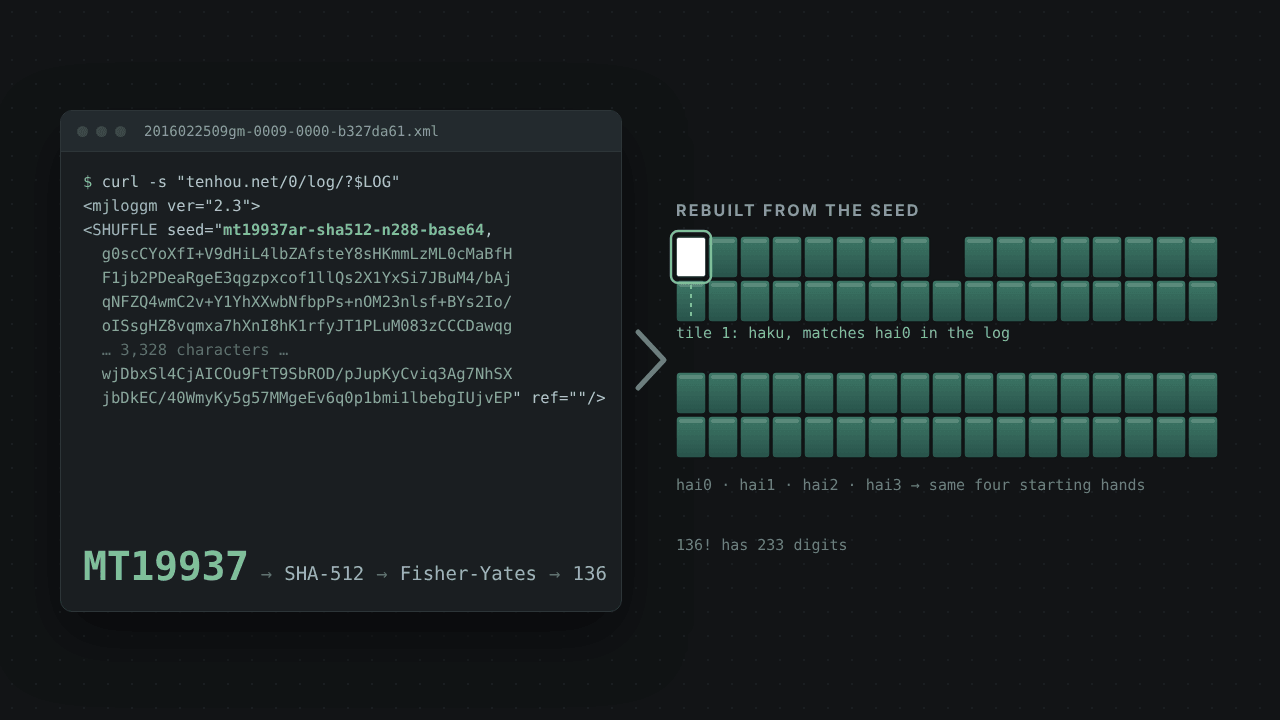
PC Watch's write-up points out the catch. The hash proves nobody edited the wall after the deal. It tells you nothing about how the wall was built in the first place. Tenhou covers both halves. It publishes its shuffle code, so you can rebuild a wall from the seed in your own log, and it posts hashes of its seeds before the games are played. The Tenhou wall post walks you through it.
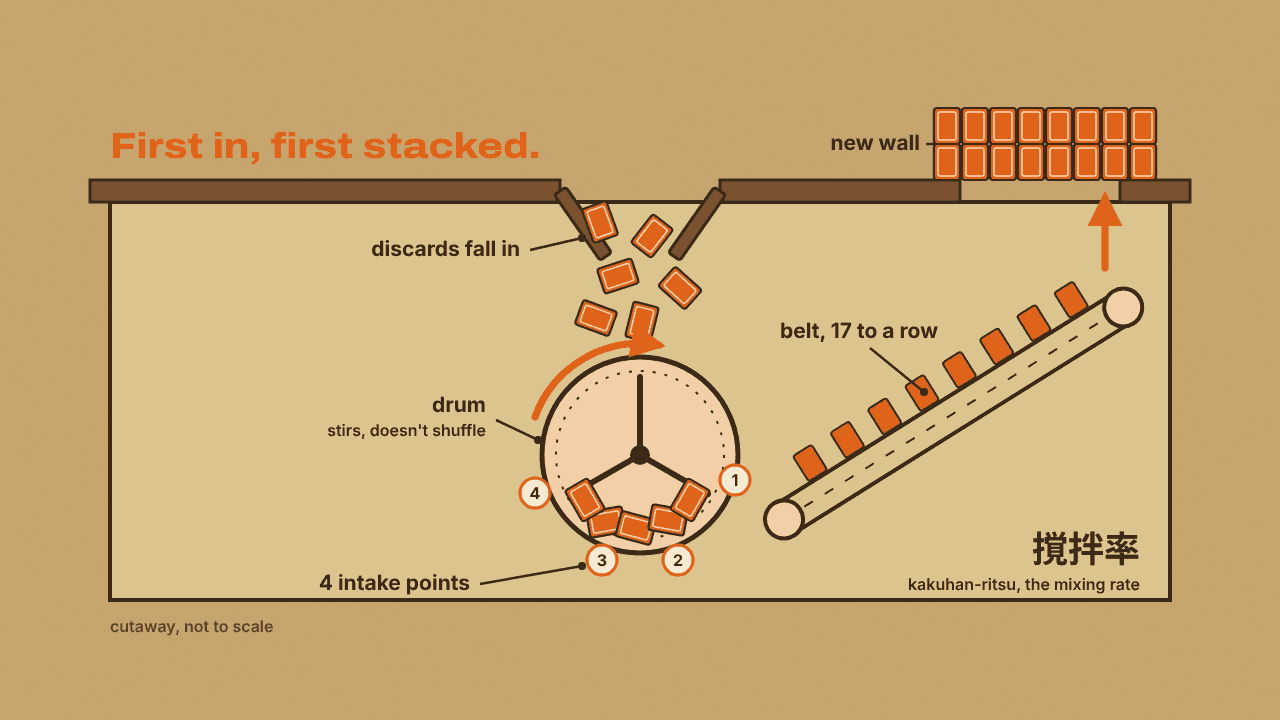
Funny thing is, Maru-Jan doesn't even want a perfectly random wall. Its server shuffles two tile sets, like a real automatic table, so each new wall leans slightly on the tiles from the hand before last. That's the mixing rate, copied on purpose. I own an automatic table myself, so I get wanting to copy one down to its quirks.
Which machine it copies depends on the page you read. The version history says the April 2006 Maru-Jan3 fully reproduced the AMOS SAVIOR, and the mixing-rate page still credits a tie-up with Taiyo Kagaku (大洋化学), the Taiyo group company behind AMOS. The reproduction page names Alban's NINJA instead, with tile and point-stick sounds recorded on a real one. So yes, the hash proves the wall didn't change during play. It's just that the wall was built to lean before anyone hashed it.
The pros on the menu
Three pro columns sit in the menu, and two are alive. Ide Yosuke's Todai-shiki Omoshiro Mahjong Juku (東大式おもしろ麻雀塾, a fun mahjong school, University of Tokyo style) posted its 33rd entry, wait puzzles for beginners, on August 26, 2026. Tsuchida Kosho's Fourteen Teachers (14人の師) is up to entry 71, posted October 9, 2026.
The third is Suda Yoshinori's Suzume Tatsumon (雀立つ門), and it's dead. Its latest entry is dated July 8, 2011. The pro stats pages for Suda and Ooi Takaharu froze around the same time. They still show each pro's fiscal 2010 record next to that year's average.
| Player | Win rate | rate | Call rate | 1st, East-only |
|---|---|---|---|---|
| Suda Yoshinori | 27.4% | 12.2% | 46.6% | 32.2% (550 games) |
| Ooi Takaharu | 27.7% | 13.5% | 38.0% | 31.6% (136 games) |
| Average player | 23.6% | 16.5% | 40.6% | 25.9% |
Both pros win about 4 points more often than the average player and deal in 3 to 4 points less. Look at Suda. He calls more than average, 46.6% against 40.6%, and still deals in less.
That 16.5% average deal-in rate is well above the 11.9 to 13.4% of Tenhou regulars in the loser's game post. Take the comparison with a grain of salt, though. Different rules, different crowd, and stats only travel well inside the ruleset they came from.
The pro league is sanctioned by the Saikouisen (最高位戦日本プロ麻雀協会). Careful with that name. It has my own organization's name inside it, the Japan Professional Mahjong Association (日本プロ麻雀協会, NPM), but the two are separate groups. Japanese pro mahjong names confuse even us. The league starts everyone in D2. League games cost 200 points, and taking part costs 50 more on top. Instead of a free next game, the refund grows with every place you climb.
The AI, the "4K" client, and four patents
The house AI, KIRIN, went live on July 18, 2023. An analysis of a four-player log costs 20 points and takes about a minute and a half. It shows your chance of winning the hand, the expected result of the hand and the hanchan, and a marker wherever your choice differed from its own.
The Maru-Jan for 4K client draws its table at 2048 × 1536, twice the 1024 × 768 of the regular version each way. The page admits that falls short of 4K's 3,840-pixel width. Points for honesty.
And then there are the patents. Maru-Jan's patent page lists four Japanese patents, granted between 2015 and 2020, on hand visibility, the tile display when you win, tile images on a call, and the display when you select a tile. Google Patents lists Kaya Takafumi (栢孝文) as inventor, and the owner as an individual rather than the company. Kaya is the president named in SignalTalk's 2008 press release. The first patent, JP5781876, shifts your hand back inside the table edge after you call and discard. Kaya wanted the screen to look like a real table badly enough to patent it.
Two last bits of trivia I couldn't leave out. 4Gamer reported in 2006 that the version after Maru-Jan3 was Maru-Jan5. Kaya told them 4 is an unlucky number, so they skipped it. (In Japanese, 4 can be read "shi", which sounds like death.) And in 2008 the Japan Anniversary Association recognized April 26, the launch date, as Online Mahjong Day, per the same press release. The date is a pun. The release reads it as "yonin de tsurumu" (4人でつるむ), four people hanging out together, with 2 and 6 standing in for "tsuru". It also offers "for tsumo" for closed-hand players and "suu fuuro" (four calls) for players who love to call. So the company that skipped 4 in its version numbers has a holiday that starts with one.
Should you play it?
If you read Japanese and miss the feel of a parlor's automatic table, try it. Maru-Jan copies one right down to the lean in its walls. Budget about 115 yen a hanchan, even if you take 1st 30% of the time. If you don't read Japanese, don't fight the payment page. Start with the free clients.
Read the rules page before you pay, because a few rules aren't Tenhou's. Maru-Jan rounds 4 han 30 fu and 3 han 60 fu up to mangan, the rule Tenhou doesn't use. Four declarations don't end the hand. You just keep playing. And an abortive draw always passes the deal, where Tenhou lets the .
The score calculator has a switch. Turn it on and enter 4 han 30 fu. The goes from 7,700 to 8,000, and the dealer's from 11,600 to 12,000. That's the hand Maru-Jan pays up on.

Was this article helpful?