South 2. You've dealt in twice, the from you has won three hands running, and your last three draws were the tile you'd cut the turn before. Someone says it out loud: the flow is with them tonight. In Japanese that's , , and most of the table nods.
Psychologists have a name for the same feeling. Thomas Gilovich, Robert Vallone, and Amos Tversky called it the hot hand in a 1985 paper on basketball shooters, and they found no trace of it in the data. The story took a turn in 2018. Both halves matter at a mahjong table, because one is about the tiles and the other is about you.
A casino in 1913 and a gym in 1985
The gambler's fallacy is the belief that a streak is due to end. On 18 August 1913, at the Monte Carlo casino, the roulette ball landed on black 26 times in a row. Gamblers lost millions of francs betting against black, because after ten blacks, then fifteen, then twenty, red felt overdue. The wheel didn't know.
The hot hand is the same mistake pointed the other way: a streak is expected to continue. Gilovich, Vallone, and Tversky tested it with basketball. They surveyed 100 fans at Cornell and Stanford, then checked the field goals of the Philadelphia 76ers across the 1980 to 1981 season, a set of free throws, and a controlled shooting experiment. In every data set, a shot's outcome was independent of the shots before it. Feeling hot predicted nothing. Their paper, "The Hot Hand in Basketball: On the Misperception of Random Sequences", became the textbook case of people seeing patterns in noise.
Then in 2018 Joshua Miller and Adam Sanjurjo showed in Econometrica that the test itself was biased. Flip a fair coin 100 times and look only at the flips that come right after three heads in a row. The share of heads on those flips is less than 50%, because of how the selection works. The 1985 team had measured their shooters against 50%. Correct for the bias and the three percentage points they'd dismissed in their Cornell shooting experiment become 11 points above a coin flip, about the gap between an average NBA three-point shooter and the best one. Some hot hand in shooting is real. Hold that thought, because for tiles it cuts the other way.
What nagare claims
Nagare says luck moves. A player who won last hand is riding it, so their next hand will come fast. A player who dealt in has lost it, so they should pull back and wait for it to return. A cheap win "breaks" an opponent's flow. A dealer on a long is hot and should be left alone. It's the hot hand and the gambler's fallacy at one table, applied to whichever player you happen to be watching.
In Japan the argument has camps. "Digital" players (デジタル) decide by probability and expected value. "Occult" players (オカルト) decide by flow, momentum, and reads the numbers don't cover. Plenty of strong players sit between the two, and I've written about where statistics stop and judgment starts. Reading an opponent is a skill. Reading the wall isn't, because the wall has nothing to read.
Tiles have no memory
Online, this is settled. Tenhou builds each wall from a seeded random number generator. It has published the algorithm, and from a game's seed anyone can rebuild every wall of that game, tile by tile. There is no flow in a seed. The  that dealt you in last hand goes back into the next shuffle as one of four identical tiles, and the generator has no idea which one hurt you.
A physical automatic table shuffles imperfectly, and that is mechanics, not luck: a machine's habit that doesn't care who's winning.
So the wall has no streaks. Your results still do, because random sequences clump. That part has numbers.
What streak math says about your bad night
Take a player who finishes 1st in 30% of , which is what top players manage. The chance of five games without a 1st is 16%. For scale, an on a wait is a 6% shot. The five-game drought is almost three times as likely as the thing you'd celebrate.
Fourth place works the same way. An intermediate player takes 4th about 20% of the time. Two in a row is about 4%. Three in a row is about 1%, which sounds rare until you count how many three-game stretches you play in a month.
Nothing in those figures needs a flow. A fair wall and a fixed skill level produce them on their own. The streak is real as a sequence of events. The explanation is what's false.
What is real: flow
Mihaly Csikszentmihalyi first described flow in 1975 and made the word famous with his 1990 book, Flow. The name came from his interviews. People described the state like water: "I was carried on by the flow." So the Japanese word for the thing that doesn't exist is the English word for the thing that does.
Flow is energized focus and complete absorption in what you're doing. Its parts read like a description of a good : intense concentration on the present moment, action and awareness merging, loss of self-consciousness, a sense of control, time going strange, and the activity rewarding in itself. It shows up when the goals are clear, the feedback is immediate, and the challenge matches your skill.
Mahjong hands you those conditions on a tray. The goal is , the feedback arrives every draw, and the table sets the challenge. When you're in it, you count the without trying, you remember the dealer's third discard, and you see the before you need it. When you're out of it, you cut a live honor into a because you stopped looking at the river two turns ago.
That's the honest split. The wall has no streaks. Your attention does. And attention is what a bad run attacks: two deal-ins, a flash of anger, and the next five discards get less thought than the first five did. The run makes you worse, the worse play extends the run, and from the inside the whole thing feels like a current. It is a current. It's inside your head.
The 2018 twist points the same way. Miller and Sanjurjo's shooters can have a hot hand because the shooter is the generator: the same arm, the same rhythm, a state that carries from one shot to the next. In mahjong the generator is the wall, and your part is the choice. The only thing at the table that can run hot is the person making the choices.
The one allowed response
When the thought arrives, "the flow is against me tonight", read it as a gauge of your concentration, not of the tiles. It's useful information about the wrong thing.
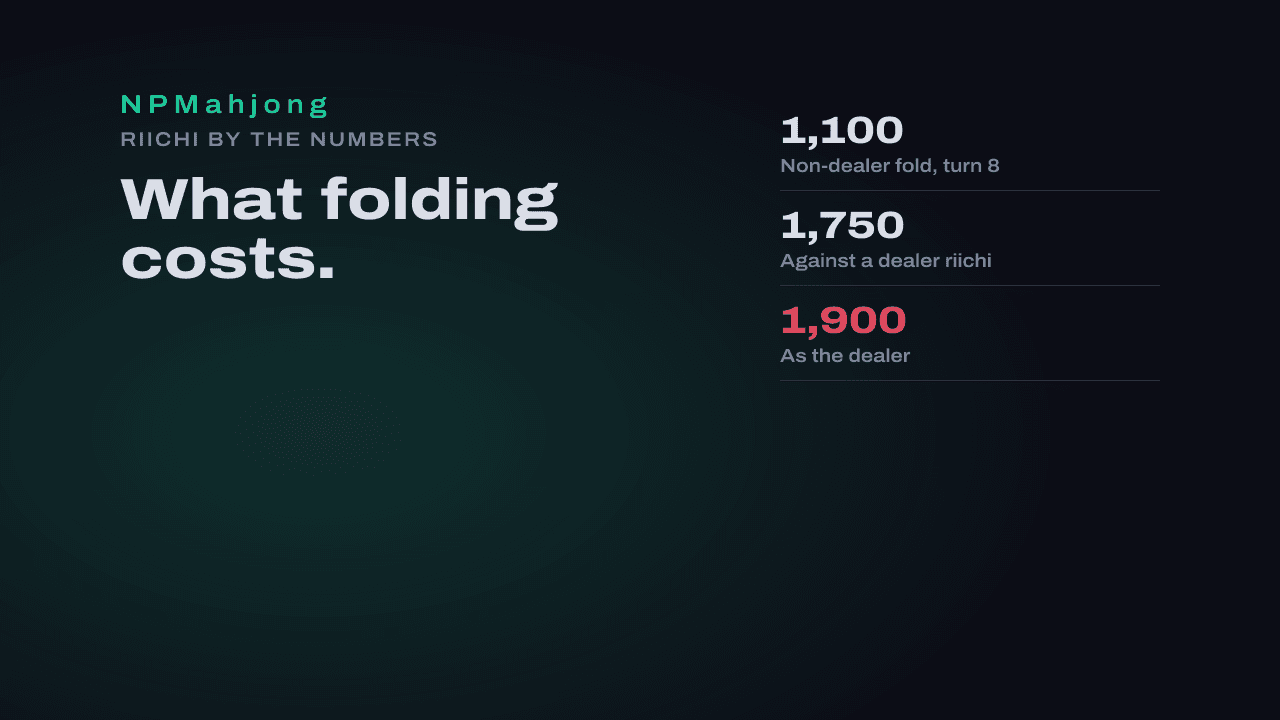
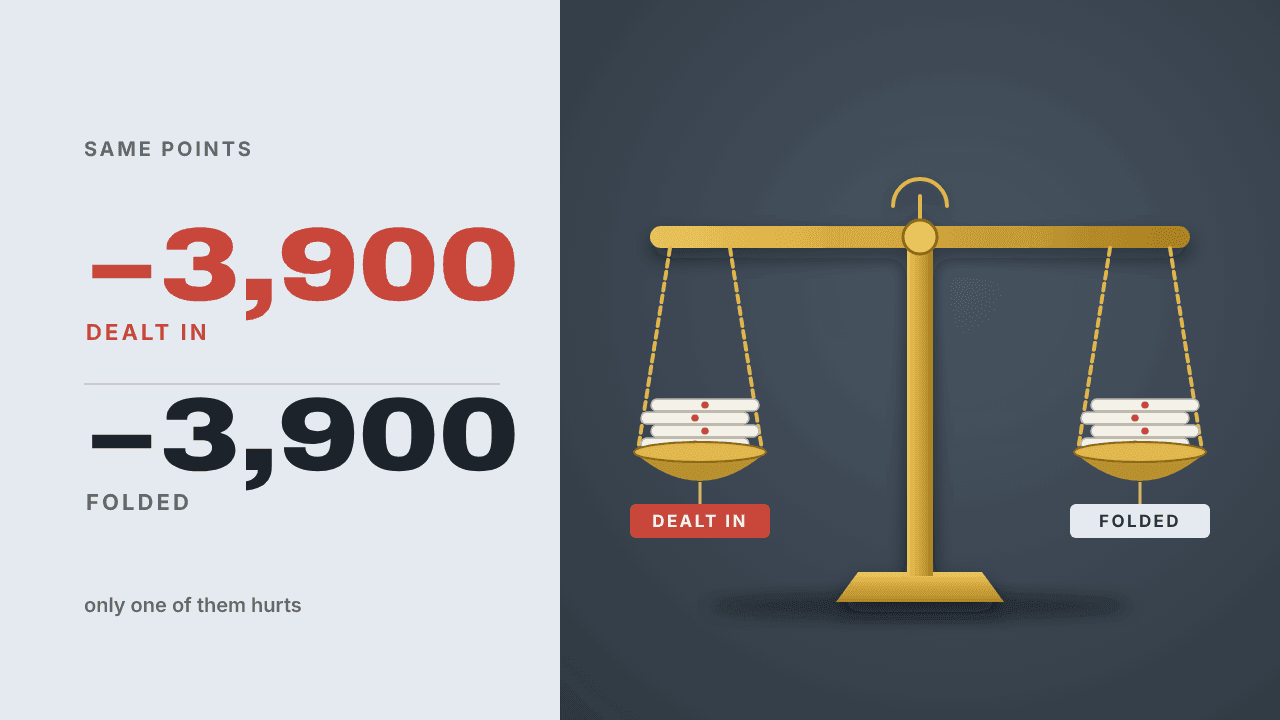
Here's the rule I use and teach. The feeling buys you one move: a short break. Finish the hand, stand up, drink some water, and come back after one hanchan online or after the game at a parlor. What it never buys you is a change of standards. A 2,000-point on a wait that you'd push in East 1 against a riichi is the same push in South 3 after two deal-ins. It still wins about half the time and deals in about a fifth, because the tiles didn't attend the first two hands. Folding it because "it's not my night" is the gambler's fallacy holding a safe tile.
Where the analogy breaks
The belief changes the table even though it's false. A player who thinks they're hot pushes more and calls more. A player who thinks they're cold folds hands they should play and clings to safe tiles. If the player across from you talks about flow, that's a tell about their next ten discards, and you should use it.
Flow isn't a lucky streak you can summon. It's a state you can protect: sleep, food, no phone between hands, no replay of the last while the next hand is being dealt. Protecting it is a habit. Expecting a good run because you've "earned" one is nagare in a lab coat.
And a real table isn't Tenhou. The shuffle is a machine, the players are tired, and two of them believe in luck more than you do. None of that puts memory in the tiles. All of it rewards the player who keeps counting after the others have started feeling.
Judge the decision, not the night
A clean fold that gets tsumo'd on was right. A reckless push that won was wrong. Grade every hand that way and a bad run loses its grip, because the result, the one thing the tiles control, drops out of your self-assessment.
Taking 1st 30% of the time is what winning looks like for a strong player, and 30% means plenty of nights that feel like the flow was somewhere else. It wasn't anywhere. Take the break, come back, and play the East 1 game in South 4.
If the streak is in your play rather than your head, your logs will show it. Send me the games and I'll mark the hands where the run moved your standards.
Was this article helpful?