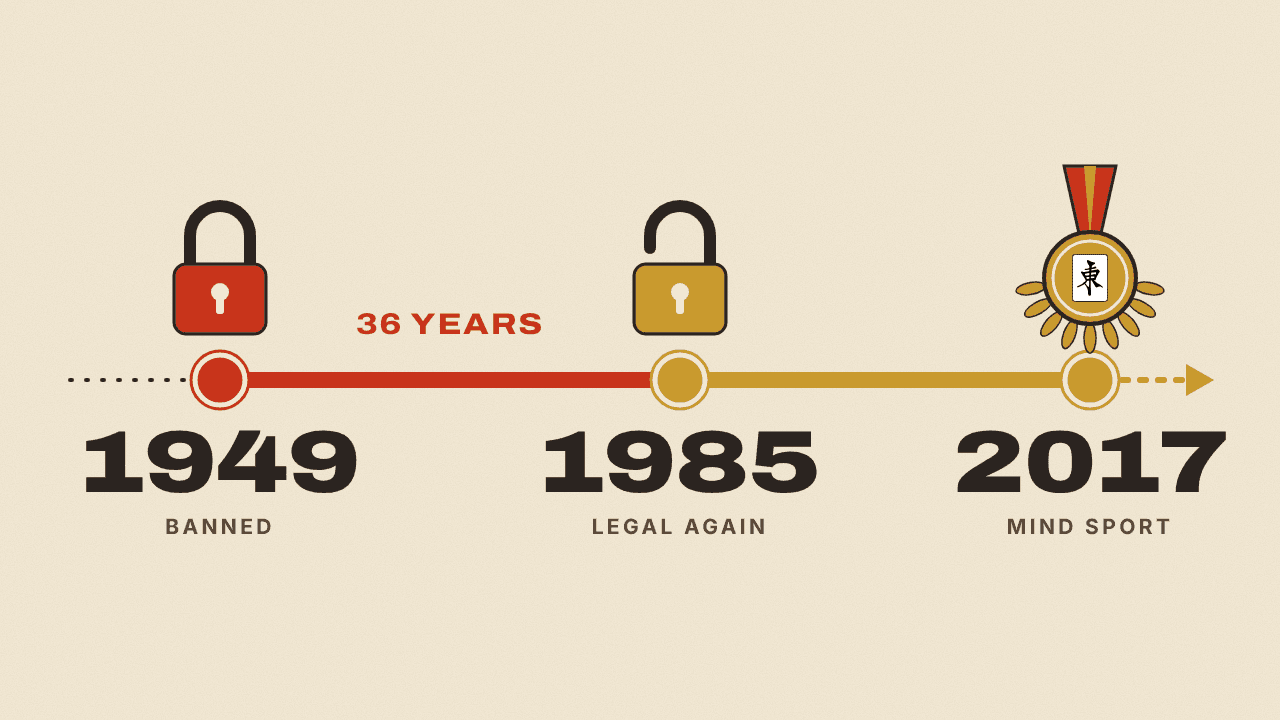
Mahjong was born in China and spent 36 years illegal there. The People's Republic banned gambling after its founding in 1949, and mahjong, treated as one more form of gambling, went down with it. It took a 1985 Bureau of Public Security document to make playing legal again.
Thirty years after that document, a federation registered in Lausanne was running its own world games and sitting beside chess and bridge at the International Mind Sports Association, whose chairman was asking the IOC for a demonstration slot at the Winter Olympics. Here are the dates, then the part that matters to a player: the format China built to take luck out of the game.
From a ban to a police memo: 1949 to 1985
Wikipedia's history of the game puts it in one line: "The ban on gambling after the founding of the People's Republic in 1949 led to a decline in playing." The game itself was then banned outright during the Cultural Revolution, 1966 to 1976.
The World of Chinese's "Tales of the Tile" (Sun Jiahui, 2019) adds that the ban came "together with other forms of gambling," Mao's own fondness for the game notwithstanding.
The turn came in 1985, when the Bureau of Public Security issued a document that drew the line the ban had blurred.
We should strictly forbid gambling, but not necessarily ban mahjong and cards.
Every step since, the rulebook, the federation, the Olympic bid, is an attempt to make the second half of that sentence true.
The 1998 rules: no gambling, no drinking, no smoking
In 1998 the China State Sports Commission published a competition rulebook, usually called Chinese Official rules or MCR, for Mahjong Competition Rules. It opened with three principles: no gambling, no drinking, no smoking. The point was a version of the game the state could call a sport.
The rules read like a designer's answer to the luck problem. The rulebook lists 81 scoring combinations, and a hand needs at least 8 points from them before it counts as a win. , in riichi, pays 88. Riichi's requirement does the same job. MCR sets the bar higher and lists 81 ways to clear it.
A federation in Lausanne and a seat beside chess
The Mahjong International League held its founding ceremony on 11 May 2015 at the Diaoyutai State Guest Hotel in Beijing and registered itself in Lausanne, Switzerland. Five months later it ran the first World Mahjong Sports Games in Sanya, Hainan, from 24 to 28 October 2015.
On 26 February 2016 IMSA accepted MIL as an observer. In April 2017 MIL became IMSA's sixth formal member, after bridge, chess, go, xiangqi, and draughts. MIL's stated purpose is to bring mahjong "into mind sports games or even the Olympic Games."
On 3 August 2017 Yicai Global reported that IMSA's chairman, Chen Zelan, was negotiating with the organizers of the Beijing 2022 Winter Olympics to add mahjong and other mind sports as indoor demonstration events, and that IMSA was applying to the IOC.
At home the 1985 line was still being drawn. In 2017 Wuhan became the first Chinese city to define "mahjong as leisure." Wuhan police ruled that relatives can play for any stakes, and that a game among fewer than 10 unrelated people with an average stake under 1,000 yuan isn't gambling. Everything else is, with fines up to 3,000 yuan and 10 to 15 days of detention. By 2019 parlors in Shenzhen and Jiangxi province were being ordered shut "in the name of public security." Same country, same game, two directions at once.
In Japan, "sport" was never the route. Pro here means membership of a private association you pay to belong to, with its own leagues and titles, and the state has nothing to do with it.

Duplicate mahjong: the same deal at every table
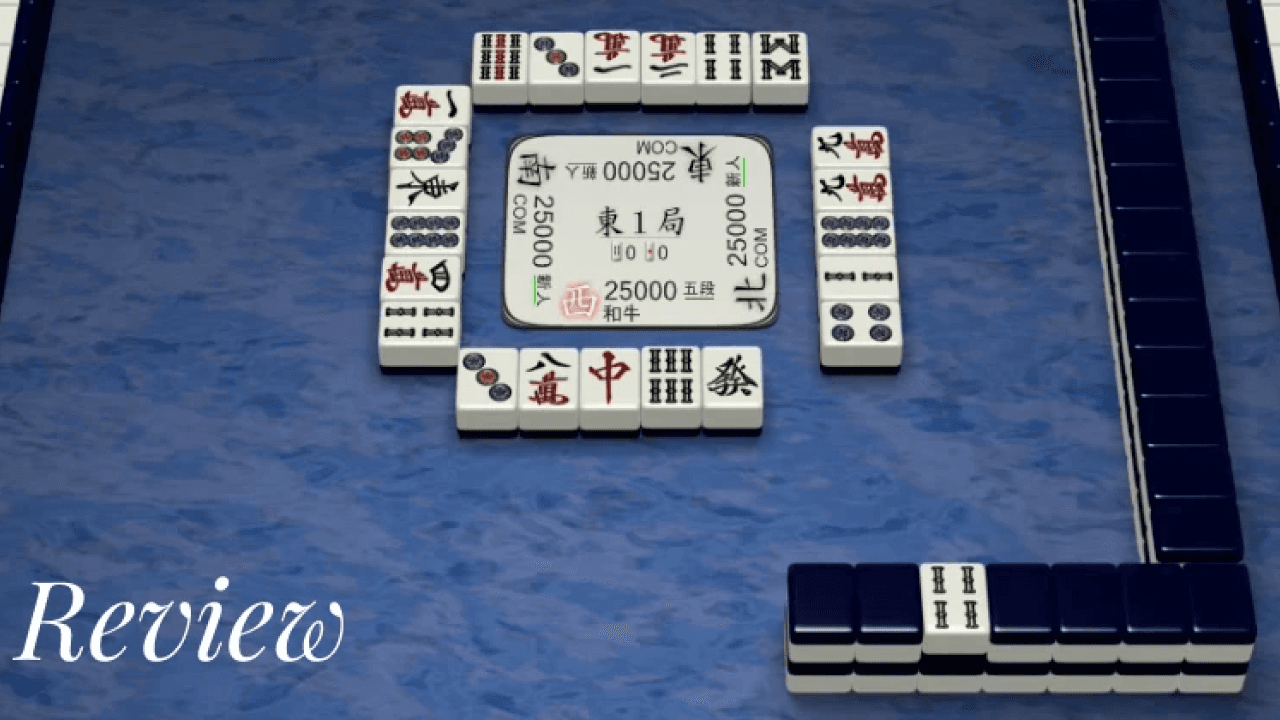
The most interesting thing MIL did isn't the Lausanne address. It's the format. MIL's duplicate rules print serial numbers on the backs of the tiles so that "starting hands for different players sitting in the same direction are completely the same." Nobody builds a wall or rolls dice. Staff lay out 34 tiles per player: 13 for the and 21 wall tiles in sequence. You draw only from the wall in front of you, so those 21 tiles are your draws for the hand, in order, whatever anyone calls. After the hand, staff restore every hand and wall for the next table.
Say the deal gives East this:
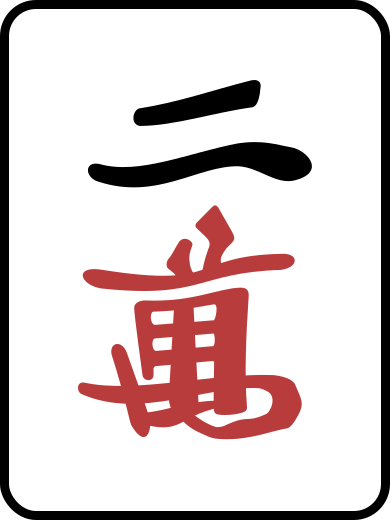
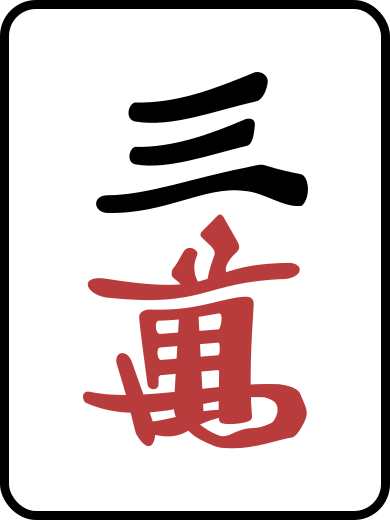
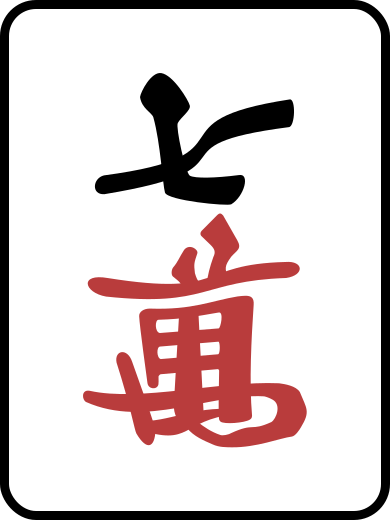
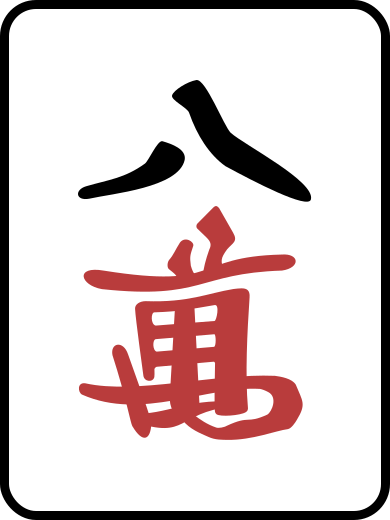
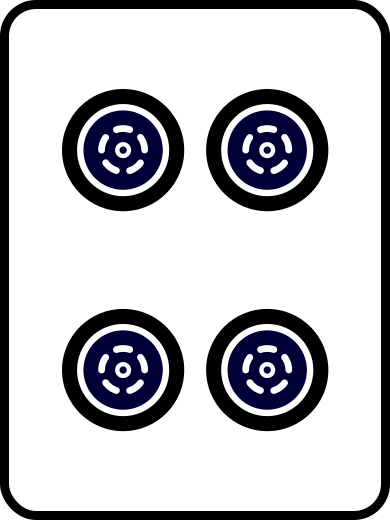
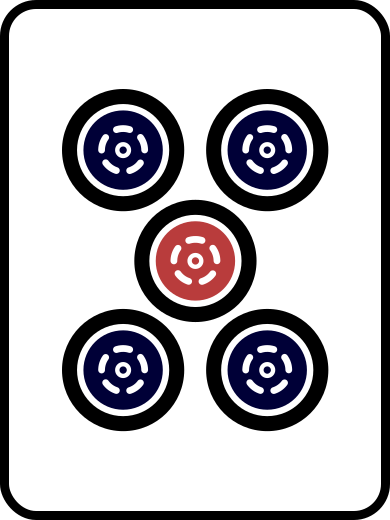
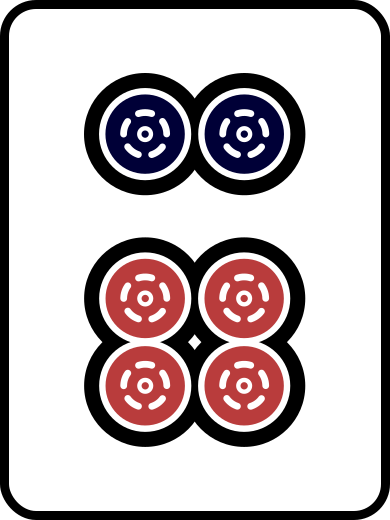
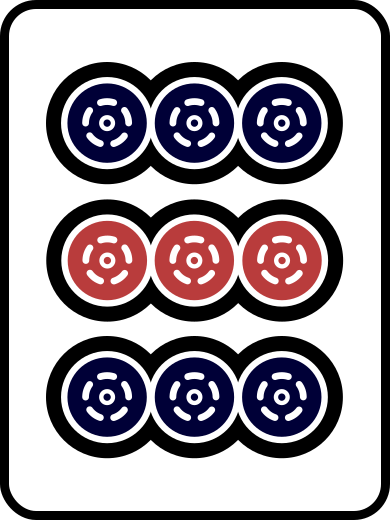

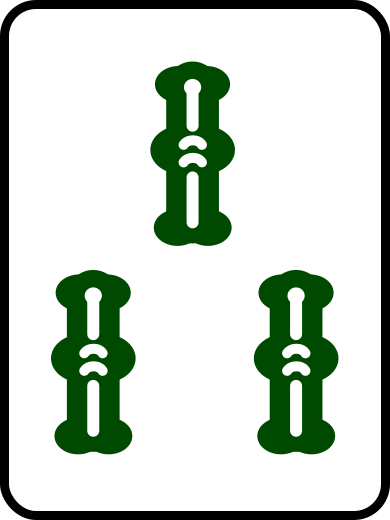
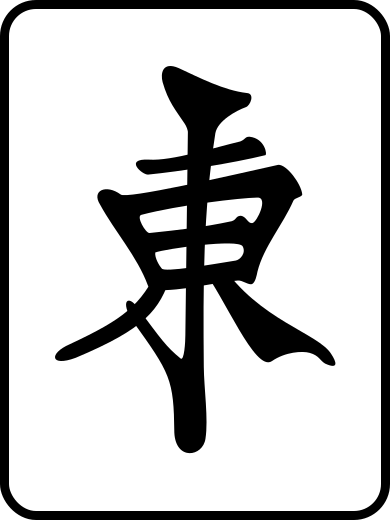

Every East in the hall opens with those 13 tiles and draws the same 21 after them. Wins are silent: you put the winning tile on the table instead of calling it, so one table can't tip off another. Scoring is by comparison. For each deal, your result is measured against the average of everyone who played your seat, and the difference converts to IMPs. A team game sums 16 hands. MIL's claim is plain: "the luck will be significantly eliminated."
In duplicate, "I never get the tiles" is dead on arrival. Everyone in your seat got your tiles.
What a duplicate wall would do to riichi
Japan took the game from China on its own timeline and built riichi on of it, a history for another post. The format isn't foreign to riichi, though. MIL lists riichi beside MCR and Sichuan rules as one of its three international competition rule sets, so a duplicate riichi event is a rulebook away.
What it would settle is the argument. In a normal a top player takes 1st about 30% of the time, so five games without a 1st happens 16% of the time to a player doing nothing wrong. Intermediate players take 4th about 20% of the time; two 4ths in a row happen about 4% of the time and three about 1%. Those runs feed every "the tiles hate me" story. Duplicate cuts the feed. Lose a deal that every other South in the hall also lost and the deal was bad. Lose one the other Souths turned into a and you've found a mistake.

The data already says what duplicate would say: over thousands of games, the results are about skill. Duplicate says it in 16 hands. That's its selling point to a mind sports body, and a reason to want a duplicate run in public at least once.
Where the format breaks
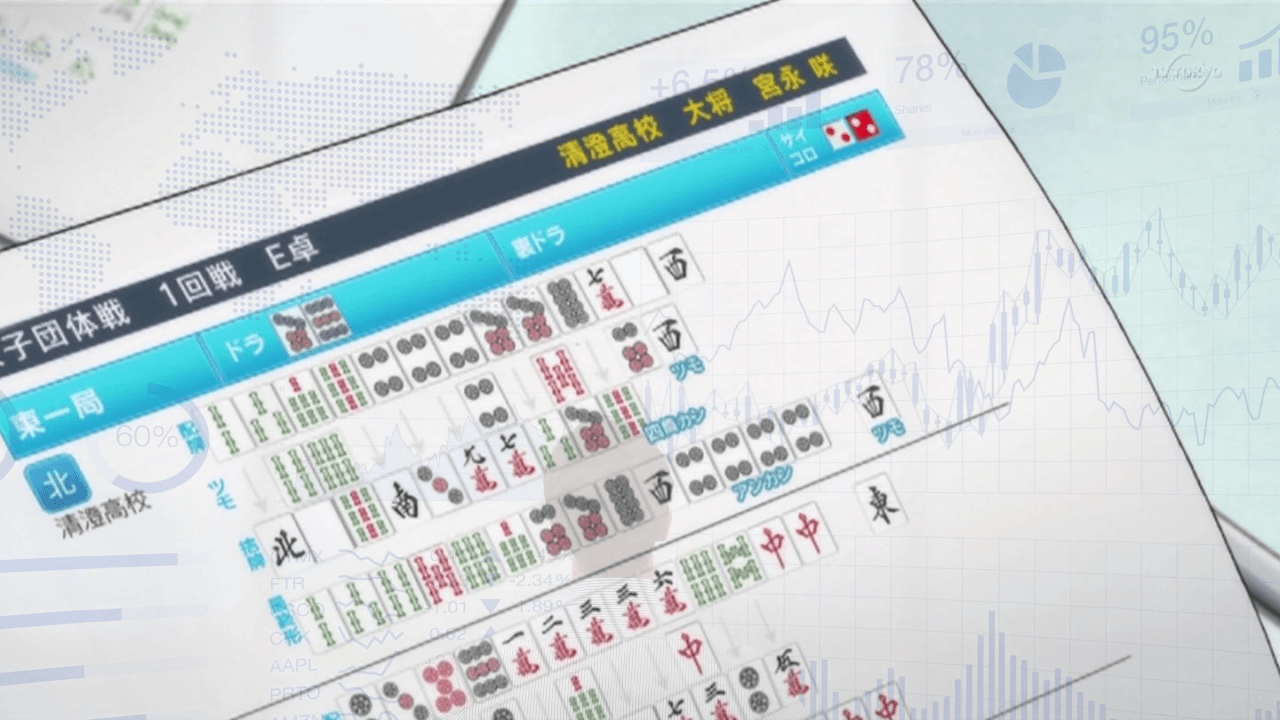
Duplicate fixes the wall and nothing else. Your 21 draws are locked, but the discards around you are not. The three players at your table call different tiles, declare riichi on different turns, and throw different tiles into your wait than the three at the next table. After the first discard the "same deal" is a different game, and in riichi the other three players carry more of the luck than the wall does. The format narrows the noise. It doesn't zero it.
It also costs something riichi players prize: silent wins and a hall full of staff remove the tells and the tempo that make live mahjong a different game from the online one.
The Olympic part is the weakest link. Chen himself put mahjong behind bridge and chess in his own queue, because the IOC recognizes those two as sports and not mahjong. A federation in Lausanne is a start. It isn't a ring.
Run your own duplicate test
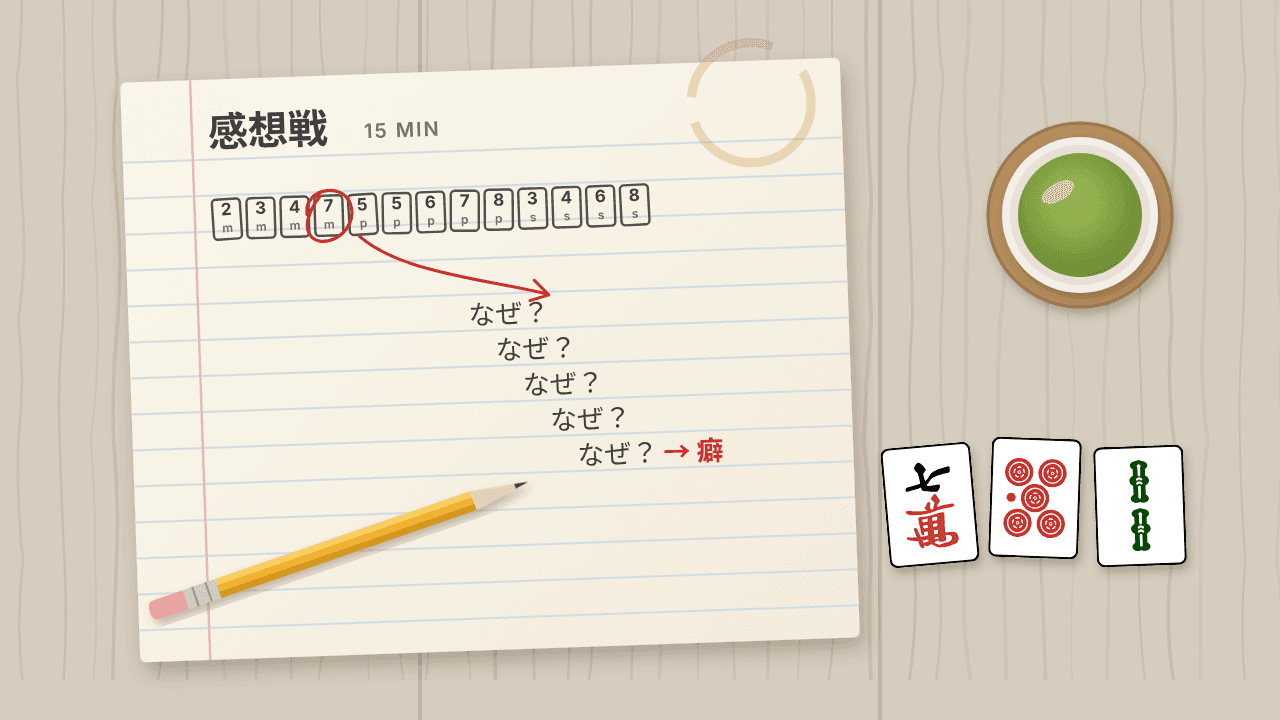
You don't need serial-numbered tiles for the useful part. Open the log of your last losing hanchan, go hand by hand, and sort every hand you lost points on into two columns. D for the deal: no discard order or call would have changed it. P for play: a discard, a call, or a riichi decision cost you. The log shows all four hands, so you can check what your tiles could have become.
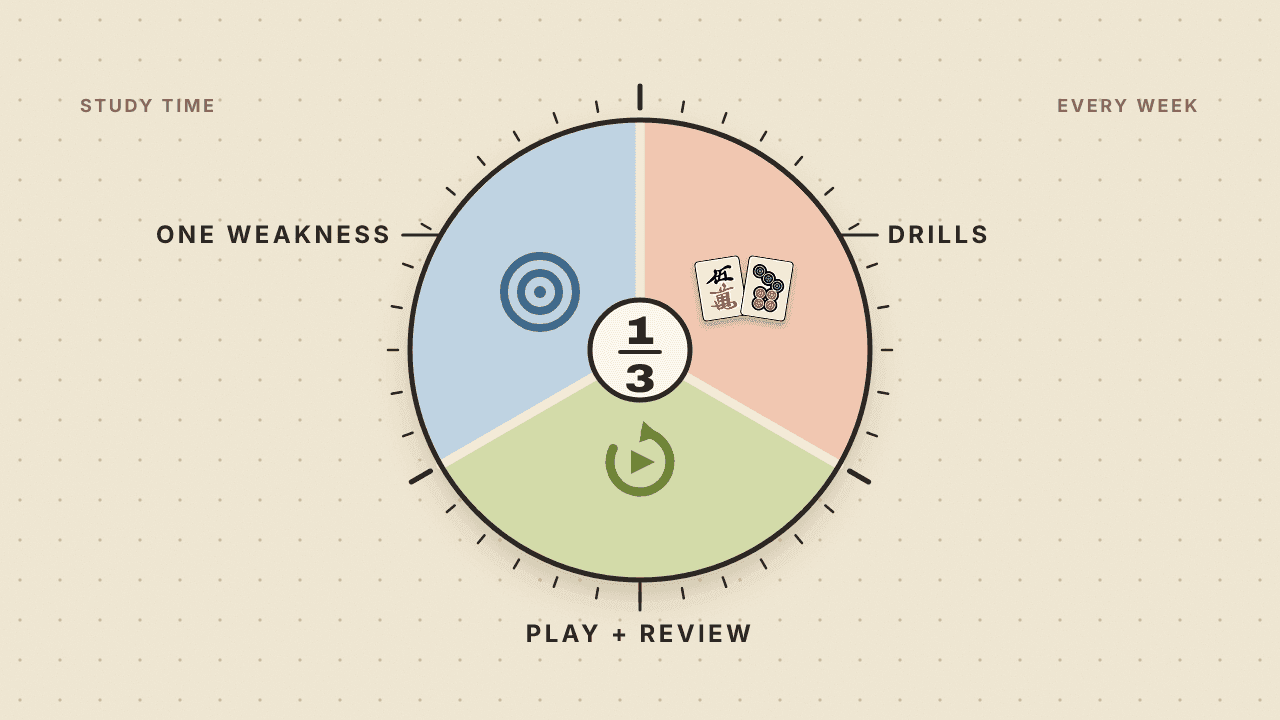
The D column is the one duplicate would wipe out. The P column follows you to every table in the hall. When it's longer than you'd like, that's the list to bring to a lesson.
Was this article helpful?