You a hand. Two , 30 , and the discarder pays 2,000. Ask most players where the 2,000 comes from and they'll point at the score table. The table is right. It's also hiding something.
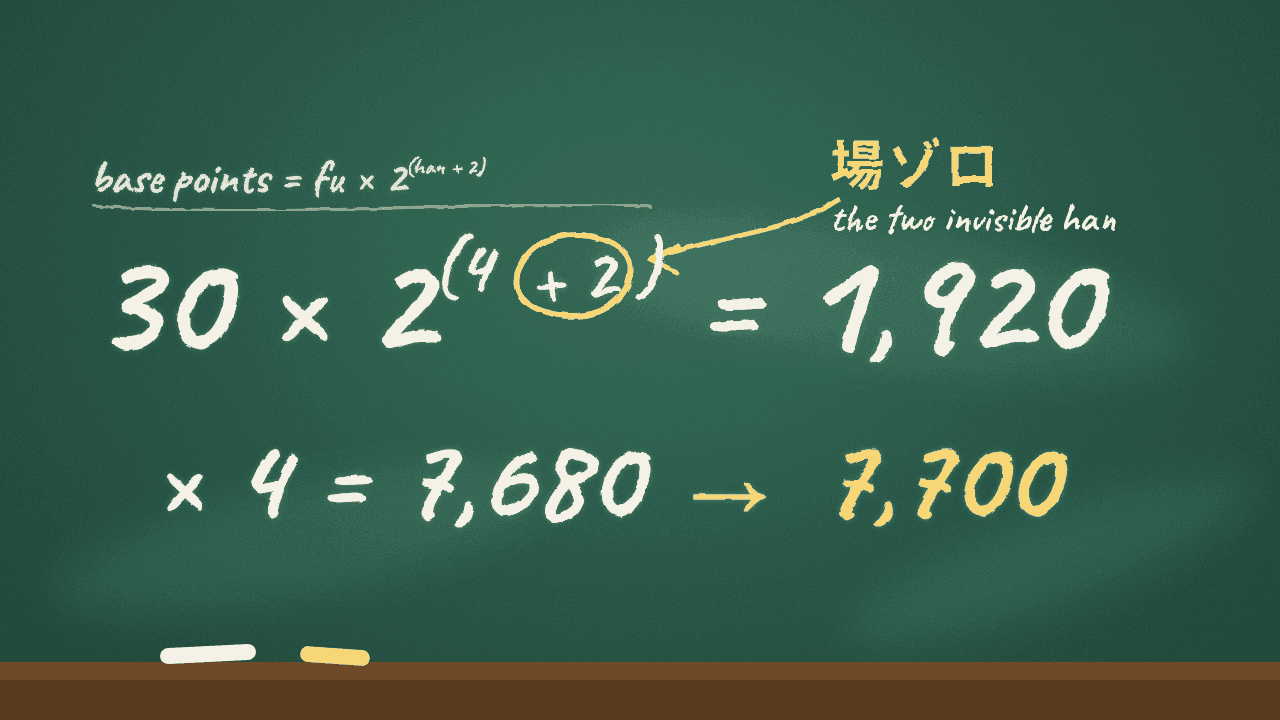
The formula behind every cell is base points = fu × 2^( + 2). Thirty fu and 2 han: 30 × 2^4 = 480. A collects four times the base, 1,920, rounded up to 2,000. The "+2" in the exponent is the part nobody says out loud. Your 2-han hand is scored as a 4-han hand. Every hand you'll ever win carries two extra doubles, and the Japanese name for them is (場ゾロ). The Japanese Wikipedia page on scoring puts it in one line under the formula: the +2 is the bazoro.
Where the two han came from
Bazoro is a leftover. The same Wikipedia page traces it to a post-war rule called zoroba (ゾロ場): the dice thrown to open a hand could add han to that hand. Doubles of 2 through 5 added one han, doubles of 1 or 6 added two. Later the two han were attached to every hand regardless of the dice. The page adds that the hanafuda game hachi-hachi had a similar rule that changed the points at the start, and suggests mahjong picked the habit up there.
The name survives in table talk. Players count a hand out loud as ", , banban", the usage the Weblio dictionary gives for banban, one of the nicknames for the bazoro along with ryanzoro, denden, and zorozoro. Strictly speaking the two han belong in the count, and the Wikipedia page says so. A "2-han hand" is a 4-han hand that stopped mentioning two of them.
The 30-fu column, worked by hand
Thirty fu is the everyday count. An open hand with nothing to add scores 30, and so does a closed pinfu ron. It's the column to know cold, so here it is from 1 to 4 han with the arithmetic behind every number.
| Han | Base points | Non-dealer ron | Dealer ron | Non-dealer tsumo | Dealer tsumo |
|---|---|---|---|---|---|
| 1 | 30 × 8 = 240 | 960 → 1,000 | 1,440 → 1,500 | 300 / 500 | 500 all |
| 2 | 30 × 16 = 480 | 1,920 → 2,000 | 2,880 → 2,900 | 500 / 1,000 | 1,000 all |
| 3 | 30 × 32 = 960 | 3,840 → 3,900 | 5,760 → 5,800 | 1,000 / 2,000 | 2,000 all |
| 4 | 30 × 64 = 1,920 | 7,680 → 7,700 | 11,520 → 11,600 | 2,000 / 3,900 | 3,900 all |
Read down the non-dealer ron column: 1,000, 2,000, 3,900, 7,700. Each han doubles the base, so the payments should double too. They almost do. The hiccup at 3,900 is rounding. Each payment rounds up to the next 100 after the multiplication, so 1,920 becomes 2,000 but 3,840 only reaches 3,900. Double the rounded number and you'd get 4,000. Double the real number first and then round, and you get 3,900. The table does the second.
The tsumo columns show the other side of the same coin. Three payers means three round-ups instead of one. The 3-han hand collects 3,900 by ron and 1,000 + 1,000 + 2,000 = 4,000 by . The 4-han hand collects 7,700 by ron and 7,900 by tsumo. Those extra hundreds come from rounding and nothing else, and rounding always falls the winner's way.
What the two han are worth
Now take bazoro out. A 1-han 30-fu hand drops to 30 × 2^1 = 60 base points. A non-dealer ron would be 240, rounded to 300. With bazoro it's 1,000. Two han is two doublings, so every payment in the game is four times what the visible han would give. The cheapest ron in riichi pays 1,000 instead of 300 because of a dice rule the game dropped and never cleaned up after.
Dealer payments follow from the same base. A ron is base × 6, so before rounding it's always 1.5 times the non-dealer ron: 1,440 against 960, 11,520 against 7,680. Rounding blurs the ratio, which is why 1,500 against 1,000 looks exact and 2,900 against 2,000 doesn't.
Why the cap sits at 2,000 base points
The formula doubles forever. Thirty fu reaches 1,920 base points at 4 han, 3,840 at 5, and 983,040 at 13. A non-dealer ron on that 13-han hand would cost the discarder 3,932,200 points. A rule set with no ceiling exists, , and that number is the case against it.
Standard rules put a ceiling in. The Wikipedia page states it as a rule: base points from the formula stop at 2,000, and anything over that is replaced by a fixed value set by han count. The cap is : 2,000 base points, 8,000 for a non-dealer ron, 12,000 for the dealer. Thirty fu needs 5 han to reach it. Forty fu gets there at 4 han, because 40 × 64 = 2,560 clears the line, and 70 fu at 3 han, because 70 × 32 = 2,240 does too.
The famous near miss is 4 han 30 fu. Its 1,920 base points sit 80 short of the cap, so the ron pays 7,700 and the dealer's pays 11,600, 300 and 400 short of a mangan. Some clubs round those two hands up, and the rule has a name, . Tenhou's ranked games don't play it and neither do the EMA 2016 rules, as the scoring guide spells out, so online 7,700 stays 7,700. At a club, ask before the first hand. Three han 60 fu lands on the same 1,920, which is why the rule names both hands.
Mangan, haneman, baiman: what the names say
Above mangan the fu stop mattering and each level pays a fixed amount. The names are arithmetic once you read the kanji.
Mangan, 満貫, reads as "a full string". 貫 () was a unit of money, 1,000 copper coins threaded on a string, according to the dictionary entries for 貫 on kotobank. In Chinese, 滿貫 means coins strung to a full string, then by extension reaching the limit, and in mahjong having the maximum points. Japanese dictionaries treat the word as a loan from Chinese and define it as a cap: the Daijisen entry calls it a point value fixed so that winning hands don't grow too large. Mangan is the hand that filled the string.
, 役満, is short for 役満貫, yaku-mangan (Wiktionary): a mangan paid for a specific hand rather than for a count of han. The Japanese Wikipedia page says that in the old days mangan meant yakuman, and that was the top of the scale. Then bazoro, riichi, dora, and a run of new yaku inflated ordinary hands. The yakuman payout was raised to stay special, and the gap below it needed filling.
, 跳満, filled the first slot. It's a clipping of 跳ね満貫, hane-mangan, "the jumping mangan" (Wiktionary): the hand that jumped past the cap. , 倍満, is the double, twice a mangan (Weblio). , 三倍満, is the triple. The Wikipedia page notes that old rulebooks had no sanbaiman at all: a yakuman paid three times a mangan, and that was the ceiling. Today 13 han gets you the yakuman payout by counting alone, a , on Tenhou and Mahjong Soul. The EMA 2016 rules stop that hand at sanbaiman.
| Name | Kanji | Reads as | Han | Base points | Non-dealer ron | Dealer ron |
|---|---|---|---|---|---|---|
| Mangan | 満貫 | full string | 5, or 3 to 4 with enough fu | 2,000 | 8,000 | 12,000 |
| Haneman | 跳満 | jumping mangan | 6 to 7 | 3,000 | 12,000 | 18,000 |
| Baiman | 倍満 | double mangan | 8 to 10 | 4,000 | 16,000 | 24,000 |
| Sanbaiman | 三倍満 | triple mangan | 11 to 12 | 6,000 | 24,000 | 36,000 |
| Yakuman | 役満 | the mangan for a yaku | 13 or more, or a yakuman hand | 8,000 | 32,000 | 48,000 |
Why fu round to 10 and points to 100
Two round-ups sit inside every score.
Fu first. You start at 20, add 10 for a closed ron, 2 to 8 for each triplet (a quad pays four times as much), 2 for a pair of dragons, , or , 2 for a single-tile, edge, or , then round the total up to the next 10. The Wikipedia page builds that rounding into the definition: the items are summed and the sum is rounded up in units of 10. A riichi ron with one closed triplet of terminals and a wait comes to 20 + 10 + 8 + 2 = 40. Swap the kanchan for a and it's 38, which also rounds to 40. The step erases small differences on purpose. It keeps the table to a handful of rows instead of one for every even number from 20 to 110. The one hand that skips the rounding is , fixed at 25.

Points next. come in 100, 1,000, 5,000, and 10,000. There's no 20-point stick, so each payment rounds up to the next 100 at the moment it's paid. The Wikipedia page puts the rounding "just before payment", and that placement is why a tsumo rounds three times and a ron once.
The drill: say the base before you look
For your next , read the table last. Before each payment, yours or anyone's, say the base points: fu × 4, then double once per han. Thirty fu, 3 han: 120, 240, 480, 960. Non-dealer ron, times four: 3,840, call it 3,900. Dealer, times six: 5,760, call it 5,800. Then check the sheet. By the end of the week the 30 and 40 fu rows will come out of your mouth before your eyes reach it, and you'll catch the next wrong payment at a live table without a chart.
Where the formula stops explaining
Not every rule set carries the two han. The Wikipedia page lists アルシーアル麻雀, an older rule set, as having no bazoro, and 純麻雀, a modern reform rule set, as having abolished it along with fu counting and the dealer's extra share. Scores there come off a different table, and the arithmetic above won't match it.
Some parlors skip fu entirely. The same page describes a no-fu score table, adopted at free parlors run by reform-minded players and spreading to clubs. At those tables a hand's price is read straight off the han, and 7,700 may not exist.
And the formula prices a hand, not a game. It says nothing about the or the 4th-place penalty, and those decide what a hanchan was worth. Tenhou's 4th-place penalty is the other half of the arithmetic.
Run it on your own hands
The score calculator follows Tenhou's rules, has the fu counter built in, and keeps kiriage off with a switch to turn it on, so you can see exactly which hands it rescues.

The fu quiz drills the step before the formula: count the fu of a random hand, then name what it pays. Do ten a day for a week. The next time someone calls "riichi, pinfu" for 2,000, you'll know it was 4 han all along.
Was this article helpful?