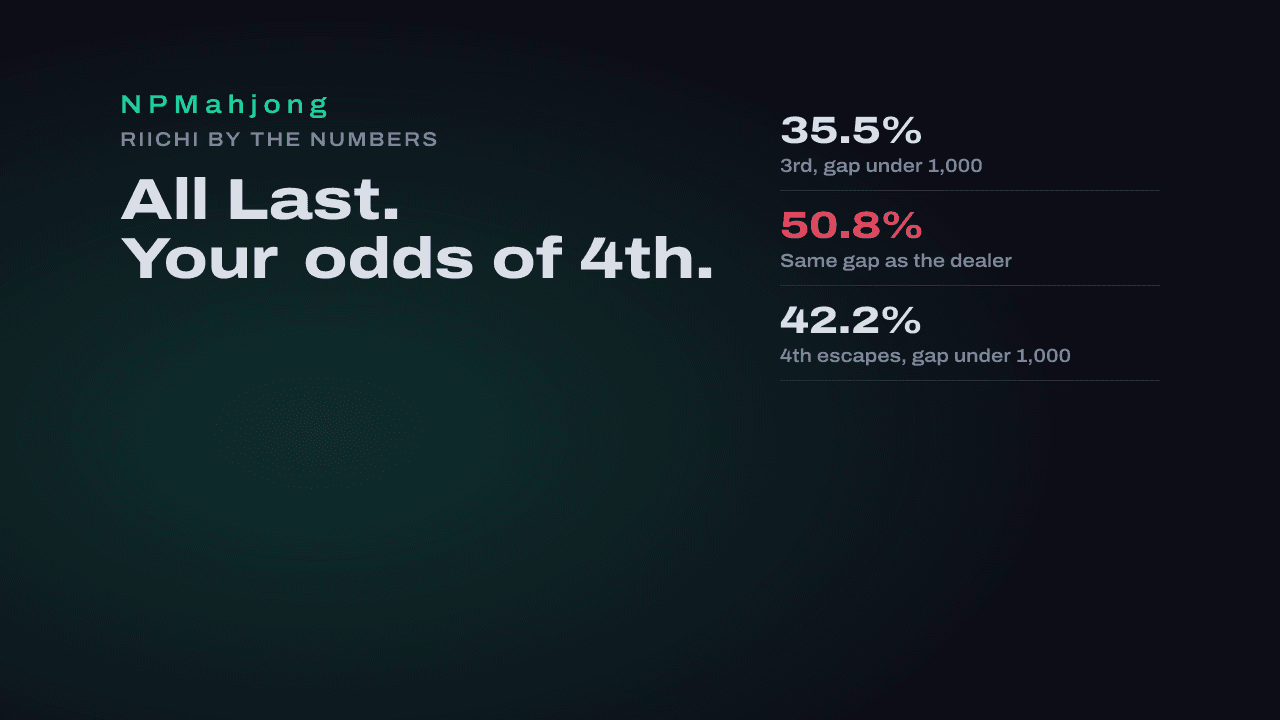
You start in 3rd, less than 1,000 points above 4th. In Tenhou's room, you finish the game in 4th 35% of the time. Start 4,000 points clear and it's 18%. Sit in 3rd as the dealer with the same thin cushion and it's 51%.
Every number here comes from Tenhou Houou logs 2016–2020, analysis by chienshyong (fork of Euophrys/houou-analysis). That's Houou-level 4-player , so your table may differ. Tenhou punishes 4th harder than any other placement, which is why this one hand gets its own post.
What the numbers count
The analysis looks at every hand that starts in South 4, including repeats after a dealer win or a dealer . It ranks the four scores, measures the gap between 3rd and 4th, and records where the players in 3rd and 4th finish the game.
Three details matter:
- The gap is rounded down to the thousand. "Under 1,000" means 100 to 900 points. A tie for 3rd is left out.
- "Finish" means the end of the game. On Tenhou, a hanchan where nobody reaches 30,000 goes on to the West round, so some games end later than South 4.
- Every South 4 hand start counts. A dealer who wins and plays again shows up once per hand.
The sample is large: 122,574 starts with two non-dealers in 3rd and 4th, 64,873 with the dealer in 3rd, and 59,871 with the dealer in 4th.
In 3rd: your odds of falling to 4th
Here's how often the player in 3rd at the start of All Last finishes the game in 4th.
| Gap to 4th | 4th is a non-dealer | 4th is the dealer | You're the dealer |
|---|---|---|---|
| Under 1,000 | 35.5% | 30.4% | 50.8% |
| 1,000 to 1,900 | 33.2% | 26.8% | 42.5% |
| 2,000 to 2,900 | 27.7% | 24.8% | 33.8% |
| 3,000 to 3,900 | 21.7% | 21.7% | 25.8% |
| 4,000 to 4,900 | 18.0% | 18.5% | 20.3% |
| 5,000 to 5,900 | 16.3% | 17.8% | 16.4% |
| 6,000 to 6,900 | 14.4% | 14.7% | 14.6% |
| 8,000 to 8,900 | 9.5% | 13.4% | 10.9% |
| 10,000 to 10,900 | 6.5% | 11.3% | 9.5% |
| 12,000 or more | 2.5% | 6.7% | 3.3% |
A thin lead is a third of a 4th. With a gap under 1,000 and two non-dealers involved, 3rd finishes 4th 35.5% of the time. Any win by the player in 4th passes you.
Each thousand points buys about 2 to 6 points of safety up to a 4,000 gap. After that the curve flattens. Going from 4,000 to 6,000 only takes you from 18.0% to 14.4%.
The dealer in 3rd is in the most danger. With a gap under 1,000, the dealer finishes 4th 50.8% of the time, against 35.5% for a non-dealer. The likely reason: a non-dealer in 3rd who wins any hand usually ends the game. A dealer in 3rd who wins, or sits tenpai at a draw, plays another hand. Every extra hand is another chance for 4th to catch up, and a by 4th costs the dealer double.
The extra hands cut both ways. From 3rd with a gap under 1,000, the dealer also finishes 2nd or better 16.1% of the time, against 12.7% for a non-dealer. More hands means more swings, up and down.
Take the spot that makes this table matter. All Last, you're the dealer in 3rd, 800 points above 4th, 6,000 below 2nd. A cheap win keeps you dealing and keeps the game alive, which the table prices at a coin flip for 4th. Pushing for 2nd needs a . Folding to a draw is a draw only if you're tenpai, and a draw hands 4th the points to pass you.
My play here is a fast hand I'm willing to end on. on the first tenpai, whatever the wait, and if the riichi gets me a cheap win, I take it and keep dealing with a bigger cushion. What I don't do is build toward the haneman. The 50.8% in the table is what building costs. The one adjustment comes if someone else riichis first. A now drops me to 4th, so I push only a two-sided tenpai, and only early. Anything else folds, and I take the draw with tenpai if I can get there safely.
A dealer in 4th never lets you relax. Look at the middle column. With a small gap, you're safer when the dealer is 4th: 30.4% instead of 35.5%. With a big gap, you're less safe. At 10,000 points, you still finish 4th 11.3% of the time, almost double the 6.5% you'd face against a non-dealer. At 12,000 or more, it's 6.7% against 2.5%. A dealer in 4th keeps playing as long as they win or stay tenpai, and a dealer is 12,000 points.
In 4th: your odds of climbing out
Now the other side. Here's how often the player in 4th at the start of All Last finishes 3rd or better.
| Gap to 3rd | 3rd is a non-dealer | 3rd is the dealer | You're the dealer |
|---|---|---|---|
| Under 1,000 | 42.2% | 57.7% | 37.5% |
| 1,000 to 1,900 | 38.6% | 47.5% | 32.9% |
| 2,000 to 2,900 | 32.2% | 39.0% | 29.7% |
| 3,000 to 3,900 | 25.5% | 30.7% | 26.8% |
| 4,000 to 4,900 | 21.4% | 24.0% | 23.2% |
| 5,000 to 5,900 | 19.5% | 19.8% | 22.0% |
| 6,000 to 6,900 | 17.4% | 18.0% | 18.7% |
| 8,000 to 8,900 | 11.8% | 12.8% | 16.4% |
| 10,000 to 10,900 | 8.5% | 11.7% | 13.8% |
| 12,000 or more | 3.5% | 4.1% | 8.9% |
Chase the dealer. When the player just above you is the dealer and the gap is under 1,000, you escape 4th 57.7% of the time. That's the mirror of the dealer's 50.8% in the first table. A cheap tsumo is enough, because the dealer pays double.
As the dealer in 4th, time is on your side. With a small gap, the dealer escapes less often than a non-dealer: 37.5% against 42.2%. With a big gap, more often: 8.9% from 12,000 or more behind, against 3.5%. A non-dealer in 4th usually gets one hand. The dealer keeps going as long as they win or stay tenpai.
Under 1,000 behind is not a lost game. A non-dealer in 4th with a gap under 1,000 climbs out 42.2% of the time. Two in five.
Most of those escapes land in 3rd, though. From under 1,000 behind, a non-dealer in 4th finishes 2nd or better only 10.4% of the time, and the dealer 16.0%. Plan to pass one player, not two.
My rule for 4th in All Last on Tenhou: first, before the tiles come out, count the smallest hand that passes the player right above me. Know the tsumo gaps cold: a 1,000-2,000 tsumo closes 5,000 against a non-dealer and 6,000 against the dealer, a 1,300-2,600 closes 6,500 and 7,800, a tsumo closes 10,000 and 12,000. If the hand I need is a 1,000-point tsumo or a 2,000 off anyone, I take any win I can get, and I don't fold. From 4th, a deal-in usually changes nothing, so the deal-in rate stops mattering. If the smallest hand that passes one player is a mangan, I build the mangan and only the mangan, and I count on the dice: a riichi that comes up one short still gets there about four times in ten, through ura, , or a direct hit from the one player who pays enough. If it needs a haneman, I don't build it. A hand I can't make this round is a hand I'm not playing for, and the only exception is a with two , which I riichi on any live and hope. The mistake is the middle: a 2,600 hand that passes nobody, played carefully as if it could.
Why small gaps are close to coin flips
The tables make more sense once you see how much scores still move in the last hand. The variance analysis measures how far each player's score moves from the start of a hand to the end of the game.
| Hand | Everyone | 1st | 2nd | 3rd | 4th |
|---|---|---|---|---|---|
| East 1 | 14,650 | 13,982 | 14,367 | 14,298 | 14,756 |
| South 1 | 10,123 | 9,381 | 9,899 | 10,302 | 10,829 |
| South 3 | 7,078 | 6,353 | 6,903 | 7,203 | 7,764 |
| South 4 | 4,831 | 4,087 | 4,787 | 4,994 | 5,354 |
From the start of All Last, a typical score still moves by about 4,800 points. The player in 4th moves the most, 5,354, likely because 4th is where players push hardest. A 1,000-point gap is a fifth of that. Even 4,000 points is less than one standard deviation for the two players at the bottom.
The spread shrinks as the game goes on. In East 1 it's 14,650 points. By South 3 it's 7,078, and in All Last it's still about a third of the East 1 figure. One hand is enough for a mangan, and a mangan moves 8,000 points or more.
That fits the first table, where 3rd's risk only drops below 10% at a gap of about 8,000.
How to use these numbers
- In 3rd with under 2,000 points of cushion, you finish 4th about one time in three as a non-dealer. Your own win usually ends the game with you safe. Take it.
- As the dealer in 3rd, the same cushion is close to a coin flip. Count every extra hand as more risk, because a win keeps you playing.
- In 4th behind the dealer, look for the cheap tsumo first. Any win you can finish is often enough.
- With a big lead over a 4th-place dealer, don't relax. At 10,000 points you still finish 4th more than one time in ten.
- Know your gap before the hand starts. It changes which hands are worth playing.
To check your odds for any gap and seat, use the All Last 4th-place calculator. To find the smallest hand that lifts you out of 4th from your exact scores, use the All Last calculator. To see what a lower 4th rate does to your rank over hundreds of games, run your placement rates through the Mahjong Soul rank calculator. For why Tenhou punishes 4th so hard, read why Tenhou punishes 4th. Look up any unfamiliar term in the glossary.
The All Last mistake I see most in reviews is the one I'd flagged for Master-rank players already: the hand starts and the player hasn't done the math. They're in 3rd with a thin lead and they fold to a riichi from 2nd, who can't hurt them, while the player in 4th draws freely. Or they're in 4th and riichi a 1,300 hand that passes nobody even with ura. Or they're in 1st with a yaku tenpai, riichi out of habit, and hand 2nd the stick that puts them within a mangan. The fix takes ten seconds and no tiles: before your first discard, say out loud what you need and who it has to come from, and then narrow the wait if a narrower one wins without luck. A 1,000-2,000 tsumo that passes someone beats a two-sided riichi that only passes them with ura.
Get your All Last decisions reviewed
All Last is where a whole hanchan of good play gets kept or thrown away. Send me your games for a review and you'll get the final hands where a different push, fold, or target score would have kept you out of 4th.
Was this article helpful?