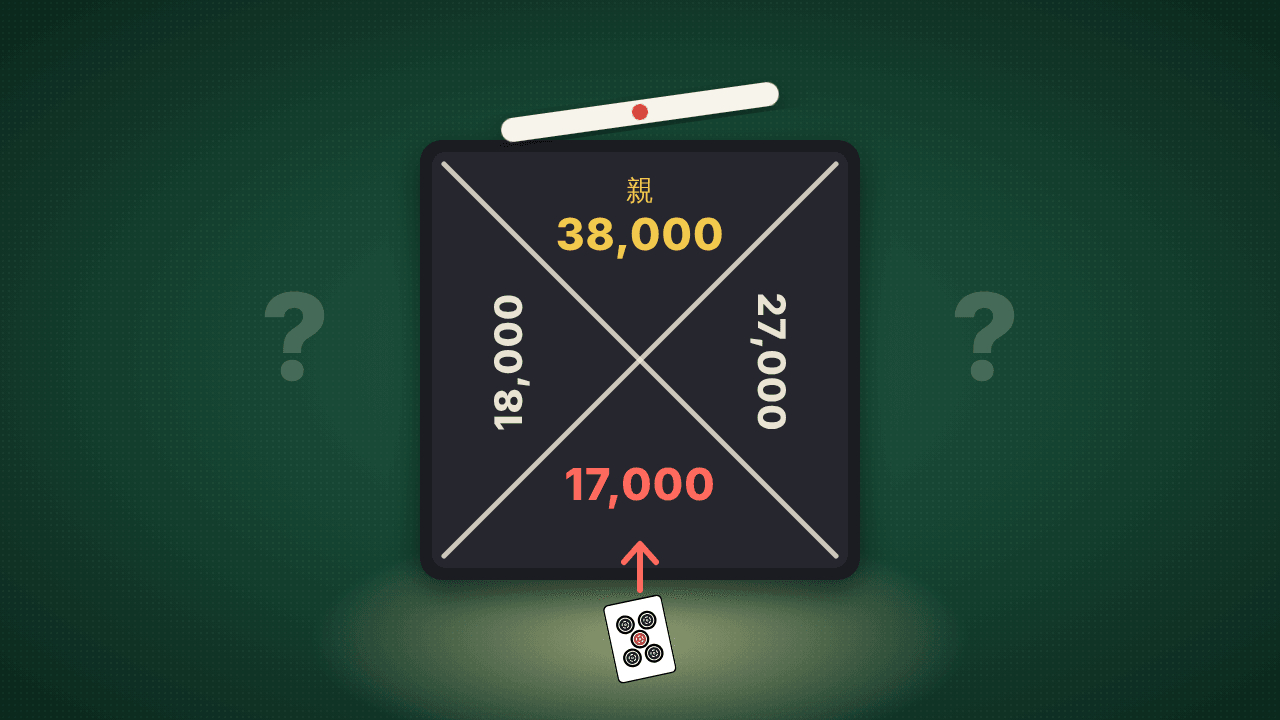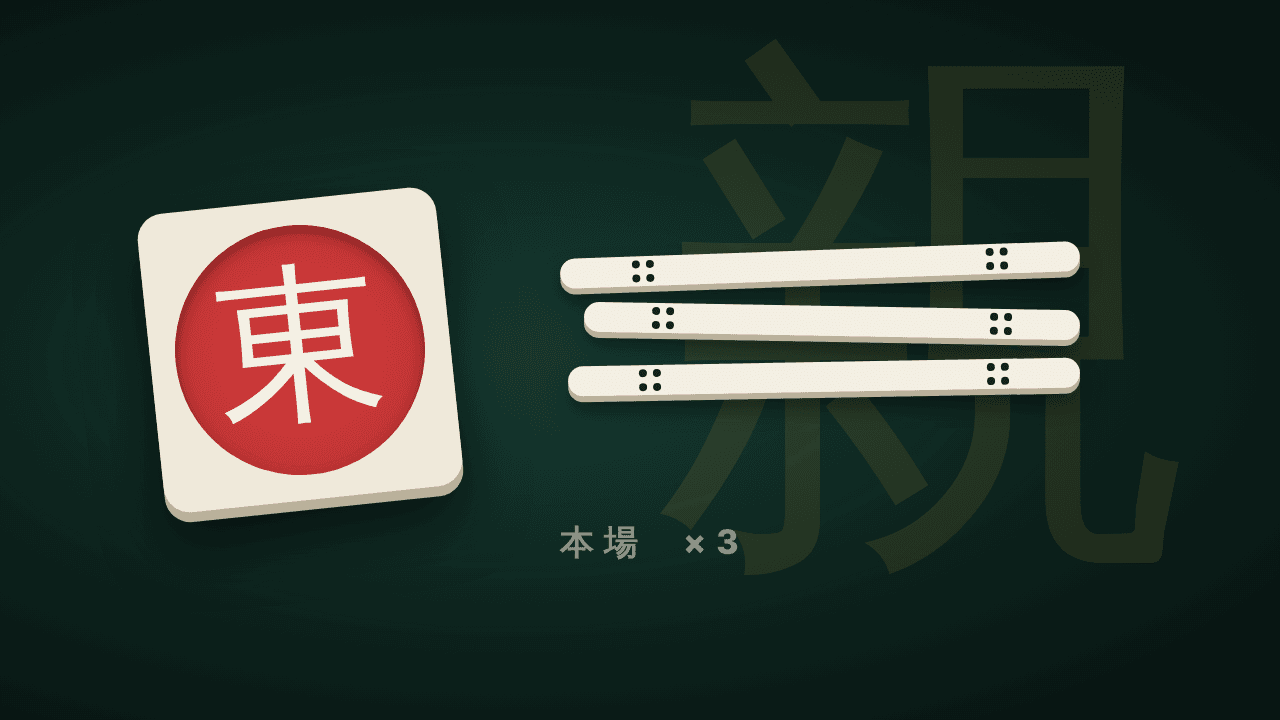
East 1, and the marker sits in front of you. Every hand you win pays half again. Every tsumo anyone else wins bills you double. And if you win or reach , you deal again.
Most advice stops at "the dealer is worth 1.5 times." That covers one hand. The seat is worth more, because the dealer () also wins more often: in a week of games, 23.6% of hands against 20.2% for a . Net of everything, the seat is worth about 730 points a hand.
Where the numbers come from
Tenhou publishes the log of every game in its top room. Its raw archive lists the Houou games hour by hour, and each one links to a full replay. For this post, every four-player Houou that started between October 16 and the afternoon of October 23, 2026, Japan time, went through a parser that reads each hand: who dealt, who called, who declared , who won what, and who paid. That's 3,810 games and 40,439 hands.
A week is a small slice, so check it against the long counts first. kobalab's statistics for all 159,798 Houou hanchan of 2016 give 10.71 hands per game, a 21.1% win rate, 12.5% , 17.0% riichi, and 34.4% calls. Path of Houou's count of 1.2 million Houou games from 2011 to 2019 found 10.7 hands per game and 15.5% of hands ending in an exhaustive draw. This sample lands at 10.61 hands, 15.0% exhaustive draws, 18.1% riichi, and 32.9% calls. Close enough to trust the shape, not the decimals. The thinnest rows below rest on fewer than 2,000 hands or dealerships, and their captions give the count.
The dealer wins bigger and more often
The scoring guide has the rule: a dealer is base points × 6 against × 4 for a non-dealer, and when someone else wins by the dealer pays a double share. The table shows what Houou players do with it.
| Per hand | Dealer | Non-dealer |
|---|---|---|
| Win rate | 23.6% | 20.2% |
| Average win | 7,727 | 5,098 |
| Riichi rate | 21.2% | 17.1% |
| Call rate | 35.0% | 32.2% |
| Deal-in rate | 13.1% | 12.1% |
| Average deal-in | 4,542 | 5,318 |
| at an exhaustive draw | 52.7% | 41.2% |
| Net points per hand | +548 | -185 |
Read the first two rows together. The average dealer win is 1.52 times the non-dealer's, the rule doing its job. The surprise is the win rate. The dealer also riichis more, calls more, and is tenpai more often at the draw. A cheap hand is worth more to the dealer, so the dealer plays more of them to the end.
Path of Houou's study of how the leader plays, 1.2 million games from a different decade, shows the same split. A dealer in 1st by under 4,000 won 23.0% of hands at 7,262 a win. A non-dealer in the same spot won 20.3% at 4,598.
The deal-in rows look backward until you remember who the dealer can deal into. A dealer only ever pays a non-dealer's hand, so the average deal-in is smaller: 4,542 against 5,318. The rate runs a little higher, because a dealer pushes more.
Add it up and the seat nets +548 a hand while each non-dealer seat loses 185. The four seats sum to about zero, as they should. In a hanchan that nobody ends early by going bust, each player deals at least twice, once in each wind, and every adds another hand on the good side of that 730-point swing.
What keeping the seat is worth
A dealer keeps the seat by winning, by being tenpai at an exhaustive draw, or through an abortive draw. On Tenhou a dealer passes the seat, noten oya-nagare (ノーテン親流れ), and a tenpai dealer deals again, tenpai (聴牌連荘). Every abortive draw is a renchan too (Tenhou's rules).
| The hand ended with | Share of dealer hands | Dealer keeps the seat |
|---|---|---|
| The dealer winning | 23.7% | Yes |
| A draw, dealer tenpai | 8.6% | Yes |
| An abortive draw | 1.3% | Yes |
| A draw, dealer noten | 7.1% | No |
| Someone else winning | 59.3% | No |
The dealer kept the seat 33.6% of the time. A quarter of those renchan came from tenpai at the draw, not a win. That's why the dealer's tenpai-at-draw rate runs 11 points above everyone else's. A non-dealer who scrapes tenpai on the last turn collects . A dealer collects them and deals again.
Now follow whole dealerships, from the first hand a player deals until the seat moves on.
| Hands in the dealership | Share | Dealer's net over the run |
|---|---|---|
| 1 | 68.2% | -2,233 |
| 2 | 22.3% | +3,738 |
| 3 | 6.8% | +9,809 |
| 4 or more | 2.8% | +17,193 |
Two dealerships in three last one hand, and those cost the dealer 2,233 on average. The extra tsumo share and the noten payments see to it. The rest pay, and they pay steeply: each hand you hold the seat adds about 6,000 to the run. Most of that is the win that kept the seat. The extra hand itself is worth about 730, the gap between +548 and -185. The seat costs you up front and pays in the tail, and the tail only pays if you're still dealing.
So the dealer's job is to stay. A 1,500-point win keeps the seat. So does a tenpai on the last tile.
The dealer's fold price, and what Houou dealers do about it
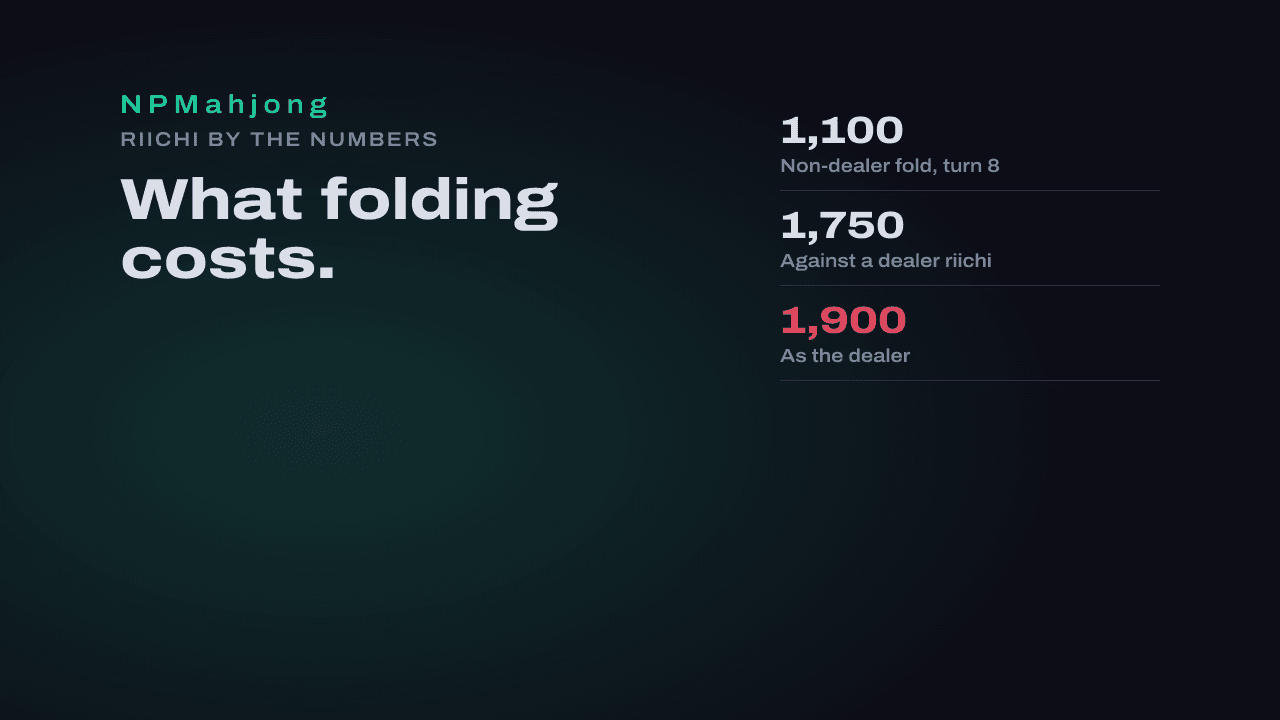
What folding costs prices it from Tenhou Houou logs 2016 to 2020, a much larger set than this week: a clean fold against a non-dealer riichi at turn 8 costs a non-dealer 1,120 points and the dealer 1,890. The dealer pays double on every tsumo, and that bill doesn't count the dealership you hand over.
Houou dealers don't pay it quietly. The table follows every player who hadn't declared yet, from the hand's first riichi to the end of the hand.
| You, vs the riichi | Dealer vs non-dealer | Non-dealer vs non-dealer | Non-dealer vs dealer |
|---|---|---|---|
| Win | 12.7% | 10.4% | 10.4% |
| Deal in | 12.3% | 10.4% | 10.1% |
| Chase | 8.9% | 7.3% | 6.9% |
| Net | -834 | -788 | -1,353 |
Facing a riichi, the dealer wins, chases, and deals in more often than a non-dealer does. Yet the net lands within 50 points of a non-dealer's. At turn 8 the dealer's fold costs 770 more than a non-dealer's, and Houou dealers push most of that gap back.
The last row is the other side. A non-dealer facing the dealer's riichi loses 1,353 a hand, the worst row in the table. The dealer's hand pays half again, and you're the one paying. When a second riichi joins it, triage your defense sorts out who gets your safe tiles.
How much lower the dealer's push bar sits
The fold-price post gives a rough formula for a tenpai push against a riichi. Call your hand's value W, the riichi hand's average deal-in L, and your fold price F. Pushing beats folding when your win rate is more than (L − F) ÷ (W + F) times your deal-in rate.
Plug in the Houou inputs at turn 8. L is 5,869, the average ron of a non-dealer riichi from that turn. F is 1,120 for a non-dealer and 1,890 for the dealer. The dealer gains twice: W is 1.5 times bigger, and the bigger F shrinks the top of the fraction.
| Hand | Ron, non-dealer / dealer | Needs, non-dealer / dealer |
|---|---|---|
| 1 30 fu | 1,000 / 1,500 | 2.2× / 1.2× |
| 2 han 30 fu | 2,000 / 2,900 | 1.5× / 0.8× |
| 3 han 30 fu | 3,900 / 5,800 | 0.9× / 0.5× |
| 8,000 / 12,000 | 0.5× / 0.3× |
The arithmetic for the dealer's 2,900: (5,869 − 1,890) ÷ (2,900 + 1,890) = 3,979 ÷ 4,790 = 0.83. The same 2-han hand as a non-dealer is 4,749 ÷ 3,120 = 1.52.
Set that against the turn-8 chase rates in the fold-price post. A chase riichi on a narrow wait (, , , or ) won 32% and dealt in 21%, a ratio of 1.5. A two-sided chase won 48% and dealt in 16%, a ratio of 3.
Here's the hand. South 1, you're the dealer, turn 8. You called the 678p for , and you're tenpai on a for the 5p with no , worth 1,500. The declared riichi a turn ago. You draw an 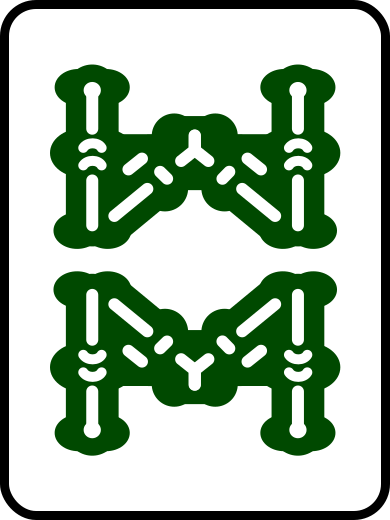 : no use to your hand, and fresh, with no 5s or 8s anywhere in the riichi player's river.


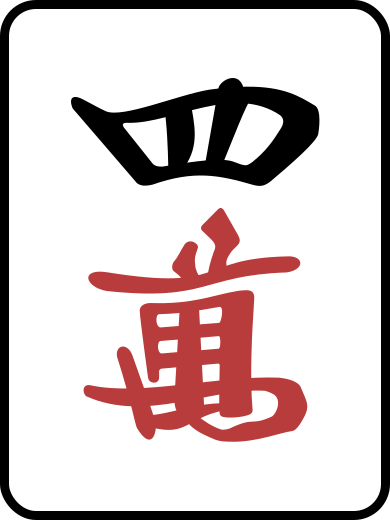
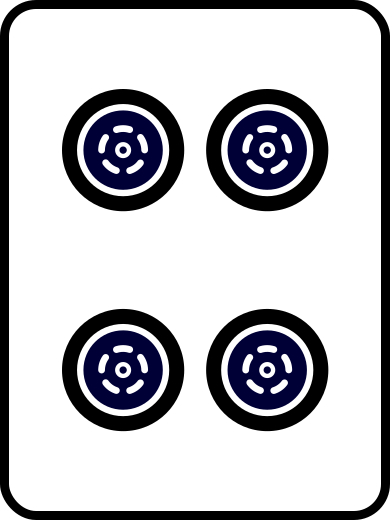
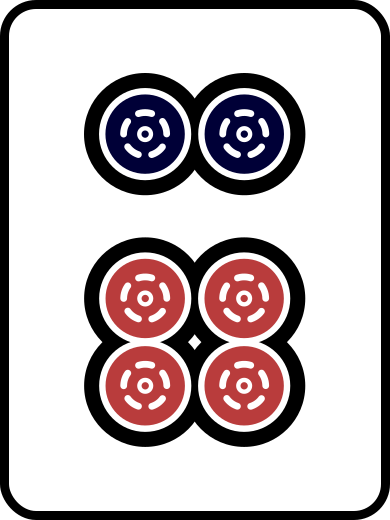
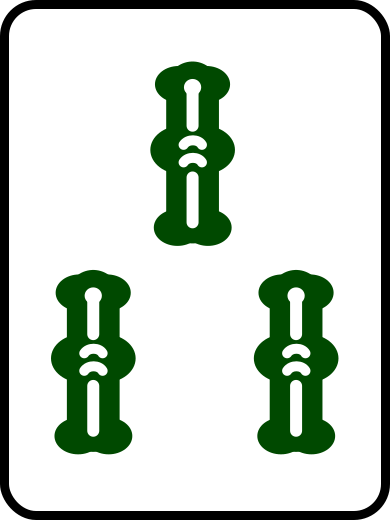
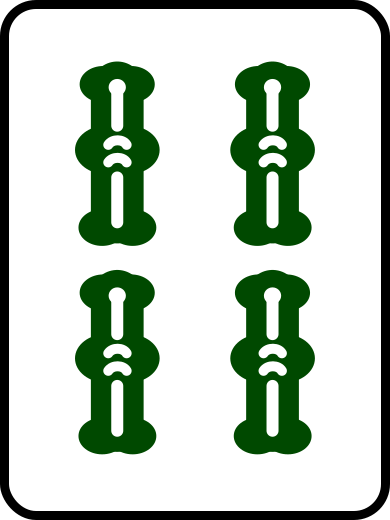
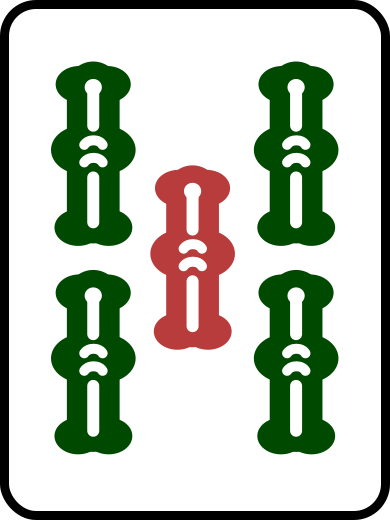
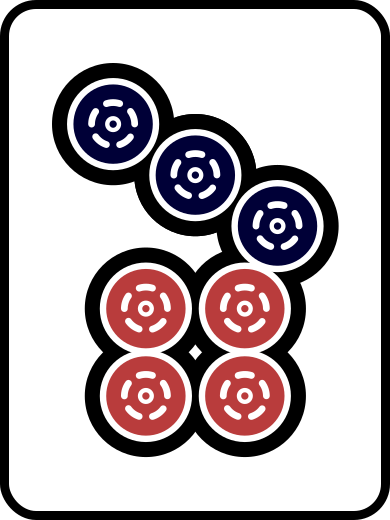
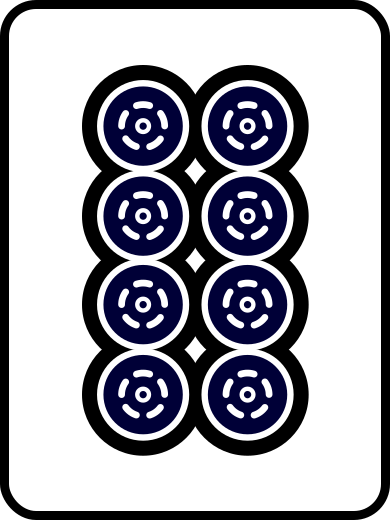
As a non-dealer this is the 1,000-point kanchan that riichi is a loser's game folds at turn 11, because a narrow wait needs a hand worth about 2,000. At turn 8 the table here asks it for 2.2 times its deal-in rate, and narrow waits manage 1.5. As the dealer it needs 1.2. The rough math says push, and it says so before counting the renchan the win would buy.
Two caveats. The sketch flatters pushing: those chase deal-in rates leave out a ron on the riichi tile itself. And it's a turn-8 snapshot. Every turn you keep pushing a narrow wait, the deal-in side grows and the win side shrinks. The rule in the fold-price post is stricter: from the middle turns on, it asks a dealer's one-sided wait for 3,900 or more. The push-or-fold calculator still says push this hand at turn 8. So push the one tile, and if the next draw is another live tile, go with the rule and fold.

Honba: 300 points, and not much else
Each adds 300 to the next win, 100 from each payer on a tsumo. They pile up after every dealer win and every draw, and they clear when a non-dealer wins.
| Honba | Share of hands | Dealer wins | Dealer keeps the seat |
|---|---|---|---|
| 0 | 62.7% | 23.8% | 34.2% |
| 1 | 23.7% | 23.8% | 32.9% |
| 2 | 8.7% | 24.1% | 33.5% |
| 3 or more | 4.9% | 20.7% | 30.2% |
The dealer's chances barely move with the count. At 3 or more they drop about three points, in a small bucket. One honba is 300 points, a sixth of the dealer's 1,890 fold price. On a 1,000-point hand two honba add 60%, which can tip a cheap hand that was already close to a push. It rarely tips anything else.
All Last: the scoreboard outranks the seat
On Tenhou, an dealer in 1st on 30,000 or more who wins or is tenpai at the draw ends the game on the spot, rasu-oya top no jidou agari-yame and jidou tenpai-yame (ラス親トップの自動和了り止め、自動聴牌止め) in Tenhou's manual. Past that rule the scoreboard decides more than the seat: who pushes against the leader works through the dealer in 1st in South 4, and All Last math has the 4th-place odds when the dealer sits in 3rd, 51% with a gap under 1,000.
Three habits for the dealer seat
- Take the cheap win. A 1,500 keeps the seat. What it buys is the next hand, and two-thirds of dealerships never get one.
- Fight for tenpai at the end. A quarter of renchan in the sample came from a tenpai draw, so a late call for a cheap tenpai is worth more to you than to anyone else at the table.
- Lower your push bar, then check the next tile. At turn 8 a 2,900 tenpai can push one dangerous tile against a non-dealer riichi on almost any wait. If the next tile is live too, a one-sided wait needs 3,900, the rule in the fold-price post.
The push-or-fold calculator has a chart for exactly this seat: a non-dealer riichi with you as the dealer. Run your last ten dealer hands that met a riichi through it, and mark the ones you folded with a tenpai it says to push.
Dealer hands are the place to start a game review, because the same fold costs more there. Send me the logs and you'll get those hands back with the push, fold, or call that keeps the seat.
Was this article helpful?