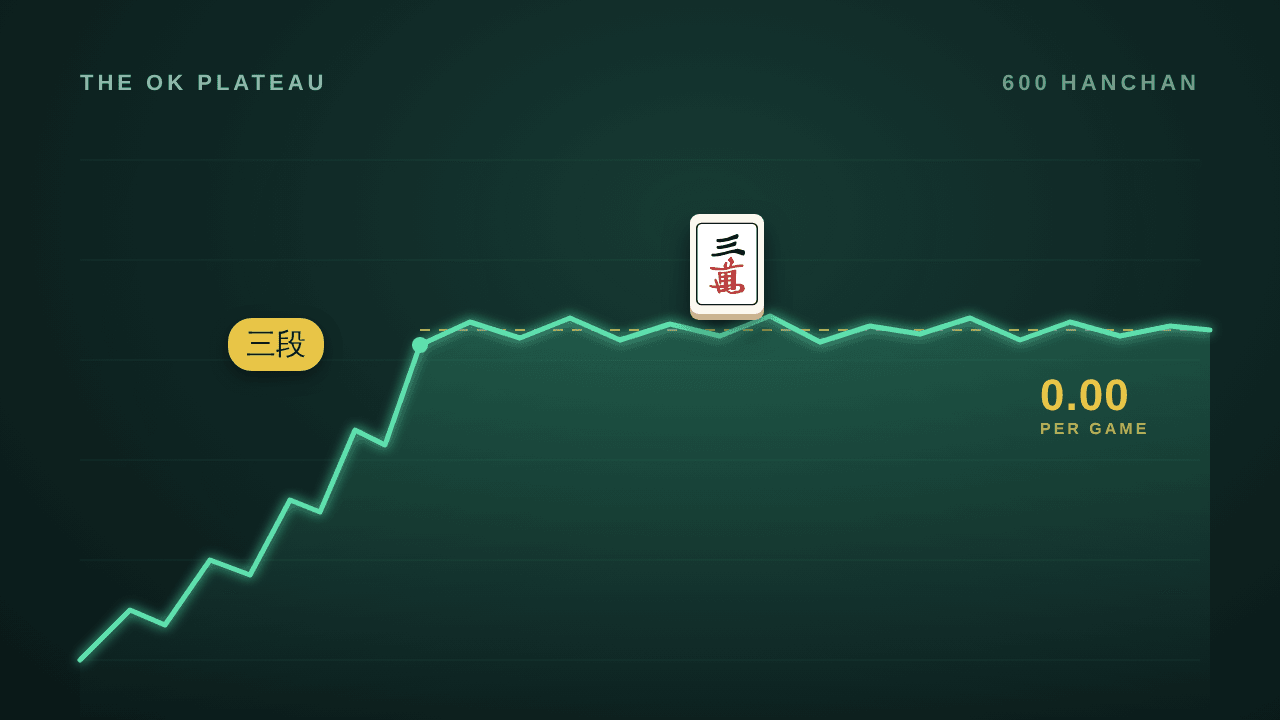
You've played 600 . The first 200 felt like climbing: a new idea every week, a new rank every month. The last 400 feel like nothing. Your discards come in under two seconds. You know the standard plays. Your rank sits at 3- on Tenhou, or Master 1 on Mahjong Soul. It goes up a little, down a little, and back.
In 2011 the journalist Joshua Foer gave this stall a name in Moonwalking with Einstein, his book about the year he spent training his memory. He called it the OK plateau. If your rank has gone flat and your discards come on reflex, you may be standing on one. Foer's point is that you can climb off it.
Where the OK plateau comes from
Foer's example is typing. A passage from the book, reproduced by the economist Miles Kimball, describes how new typists go from pecking with one finger to fluent two-handed typing, until the fingers move on their own. "At this point, most people's typing skills stop progressing. They reach a plateau." People type for hours every day and don't get faster.
Foer explains it with three stages of skill that the psychologists Paul Fitts and Michael Posner described in the 1960s. First comes the cognitive stage, where you think about the task and look for strategies. In the associative stage the big errors drop off and you get more efficient. Then you reach the autonomous stage, "when you figure that you've gotten as good as you need to get at the task and you're basically running on autopilot."
Autopilot frees your attention for everything else, which is why you want it. It's also where the improvement stops. The psychologist K. Anders Ericsson studied top performers across many fields and found, in Foer's summary, that they "develop strategies for consciously keeping out of the autonomous stage while they practice by doing three things: focusing on their technique, staying goal-oriented, and getting constant and immediate feedback on their performance." The best skaters spend more of their practice time on jumps they land less often. Lesser skaters work on the jumps they've already mastered.
The typists got off their plateau the same way. In the experiment Foer cites, words flashed 10 to 15 percent faster than the typists could type them. They fell behind at first, then found what was slowing them down and kept the faster pace.
The best way to get out of the autonomous stage and off the OK plateau, Ericsson has found, is to actually practice failing.
The rank where an even record pays nothing
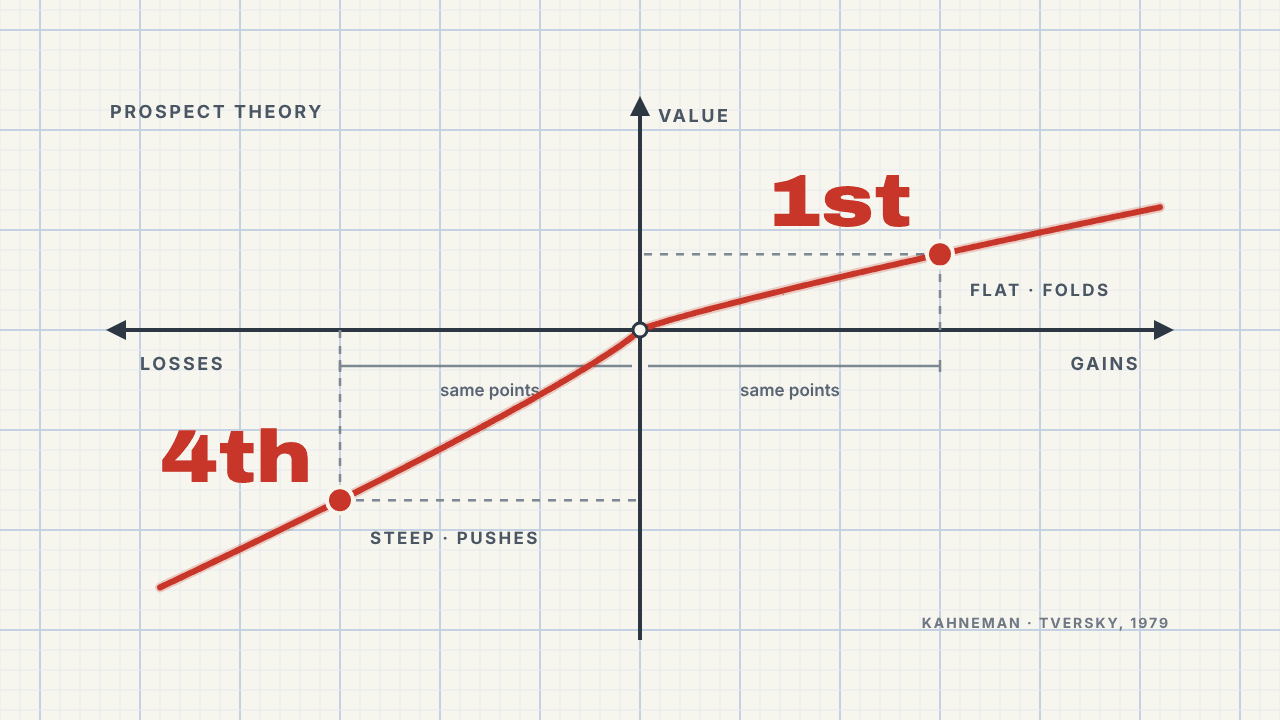
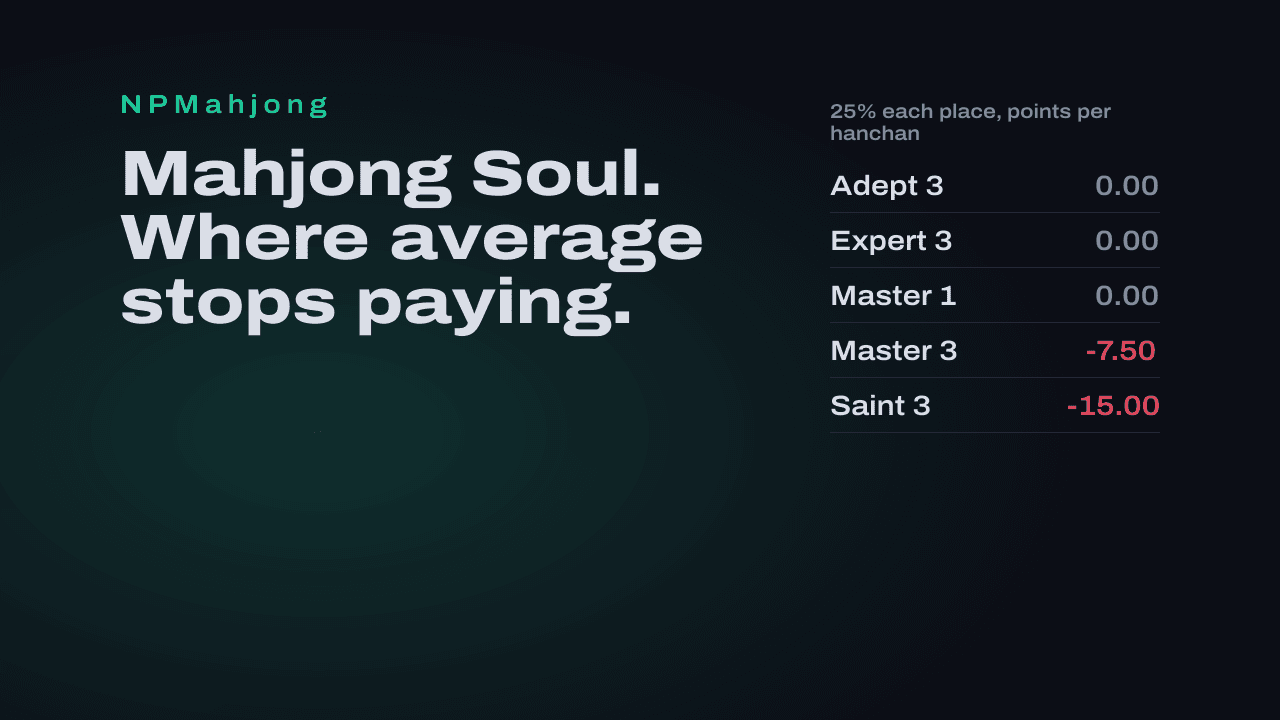
Both big ladders have one. On Tenhou it's 3-dan. The room pays +60 for a hanchan 1st and +15 for 2nd, and a 3-dan loses 75 for a 4th. Finish 25% in each place and you earn 0.25 × 60 + 0.25 × 15 + 0.25 × 0 − 0.25 × 75 = 0.00 a game. The Tenhou manual's stable formula, which the Tenhou rank calculator runs, puts that record at exactly 3-dan. Get promoted on a hot streak and it costs you: at 4-dan in Joukyuu the 4th penalty is 90, and the same record loses 3.75 a game.
On Mahjong Soul the zero is Master 1 in the Jade room, as worked out in the rank-up guide.
| Placement | Tenhou 3-dan / 4-dan | MS Master 1 / 2 |
|---|---|---|
| 1st | +60 / +60 | +125 / +125 |
| 2nd | +15 / +15 | +60 / +60 |
| 3rd | 0 / 0 | -5 / -5 |
| 4th | -75 / -90 | -180 / -195 |
| Even record | 0.00 / -3.75 | 0.00 / -3.75 |
Mahjong Soul's player counts show the pile-up. The fan-run stats site amae-koromo, as the rank-up guide reports it, counts 15.9% of its recorded players at Master 1 and 4.6% at Master 2. More than three times as many players sit on the zero as one step above it.
Tenhou's counts don't bunch up at 3-dan. Its ranking page, in data last updated in April 2025, counts 14,924 four-player accounts at 2-dan, 10,685 at 3-dan, and 7,516 at 4-dan. The average rating is R1741 at 3-dan and R1833 at 4-dan. The room, which pays more for 1st and 2nd, needs 4-dan and R1800. A 3-dan at the R1741 average who gets promoted still can't enter until the rating reaches 1800. Until then it's 4-dan in Joukyuu, where an even record loses 3.75 a game and drifts back toward 3-dan.
An even record earns nothing at these ranks, whatever is behind it. Foer's plateau is one reason a record stays even.
Why mahjong is built for autopilot
Most discards in a hanchan are easy. The isolated honor goes, the stays, you fold the hand two tiles from when someone declares . Those carry you a long way up the ladder. That's the second stage behind you. Then the clicks speed up, and you're in the autonomous stage.
The costly decisions look like the easy ones. The tile that deals in has the same shape as the hundred safe ones you threw on reflex. Autopilot plays the standard move, and in the few spots that decide a placement, the standard move is often the wrong one.
Typing at least tells you when you miss a key. Mahjong grades you wrong a lot of the time. A bad push wins sometimes, and a clean fold gets 'd on. Your placement record can't flag the mistakes either. Per the rank-up guide, a player whose true 4th rate is 22% will show anything from about 14% to 30% over 100 games, roughly 95% of the time. Results won't show you the plateau, and they won't show you leaving it either. So Ericsson's "immediate feedback" has to come from somewhere other than your results.
Getting off the plateau
Slow down one decision
You can't slow down every discard. Pick one kind of decision and slow that one down. A good first choice: your first discard after someone else declares . For the next 20 hanchan, every time it comes up, stop. Count your safe tiles out loud. Say whether you're , and what your hand is worth. Then click.
The typists' drill came at this from the other side. A pace slightly too fast forced them to notice what was slowing them down. Counting out loud before you click does the same job with a pace that feels too slow: the decision stops making itself, and you get to look at it.
Review the same night, and practice failing
Feedback has to be immediate, so review the night you play. The 15-minute kansousen (感想戦, a post-game review borrowed from shogi) takes two hands a hanchan: the and the hand that decided your placement. Decide what you'd change before you open Mortal, the free, open-source AI reviewer.
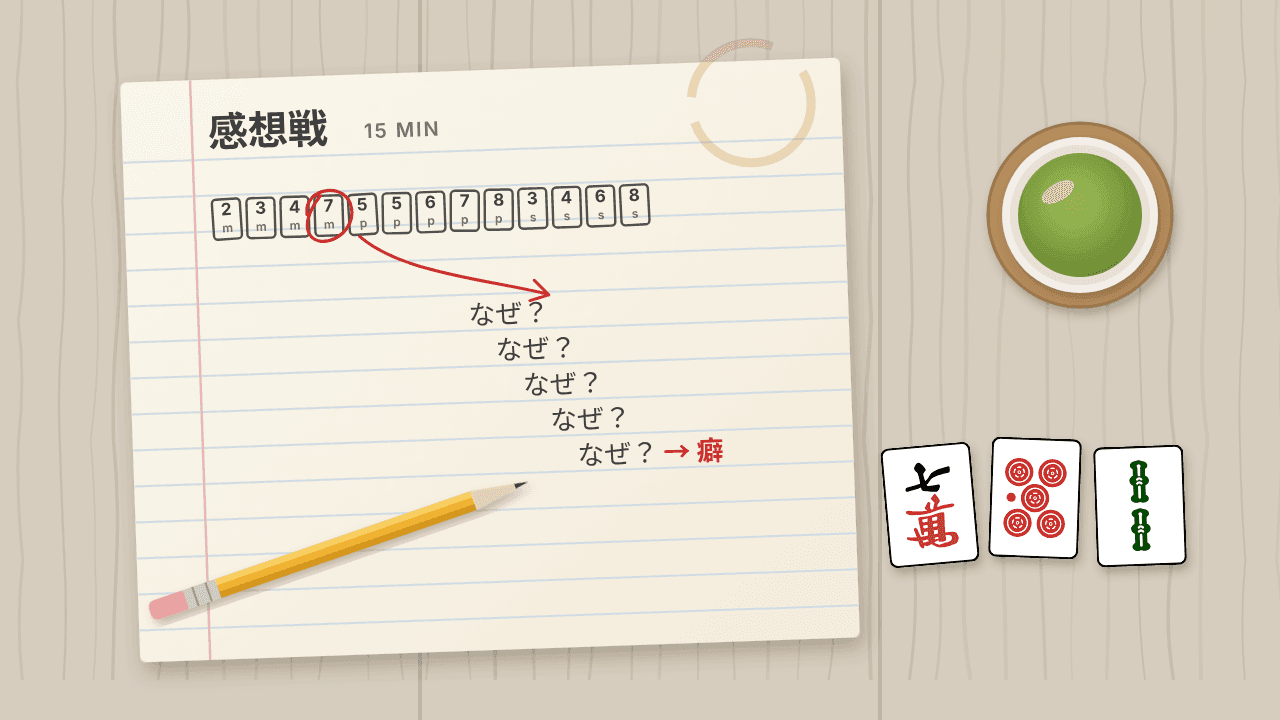
Then practice failing on purpose. Foer describes chess players who replay grandmaster games "one move at a time, trying to understand the expert's thinking at each step." Do the same with a strong log. Tenhou's ranking page lists the players who reached Tenhou-i (天鳳位, Tenhou's top rank), with a haifu (game record, 牌譜) link beside each name. Open one at its first hand. Before each discard, write down yours, then step forward and compare. Count your misses. Each one is a decision your autopilot would have made without you noticing.
Pick one weakness and give it a month
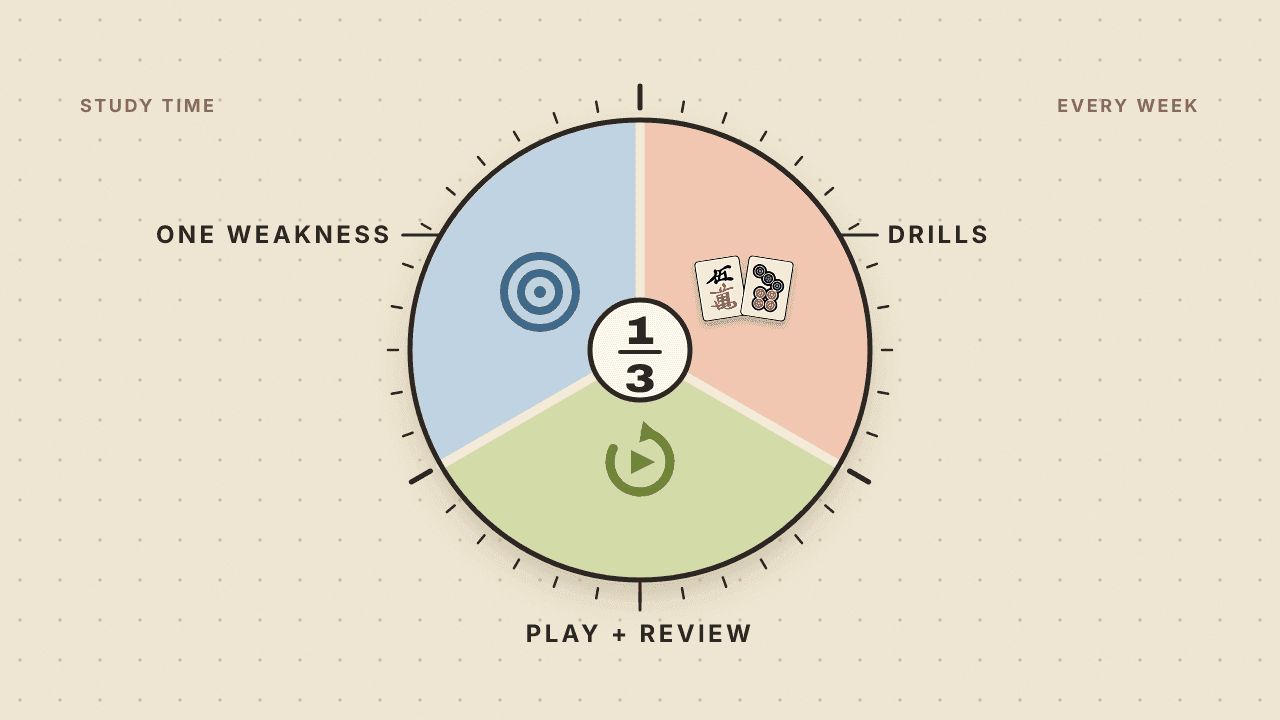
Goal-oriented means a goal narrow enough to check in review, such as "Before every call, say the yaku and the hand value out loud, and log the calls you'd take back." Pick one area for a month, the way the one-third rule splits study time, and check it in every review. The usual candidates are middle-game push/fold, calls, and placement math. Take them one at a time.
What one habit is worth
Take a 3-dan in Joukyuu and turn four 4ths per hundred into 2nds and 3rds, a 25/27/27/21 record:
0.25 × 60 + 0.27 × 15 + 0.27 × 0 − 0.21 × 75 = 15.00 + 4.05 + 0 − 15.75 = +3.30 a game
3-dan starts at 600 points and promotes at 1,200. At +3.30 a game, the 600 points take about 182 hanchan on average. At 4-dan in Joukyuu the same record is worth +0.15 a game, so the work doesn't stop at promotion: you keep improving until your rating reaches 1800 and Tokujou opens. On Mahjong Soul the same record is worth +8.30 at Master 1, about 169 hanchan to Master 2, per the rank-up guide.
Treat the math as an illustration. Four placements per hundred games is about the size of change one fixed leak can make.

What the typing comparison misses
Typing has no opponents and no luck. The typists got their feedback on every keystroke. You get yours from a review you have to choose to do, and the results keep lying to you in the meantime.
Not everyone stuck at the zero is on autopilot. Some players at 3-dan are playing at their real level, and 3-dan is where they belong . Practice isn't the whole story either: a 2014 meta-analysis of 88 studies found that practice accounted for about 26% of individual differences in performance in games.
Foer doesn't treat the plateau as permanent. In his New York Times Magazine piece adapted from the book, quoted at length by Make, he writes that "psychologists used to think that O.K. plateaus marked the upper bounds of innate ability." The typing experiment showed otherwise: the typists' plateau was the speed at which they stopped paying attention.
Get a second pair of eyes
Tonight, pick your one decision and start the 20 hanchan. The decisions you play on reflex are the hardest ones to catch in your own review, because they never felt like decisions.
Send me your logs. I'll read them turn by turn and mark the decisions you make on autopilot that cost you placements, then give you the one to slow down first.
Was this article helpful?