Scroll to the bottom of the tenhou.net home page, or its manual, and the last line is "© C-EGG". That's Yuugen Gaisha Shii Eggu (有限会社シー・エッグ), a Tokyo limited company founded in August 2002 with ¥3 million in capital. Its representative director is Tsunoda Shingo (角田真吾). 4Gamer's game database lists C-EGG as Tenhou's developer and publisher. It was making log analysis and screen-capture software before it ran a mahjong server, and when that server opened in 2006 it wasn't called Tenhou.
The facts below come from C-EGG's and Tenhou's own pages wherever they exist, plus a 2009 press release and a few outside references, each linked. Where those are silent, the post says so.
The company on the copyright line
C-EGG's company profile is short. Founded 2002.8. Representative director Tsunoda. Capital ¥3,000,000. Product sales to about 700 companies as of October 2007. Tenhou's legal notice gives the same address and names Tsunoda as the person responsible for the service.
The company form dates it. Under the old law, a yuugen gaisha (有限会社) was a form of limited company with a minimum capital of ¥3 million. The Companies Act that took effect in May 2006 abolished the form for new companies, and existing ones carried on as tokurei yuugen gaisha (特例有限会社), "special" limited companies. C-EGG's capital sits at exactly the old minimum, and the company registered almost four years before the form closed to new companies.
The site's Tenhou guide puts it in one line: C-EGG developed Tenhou, and Tsunoda runs it. The reading Tsunoda Shingo comes from that guide. C-EGG prints the name in kanji only.
On 18 March 2009, C-EGG and the operator of a mahjong social network announced a joint online tournament with 20 or more women pros playing against ordinary users. The release calls Tenhou one of the largest online mahjong services in Japan. Its company summary lists the same representative director and the same founding date, August 2002.
What C-EGG made before mahjong
The C-EGG homepage shows only the Tenhou link now, but its page source still carries the old catalogue, commented out, and the footer reads "© C-EGG since 2000.6", two years older than the company registration.
- ClickFlow, a desktop log analyzer for websites, version 2.0 in December 2005.
- AppliGuide, a desktop capture tool for making narrated software demos and manuals, which that hidden text says about 500 companies were using.
- BriefPalette, a slide-out sticky-note app.
- FigBox, a Flash app for drawing diagrams on the web, in beta from September 2005.
The press page adds a game, EGG Market, a planet-colonization simulation, now discontinued. It lists coverage of C-EGG's freeware in Windows and PC magazines from the early 2000s, years before the first mahjong article in February 2006.
Hanjukusou, the half-cooked parlor
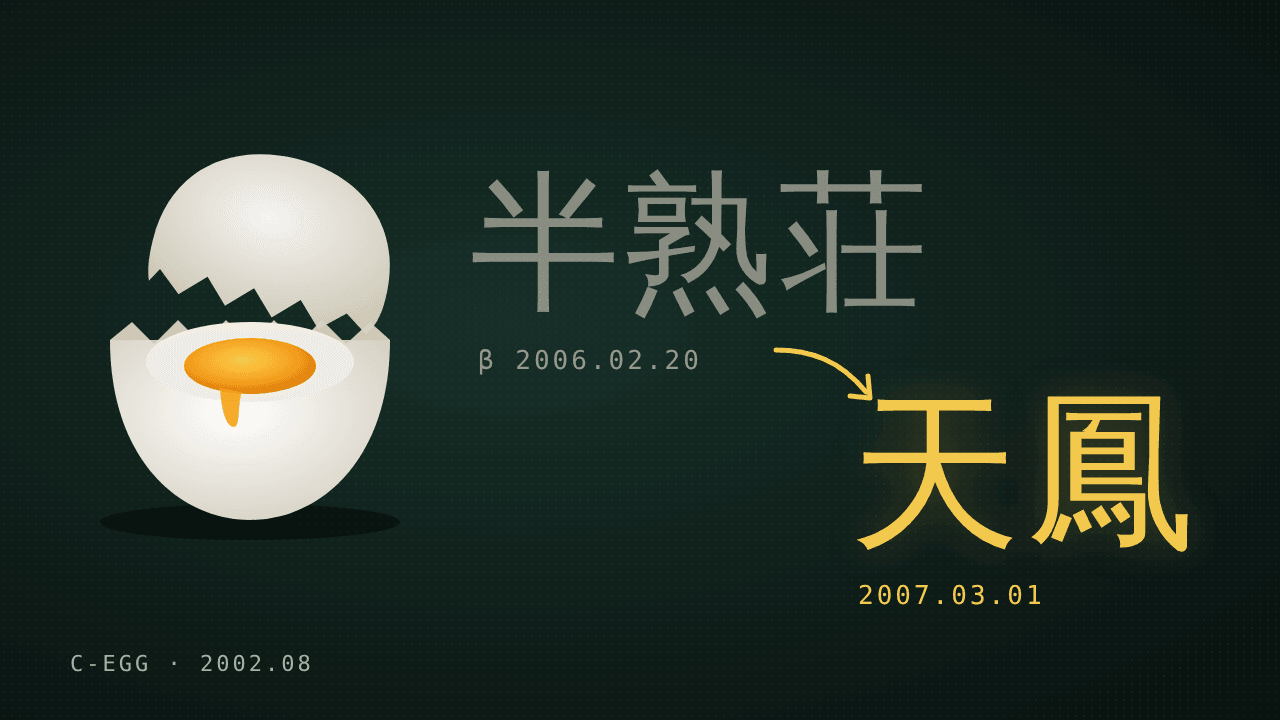
Tenhou's manual ends with a section called Hisutori (ヒストリ), history. Its first line is "06.02.20 半熟荘β": a beta named Hanjukusou (半熟荘) opened on 20 February 2006. The official service started on 1 August 2006, the date 4Gamer's game database also gives, with C-EGG as developer and publisher. The rename came the next spring: "07.03.01 天鳳へ改名", renamed to Tenhou (天鳳) on 1 March 2007.
Read the old name in Japanese and it's a good joke, whether or not anyone meant one. Sou (荘) is the sou of jansou (雀荘), the mahjong parlor. Hanjuku (半熟) is half-cooked, and the Daijisen dictionary gives it four senses: underdone food, short for a soft-boiled egg, unripe fruit, and a skill not yet mastered. A beta server called the half-cooked parlor, run by a company called C-EGG. Neither C-EGG's pages nor Tenhou's manual explains the name.
The launch date has its own coincidence. 1 August is Mahjong Day (麻雀の日), because 8 and 1 read as "pai", the word for a tile, as the post on mahjong words in Japanese explains. If C-EGG picked the date on purpose, it never said so in print.
Twenty years in Tenhou's own timeline
The same history section logs Tenhou's milestones in its own shorthand. A selection, with the manual's YY.MM.DD dates written out.
| Date | Event |
|---|---|
| 20 Feb 2006 | Hanjukusou beta opens |
| 1 Aug 2006 | Official service starts |
| 24 Oct 2006 | 10,000 IDs |
| 1 Mar 2007 | Renamed Tenhou |
| 25 Dec 2007 | 100,000 IDs |
| 1 Feb 2008 | Paid Windows client |
| 20 Feb 2009 | Houou room opens |
| 22 Aug 2010 | 1,000,000 IDs |
| 9 Jun 2012 | 10,000 players online at once |
| 25 Jan 2017 | App released |
| 9 Jun 2021 | 6,000,000 IDs |
| 1 Feb 2026 | 7,350,000 IDs |
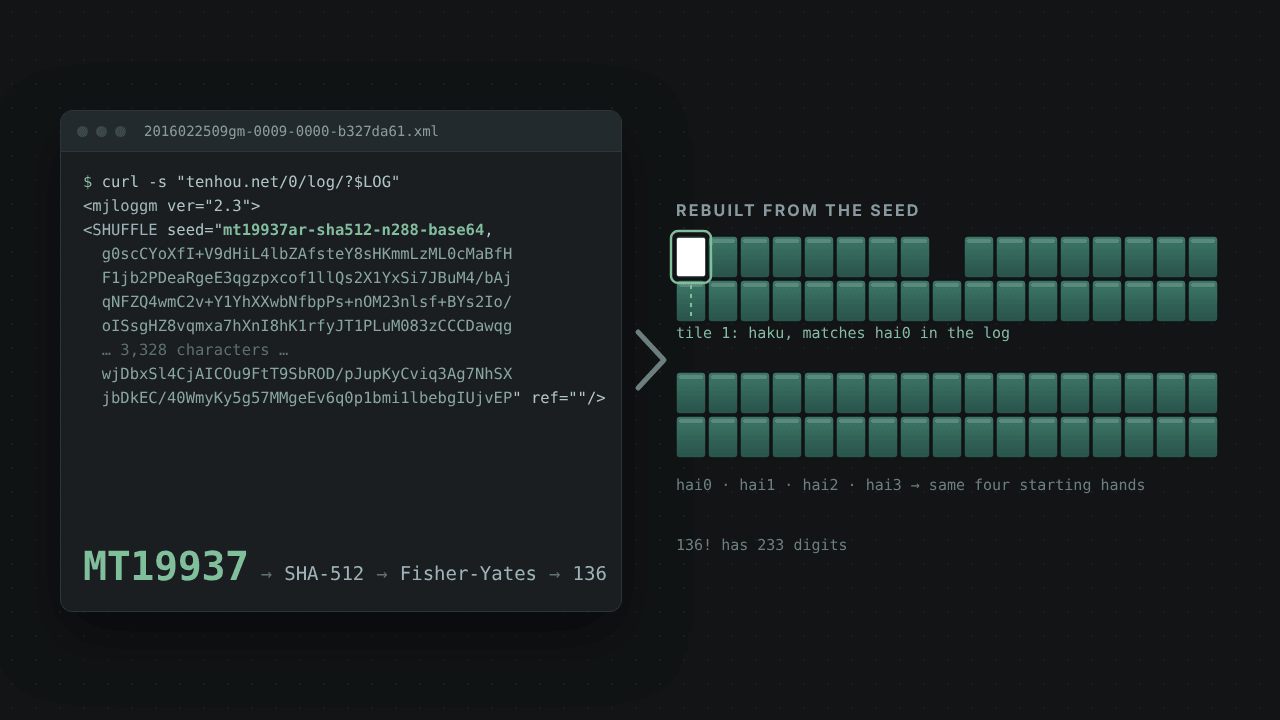
The room, Tenhou's top table, arrived two and a half years after launch. The shuffle went public the same year: Tenhou's blog announced on 13 July 2009 that the wall-generation method and seeds would be published, which is the story of whether Tenhou is rigged.
What the manual says about a 7-dan
I'm Tenhou 7-dan. The manual's four-player table starts a 7-dan at 1,400 points, with 2,800 needed for 8-dan. A 4th place costs 90 in an and 135 in a . The Houou room's floor is also 7-dan, with a rating of 2000 on a paid account.
Why Tenhou charges 4th that much, and what it does to your play off the server, is in the Tenhou guide.
The manual has one more line for this rank. A paid ID that lapses and plays no games against people for 180 days gets deleted below 7-dan. At 7-dan and above it's suspended instead, and the same steps used to reissue an ID bring it back.
The 4th-place penalty grows by 15 per in a , from 45 at 1-dan to 180 at 10-dan. That table is what the Tenhou rank calculator runs on.

Put in your dan, points, placement rates, and room, and it gives your expected points a game, the 4th-place rate where you stop climbing, and how many games the next promotion takes, all from the numbers C-EGG wrote into its manual.
Was this article helpful?