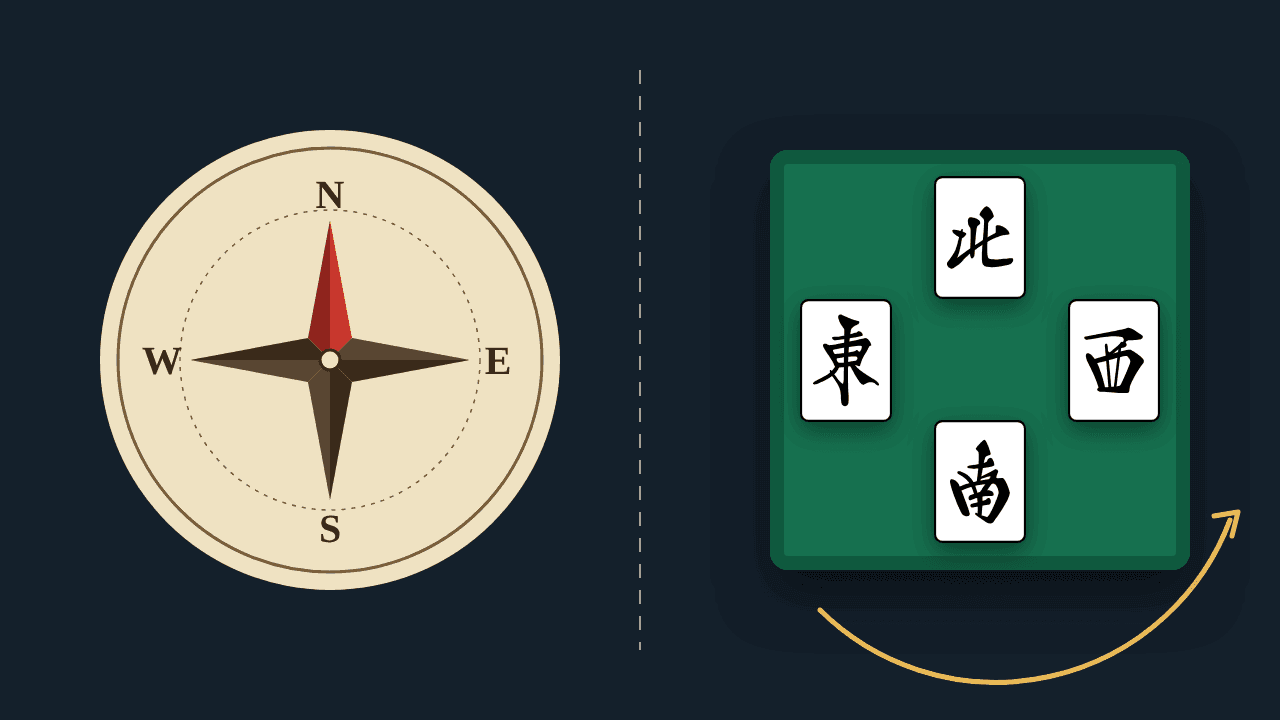
Sit in the East seat. South is on your right, West is across from you, and North is on your left. Now picture a map. Stand at its east edge facing the middle, and South is on your left. The mahjong table is a compass drawn in a mirror.
The European Mahjong Association (EMA) flags it. Its riichi rules place the seats, then add a note: "the counter-clockwise order east-south-west-north does not correlate with the directions of a compass." The note doesn't say why. Three explanations circulate, and each covers a different part of the problem.
What's backwards, exactly
Draw the table from above and turn it so North is at the top. Next to a map, East and West have swapped places.
That's a reflection, not a rotation. You can spin the table any way you like and it won't match the map. A map drawn with south at the top doesn't rescue it either: turn the table so South is at the top, and West sits on the left where a south-up map has East.
You feel it in the play order. Turns pass to the right, counterclockwise around the table. The player on your right, your , is the next wind in the sequence. On a map, East to South to West to North goes clockwise.
| Position | Map | Mahjong table |
|---|---|---|
| Top | North | North |
| Right | East | West |
| Bottom | South | South |
| Left | West | East |
Explanation one: the turn order came first
The Heibonsha World Encyclopedia's entry on mahjong, written by Tezuka Haruo (手塚晴雄), gives the plainest answer. The , it says, came from older flower tiles named dōngwáng, nánwáng, xīwáng, and běiwáng (東王, 南王, 西王, 北王), with the wáng (王, literally "king") removed. The game kept its old direction of play, to the right, migitemawari (右手回り), and the seats took the names in the order east, south, west, north. The entry hedges with "it seems" (思われ) and concludes that this is why south and north ended up opposite their positions on a map.
The entry puts the swap on South and North. This post puts it on East and West. Both are right: a mirror can be drawn across either axis, and the two versions differ only by turning the table half a circle.
Chinese has a set phrase for east, south, west, north, dōngnánxīběi (東南西北), per Wiktionary, though it also uses dōngxīnánběi (東西南北). Japanese has only the second: the everyday phrase is tōzainanboku (東西南北), east, west, south, north. Japanese mahjong ignores it and keeps the Chinese order with Chinese-style readings: , , , .
Explanation two: the winds follow the seasons
A guide to tile symbolism by van 't Veer, hosted on Tom Sloper's site, calls this "the most credible explanation." In China, it says, the east wind blows in spring, the south wind in summer, the west wind in autumn, and the north wind in winter. Over a year the winds come in the order East, South, West, North.
A year's winds can run clockwise around a table as easily as counterclockwise, and on a map they do run clockwise. The seasons tell you why South follows East. They don't tell you why South sits on East's right.
Explanation three: the table is a sky map
The same guide mentions a rival it rates below the seasons: that the winds show "the celestial positions as seen from the Taoist gods in the heaven." It gives no source for the idea.
The geometry is on its side, though. A map of the ground is drawn looking down. A map of the sky is drawn looking up. NASA's STEREO site explains the consequence: "if we want north to be at the top of our map east has to be to the left and west to the right." Turn the mahjong table so North is at the top and East is on the left. The table matches a sky map exactly.
A perfect fit isn't evidence of intent. The turn-order explanation produces the same table by accident. Without a document from the game's early years that says the seats were laid out like the sky, it stays a good story.
Nobody agrees, and the table doesn't care
None of these sources cites a primary document. The EMA rulebook notes the mirror and leaves it there.
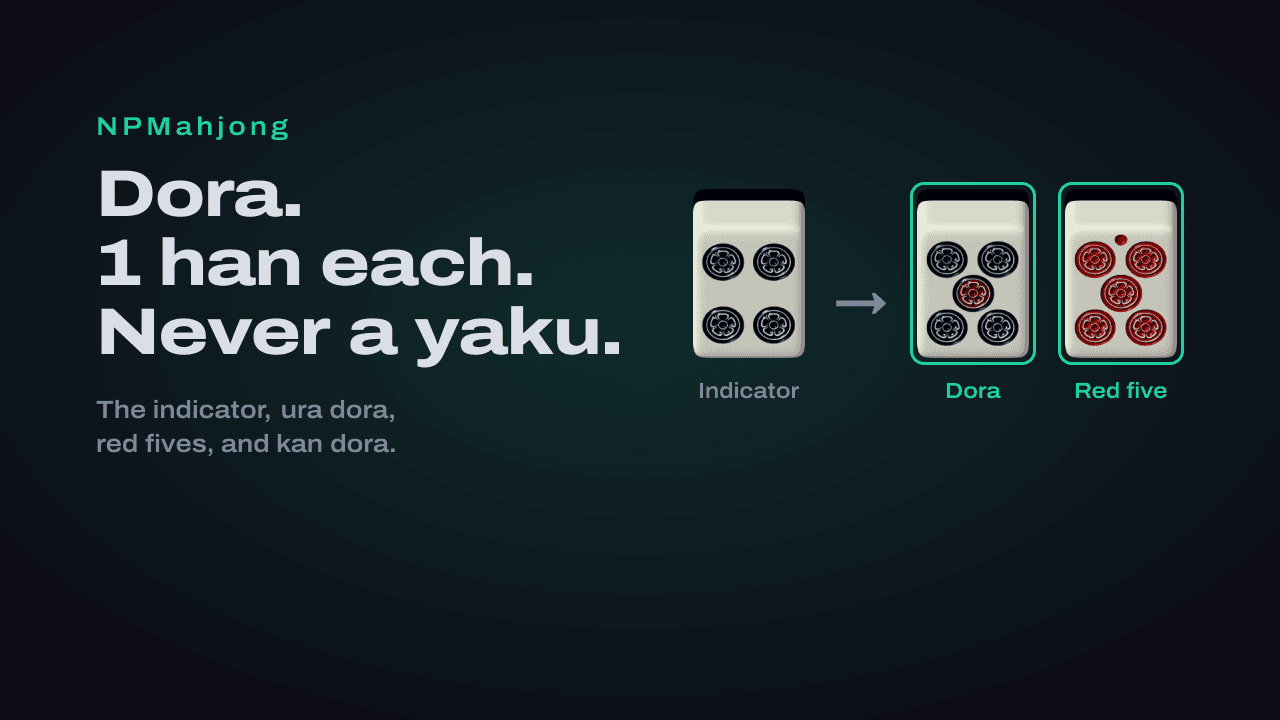
What matters at the table is the order, and it never changes. The dealer seat passes in it, the advances in it, and the dora indicator follows it: an East indicator makes South the , and a North indicator wraps back to East.
Learn the rest of the table's vocabulary in the glossary, where every term has its Japanese, its romaji, and a one-line meaning. Drop the map. The next wind is always on your right.

Was this article helpful?