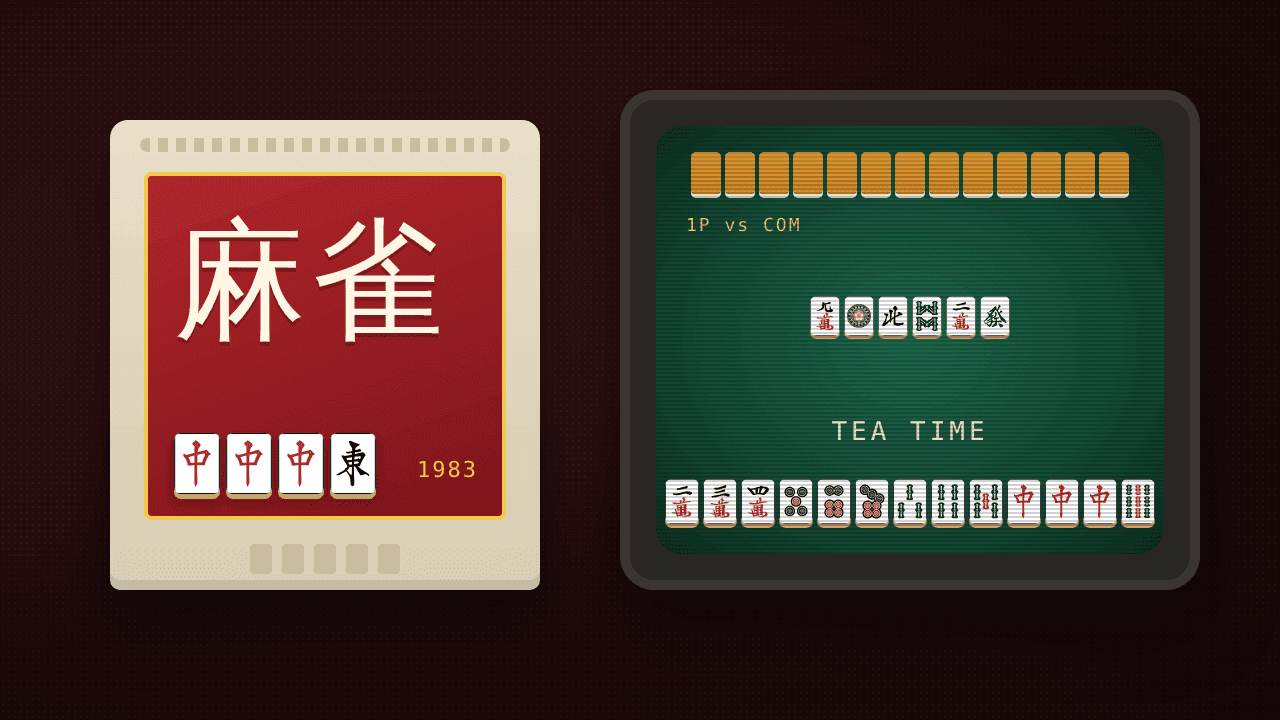
Nintendo released a Famicom cartridge called Mahjong on 27 August 1983, six weeks after the console's first three games. It sold 2.14 million copies, 2.13 million of them in Japan. The Famicom Donkey Kong cartridge sold 1.13 million. A mahjong game against the console outsold it almost two to one.
Those numbers come from the CESA Games White Paper, the annual data book of CESA, Japan's game industry association. It's a paid print publication, so the figures here are CESA's as Wikipedia cites them. The Japanese Wikipedia page cites the 2023 edition for 2.14 million worldwide and 2.13 million in Japan as of the end of 2022, and the English list of best-selling NES games cites the 2021 edition for the same 2.14 million.
Only Mario Bros. sold more
The table lists every 1983 Nintendo Famicom game on that best-sellers list that cites CESA, plus the 1984 four-player follow-up for scale. Baseball sold more than any of them, 3.2 million, but the list sources that figure to Guinness, not CESA, so it stays out of the comparison.
| Game | Famicom release | Copies |
|---|---|---|
| Mario Bros. | 9 Sep 1983 | 2,280,000 |
| Mahjong | 27 Aug 1983 | 2,140,000 |
| 4 Nin Uchi Mahjong | 2 Nov 1984 | 1,450,000 |
| Donkey Kong | 15 Jul 1983 | 1,130,000 |
| Donkey Kong Jr. | 15 Jul 1983 | 1,110,000 |
| Popeye | 15 Jul 1983 | 1,100,000 |
A fan list of Nintendo's mahjong games gives the full run from 1983 to 2015, and notes that 4 Nin Uchi Mahjong was Hudson Soft's port of its own computer game.
What was on the cartridge
The game was two-player mahjong. You sat across from a single computer opponent, and the console never let two humans play each other. The Japanese Wikipedia page lists the rules, without a source for them: allowed even with under 1,000 points left, and in play, on, 30,000 starting points each, and a game of four hands, East 1, East 2, South 1, South 2.
There were three difficulty levels. The same page says the beginner level dealt you better starting hands and stopped you from making illegal moves, and the top level put a 12-second clock on some decisions. Pause the game and the screen showed a cup of coffee or tea with the words "TEA TIME".
The English Wikipedia page lists the cartridge's afterlife: playable inside the Japanese Animal Crossing for GameCube, and added to Nintendo Classics on 4 July 2024. The arcade version, VS. Mahjong, reached Switch through Hamster's Arcade Archives in February 2020, per the Japanese page.
Why one opponent sold
A mahjong table needs other people. That's the problem every player knows. I worked as staff in an Osaka parlor, and part of that job is sitting down as the fourth when a table is one short. The parlor post covers what that's like.
The cartridge solved the same problem with a box under the TV. Inside Games' look back at the Famicom's first year says the same. Mahjong and baseball both need an opponent in real life, the Famicom supplied one, and plenty of households ended up with a Famicom the father had bought to play himself. No fourth to find, and nobody watching you misread a wait.
Nintendo also sold the tiles
Nintendo started in 1889 making , and its corporate history lists playing cards from 1902, the first home TV game consoles in 1977, and Game & Watch in 1980. Mahjong tiles don't appear on that page. They existed anyway.
Nintendo sold full mahjong sets under the name Yakuman (役満), the word for a limit hand. Nintendo World Report says the brand dates from 1964, and Taiwan's Business Next, citing SankeiBiz, says the same and adds that no new set came out between 1976 and 2013. Neither names a primary source, so take 1964 as the reported date. If it's right, Nintendo was selling mahjong sets thirteen years before its first home TV game console.
The brand is real either way. On 29 November 2013 Nintendo released a new set, Yakuman Houou, for ¥18,900, following earlier sets in the line such as Yakuman Juuryou (役満 重量) and Yakuman Tokujuu (役満 特重). Its 1-pin carries a Nintendo turtle mark, and the point chips carry the Nintendo logo.
The name moved from the tiles to the machines. It went on a 1983 handheld, then on most of Nintendo's mahjong games from 1989: Yakuman on Game Boy, Yakuman DS, and in 2015 a Wii U and 3DS game called Yakuman , the same name as the 2013 tile set.
Nintendo's first link cable was for mahjong
Seven weeks after the Famicom cartridge, on 18 October 1983, Nintendo released Computer Mah-jong Yakuman, a handheld with a dot-matrix screen and 20 buttons, 13 of them for the 13 tiles in your hand. It cost ¥16,800, more than the Famicom's ¥14,800, and it sold poorly. It was also the first Nintendo handheld with a link cable, sold separately, so two players could connect their units and play each other.
Six years later the idea came back. Yakuman, developed by Intelligent Systems, was one of four Japanese launch games for the Game Boy on 21 April 1989, alongside Super Mario Land. It and Baseball were the two launch games with two-player play over the Game Link Cable.
The fourth player is online now
The 1983 pitch was one opponent and no waiting. Today a free client finds you three human opponents and counts the score for you. Where to play riichi online compares the options.
The Famicom's beginner level dealt you a better hand. Nobody online will. If you want to practice the decisions instead of the deal, the What would you discard problems give you a real hand and one question at a time.
Was this article helpful?