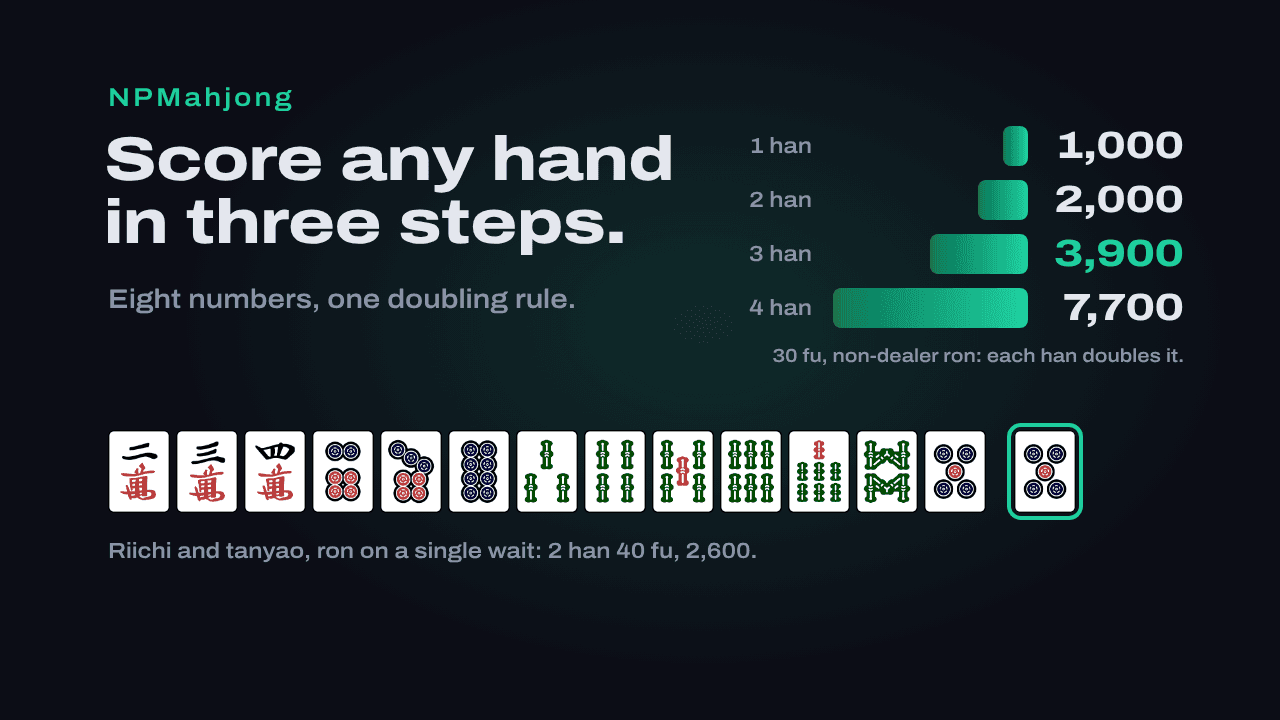
The full score table has more than a hundred cells. You don't need it. In 300,000 games on Tenhou's top table, one win in five was a limit hand, where the fu don't matter. Of the rest, nine in ten were 30 or 40 . Learn the limits and two columns and you've covered about 92% of the wins in that sample.
Every widget below runs on the same code as the site's score calculator, so play with them. The numbers follow Tenhou's ranked rules, and three settings change them at other tables.
Score a hand in three steps
- Count the . Yaku plus . Five or more? It's a limit hand. Read it off the limit table and you're done.
- Pick the fu. Under five han, decide between 30 and 40 with the four boxes below. Count properly only when the hand gives you a reason.
- Read the payment. Use the eight anchor numbers, and slide from them for anything else.
That's the whole method.
Step 1: five han or more, stop counting
From five han up, the fu stop mattering and every hand pays a fixed amount. Each limit is a multiple of .
| Limit | Han | Dealer ron | |
|---|---|---|---|
| , ×1 | 5 | 8,000 | 12,000 |
| , ×1.5 | 6-7 | 12,000 | 18,000 |
| , ×2 | 8-10 | 16,000 | 24,000 |
| , ×3 | 11-12 | 24,000 | 36,000 |
| , ×4 | 13+ | 32,000 | 48,000 |
Learn the non-dealer column and the rest follows. The gets half again: 8,000 becomes 12,000. At the limits, "half again" is always exact, because these numbers never need rounding. Below mangan it only sometimes is.
A hand under five han can still hit the cap. Four han at 40 fu or more pays a mangan, and so does three han at 70 fu or more. The two invisible han post explains where the cap comes from.
Step 2: the fu are almost always 30 or 40
Counting fu (符計算) is the part of scoring that beginners dread, and you can mostly skip it. The developer of a fu-training app counted 300,000 games from Tenhou's top table, . Among wins of four han or less, 62.6% were 30 fu and 27.3% were 40 fu. Twenty fu ( ) was 5.2%, 25 fu () 1.9%, 50 fu 2.3%, and everything from 60 up, 0.6% put together.
So guess first. The sirkus point dojo, a Japanese scoring site, sorts every hand into four boxes.
| How the hand won | Default fu | Right this often |
|---|---|---|
| , ron | 40 | 90% |
| Closed hand, tsumo | 30 | 81% |
| Open hand, ron | 30 | 85% |
| Open hand, tsumo | 30 | 72% |
Three hands have fixed fu and skip the boxes: pinfu by tsumo is 20, pinfu by ron is 30, and seven pairs is 25, never rounded.
Why the boxes work
Every hand starts at 20 fu. A closed ron adds 10, so it starts at 30. A closed hand that isn't pinfu always has at least 2 fu more, and 32 rounds up to 40. That's why the box is right for 90% of closed rons that aren't pinfu or seven pairs. Most of the rest climb to 50.
A tsumo starts at 22: the base 20 and 2 for the tsumo. It has 8 fu of headroom before it rounds past 30. An open ron starts at 20 and is never scored below 30, so it has 10 fu of headroom. Small extras fit inside that room: a pair of dragons, an , or one triplet of 2s.
When to count for real
Count the fu properly only when the hand shows one of these signals, the dojo's three plus one for Tenhou:
- A quad (), open or closed.
- A concealed triplet of 1s, 9s, or honors.
- Two or more triplets.
- On Tenhou, a pair of your that is also the , on a tsumo.
With none of them, the box is right every time. Put every combination of four sets, pair, wait, and win through the site's fu counter, and every shape without a signal lands on its box, or on its fixed value if it's pinfu.
When you do count, triplets are the part to know. Start at 2 for an open triplet of 2s to 8s. Double it for a closed triplet, double it for 1s, 9s, or honors, and multiply by four for a quad. A closed quad of East is 2 × 2 × 2 × 4 = 32 fu.
Fu builder
Build a hand and count its fu
Set the parts. Every line that adds fu shows up below, then the sum rounds up to the next 10.
Try a hand
Fu breakdown
- Base+20
- Closed ron+10
Sum
20 + 10 = 30
30fu
30 needs no rounding.
Triplet ladder
Open triplet, 2 to 8:2×2 closed×2 for 1, 9 or honor×4 for a quad
| Meld | Triplet | Quad |
|---|---|---|
| Open, 2 to 8 | 2 | 8 |
| Closed, 2 to 8 | 4 | 16 |
| Open, 1, 9 or honor | 4 | 16 |
| Closed, 1, 9 or honor | 8 | 32 |
The builder's triplet ladder shows that chain. Set a meld to an honor triplet, tick Called, change the wait, and watch which changes push the total past the next multiple of 10.
Step 3: eight anchor numbers
Here are the two columns that cover most hands under five han.
| Han | 30 fu | 40 fu |
|---|---|---|
| 1 han | 1,000 (rounded up) | 1,300 (rounded up) |
| 2 han | 2,000 (rounded up) | 2,600 (rounded up) |
| 3 han | 3,900 (rounded up) | 5,200 (rounded up) |
| 4 han | 7,700 (rounded up) | 8,000Mangan |
Read the 30 fu column out loud: 1,000, 2,000, 3,900, 7,700. Japanese parlor talk turns it into a chant, セン、ニセン、ザンク、チッチー (sen, nisen, zanku, chicchi), the digits said fast. The 40 fu column is イチサン、ニーロク、ゴンニ (ichisan, niroku, gonni), and then mangan. You'll hear these at a Japanese table, but not from Saikouisen pros: that organization's rulebook bans abbreviations in score calls, so they say the number.
Why it's 3,900, not 4,000
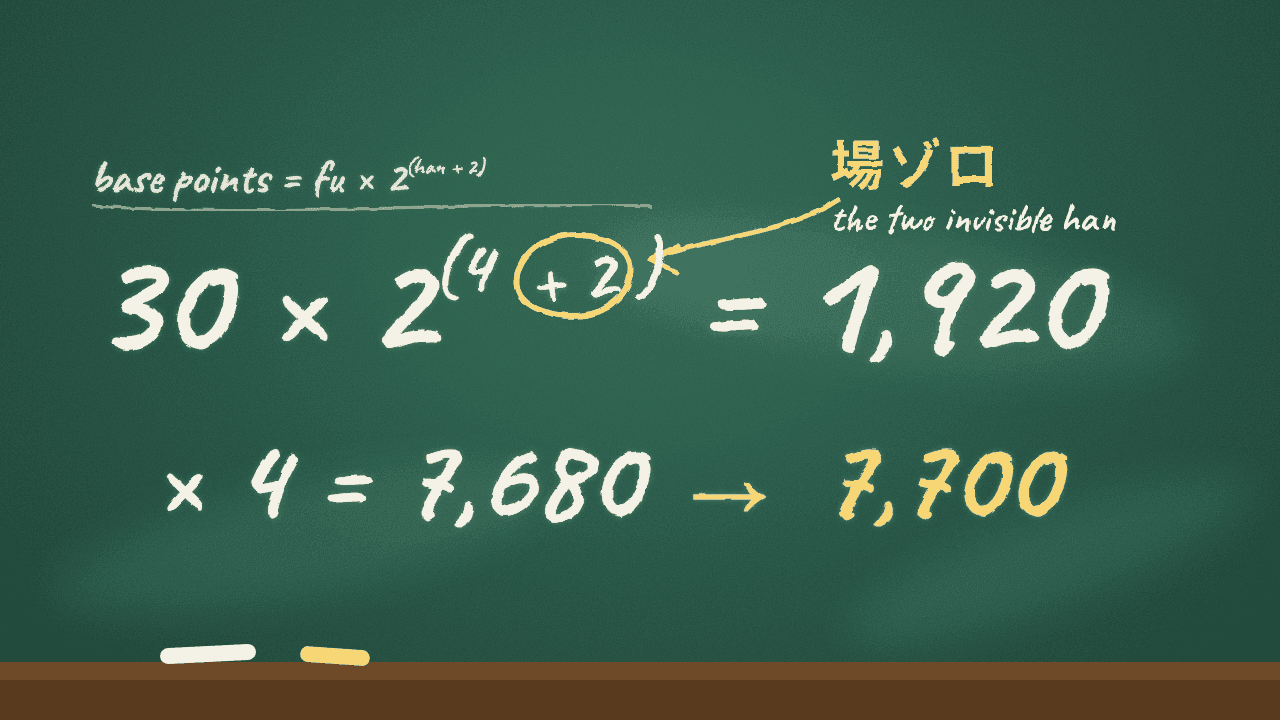
Behind every payment sits one number, the basic points: fu × 2^(han + 2). One han at 30 fu is 30 × 8 = 240 basic points, and a non-dealer ron pays four times that: 960, rounded up to 1,000. The scoring reference calls the same number base points, and the two invisible han post explains the +2.
Every extra han doubles the basic points. The table doubles the raw number and rounds once, at the end. Double the 960 three times and you get 1,920, 3,840, and 7,680. Round each one up and you have 2,000, 3,900, and 7,700.
Try it
Each han doubles the hand
Pick a fu and a seat. Each bar is the hand's basic points: fu × 2han + 2. The dashed line is the mangan cap at 2,000.
- 1 han1,000240 basic
- 2 han2,000480 basic
- 3 han3,900960 basic
- 4 han7,7001,920 basic
- 5 hanMangan: 3,840 basic points before the cap.8,0002,000 basic
Non-dealer ron pays basic points × 4. 1,000 to 2,000 to 3,900 to 7,700: each han doubles the hand, and rounding up to the next 100 hides the exact doubles. At 5 han the mangan cap holds the hand at 8,000.
Doubling the fu is worth one more han: 2 han 30 fu has the same basic points as 1 han 60 fu (480).
Move the fu to 40 and watch the four-han bar cross the mangan line. That's why 40 fu caps at 8,000 while 30 fu stops at 7,700.
Other fu: double the fu, add a han
Double the fu and the basic points double, exactly as if you'd added a han. You never need to learn the 60 or 80 fu columns. Fifty fu you do learn, but it's the easy one: 1,600, 3,200, 6,400, no rounding anywhere.
- 60 fu is the 30 fu column one han higher.
- 80 fu is the 40 fu column one han higher.
- 20 fu, pinfu tsumo, is the 40 fu column one han lower.
- 25 fu, seven pairs, is the 50 fu column one han lower.
Two han at 60 fu pays 3,900, like three han at 30. One han at 80 fu pays 2,600, like two han at 40.
That leaves 70 fu, which pays 2,300 and 4,500 for one and two han. Learn both by heart. Adding the 30 and 40 fu payments works at one han (1,000 + 1,300 = 2,300) but gives 4,600 at two, 100 too many. Ninety and 110 fu barely showed up in that count: 90 fu rounds to 0.000%, and 110 fu isn't listed at all. Let the calculator have them.
Every payment below mangan, except at 70, 90, and 110 fu, sits on a doubling chain. The tsumo shares use the same chains as the ron payments, and the dealer's ron adds two chains of its own, which the dealer section covers. Mahjong Dragon calls these chains "lines".
Each chain starts from one basic-points value. Keep doubling that value, not the rounded payment, and round each step up to 100:
- From 240 basic (30 and 60 fu): 300, 500, 1,000, 2,000, 3,900, 7,700.
- From 320 basic (20, 40, and 80 fu): 400, 700, 1,300, 2,600, 5,200, then mangan.
- From 400 basic (25, 50, and 100 fu): 400, 800, 1,600, 3,200, 6,400, then mangan.
The dealer: times six, not times 1.5
The dealer's ron is basic points × 6, where yours is × 4. That sounds like "add half". It isn't, quite, because your payment was already rounded. Two han at 30 fu pays you 2,000. Half again is 3,000, but the dealer collects 2,900: 480 basic points × 6 is 2,880, rounded up once.
| Han | 30 fu | 40 fu |
|---|---|---|
| 1 han | 1,500 (rounded up) | 2,000 (rounded up) |
| 2 han | 2,900 (rounded up) | 3,900 (rounded up) |
| 3 han | 5,800 (rounded up) | 7,700 (rounded up) |
| 4 han | 11,600 (rounded up) | 12,000Mangan |
Two tricks save you most of this table. The dealer's 40 fu column is your 30 fu column one han early: 2,000, 3,900, 7,700, then 12,000 for the cap. And the dealer's 30 fu column is a chain and a chant of its own: イチゴー、ニック、ゴッパー、ピンピンロク (ichigo, nikku, goppa, pinpinroku), 1,500, 2,900, 5,800, 11,600. Its 25 and 50 fu chain runs 2,400, 4,800, 9,600.
Tsumo: who pays what
On a ron, the player who discarded the tile pays it all. On a tsumo, everyone pays.
- Non-dealer tsumo. The dealer pays a double share, basic points × 2. Each other player pays one share, basic points × 1. The table writes it as 1,000/2,000: non-dealers first, then the dealer.
- Dealer tsumo. Everyone pays a double share. The table writes 2,000 all.
Each share rounds up on its own, so a tsumo can collect more than the same hand by ron. One han at 30 fu pays 1,000 on a ron and 300/500 on a tsumo: 300 + 300 + 500 is 1,100.
The small numbers at the start of each doubling chain are these shares. A 30 fu tsumo pays 300/500 at one han, 500/1,000 at two, and 1,000/2,000 at three. Same chain.
Who pays
Follow the points around the table
East is the dealer. Tap a seat to pick the winner. On a ron, switch to Discarder and tap the seat that dealt in.
Tap a seat to set the
Winner. On a tsumo the other three pay.
Who pays what
- East pays 2,000.
- West pays 1,000.
- North pays 1,000.
- South gains 4,000 in all.
Non-dealer tsumo: the dealer pays double a non-dealer's share, each rounded up to 100.
30 × 25 = 960 basic points.
East: 960 × 2 = 1,920, rounded up to 2,000. Each non-dealer: 960, rounded up to 1,000.
Tap a seat to move the win, switch to ron, and pick who dealt in. Make East win and every arrow carries the same number.
Your 30 and 40 fu columns by tsumo, the non-dealers' share first:
| Han | 30 fu | 40 fu |
|---|---|---|
| 1 han | 300/500 (rounded up) | 400/700 (rounded up) |
| 2 han | 500/1,000 (rounded up) | 700/1,300 (rounded up) |
| 3 han | 1,000/2,000 (rounded up) | 1,300/2,600 (rounded up) |
| 4 han | 2,000/3,900 (rounded up) | 2,000/4,000Mangan |
Honba and riichi sticks
Two extras ride on top of the hand. Each adds 300 to the next win: all of it from the discarder on a ron, or 100 from each payer on a tsumo. Each stick on the table is 1,000 more for whoever wins. Three han 30 fu by ron with two and one stick out: the discarder pays 3,900 + 600 = 4,500, and you collect 5,500 with the stick. Same hand by tsumo: 1,200 from each non-dealer and 2,200 from the dealer, 5,600 with the stick.
Rules that change the numbers
This guide follows Tenhou's ranked rules, the same as the score calculator. Three settings differ elsewhere, so ask before your first hand.
- Kiriage mangan. Four han 30 fu and three han 60 fu land 80 basic points short of the cap. Tenhou's ranked games pay 7,700. M-League and my own association, the Japan Professional Mahjong Association (NPM), round them up to a mangan: 8,000, and 12,000 for the dealer's 11,600.
- The double-wind pair. A pair of East when you're East in the East round is 4 fu on Tenhou and 2 fu under M-League and NPM rules.
- Thirteen han. Tenhou and Mahjong Soul pay a . The EMA rules cap it at sanbaiman.
Five mistakes that cost points
- Pinfu tsumo at 30 fu. It's 20. Pinfu skips the 2 tsumo fu, so it never rounds up.
- An open all-sequence ron at 20 fu. It's 30. An open hand is never scored below 30.
- A (two-pair wait) ron with the finished triplet counted as closed. The triplet the ron completed counts as open, 2 fu for 2s to 8s. The hand stays closed and keeps the 10 fu for a closed ron.
- Rounding seven pairs. Twenty-five fu stays 25. Two han seven pairs by ron pays 1,600.
- Doubling a rounded payment. 2,000 doubled is 4,000, but three han at 30 fu pays 3,900. Double the basic points, then round.
Practice until the numbers say themselves
The drill deals a seat, a win, the han, and the fu. Pick the payment, out loud first. Miss one and it comes back two questions later.
Drill
What does it pay?
0 of 0 right
- Winner
- Non-dealer
- Win
- Ron
- Han
- 4
- Fu
- 40
Say the number out loud before you tap it.
When the anchors come without thinking, take real hands to the fu quiz, which deals a finished hand and asks for the fu or the payment. The cheat sheet puts both score tables on one printable page, and the full scoring reference has every rule this guide skipped. Learn the 30 and 40 fu columns this week, and you'll stop reaching for the hundred-cell table.
Was this article helpful?