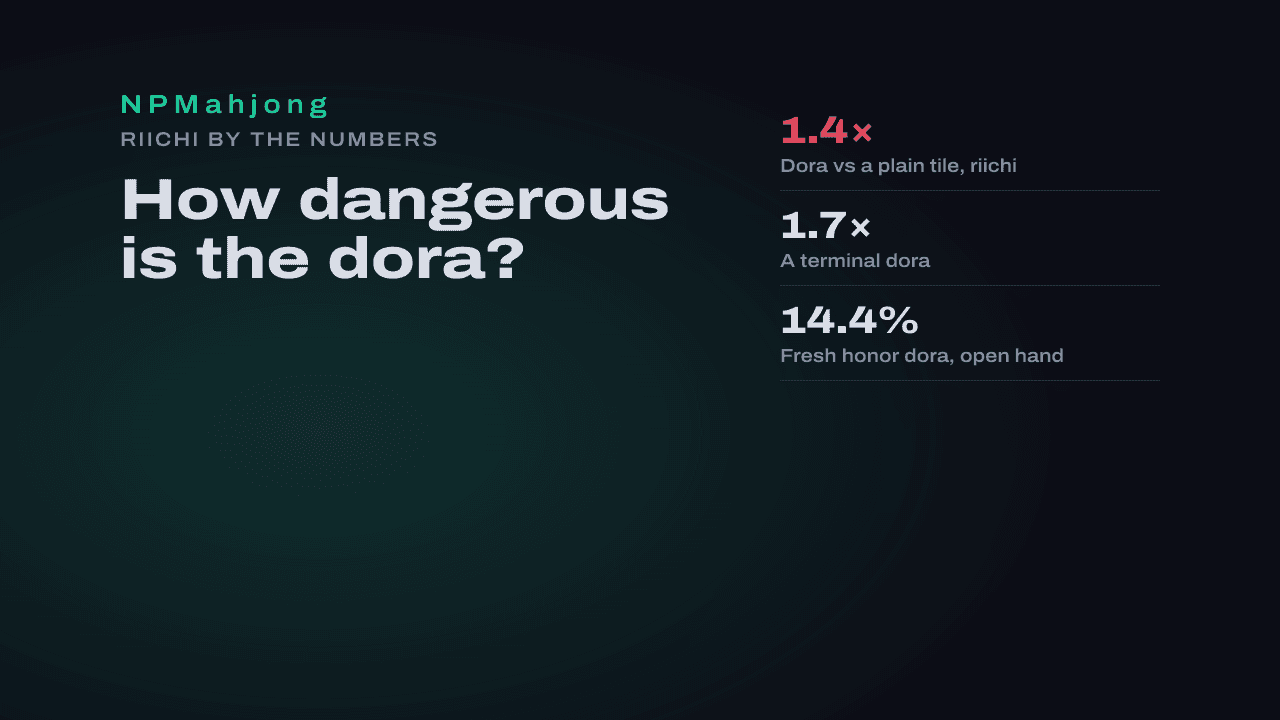
A goes up and the 5 is sitting in your hand. In Tenhou's room, when the dora is a 5, 11.5% of riichi hands are waiting on it. A 5 that isn't dora shows up in 8.0% of riichi waits. Throw the dora into a fresh riichi and you're about 1.4 times as likely to deal in as with a plain 5.
Every number here comes from Tenhou Houou logs 2016–2020, analysis by chienshyong (fork of Euophrys/houou-analysis). That's Houou-level 4-player , so your table may differ. The sample covers 273,951 riichi hands and 357,644 open hands.
What the numbers measure
The analysis looks at each riichi the moment it's declared and reads the hand's wait. It does the same for open hands, the first time a player with calls reaches by cutting a tile from hand. Then it sorts each wait by how it touches the dora.
Two definitions matter:
- On the dora means the dora tile itself is one of the winning tiles.
- Around the dora means the wait doesn't include the dora but sits close to it. That covers a with the dora inside the shape, like 4-5 waiting on 3-6 when 5 is dora, any single-tile wait one or two steps from the dora, and a few three-sided and complex shapes built around it.
The share of waits that include a tile is your chance of dealing in with that tile, thrown right after the riichi, before you've read anything else. So "11.5% of riichi waits include the dora 5" means an 11.5% chance on that throw.
Three limits apply. Only the first dora counts, so and red fives aren't in it. The analysis doesn't check . And the baseline for an ordinary tile comes from a separate wait analysis in the same repo, 142,461 riichi hands. Treat the comparisons as rough.
The dora is about 1.4 times as dangerous
Here's how often a riichi hand waits on the dora, next to how often it waits on the same tile when that tile isn't dora.
| Dora | On the dora | Same tile, not dora | Multiple | Around the dora |
|---|---|---|---|---|
| 1 | 7.0% | 4.1% | 1.7× | 5.3% |
| 2 | 8.5% | 5.3% | 1.5× | 9.1% |
| 3 | 9.7% | 6.2% | 1.5× | 11.7% |
| 4 | 11.1% | 7.8% | 1.4× | 12.6% |
| 5 | 11.5% | 8.0% | 1.4× | 14.5% |
| 6 | 10.9% | 7.9% | 1.3× | 13.4% |
| 7 | 9.5% | 6.3% | 1.5× | 11.8% |
| 8 | 8.0% | 5.3% | 1.5× | 8.5% |
| 9 | 6.3% | 4.1% | 1.5× | 4.7% |
The middle tiles carry the most raw danger. A 4, 5, or 6 dora sits in 10.9% to 11.5% of riichi waits, because middle tiles connect to the most shapes. A terminal dora is in 6.3% to 7.0%.
The terminals gain the most, though. A 1 that's dora is 1.7 times as dangerous as a plain 1. That fits how hands get built. Nobody keeps a lone 1 for its shape, but a dora 1 is worth a , so players hold it and wait on it.
Add the two columns together and one riichi in four is waiting on a dora 5 or on a tile right around it: 25.9%.
Take a case I use when I teach this: turn 9, dealer riichi, the dora is 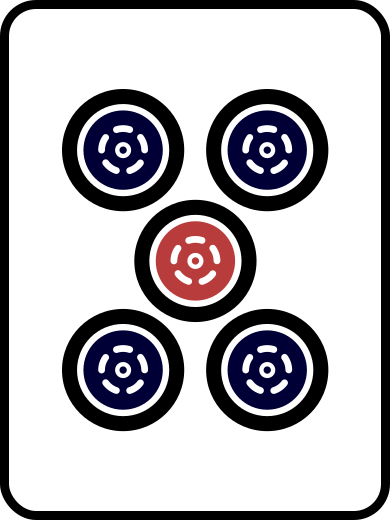 and you hold one, with a on a two-sided wait. The table says the dora 5p is 1.4 times as dangerous as a plain tile. The riichi player's pond says more: an early
 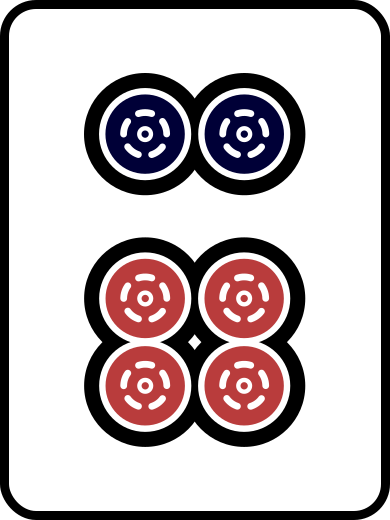 cut from hand, then a
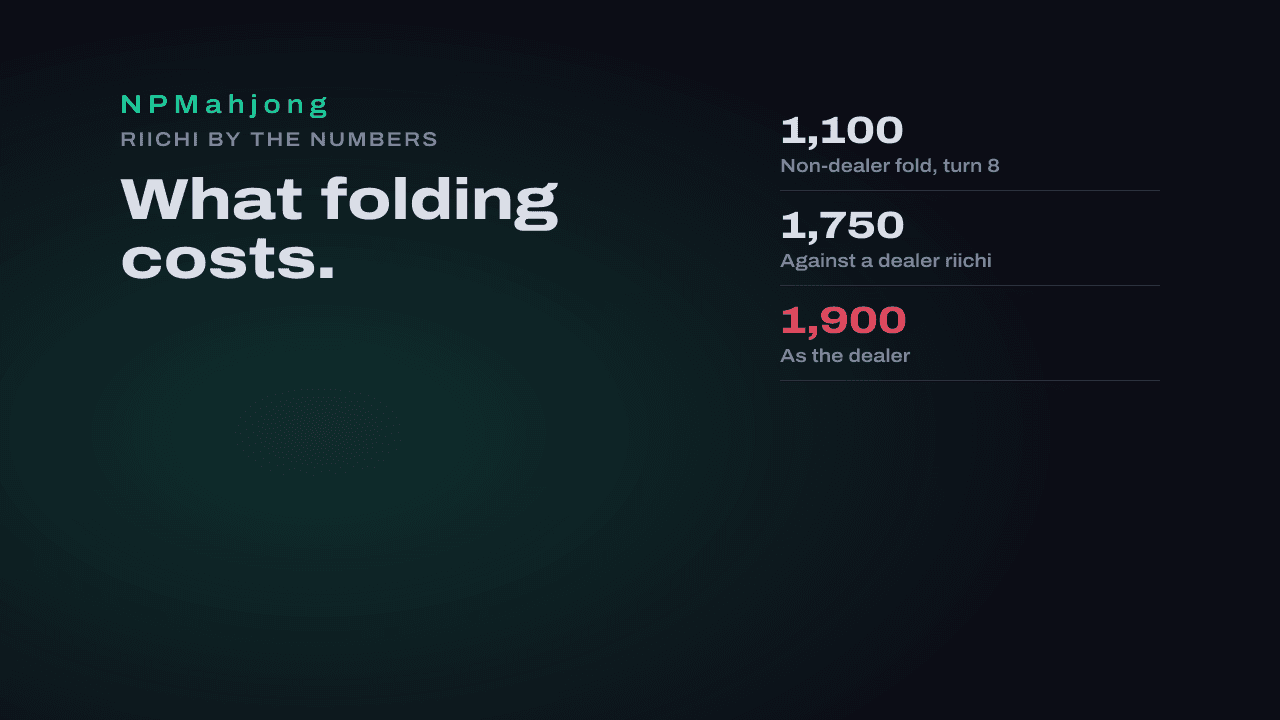
 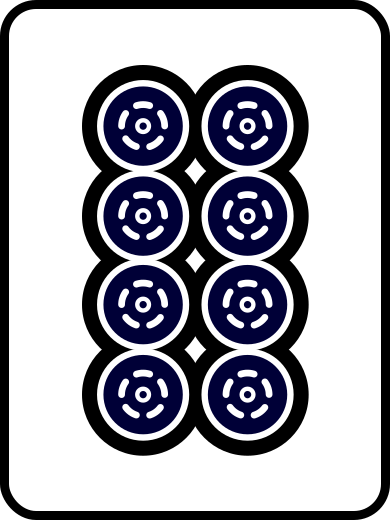 at turn 7. That shape change in , late, points at a wait around 4p to 7p. The averages say the 5p is dangerous. The pond says it's the wait. That's a fold, and the fold costs 1,750. Without the pinzu tells, the same push is right.
Two reads cut the other way, and they're worth more than the averages. If the riichi player cut a dora early, before tenpai, the waits around that dora are close to dead: nobody throws a middle dora from a shape that still needed it. And if the riichi tile itself was the dora, the wait is almost never a or a on the dora's , because a hand that can afford to throw its dora at tenpai is rare. A riichi on the dora is one of the few riichi where the dora's neighbors get safer, not more dangerous.
The danger hides in bad waits
The dora doesn't make two-sided waits much more common. It makes ugly waits more common. Split the riichi waits by shape and the gap is clear.
| Dora | Single-tile wait: dora vs not | Multiple | Two-sided wait: dora vs not | Multiple |
|---|---|---|---|---|
| 1 | 0.96% vs 0.17% | 5.6× | 3.4% vs 2.6% | 1.3× |
| 2 | 2.2% vs 1.0% | 2.3× | 3.8% vs 3.0% | 1.3× |
| 3 | 3.4% vs 1.8% | 2.0× | 4.1% vs 3.3% | 1.2× |
| 4 | 2.0% vs 0.76% | 2.6× | 6.7% vs 5.9% | 1.1× |
| 5 | 2.0% vs 0.73% | 2.7× | 7.1% vs 6.0% | 1.2× |
| 6 | 1.8% vs 0.75% | 2.5× | 6.8% vs 6.0% | 1.1× |
| 7 | 4.0% vs 1.8% | 2.2× | 3.4% vs 3.3% | 1.0× |
| 8 | 2.6% vs 1.0% | 2.6× | 3.2% vs 3.0% | 1.1× |
| 9 | 0.95% vs 0.17% | 5.7× | 3.0% vs 2.7% | 1.1× |
A single-tile wait on the dora shows up 2.0 to 2.7 times as often as normal for 2 through 8, and almost 6 times as often for a terminal. A two-sided wait through the dora barely moves: 1.0 to 1.3 times.
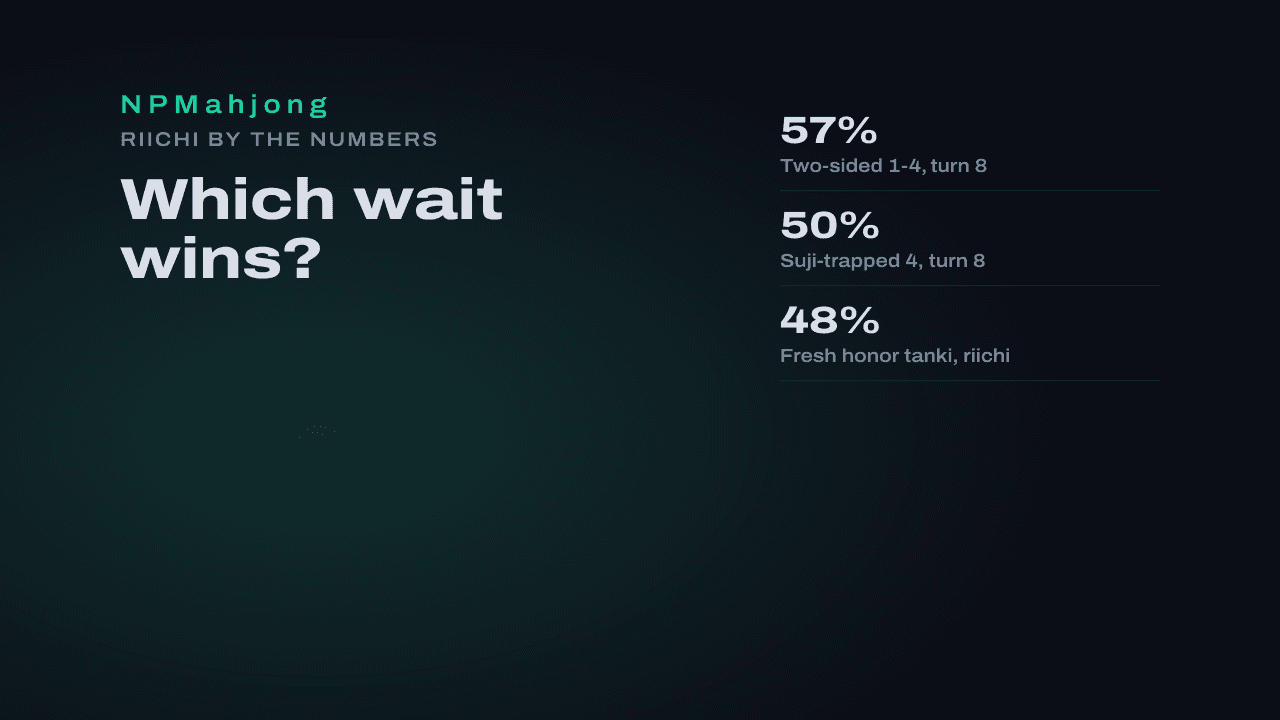
The likely reason is hand building. A two-sided wait is worth keeping whatever it holds. A or a usually isn't, unless the dora is involved. A tanki on the dora already holds one, and a kanchan like 4-6 picks up a han when the dora 5 lands. Players keep those shapes, and they riichi on them.
waits follow the same logic. With a number dora, 1.1% to 1.7% of riichi hands are on a that includes it. The wait analysis classifies two-tile waits differently, so there's no clean baseline for that row.
What about the tiles next to the dora?
Many players treat the tiles beside the dora, the , as almost as risky as the dora itself. Against riichi, a middle dora doesn't support that.
Take the dora 5. Two-sided waits with the 5 inside, so 3-6 or 4-7, show up in 7.4% of riichi hands, against 6.6% when 5 isn't dora. Single-tile waits on a 3, 4, 6, or 7 show up in 5.5%, against 5.1%. That's 1.1 times the usual danger. For a 4 or 6 dora the picture is the same: 1.0 to 1.1 times.
Edge doras are different. When the dora is a 2, single-tile waits on the 1, 3, or 4 show up in 4.5% of riichi hands, against 2.7% normally. That's 1.7 times. Think of a 1-2 waiting on 3: a hand keeps it because the 2 is worth a han. An 8 dora shows the same pattern at 1.7 times. The 1 and 9 columns point the same way, but the code lets a few waits from the next suit in, so treat them as rough.
Honor doras: deadly against open hands
Open hands wait on number doras about as often as riichi hands do. Honors are another story.
| Dora | Riichi: on it | Open hand: on it | Riichi: on or around | Open hand: on or around |
|---|---|---|---|---|
| 1 | 7.0% | 5.6% | 12.3% | 11.0% |
| 3 | 9.7% | 10.1% | 21.4% | 21.7% |
| 5 | 11.5% | 10.9% | 25.9% | 27.4% |
| 7 | 9.5% | 10.0% | 21.3% | 21.2% |
| 9 | 6.3% | 5.2% | 10.9% | 10.2% |
| Honor dora | Riichi: on it | Open hand: on it | Open hand: as a shanpon |
|---|---|---|---|
| Fresh, no copy out | 6.9% | 14.4% | 9.9% |
| One copy out | 2.1% | 2.5% | 1.2% |
| Two copies out | 0.6% | 0.7% | 0.2% |
When the dora is a fresh honor, an open hand is waiting on it 14.4% of the time. That's more than any number dora, and twice the riichi rate of 6.9%. Most of it, 9.9 points, is a shanpon: the player holds a pair of the dora honor and waits to complete it.
That matches what you see at the table. A player with a pair of dora honors has two han in hand and every reason to call fast. The pair stays, and the fresh dora honor becomes half of their wait.
One discarded copy changes everything. Once a copy of the honor dora is out, it's in 2.1% of riichi waits and 2.5% of open waits. Two copies out, and it's under 1%.
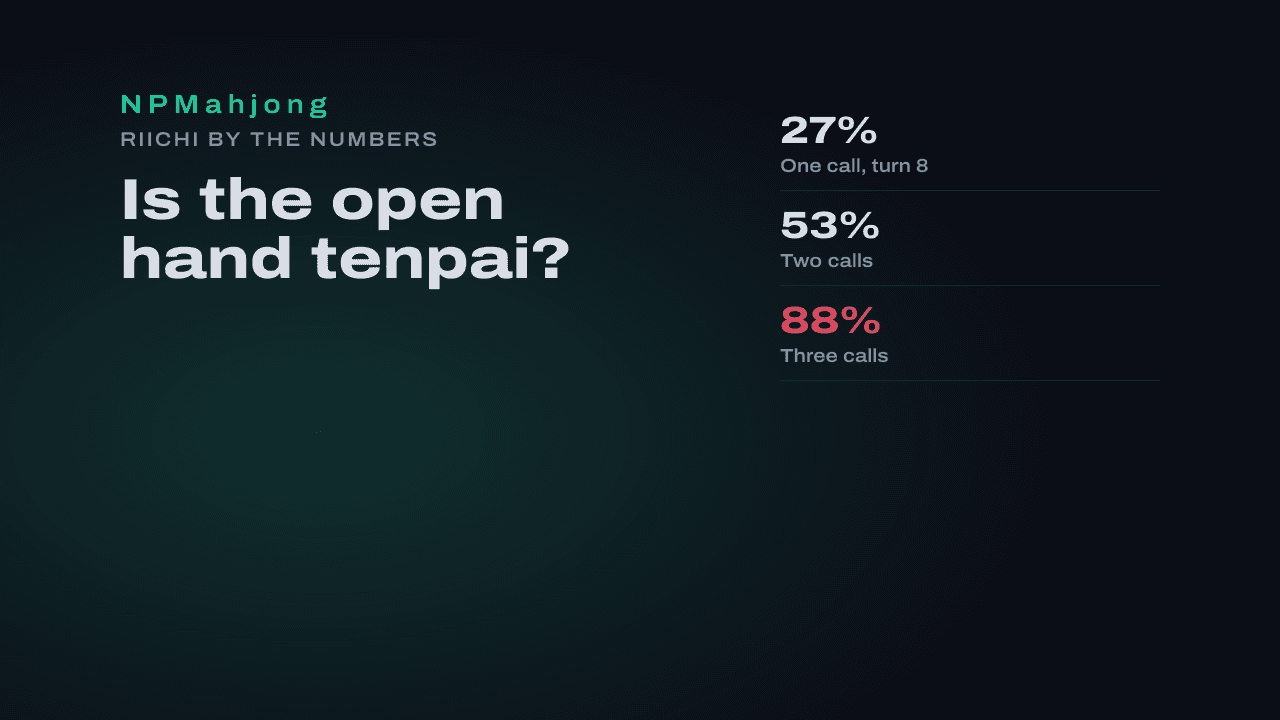
When someone calls on turn 2 or 3 while a fresh honor dora is still unseen, I assume they hold a pair of it until their discards prove otherwise. The table backs the read: an open hand waits on a fresh honor dora one time in seven, and most of that is a shanpon. An early call from a two-sided shape on a slow-looking hand usually means dora dora inside it, with that honor as half the wait. So I hold the honor through the whole hand against that player, unless two things happen: a copy of it shows up in someone's pond, or the caller cuts a tile that only a finished shape would release, like a dora from hand. One copy out and the 14.4% becomes 2.5%. Then the honor is a tile again.
The flip side is a dora that's been ponned. That hand is a mangan or more, no reading required, and every tile you throw it is thrown against a mangan. Price your pushes against that player accordingly.
How to use these numbers
- Price the dora at 1.4 times a normal tile against a fresh riichi, more for a terminal.
- Watch for bad-wait signs. If the riichi player's discards suggest a kanchan or tanki, the dora's danger climbs fastest.
- Don't fear the dorasoba of a middle dora more than any other tile against riichi. Edge doras are the exception: with a 2 or 8 dora, single-tile waits on its neighbors run 1.7 times normal.
- Hold a fresh honor dora against an open hand. It's in one wait in seven.
- Watch the first copy of an honor dora. Once it shows, the open-hand risk falls from 14.4% to 2.5%.
To check any tile's danger against a riichi or an open hand, use the deal-in danger tool. For when to trust tables like these and when to trust your reads, see mahjong statistics vs Japanese riichi players. Look up any unfamiliar term in the glossary.
The dora mistake I see most in reviews is pushing it into a riichi without pricing it. Players treat the dora like any other tile because "it's just one tile," then cut it at turn 10 into a riichi whose pond is full of suji tells. The second most common is the opposite: holding a dora in a hand that was never going to use it, until it's the last tile standing between them and a fold.
The rule I teach for the timing comes from the old Japanese beginner texts and it still holds: a dora leaves your hand on the first discard or at tenpai, almost never in between. On the first discard nobody can it yet. At tenpai it becomes your riichi tile and buys you a wait. The in-between cut, "I'll get rid of it before it's dangerous," is the worst of both: you've carried the risk and thrown away the han, and if someone pons it anyway, every tile in your hand is dangerous from then on. The exception is a hand that was never going to use it, with no real shape around it: cut it early and cut it clean.
Get your defense reviewed
Dora decisions show up in every log: when you cut it, when you hold it, and when you throw it into a riichi. Send me your games for a review and you'll get the hands where your dora play cost you points, with what to throw instead.
Was this article helpful?