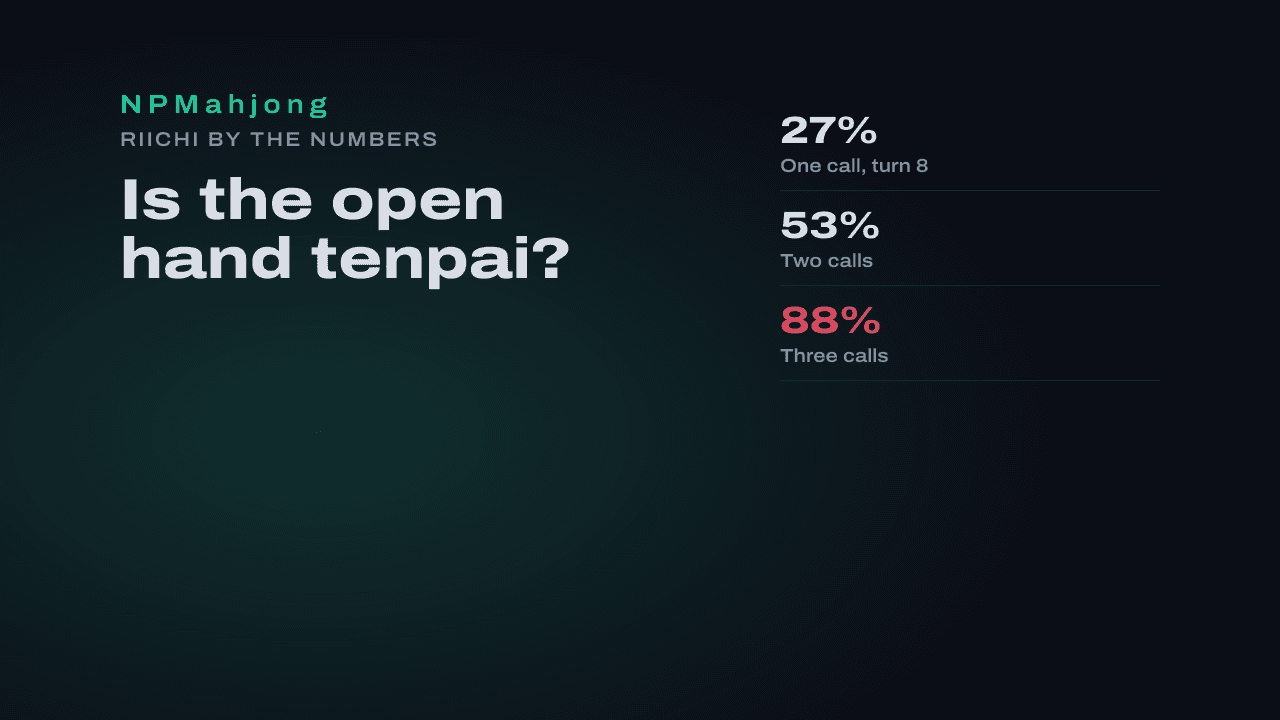
Your opponent has two calls on turn 8. In Tenhou's room, that hand is 53% of the time. With one call it's 27%. With three, 88%.
Those numbers decide a lot of hands. A tile you'd push into a hand that's 27% can be a against one that's 88% tenpai. This post gives you the odds by calls and turn, by the kind of hand they're building, and by the discards that move them.
Every number here comes from Tenhou Houou logs 2016–2020, analysis by chienshyong (fork of Euophrys/houou-analysis). That's Houou-level 4-player , so your table may differ.
What the analysis counts
The analysis stops every time the dealer discards and checks all four hands. It keeps going until someone declares , so these numbers describe tables where nobody has declared yet. A hand counts as tenpai when its shape is one tile from a win. The code doesn't check for a yaku.
Turns count from zero. Turn 8 is the ninth time around the table.
Called hands fall into three groups:
- Honitsu: every number tile in the hand and the calls is in one suit, with one stray tile allowed.
- Yakuhai: the player called a value honor or holds two or more of any honor tile.
- Other: every remaining called hand. Most of these are .
Closed hands sit in their own column. They're players with no calls who haven't declared riichi.
Tenpai odds by calls and turn
This table merges the yakuhai and other groups, the hands you face most often. Honitsu gets its own row in the next section.
| Turn | Closed | 1 call | 2 calls | 3 calls |
|---|---|---|---|---|
| 4 | 0.6% | 7.0% | 27.6% | 76.9% |
| 6 | 2.0% | 15.8% | 40.9% | 83.4% |
| 8 | 4.5% | 26.8% | 53.3% | 88.5% |
| 10 | 7.8% | 37.6% | 62.7% | 91.0% |
| 12 | 11.8% | 45.8% | 69.0% | 91.9% |
| 14 | 15.7% | 51.2% | 72.3% | 91.8% |
Three patterns stand out.
The second call roughly doubles the odds. At turn 8, one call is 27% and two calls 53%. The third call takes it to 88%.
Three calls usually means tenpai. From turn 6 on, a three-call hand is tenpai more than 80% of the time. Treat it like a riichi without the stick.
One call stays under 50% for a long time. A one-call hand doesn't reach 50% until about turn 14. One early tells you the player wants speed. It doesn't tell you they're close.
The closed column is a reminder of how much a call buys. A that hasn't declared riichi by turn 8 is tenpai 4.5% of the time. Some of those are quiet hands, but most closed players without a riichi are still building.
At a real table a two-call hand at turn 8 is a coin flip, and I play it like one. First I price it, because a 1,000-point hand isn't worth folding to even when it's tenpai. Dora ponned, a value honor plus dora showing, or a half flush with its suit now overflowing from the hand: that's a , and I treat it as a riichi. A plain tanyao chase with no dora in sight: I keep playing my hand. Then I read the shape. I keep pushing the tiles that player has shown me are safe: anything in their pond, the of their last two , and the honors they cut from hand while still building. I hold everything else, especially the dora and the tiles next to it, and any honor nobody has shown yet against a hand that smells like . What I don't do is fold flat. Half the time that hand isn't tenpai, and folding to a hand that isn't there costs the fold price for nothing. Two calls means read, not retreat. Three calls means tenpai, nine times in ten, and the reading is over.
Hand type changes the odds
Not every two-call hand is the same hand. Here's the split by what the player is building.
| Hand type | Turn | 1 call | 2 calls | 3 calls |
|---|---|---|---|---|
| Yakuhai | 8 | 28.0% | 54.7% | 90.0% |
| Other (mostly tanyao) | 8 | 24.8% | 48.6% | 80.5% |
| Honitsu | 8 | 14.0% | 33.0% | 66.7% |
| Yakuhai | 12 | 47.9% | 70.5% | 93.3% |
| Other (mostly tanyao) | 12 | 43.9% | 66.5% | 87.9% |
| Honitsu | 12 | 32.7% | 53.2% | 79.2% |
Yakuhai hands are the fastest. A player who called a value honor, or holds an honor pair, is tenpai 28% of the time at turn 8 with one call. The likely reason: a value honor settles the yaku early, so later calls and draws go toward the shape.
hands are the slowest. At turn 8, a one-call honitsu is tenpai 14% of the time, half the yakuhai rate. Even with three calls, it's 67%. A one-suit hand needs many tiles from one suit, and they take time to collect.
That's the practical read. A player who's calling into one suit looks scary, and the hand will be expensive when it's done. At turn 8 with one or two calls, it's usually not done yet.
One quirk: the code files West wind calls, and South wind calls in the East round, under yakuhai for every seat. A few guest-wind hands sit in that row.
Tells that move the odds
The table above is a starting point. What the player does on their turn moves it. These rows compare the moment of a specific discard with the baseline for all called hands, honitsu excluded.
| What the player does at turn 8 | 1 call | 2 calls |
|---|---|---|
| Baseline: any called hand | 26.8% | 53.3% |
| Discards right after calling | 32.3% | 59.4% |
| Throws a dora | 37.7% | 67.1% |
| Throws a red five | 36.3% | 62.2% |
| Third tsumogiri in a row | 38.4% | 61.9% |
| Cuts a number tile from hand | 24.2% | 44.4% |
| Cuts an honor from hand | 17.0% | 29.8% |
A thrown dora or red five is a warning. A player with one call who throws a dora at turn 8 is tenpai 37.7% of the time, 11 points above the baseline. The likely reason: players hold dora until the hand has no room for it, so throwing one often means the shape is complete.
A run of often means the hand is set. Three tsumogiri in a row from a one-call hand at turn 8 means tenpai 38.4% of the time. A tenpai player keeps throwing what they draw when nothing improves the hand.
The discard right after a call matters. A player who just called and discards is tenpai 32.3% of the time with one call and 59.4% with two. Calls often finish the shape.
An honor cut from hand is the opposite signal. A one-call hand that cuts an honor from hand at turn 8 is tenpai 17.0% of the time, almost 10 points below baseline. The likely reason: players drop loose honors while they're still building.
The tell I teach from this table is the dora cut. Take a one-call hand at turn 8 that has been building quietly, then throws a red five from hand. Most players read that as "he doesn't need it, he's slow." The table says the opposite: that hand is tenpai 38% of the time, eleven points over baseline, because a player holds the dora until the shape is done. The miss goes the other way: a player who reads an honor cut from hand as "he's finishing" and folds a good hand to a player who's 17% to be tenpai.
The sharper tell is where the tedashi came from. An open player who chis, then cuts a 5s from hand while a 4s sat in their pond three turns earlier, just took a tile out of a connected block. Nemata's rule for that pattern: a cut from a connected block after a call means the shape is complete and the wait sits right next to that block. The hand is tenpai, and the tiles on either side of the 5s are the ones to hold.
The first call: what it tells you
For one-call hands outside the honitsu and yakuhai groups, the analysis also sorts by the call itself.
| First call | Turn 8 | Turn 12 | Hands at turn 8 |
|---|---|---|---|
| from a two-sided shape | 27.6% | 46.8% | 44,082 |
| , not dora | 25.6% | 46.1% | 57,139 |
| Chi from a or edge shape | 23.5% | 40.8% | 45,733 |
| Pon of the dora | 16.1% | 36.4% | 3,632 |
A chi from a two-sided shape, like 3-4 calling a 2 or a 5, is the fastest first call. A chi from a or runs about 4 points behind.
The surprise is the dora pon. At turn 8, a hand that opened with a pon of the dora is tenpai 16.1% of the time, 9.5 points below a plain pon. A dora pair is worth calling early, even from a slow hand, so a dora pon often comes from a hand that's far from done. It carries three dora, so it pays well when it gets there. It just gets there less often than you'd think.
When someone pons the dora early, I keep pushing. The table is clear about why: a dora pon at turn 8 comes from a hand that's tenpai 16% of the time, nine points under a plain pon, because a dora pair is worth calling from any shape. That player is expensive when they get there and slow to get there. So I play my own hand at full speed and start holding safe tiles only when the second call comes, which doubles the odds. The one tile I hold from the first call on is the dora's neighbors, since the hand is built around that suit.
How to use these numbers
- Count the calls first. One call at turn 8 is about one in four. Two calls is a coin flip. Three calls is close to a riichi.
- Adjust for the hand type. Yakuhai hands run fastest, honitsu slowest.
- Raise your estimate when the player throws a dora or red five, or tsumogiris three times in a row.
- Lower it when they cut an honor from hand.
- Respect the dora pon for its value, not its speed. It's slower than a plain pon, but it pays more when it gets there.
To get the odds for any number of calls and turn, use the open hand tenpai tool. For when to trust tables like these and when to trust your reads, see mahjong statistics vs Japanese riichi players. Look up any unfamiliar term in the glossary.
Get your reads checked
Reading open hands shows up in every log: what you pushed into a two-call hand, and what you folded against a one-call hand that wasn't close. Send me your games for a review and you'll get the hands where your read on an open opponent cost you points, with what to throw instead.
Was this article helpful?