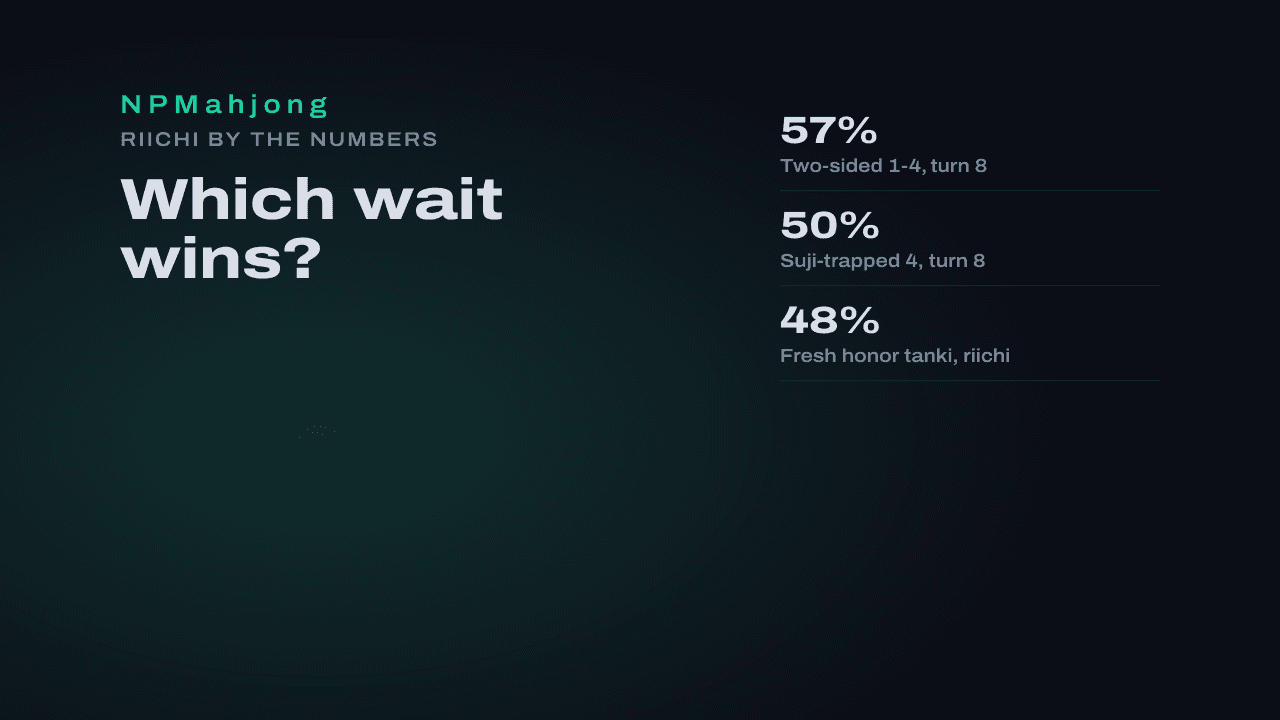
A declared on turn 8 wins 52% to 57% of the time in Tenhou's room. A single-tile wait on a 5 wins 33%. Discard the 2 and the 8 of that suit first, so the 5 looks safe by , and the same wait wins 46%.
Every number here comes from Tenhou Houou logs 2016–2020, analysis by chienshyong (fork of Euophrys/houou-analysis). That's Houou-level 4-player , so your table may differ. The analysis follows the first of each hand to the end. A win means or tsumo. The main table leaves out waits and waits on , and it counts turns from zero: turn 8 is your ninth discard.
Riichi wait win rates by turn
Here's the core table. Each row is the share of first riichis on that wait that won the hand.
| Wait | Turn 2 | Turn 5 | Turn 8 | Turn 11 | Turn 14 |
|---|---|---|---|---|---|
| Three-sided 1-4-7 | 87% | 76% | 66% | 53% | 42% |
| Two-sided 1-4 | 79% | 67% | 57% | 47% | 35% |
| Two-sided 2-5 | 73% | 64% | 54% | 44% | 30% |
| Two-sided 3-6 | 70% | 61% | 52% | 41% | 30% |
| , two honor pairs | 81% | 70% | 59% | 48% | 37% |
| Honor , one copy out | 75% | 64% | 55% | 49% | 36% |
| Honor tanki, fresh | 76% | 63% | 48% | 32% | 23% |
| Shanpon, two pairs of 2s to 8s | 60% | 51% | 41% | 32% | 21% |
| Single-tile wait on 2 or 8 | 61% | 51% | 41% | 30% | 21% |
| Single-tile wait on 5 | 48% | 39% | 33% | 25% | 17% |
A single-tile wait is any wait on one tile: a , a , or a . The data groups them by the tile you're waiting on. Mirror waits match within about a point, so 6-9 tracks 1-4, 5-8 tracks 2-5, and 4-7 tracks 3-6. The three-sided 2-5-8 and 3-6-9 waits track 1-4-7.
Two patterns run through the whole table.
Time costs every wait. A two-sided riichi on 1-4 drops from 79% at turn 2 to 47% at turn 11, about 3.6 points per turn. A fresh honor tanki falls faster, about 5 points per turn. Late riichi still wins, though. At turn 14, a two-sided wait wins 30% to 35%, and a 42%.
Outside beats inside. A waiting on 1 and 4 wins 57% at turn 8. A waiting on 3 and 6 wins 52%. The tsumo share explains where the gap comes from: 50% of the 1-4 wait's wins come by tsumo, against 58% for the 3-6 wait. More of the outside wait's wins come off other players' discards, probably because a 1 is a tile they let go of early.
The number that surprises my students most is the honor tanki. They've been taught a single-tile wait is bad, and then the table shows a fresh honor tanki beating a two-sided 3-6 at turn 2. The wait choice they get wrong in reviews is the mirror of that: they take a on two live middle pairs over a on a 1 or 9, because "two outs beats one." The 1 or 9 kanchan gets fed. The middle shanpon doesn't.
The order I teach for a riichi wait is the one the Japanese guides settled on years ago. Count first: more tiles wins. Value second, when the counts tie. Ease third, when both tie: honors and terminals come out of folding hands, middle tiles don't, and the dora and its indicator are the hardest tiles to get. Between a shanpon and a kanchan at the same count, take the shanpon, because every suji and a folding player trusts can feed one of its two tiles. A kanchan has one tile to feed.
Suji traps: the hikkake bonus
A single-tile wait becomes a suji trap, or , when you've already discarded every tile that makes it look safe by . Opponents read your discards, decide the tile is safe, and throw it.
| Waiting on | The trap means you already discarded | Plain | Suji trap | Gain |
|---|---|---|---|---|
| 1 or 9 | 4 for a 1, 6 for a 9 | 47% | 57% | +10 |
| 2 or 8 | the 5 | 41% | 52% | +11 |
| 3 or 7 | 6 for a 3, 4 for a 7 | 38% | 47% | +9 |
| 4 or 6 | 1 and 7 for a 4, 3 and 9 for a 6 | 36% | 50% | +14 |
| 5 | 2 and 8 | 33% | 46% | +13 |
The trap turns a kanchan on 4 into a wait that wins 50%, two points short of a two-sided 3-6. The extra wins come from discards. A plain wait on 5 wins 57% of its hands by tsumo. A trapped 5 wins only 35% by tsumo, because the other players hand it over.
The middle tiles gain most: +14 on a 4 or 6, +13 on a 5. Those are the tiles opponents fear most when they're fresh, so a suji read likely moves them the most.
Take a hand like this at turn 6: 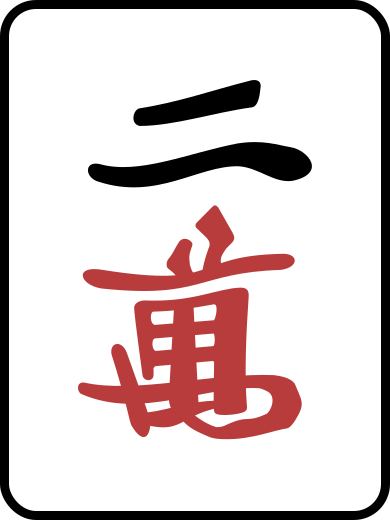
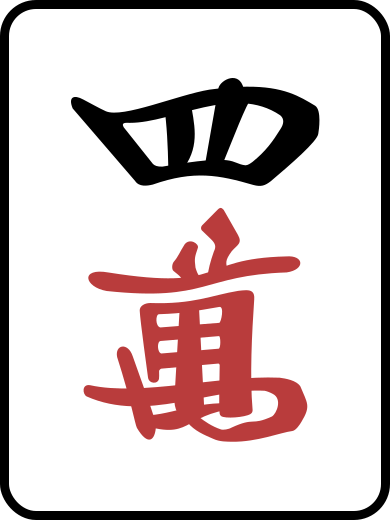 in hand, a
 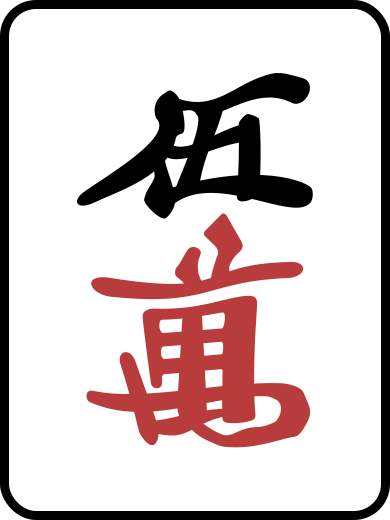 you don't need, and the rest complete. Cut the 5m now, wait two turns, riichi on the 3m kanchan. Anyone folding reads 5m in your pond and throws the 2m and 3m suji first. That's the +9 to +14 in the table above, earned on purpose.
When do I take the trapped single tile over a plain two-sided wait? When the two-sided wait is on tiles the table has already shown it's holding, and the trap tile is one a folding player will throw early. A waiting on 5 and 8 after two 5p and an 8p have already been cut is a two-sided wait with one and a half outs. A trapped 3m with the 5m sitting in my pond is a one-tile wait that other players hand me.
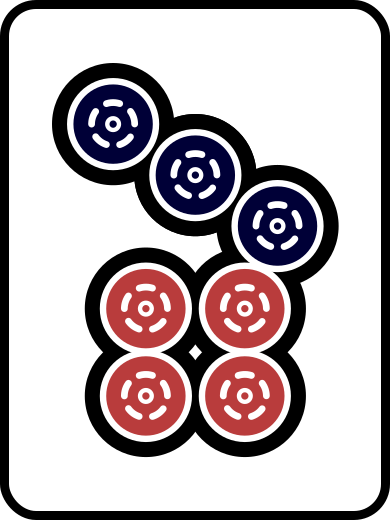
Honor waits win off discards
Honor waits do better than their tile count suggests. At turn 8, a riichi on a single honor wins 48% when the honor is fresh, 55% with one copy already discarded, and 44% on the last copy, the wait. Plain single-tile number waits win 33% on a 5 and at most 47% on a terminal.
waits with honors do even better. At turn 8, two honor pairs win 59%, an honor with a terminal 55%, and an honor with a 2-to-8 tile 52%. Two pairs of 2s to 8s win 41%.
Honor waits win mostly off discards. Only 30% of a fresh honor tanki's wins at turn 8 come by tsumo, against 50% to 58% for two-sided waits. Hold that thought for the dama section.
Bad waits deal in more, too
A riichi hand can't fold. Every turn it stays open is another drawn tile you have to throw, whatever it is. So a slow wait doesn't only win less. It also deals in more.
At turn 8, a three-sided riichi deals in about 8% of the time and a two-sided riichi 10% to 11%. Single-tile waits deal in 14% to 15%. Draws split the same way: 14% to 16% of two-sided riichis end in a draw, against 21% to 26% of single-tile waits on 2 through 8.
Put the two together and a bad wait costs you twice. Take a two-sided 1-4 against a single-tile wait on 5, both declared on turn 8. The first wins 57% and deals in 10%. The second wins 33% and deals in 15%. That gap is what you weigh when you decide whether to riichi a bad wait now or wait a turn for a better one.
A dealer's riichi doesn't win more often. A two-sided 1-4 at turn 8 wins 56.8% for the dealer and 55.8% for a . The dealer's edge is in the payout, not the win rate.
Riichi or dama: the same wait without riichi
The dama analysis follows closed hands that reach without declaring riichi, with no riichi on the table yet and a pile of dora in hand. The code keeps hands with three or more dora, while the author's notes say two or more. It counts a hand at every turn it sits in tenpai, then checks the result. Unlike the riichi table, it keeps furiten and dora waits. Treat the comparison as rough.
| Wait | Riichi | Dama | Dama minus riichi |
|---|---|---|---|
| Two-sided 1-4 | 57% | 67% | +10 |
| Two-sided 3-6 | 52% | 62% | +10 |
| Single-tile wait on 5 | 33% | 39% | +6 |
| Single-tile wait on 2 or 8 | 41% | 45% | +4 |
| Three-sided 1-4-7 | 66% | 69% | +3 |
| Shanpon, two pairs of 2s to 8s | 41% | 44% | +3 |
| Honor tanki, one copy out | 55% | 54% | -1 |
| Shanpon, two honor pairs | 59% | 52% | -7 |
| Honor tanki, fresh | 48% | 40% | -8 |
Number waits win more as . A two-sided wait gains 10 points, and these dama hands almost never folded: about 2% of the time at turn 8.
Honor waits flip. A fresh honor tanki wins 48% with riichi and 40% without it. Two honor pairs drop from 59% to 52%. The likely reason: once a riichi goes up, the other players fold, and honors are among the first safe tiles they throw. A riichi on an honor wait gets those tiles. A quiet dama doesn't.
Win rate isn't the whole trade. Riichi adds a , ura dora, and , and dama keeps your options open. This table doesn't price that. It tells you which side of the trade the wait sits on.
With a two-sided wait and two or more dora in hand, my rule has turn numbers on it, borrowed from Nemata's comparison of dama and riichi win rates. A two-sided dama stays dama from turn 13 on. A two-sided dama 6,400 stays dama from turn 10. Earlier than that, riichi: the table shows the quiet hand wins a few points more often, and the stick, ura dora and ippatsu buy back far more than a few points. A two-sided 3,900 or 5,200 is a riichi at any turn before the last few. The exception is placement. If a 5,200 already does the job, passing someone or killing their condition, and the mangan doesn't change anything, it wins more quietly and keeps my hand flexible if someone else riichis.
The honor wait I riichi every time: a fresh honor tanki or a pair of honors as a shanpon, at turn 8 or earlier. Nothing else in the game turns my opponents' safe tiles into my winning tiles. The table says riichi adds 8 points to that wait. At the table it feels like more. The one honor wait I keep quiet is a tanki on a terminal or honor dora: riichi makes everyone hold the dora, and dama lets it fall out of a hand that can't use it.
Waiting on the dora costs wins
A wait that includes a dora wins less, because opponents keep their dora. At turn 8, a two-sided 1-4 wait drops from 57% to 52% when one of its tiles is dora. A single-tile wait on 2 or 8 drops from 41% to 28%. A fresh honor tanki on a dora honor drops from 48% to 28%.
The dora still pays when it lands. Don't count on it landing as often.
How to use these numbers
- Compare waits at the turn you're on. A fresh honor tanki beats a two-sided 3-6 wait at turn 2 and loses to it by turn 8.
- Take the outside two-sided wait when the tile count is close. It wins about 5 points more at turn 8.
- Build traps on purpose. If you're headed for a single-tile wait, the trap is worth 9 to 14 points.
- Riichi your honor waits. They're the waits riichi helps most.
- Price the dora wait. A single-tile wait on a 2 or 8 loses about a third of its wins when that tile is dora.
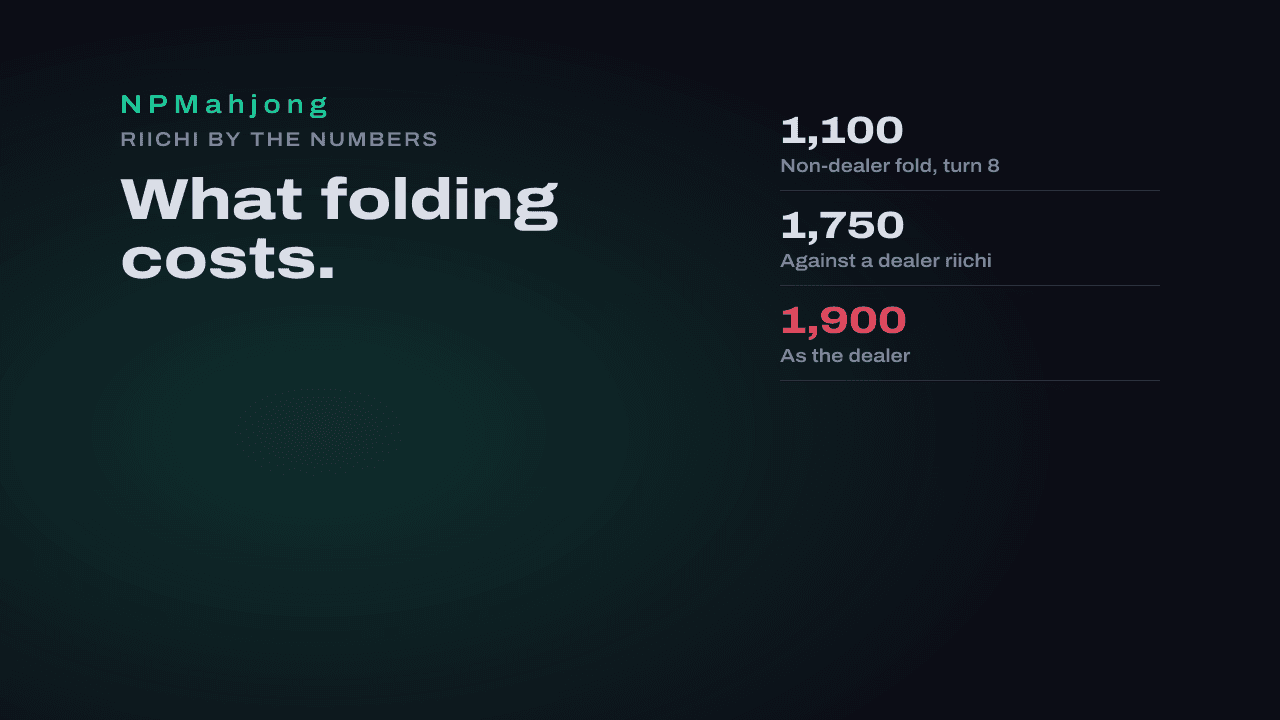
To look up any wait at any turn, use the wait win rate tool. When someone else declares first and you have to decide whether to keep going, run the hand through the push-or-fold calculator.
A hand where these numbers decide the wait: turn 5, you can take a waiting on 1 and 4, or a waiting on 3 and 6, by cutting one tile or the other. Same tile count. The table says 1-4 wins about 5 points more at turn 8 because the 1 gets thrown. Take the outside wait.
A hand where I break from them: the same choice, but the player on my right has cut two 1s and holds a 4s I watched him keep through three discards. The table can't see his hand. The 3-6 wait wins now, because the 1-4 wait's extra points came from discards that aren't coming.
Tables like these help most when you can't read anything else at the table. For when to trust them and when to trust your reads, see mahjong statistics vs Japanese riichi players. For more on Tenhou's ranked rooms, read why Tenhou punishes 4th. Look up any unfamiliar term in the glossary.
Get your riichi decisions reviewed
Wait choice, riichi or dama, and when to declare all show up in your logs. Send me your games for a review and you'll get the hands where a different wait or a different call would have won more.
Was this article helpful?