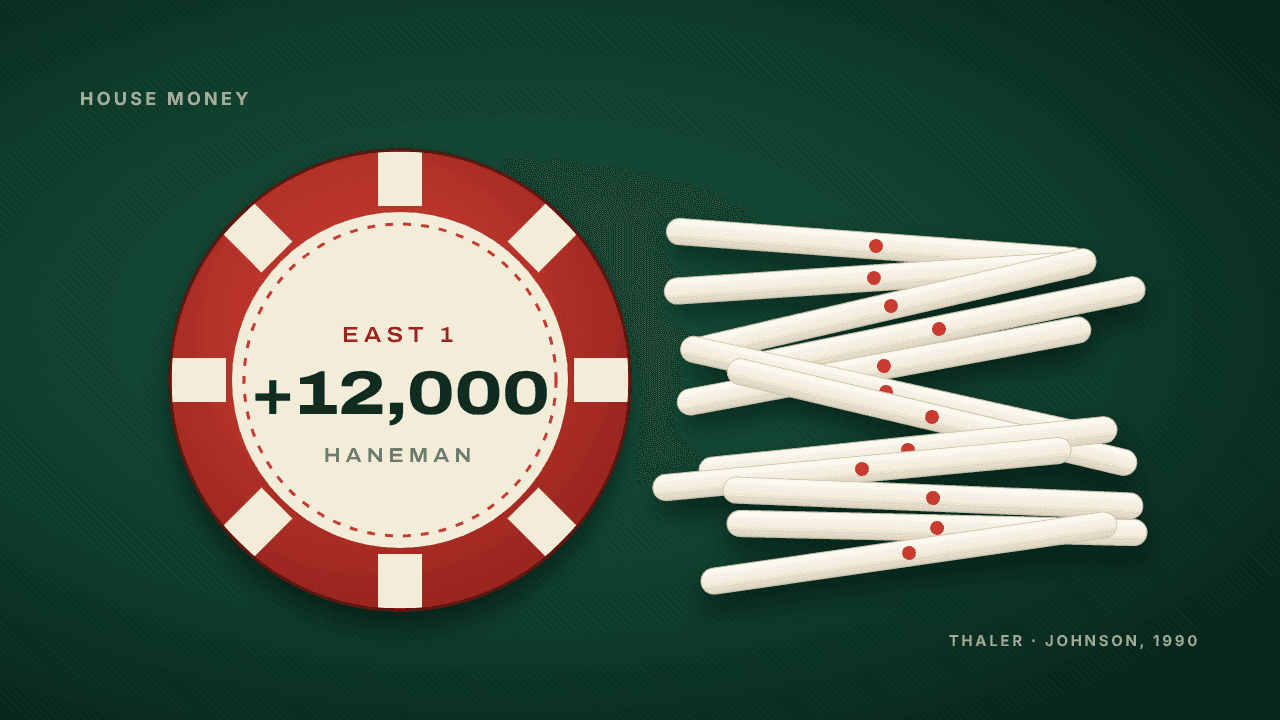
East 1. You're West, your already holds a , and North throws the 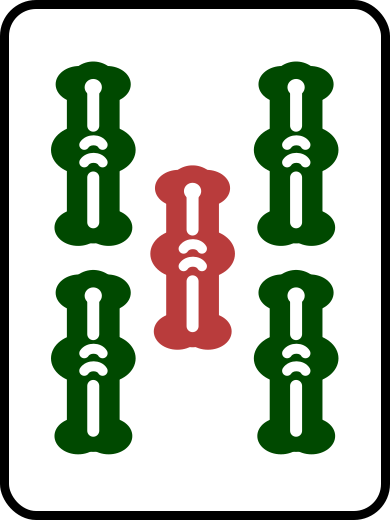 that finishes it. You flip two . , 12,000 points. Then the next hand you're on a 1,000-point and a riichi is on the table, and you push a fresh tile without a second look. You're up 12,000. You can afford it.
Richard Thaler and Eric Johnson studied that feeling and called it the house money effect in a 1990 paper in Management Science, borrowing the phrase from casino gamblers. After a win, people take bets they'd refuse with their own money, because a loss feels like giving back winnings rather than losing anything. A in East 1 is house money at its purest: a big pile, and a whole left to spend it.
Thaler and Johnson asked one bet two ways
Thaler and Johnson's paper, "Gambling with the House Money and Trying to Break Even: The Effects of Prior Outcomes on Risky Choice," opens in a Vegas casino: you put a quarter in a slot machine and win $100. Does the rest of your evening change? Their experiments say yes, and the clean version is one question asked two ways.
Asked as two steps, "You have just won $30. Now choose between no further gain or loss, or a 50% chance to win $9 and a 50% chance to lose $9", 70 to 82% of Cornell MBA students took the gamble. Asked as one step, a sure $30 or a 50% chance of $39 and a 50% chance of $21, only 43 to 44% did. The final outcomes were identical. What differed was whether the $30 sat in its own mental account. Then they scaled it down to a $15 gain and a $4.50 coin flip and ran it for real money in a large introductory economics class at Cornell: 77% gambled in the two-step version, 44% in the one-step version.
Their explanation is in the gamblers' own phrase. Until the winnings are gone, a loss gets coded as a smaller gain instead of a loss.
As if losing some of "their money" doesn't hurt as much as losing one's own cash.
The paper found the other half too. After a loss, people turn cautious, except toward a bet that could get them back to zero. Of the subjects who'd just lost $30, 54 to 60% took a one-in-three shot at $30 over a sure $10. After a $9 loss, where the sure $10 already broke even, 34 to 39% did. That's the "trying to break even" in the title. At the table, it's the player who deals into a in East 1 and riichis every hand afterward. After your haneman, that's North, now down 12,000. Expect them to push for a hand big enough to get back to 25,000.
Why the haneman feels like free money
Mahjong builds the two-step frame for you. Everyone starts at 25,000, and the screen after every hand shows your change in points. After a 12,000 the screen flashes +12,000 next to your new 37,000, and the +12,000 is the number you remember.
So the next deal-in doesn't feel like losing 5,900 points. It feels like 12,000 becoming 6,100, and you're still up. That's the quasi-hedonic editing Thaler and Johnson describe: a loss smaller than the earlier gain gets folded into it, and loss aversion, the finding that a loss hurts about twice as much as a gain pleases, loses its bite.
East 2, turn 9, you're a non-dealer on 37,000. The from you, also a non-dealer, declared riichi on turn 7 and cut a 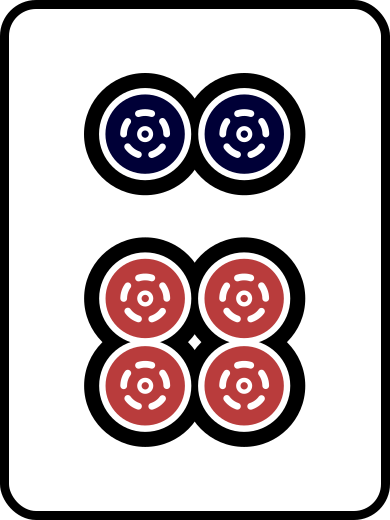 early. You've called on the 888s. You draw a
 , and there's no 5m in their river, so the 8m isn't even .

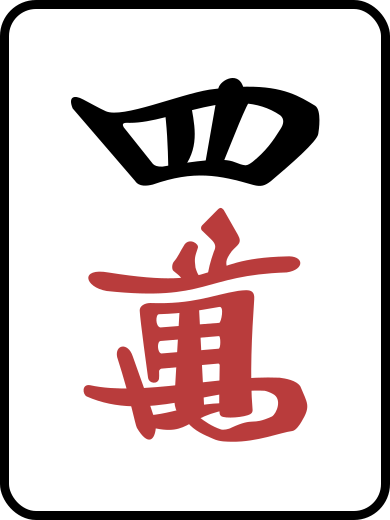
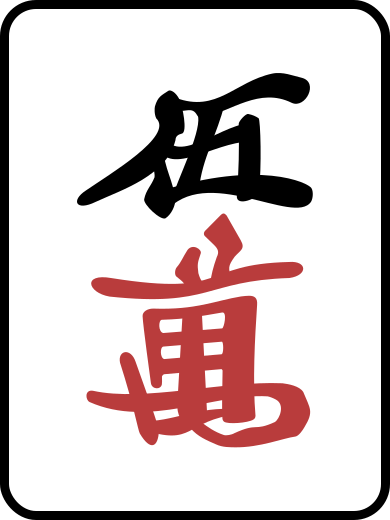
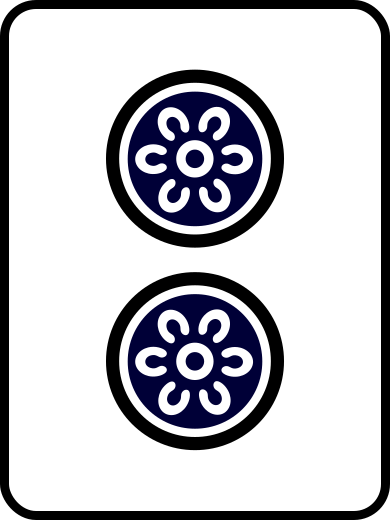
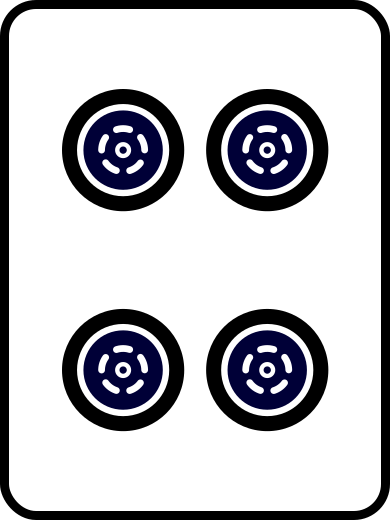
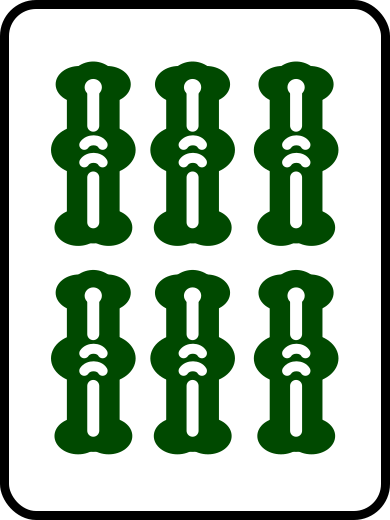
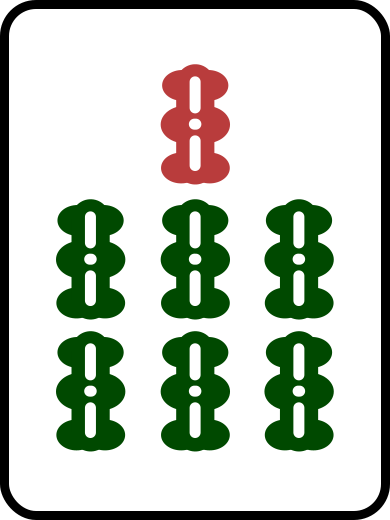
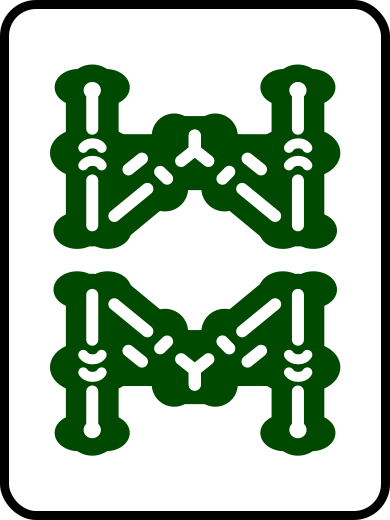
Cut the 8m and you stay on a waiting on the 5p: open , 30 , 1,000 points. Cut the and you're folding with , one step back from tenpai.
At 25,000 you fold this without much thought. At 37,000, the 8m goes out. Nothing about the hand changed. The still waits on one tile, the 5p. It's the same riichi, and the 8m is just as fresh. What changed is which account you charge the next loss to.
Your score isn't in the deal-in math
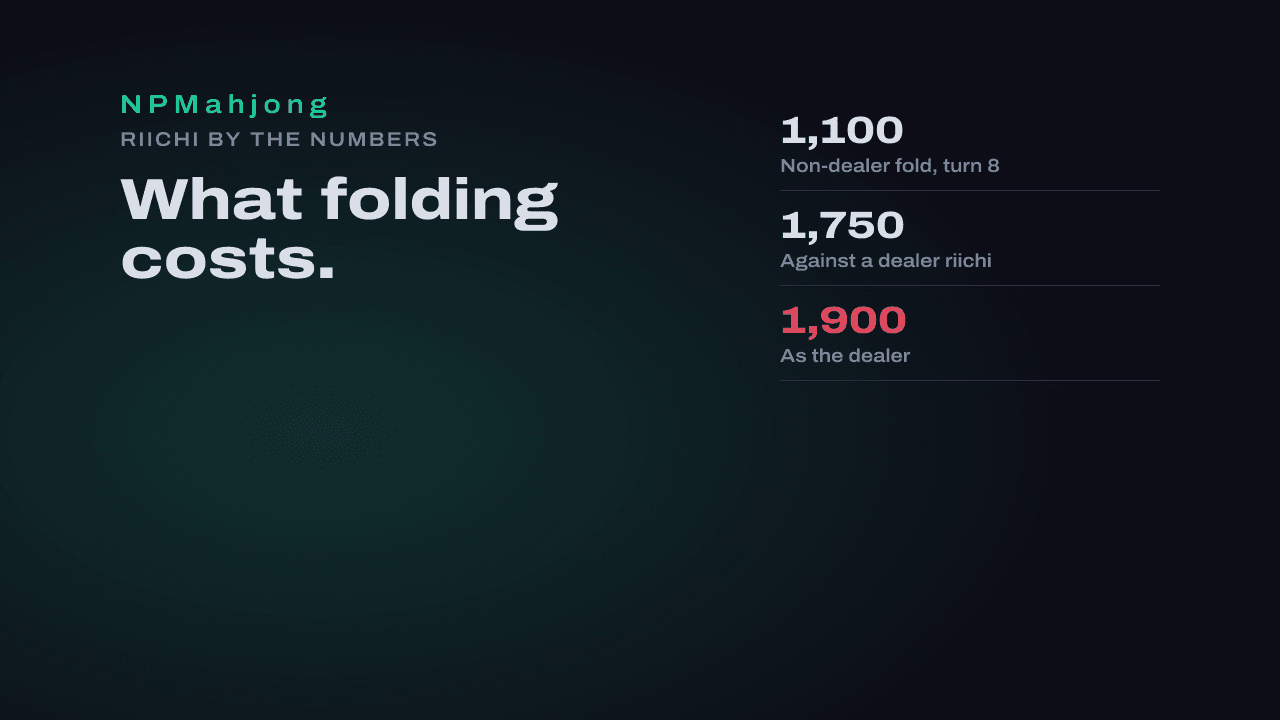
The fold-price analysis of Tenhou Houou logs gives you the numbers for that decision. A non-dealer riichi from turn 8 that wins by ron takes 5,869 points on average, included. Folding cleanly against it costs a non-dealer 1,120. Put those together with the chase win rates and a narrow wait needs a hand worth about 2,000 before pushing pays. A 1,000-point kanchan sits below that line whether you hold 25,000 points or 37,000.
A deal-in from 37,000 pays the same 5,869 as a deal-in from 25,000. The kanchan wins no more often because you won the last hand. The haneman changed your total and none of the odds.
A haneman in East 1 isn't a lead yet
The house money feeling has a second error inside it: it treats the 12,000 as banked. The All Last analysis measured how far a player's score moves from the start of a hand to the end of the game, in Houou logs:
| Hand | Score still moves by |
|---|---|
| East 1 | 14,650 |
| South 1 | 10,123 |
| South 3 | 7,078 |
| South 4 | 4,831 |
Measured from the start of East 1, a typical score moves 14,650 points by the end of the game. Measured from South 1, it still moves 10,123. Your haneman is about the size of the swings still to come. Two deal-ins at Houou averages, 5,869 each, take back almost all of it.
The ladder doesn't care where the points came from either. On Mahjong Soul, the raw-score part of your rank points is your final score minus 25,000, divided by 1,000, as the rank-up guide explains. And placement, the part that decides your rank, is only settled at the end of South 4.
The mirror of the All Last fold
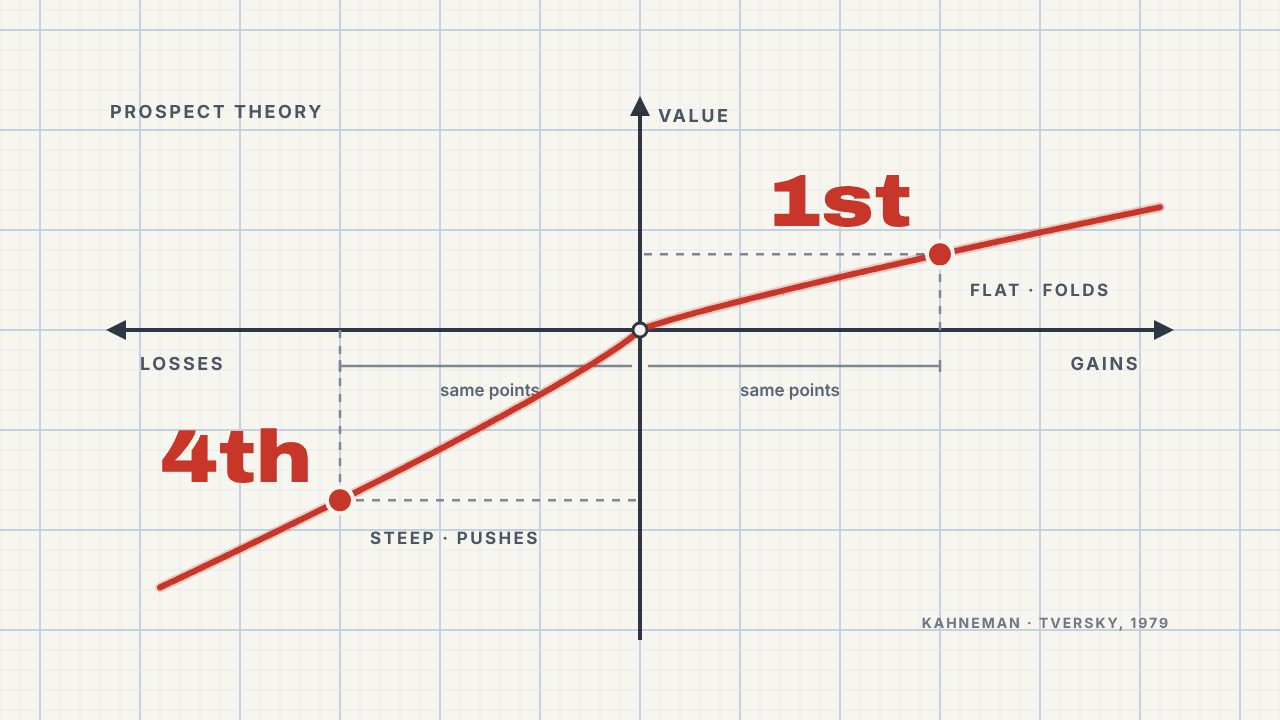
Prospect theory says people turn cautious when they're ahead. The house money effect says a gain makes people bolder. Both are true, and Thaler and Johnson's two framings show why. When the gain sits in its own account ("I won $30, now bet $9"), people gamble. When the gain is folded into a new reference point ("sure $30 or a coin flip around it"), they play safe, the way prospect theory predicts.
A runs both framings in order. In East 2, your reference point is still 25,000 and the haneman sits on top of it as winnings. You play loose. By South 4, your placement has become the reference point, the gain is now "my 1st place", and the same player folds a tenpai that would have ended the game. It's one lead and two biases, and they pull in opposite directions. The prospect theory post covers the late one. This one is about the early one, and you know when it starts: the hand after the big win.
The effect shrinks outside the lab
A 2025 meta-analysis of 36 studies by Kasumi in Frontiers in Psychology found a low-to-moderate house money effect, strong in controlled experiments and weaker the closer the setting got to real life. Thaler and Johnson's own paper cites a replication by Battalio and colleagues where 21 of 35 subjects, sitting on $30, took a coin flip for $10, but only 15 of 35 took one for $20. The effect may fade as the bet approaches the cushion. A 5,869 deal-in is half a haneman, right between Battalio's two bets. Expect the pull to be there, a little weaker than in the lab.
A lead is also allowed to change your play later. In South 3 and South 4, placement math shifts your push and fold lines, and a 12,000 lead is a real asset to protect. The house money effect is the change that shows up in East 2, before placement math has a say.
Talk in totals
Thaler and Johnson's framing result points to the switch, and you can apply it on purpose.
After any win of a or more before South 1, do two things before the next hand is dealt:
- Say the total. "I have 37,000." Not "I'm up 12,000", and not "I can afford one." The total has no winnings account to spend.
- Recall the two numbers. A deal-in into a non-dealer riichi costs 5,869 on average. A narrow wait needs a hand worth about 2,000 to push. Neither number changed.
Audit the hands after the haneman
After your next early mangan or better, check the doubtful pushes in the push-or-fold calculator once the session ends. Its inputs are the riichi, your hand, and the tile. Your score isn't one of them.

To find the hands where a big East 1 loosened your game, send me a log for a review.
Was this article helpful?