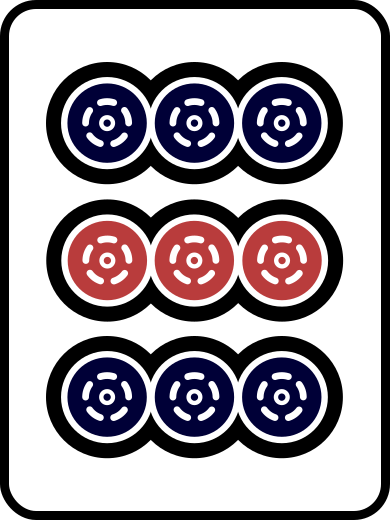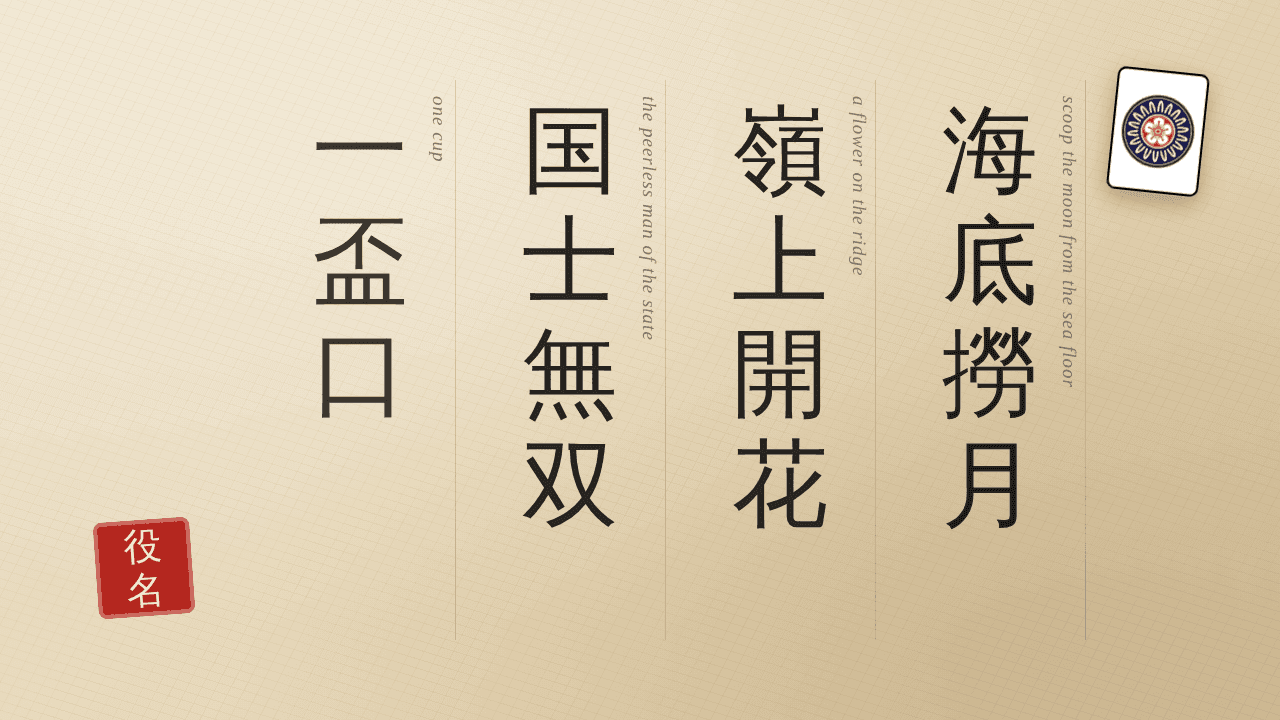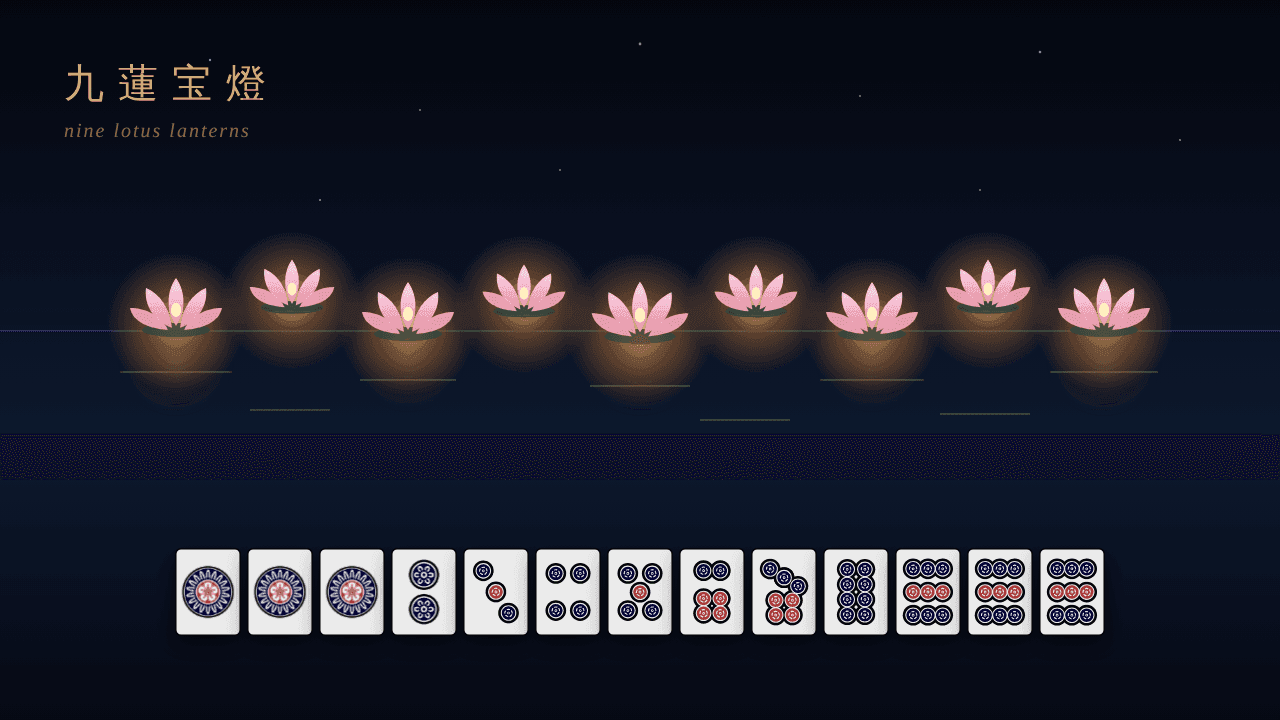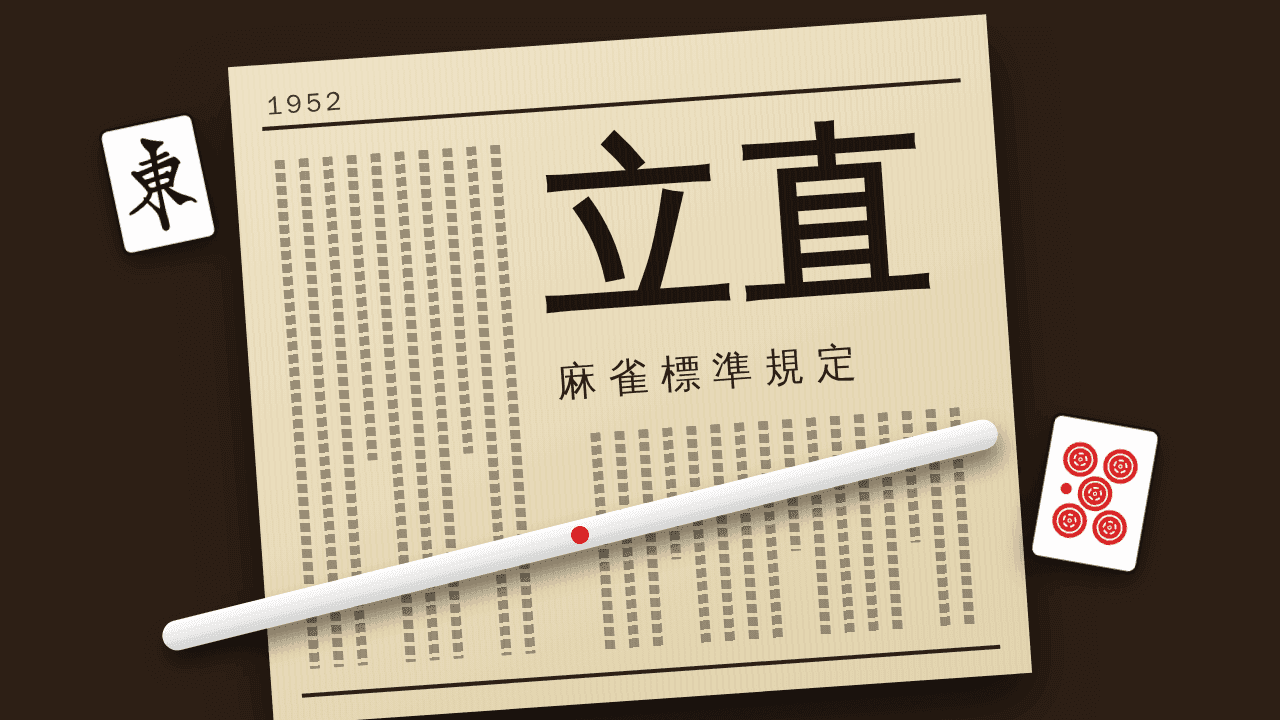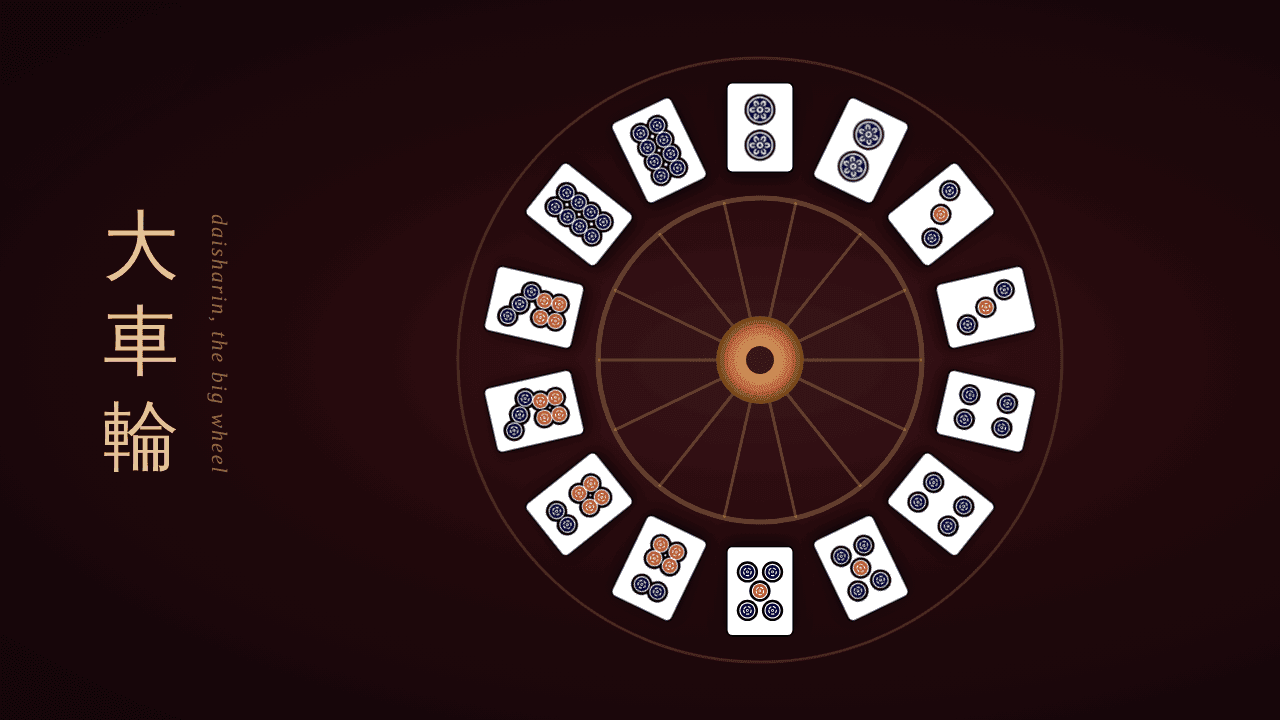
You win on this hand, all pin, every number from 2 to 8 twice:
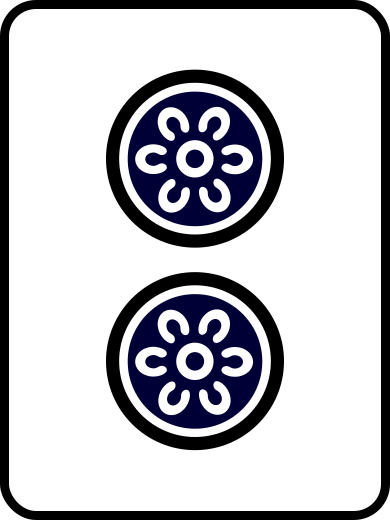
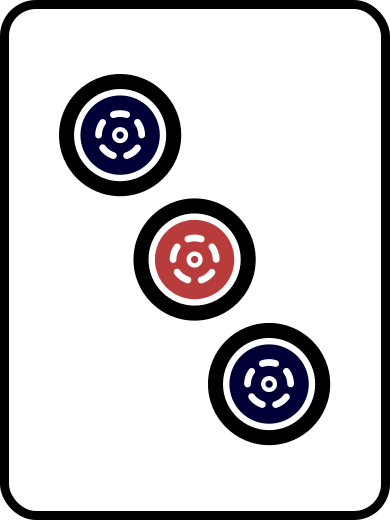
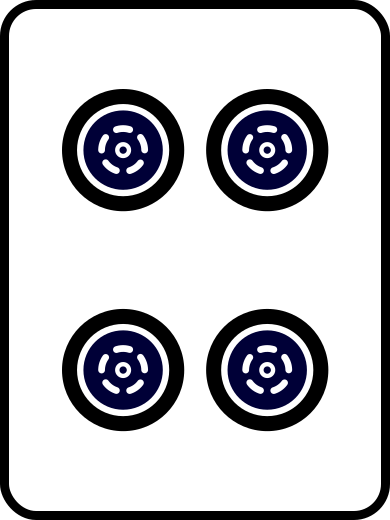
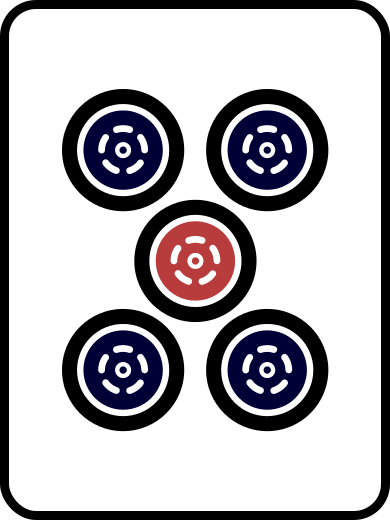
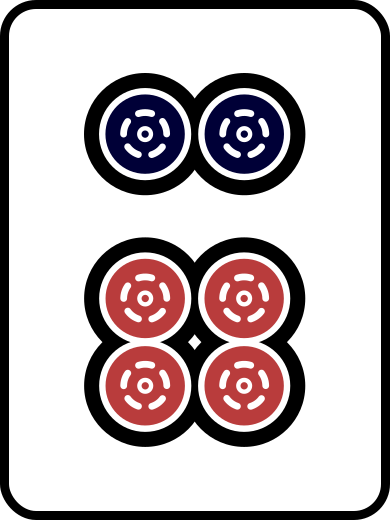
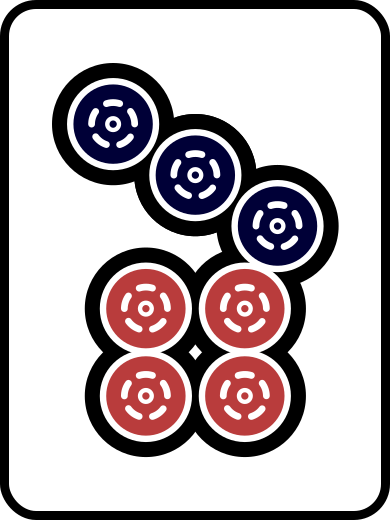
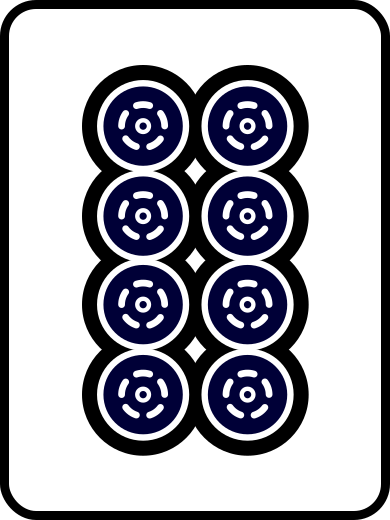
At some tables that's , the big wheel (大車輪): a , 32,000 from a . On Tenhou the name means nothing. The hand still scores as , , , and , 11 , so the same ron pays a : 24,000. Same tiles, 8,000 apart, depending on a rule nobody announced.
Japanese has a name for these: rookaru yaku, local yaku (ローカル役). Japanese Wikipedia's list sorts them into three families: hands inherited from Chinese mahjong, hands invented in Japan that spread, and hands imported from American or Taiwanese play. The old Chinese ones are also called koyaku, old yaku (古役). Most standard rules use none of them. A few survive in online games, and each game picks its own.
The big wheel and its cousins
Daisharin, the big wheel. of pin, 2 through 8, closed. A yakuman where it's played. Japanese Wikipedia traces the hand to a 1967 book, Katsu Maajan, winning mahjong (勝つ麻雀), edited by the Nihon Paikiin (日本牌棋院), and notes that some tables once used 1 to 7 instead. The same shape in sou is daichikurin, the great bamboo grove (大竹林), and in man daisuurin (大数隣). Japanese Wikipedia gives no origin for those two.
Without the rule, it's the 11 han from the opening. Win it by and it's 12. Add a red five and it's 13, and on Tenhou and Mahjong Soul 13 han is a anyway. A regular gets there even on a ron: every tile is paired, so a dora from 2 to 8 pin adds 2 han.
Daichisei, the great seven stars (大七星). Seven pairs made of all seven .
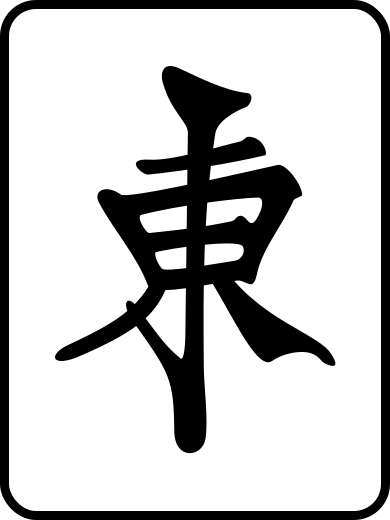
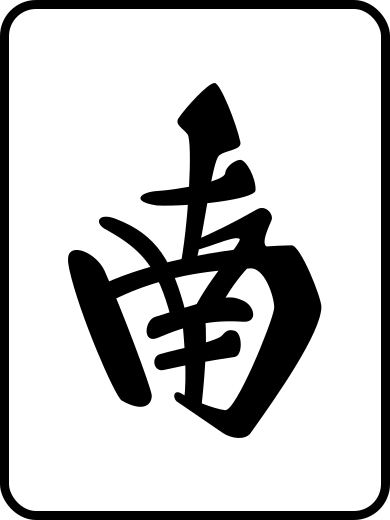
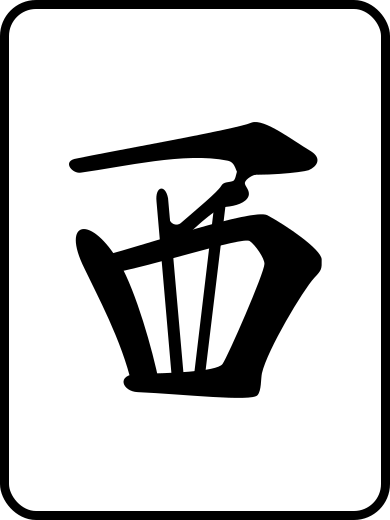
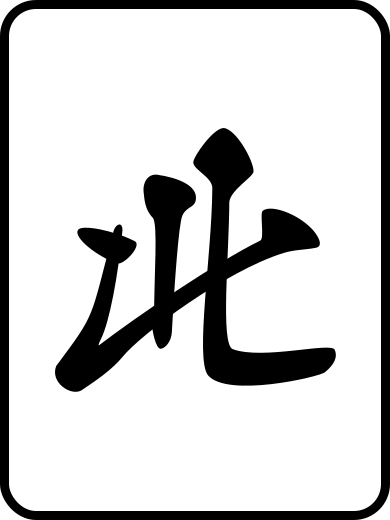

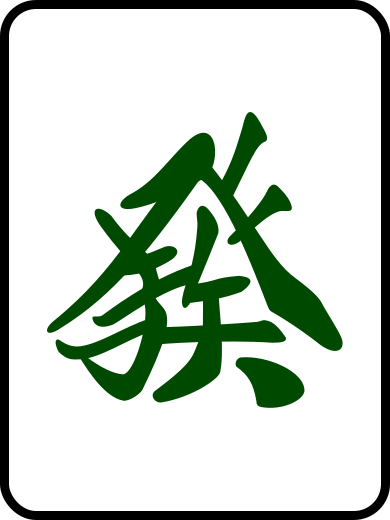
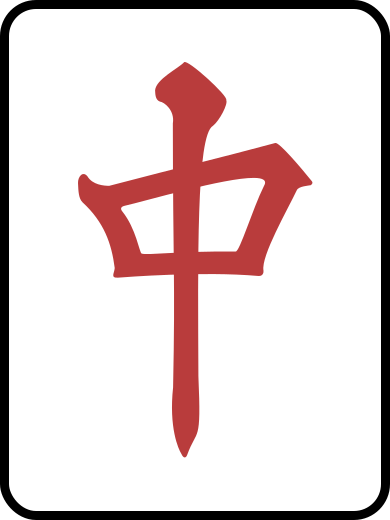
Some rule sets pay it as a double yakuman. Without the rule it's still all honors, , wherever seven pairs can count for it. Tenhou's rules say so outright: chiitoitsu no tsuuiisou ari, all honors counts in seven-pairs form (七対子の字一色あり).
A hand made of nothing
Shiisan puutaa, thirteen unconnected (十三不塔). As the dealer on your 14 dealt tiles, or as a non-dealer on your first draw with no calls before it, you hold no set, no two-tile shape, and exactly one pair. Japanese Wikipedia cites a 2007 scoring book edited by Ide Yosuke (井出洋介) that lists it as a yakuman, and adds that definitions vary.
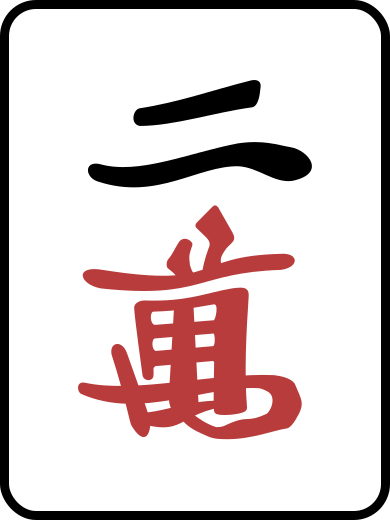
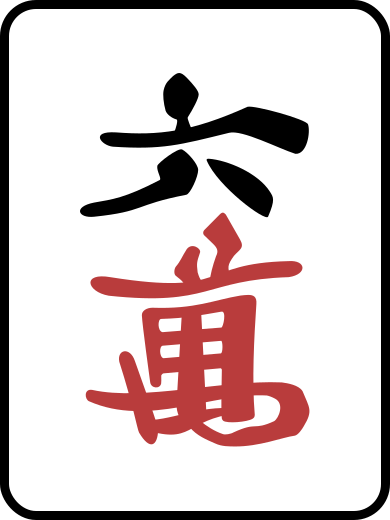
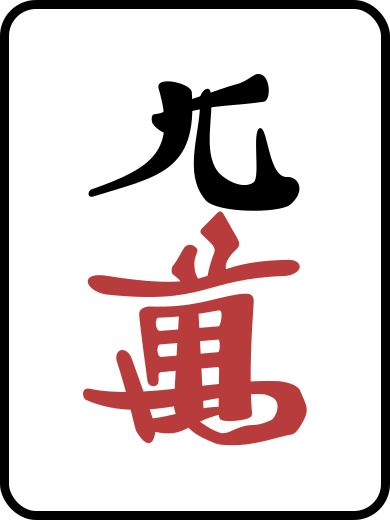
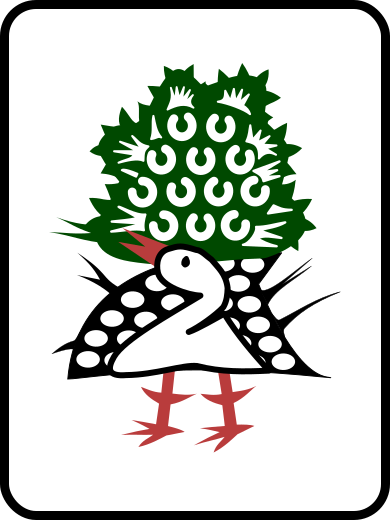
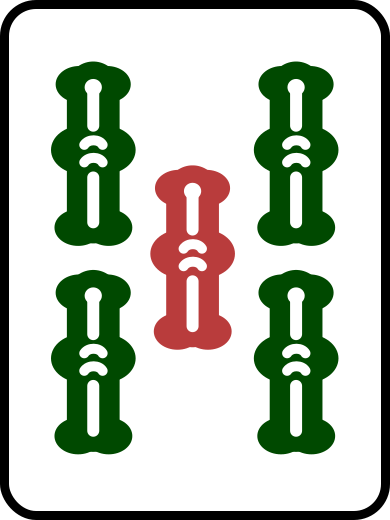
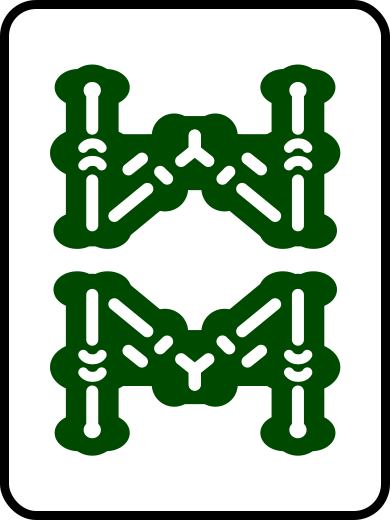
No two number tiles in a suit sit within two of each other, the other honors are all different, and the green dragons are the one pair. Tenhou names it among the rules it leaves out. It shares a root with . The post on what yaku names mean tells that story.
A red peacock and four steps
Benikujaku, the red peacock (紅孔雀). Only 1, 5, 7, and 9 of sou, plus the .
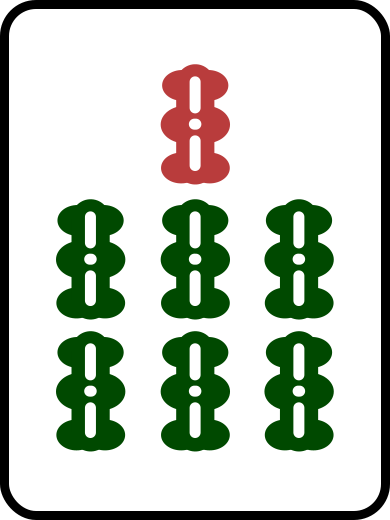
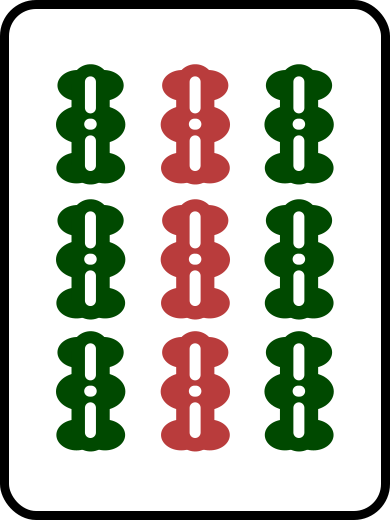
It's the leftover sou after takes 2, 3, 4, 6, and 8. None of those four numbers are next to each other, so no sequence is possible and the hand has to be four triplets and a pair. Calls are allowed. Japanese Wikipedia credits the hand to a man in Yokohama, 近藤修太郎, around 1965, who wanted an answer to . Kouiisou, "all red" (紅一色), didn't fit tiles with green on them, the article says, so he named it after the bird drawn on the 1 of sou.
Suurenkou, four in a row (四連刻). Four triplets in one suit with consecutive numbers, such as 3, 4, 5, and 6 of pin, paid as a yakuman where the rule exists. Chinese mahjong scores the same shape as four pure shifted pungs (一色四節高). Its little brother, sanrenkou (三連刻), three consecutive triplets for 2 han, is on Tenhou's list of rules it leaves out.
A dealer streak and a first-turn ron
Paarenchan, eight in a row (八連荘). Win eight times in a row and the eighth win pays a yakuman, whatever the hand. Japanese Wikipedia records two versions: the dealer has to win eight straight hands, or the dealer has to keep the deal eight times with draws in between allowed. Tenhou doesn't use . Konami's Mahjong Fight Club (麻雀格闘倶楽部), the network arcade game, lists it as a yakuman, next to daisharin (2 to 8 pin only) and renhou.
Renhou, the hand of man (人和). is a non-dealer's ron before their own first draw, with no calls before it. Its price changes with the rule set: a yakuman in some, a or in others, a mangan in the EMA 2025 rules, and nothing on Tenhou or in Mahjong Soul ranked. The tenhou and chiihou guide works one through. Japanese Wikipedia warns that at parlors that don't play it, calling ron on a hand with no other yaku can cost you a .
Two that aren't yakuman
Open (開立直). You show your hand when you declare. It's worth 2 han, one more than a normal riichi. Opponents can't throw your winning tile unless they have no other choice. In the version Japanese Wikipedia describes, a player who deals into an open riichi pays it as a yakuman, unless they're in riichi themselves. Tenhou's yaku list has no open riichi, and its rules for the parlor-style jansousen rooms (雀荘戦) name oopun riichi (オープンリーチ) among the extras they don't use.
(流し満貫). Not a yakuman, and not even a win. The wall runs out, every one of your discards is a terminal or honor, and nobody called any of them. You're paid a mangan as if you'd drawn your winning tile. Tenhou and Mahjong Soul both play it in ranked games, where it replaces the payments. In Tenhou's 2016 east-south games with red fives, it happened 283 times, against 282 .
Where each one pays
| Hand | Mahjong Soul (friendly) | Fight Club |
|---|---|---|
| Daisharin, big wheel | Yakuman | Yakuman |
| Daichisei, seven honor pairs | Double yakuman | No |
| Shiisan puutaa, thirteen unconnected | No | No |
| Benikujaku, red peacock | No | No |
| Suurenkou, four in a row | No | No |
| Paarenchan, eight in a row | No | Yakuman |
| Renhou, hand of man | Yakuman | Yakuman |
| Open riichi | No | No |
Mahjong Soul's FAQ says ranked games use no local yaku, and that they only count in friendly matches or player-run tournaments that turn them on. Game8's list of what that switch adds has renhou, the three big wheels, daichisei as a double, ishi no ue ni mo sannen, three years on a rock (石の上にも三年), which is a double riichi won on the last tile; a handful of smaller extras, but no shiisan puutaa, paarenchan, or benikujaku.
Even where a game pays them, these hands are rare. Japanese Wikipedia cites a 2003 tally from Mahjong Fight Club: out of 191,724 yakuman, 29 were daisharin and 9 were paarenchan, against 32 pure . The big wheel came up about as often as pure nine gates.
Ask before the first hand
Pro rule sets can be stricter still. I play under the Japan Pro Mahjong Association (日本プロ麻雀協会, NPM) rules, and the official rule spells it out in one line: no renhou, no nagashi mangan, no abortive draws. If a club, a parlor, or a friend's living room hands you a rule sheet, read the yakuman section before you sit down, then look for the hands it doesn't mention.
Price the big wheel the Tenhou way. Open the score calculator, enter 11 han for a non-dealer ron, then 13 for the same hand with a dora in it, and watch 24,000 become 32,000, a with no local rule at all.
Was this article helpful?