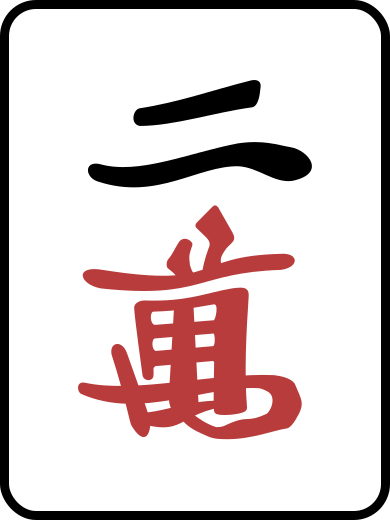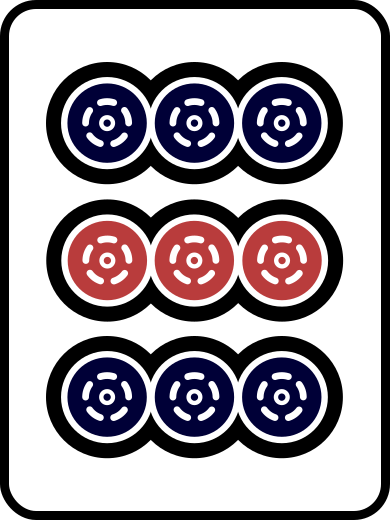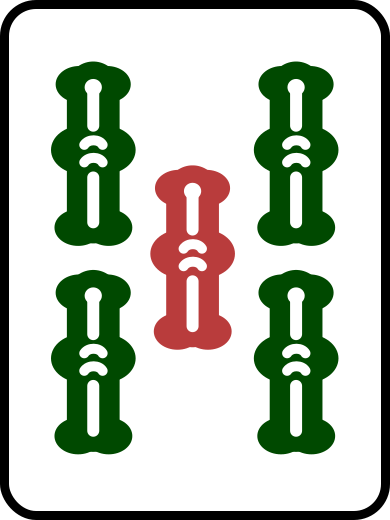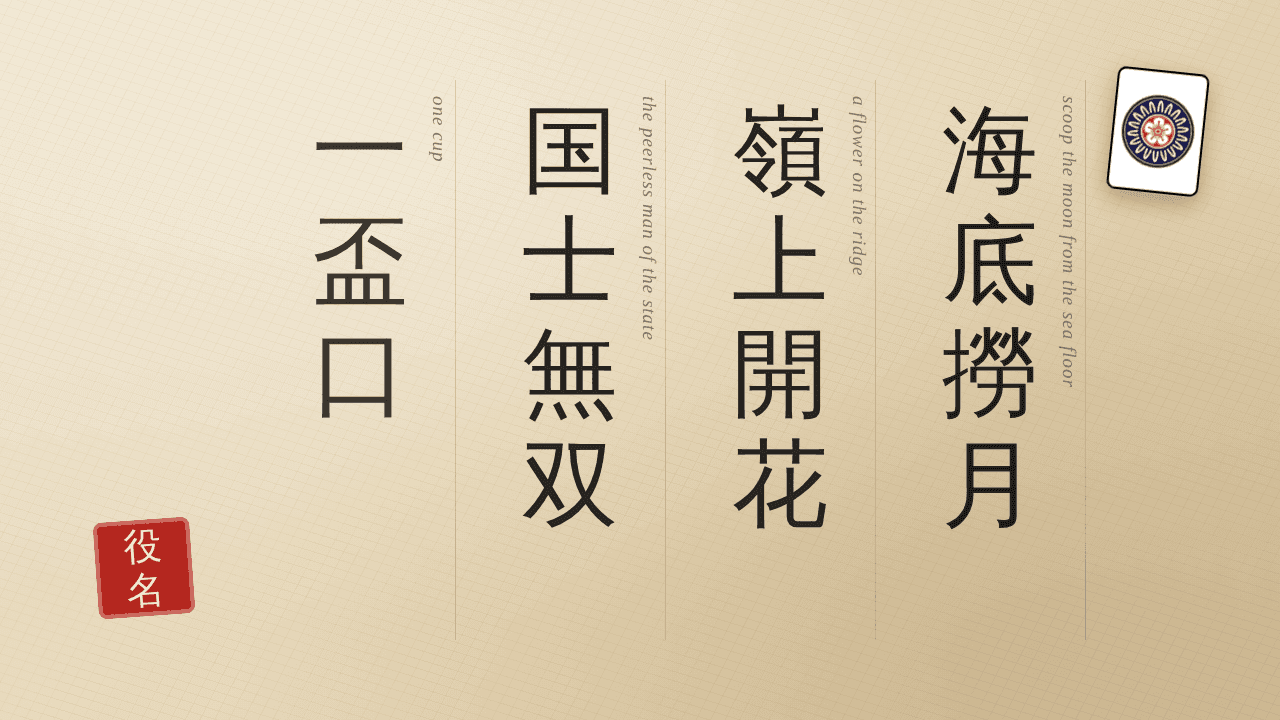
Every player says "" and "" without a second thought. Read the kanji and they turn into pictures. (海底撈月) is scooping the moon up from the sea floor. (嶺上開花) is a flower blooming on a mountain ridge. And () is praise for a general, written down more than 2,000 years ago.
Most of these names came to Japan from Chinese mahjong, readings and all. Wiktionary lists haitei raoyue, houtei raoyui, and suuankou as borrowings from Mandarin, which is why "haitei raoyue" doesn't sound like Japanese. The sounds stayed Chinese, but the kanji kept their meaning. I speak Japanese, and like any Japanese reader I see the sea and the moon in haitei raoyue.
The names, one line each
| Yaku | Kanji | What the name says |
|---|---|---|
| Haitei | 海底撈月 / 海底摸月 | Scoop (or feel for) the moon at the bottom of the sea |
| Houtei | 河底撈魚 | Scoop a fish from the bottom of the river |
| Rinshan kaihou | 嶺上開花 | A flower blooms on the ridge |
| Chankan | 搶槓 | Snatch the |
| Kokushi musou | 国士無双 | The peerless man of the state |
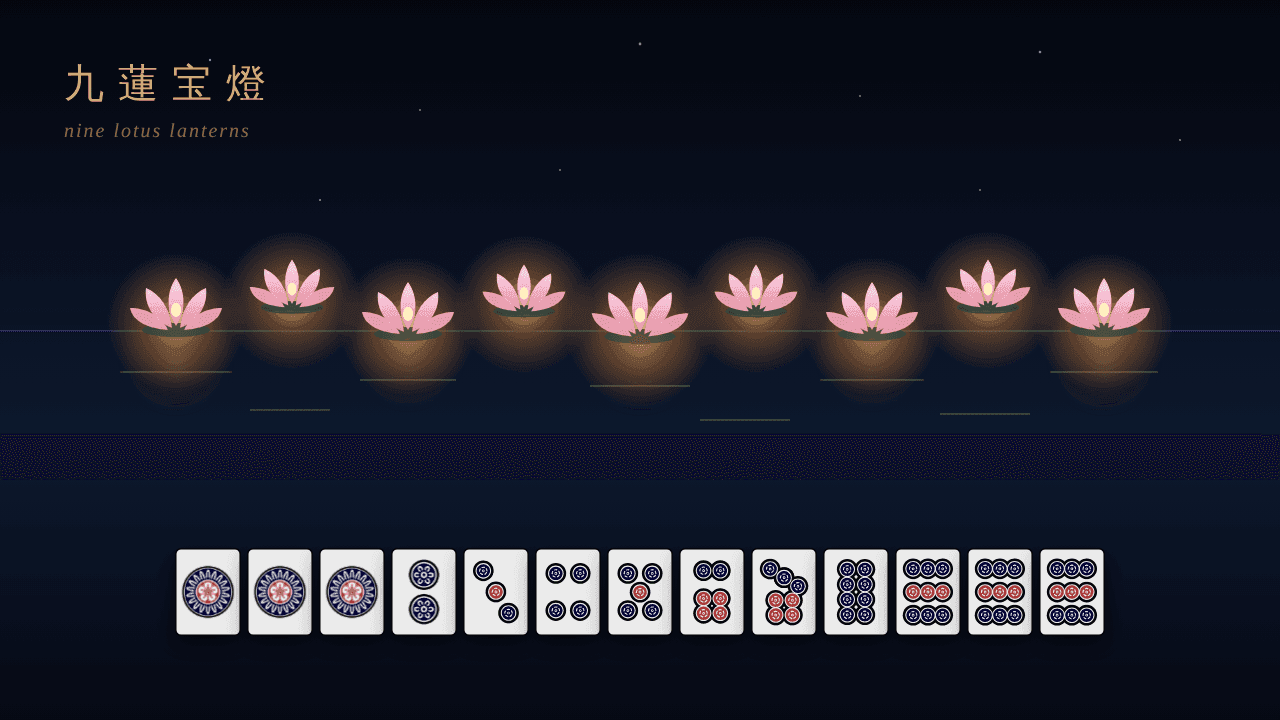
| Chuuren poutou | Nine lotus treasure lamps | |
| Shousuushii, daisuushii | , | Little and big four joys |
| Daisangen | Big three fundamentals: the dragons | |
| Tenhou, chiihou | , | Heaven's win, earth's win |
| Ryuuiisou | All one color: green | |
| Tsuuiisou | All one color: letters, the | |
| Chinitsu | One pure color | |
| Honitsu | One mixed color | |
| Tanyao | Cut off the ones and nines | |
| Pinfu | 平和 | The cheap win |
| Iipeikou | One cup (from 一般高, "one equal height", respelled as a pun on "let's go for one drink") | |
| Ittsu | Straight through in one breath | |
| Suuankou | Four hidden triplets |
Last tiles and kan tiles
Haitei. The idiom haitei raoyue means trying to scoop the moon's reflection from the sea. Shogakukan's Daijisen defines it as wasting effort on something that can't be done. As a yaku it's a self-drawn win on the last tile of the wall. Tenhou's yaku list writes it haitei moyue (海底摸月) instead: mo (摸) is to touch or feel for something, the same character as in tsumo (), the .
Houtei. Houtei raoyui (河底撈魚) is the matching win on the last discard: the fish scooped from the riverbed. Japanese Wikipedia's page on the two tells how the name was chosen. When the Nihon Maajan Renmei (日本麻雀連盟), the amateur Japan Mahjong League, set its rules in 1930, members objected that a fish smelled, and someone proposed "scooping water weed" instead. A 6-dan player on the committee drafting the standard rules, 木村衛, settled it on the fish. The story goes that he later learned of a Chinese phrase, scooping a pearl from the riverbed (河底撈珠), and kicked himself for missing the more elegant pair.
Rinshan kaihou. Wiktionary reads rinshan kaihou as a flower blooming on the ridge. The ridge is the , where your after a kan comes from. Chinese calls the same win a flower on the kan (槓上開花). The Nihon Kokugo Daijiten cites rinshan kaihou from Modan Shin'yougo Jiten, a 1931 dictionary of new words (モダン新用語辞典).
. The first character of chankan (搶槓) means to snatch: you rob the tile someone adds to a . Japanese also writes it with the character for spear (槍). Japanese Wikipedia calls that a variant spelling and says the snatching character is the one that makes sense. Tenhou uses both: the spear (槍槓) in its yaku list, the snatch in its rules. Mahjong Soul's yaku list goes with the spear. A 1914 Shanghai rulebook gave the move a grander name, the golden rooster steals the food (金雞奪食).
The peerless man who started as the worst hand
Kokushi musou is a quotation. In the Records of the Grand Historian, the chapter on Han Xin (韓信) tells how he deserted Liu Bang, the future first emperor of Han, and the minister Xiao He (蕭何) went after him in person. When Xiao He came back, Liu Bang scolded him: dozens of generals had deserted and he'd chased none of them. Xiao He's answer, in the original text, was: 諸將易得耳。至如信者,國士無雙. Generals are easy to find. A man like Han Xin has no equal in the state. The Nihon Kokugo Daijiten traces the phrase to that chapter.
The mahjong hand took a long road to that compliment. Japanese Wikipedia's kokushi article quotes a 1914 Shanghai rulebook (繪圖麻雀牌譜) where the same name (國士無雙) meant a with no sets, no partial sets, and no pairs. It was commonly called thirteen unconnected (十三不搭), and the book describes it as "惡劣之極": as bad as a hand gets. The article argues that the name shiisan yaochuu (十三么九) only arrived through books from northern China in the 1920s, and that the same league, then written 日本麻雀聯盟, adopted it as the official name in 1929. It calls the common claim that shiisan yaochuu was the "original" name wrong. The broken-hand idea survives as a house rule, shiisan puutaa (十三不塔), a at some tables.
Lamps, joys, and the big yakuman
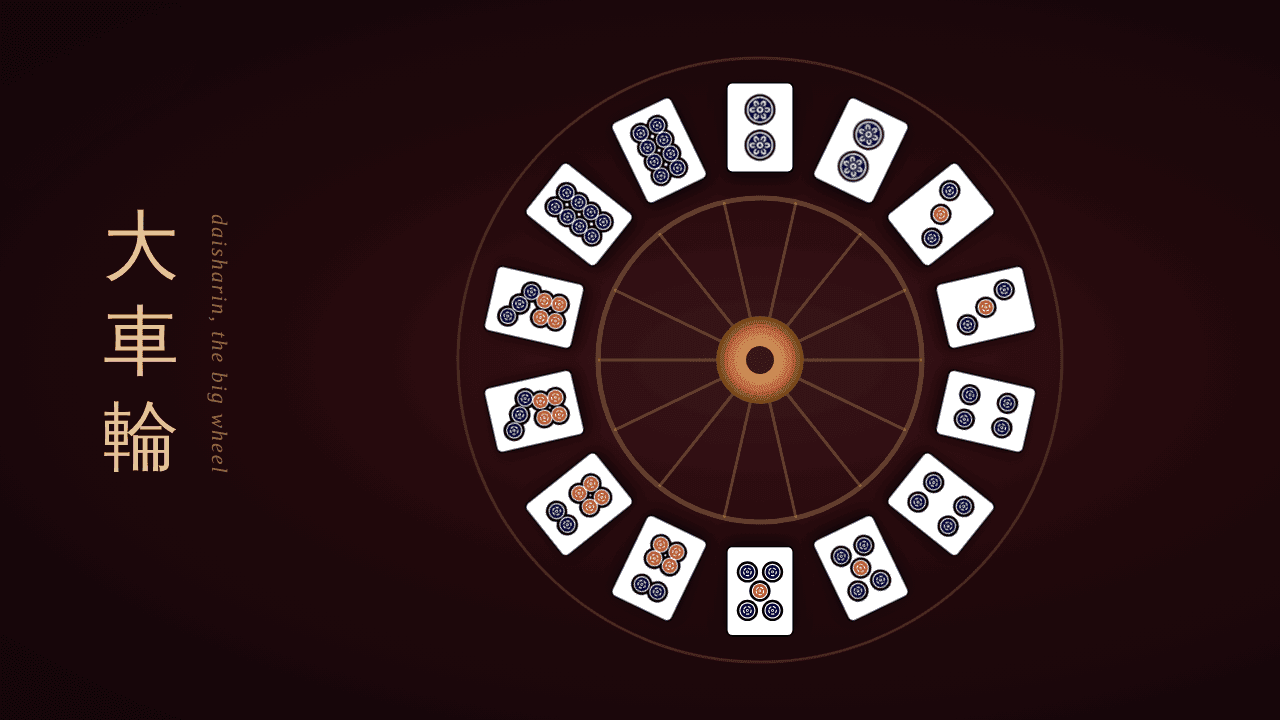
Chuuren poutou. The name (九蓮宝燈) reads as nine lotus treasure lamps. Japanese Wikipedia's article doesn't explain the name, but it gives another one, ten'i muhou, the clothes of the immortals with no seams (天衣無縫), which means flawless. The hand also has a death legend, told in the chuuren poutou curse.
Four joys. Suushii, four joys (四喜), takes its name from a poem. Japanese Wikipedia's suushiihou page traces it to Four Joys, a poem in the Song dynasty collection Shentong Shi, the child prodigy poems (神童詩). Its four joys are rain after a long drought, meeting an old friend far from home, the wedding night, and seeing your name on the list of those who passed the imperial exam. Collect all four winds and you've had them all.
Daisangen. Wiktionary glosses daisangen (大三元) as "big three fundamentals". In Japanese the sangen (三元) is short for , the three dragon tiles (三元牌).
Tenhou, chiihou. Heaven's win and earth's win, the first-turn yakuman. A third member of the family, , the hand of man (人和), is a before your first draw. What it pays depends on the rule set, as the house-rule yakuman post shows. As a Japanese word, the yaku tenhou's kanji (天和) were also an era name, Tenna, from 1681 to 1684.
The everyday ones
Tanyao. Tanyaochuu (断么九) means cut the ones and nines. The middle character, yao (么), means small, and by extension the number one, according to the Dai Kan-Wa Jiten (大漢和辞典) as cited on Japanese Wikipedia's tanyao page.
Pinfu. Pinfu's kanji (平和) spell heiwa, the Japanese word for peace, and that's not what they mean here. Japanese Wikipedia's pinfu article explains that in the Wu dialects of Shanghai and Ningbo, and in Min, Hakka, and Cantonese, pin (平) meant low in points. Pinfu was the win that scored nothing but the base 10. The 1914 rulebook calls a win made only of sequences the flat win worth 10 (平和十副).
Iipeikou. The Chinese name, one equal height (一般高), means two sequences of "the same height". Japanese Wikipedia's iipeikou article says Japanese players knew it by sound, as "ippeikou", without knowing the kanji. Amano Daizou (天野大三), the man behind the Houchi rules in the history of riichi, heard ippai ikou, "let's go for one drink" (一杯行こう), and spelled it 一盃口 in his books. The spelling stuck.
Ittsu. Ikkitsuukan (一気通貫) runs straight through in one breath, 1 to 9 in one suit. Daijisen now gives a second meaning: a business doing everything from start to finish, planning through sales.
Riichi. The word (立直) made a round trip. Wiktionary says it came from a local Chinese mahjong term that has since died out, and that Chinese players have now borrowed it back from Japanese. It isn't the English word "reach".
Yaku guide
Riichi
1 han, closed only. Declare on a closed tenpai hand and put out a 1,000-point stick.
Learn the hands behind the names
The yaku guides give every name in the table a page: what the hand needs, whether it can be open, and what it pays on Tenhou and Mahjong Soul. Pick the names you understood least, read their pages, then drill the scoring in the fu quiz until pinfu means 20 or 30 fu and not world peace.
Was this article helpful?