
How scoring works
Mahjong counts points its own way. Every winning hand carries two numbers:
- Han (飜) come from yaku and dora. Older texts, including the first edition of this book, call them fan. It's the same unit.
- Fu (符) are minipoints. They come from the shape of the hand: its melds, its pair, its wait, and the way it won.
The two together give the base points (基本点), and the base points decide what each player pays. Each extra han doubles the hand's value, so one han makes a big difference to the payment.
Dora and red fives add han, but they aren't yaku. A hand needs at least one yaku to win. Riichi with two red fives is a 3 han hand: 1 for riichi and 2 for the dora.
Most hands are worth between 1,000 and 8,000 points. The plainest hands collect the minimum, 1,000. Mangan (8,000, or 12,000 for the dealer) is a common target.
Points don't come from nowhere. They move from one player to another. If all four started on 25,000, the four scores always add up to 100,000, at the end of the game too.
Dealer and non-dealer
Each hand has one dealer (親 oya), the player in the East seat, and three non-dealers (子 ko). A dealer win pays half again as much as a non-dealer win with the same hand. The price: when someone else wins by tsumo, the dealer pays a double share.
In base points, the payments work like this:
- Non-dealer ron: the discarder pays base x 4.
- Dealer ron: the discarder pays base x 6.
- Non-dealer tsumo: the dealer pays base x 2, and each of the other two non-dealers pays base x 1.
- Dealer tsumo: each of the other three pays base x 2.
Before rounding, ron and tsumo collect the same total: 4 times the base points for a non-dealer and 6 times for the dealer. What changes is who pays.
Limit hands
Base points have a ceiling. Once a hand reaches a certain value, the formula stops mattering and the hand pays a fixed amount: a limit. From 5 han up, a hand is always a limit hand. Below 5 han, a hand with plenty of fu can still reach mangan; you'll see where in the tables.
The limits, from smallest to largest:
Mangan (満貫), 5 han. The realistic limit, the one you'll aim for often. Its base points are 2,000. A non-dealer collects 8,000 on a ron (2,000 x 4). On a tsumo they collect 4,000 from the dealer and 2,000 from each non-dealer: 8,000 again. The dealer collects 12,000 on a ron (2,000 x 6), or 4,000 from each player on a tsumo (2,000 x 2, and 4,000 x 3 = 12,000 in all).
Haneman (跳満), 6 or 7 han. One and a half mangan: 3,000 base points. A non-dealer collects 12,000 on a ron, or 3,000 from each non-dealer and 6,000 from the dealer on a tsumo. The dealer collects 18,000 on a ron, or 6,000 from each player on a tsumo.
Baiman (倍満), 8 to 10 han. Two mangan: 4,000 base points. A non-dealer collects 16,000 on a ron, or 4,000 and 8,000 on a tsumo. The dealer collects 24,000 on a ron, or 8,000 from each player on a tsumo.
Sanbaiman (三倍満), 11 or 12 han. Three mangan: 6,000 base points. A non-dealer collects 24,000 on a ron, or 6,000 and 12,000 on a tsumo. The dealer collects 36,000 on a ron, or 12,000 from each player on a tsumo.
Yakuman (役満). Any of the special hands in the yakuman chapter, or a regular hand that adds up to 13 han or more: a kazoe yakuman (数え役満). Four mangan: 8,000 base points. A non-dealer collects 32,000 on a ron, or 8,000 and 16,000 on a tsumo. The dealer collects 48,000 on a ron, or 16,000 from each player on a tsumo. A hand with two yakuman pays double, and one with three pays triple.
Here are the limit payments to keep handy. The ron comes first, with the tsumo in parentheses. In a non-dealer tsumo, the first number is what each non-dealer pays and the second is the dealer's share. In a dealer tsumo, it's what each of the other three pays.
- Mangan: non-dealer 8,000 (2,000/4,000); dealer 12,000 (4,000 all).
- Haneman: non-dealer 12,000 (3,000/6,000); dealer 18,000 (6,000 all).
- Baiman: non-dealer 16,000 (4,000/8,000); dealer 24,000 (8,000 all).
- Sanbaiman: non-dealer 24,000 (6,000/12,000); dealer 36,000 (12,000 all).
- Yakuman: non-dealer 32,000 (8,000/16,000); dealer 48,000 (16,000 all).
Calling the score
When you win by ron, you announce the total you're owed: "Ron. 8,000." If there are honba on the table, include them: with two honba, "8,600."
When you win by tsumo as a non-dealer, you say what each non-dealer pays first and what the dealer pays second, never the other way around: "Tsumo. 2,000, 4,000."
When the dealer wins by tsumo, they say what each player pays, followed by ooru (オール, from the English "all"): "Tsumo. 4,000 all." With one honba, "4,100 all."
Counting fu
The limits are easy to remember. But most hands have fewer than 5 han, and there the value depends on fu. Count them with these steps, in order:
- Is it chiitoitsu (七対子)? The hand is a flat 25 fu. Add nothing and don't round.
- Is it pinfu (平和) won by tsumo? The hand is a flat 20 fu.
- Every winning hand starts with 20 fu of base, the fuutei (副底).
- If you win by ron with a closed hand, add 10 fu of menzen kafu (門前加符).
- If you win by tsumo, open or closed, add 2 fu for the tsumo (ツモ符 tsumo-fu). The one exception is the pinfu from step 2.
- Add the fu for each meld (below).
- Add the fu for the pair.
- Add the fu for the wait.
- Round up to the next 10: 22 becomes 30, 32 becomes 40, 102 becomes 110.
- An open hand that wins by ron with only 20 fu counts as 30 fu. This is called kui pinfu (食い平和), "open pinfu."
Meld fu
Each meld (面子 mentsu) adds fu by its type, by whether it's open or closed, and by whether it's simples (2 to 8) or terminals and honors.
- Open triplet, minkou (明刻): 2 fu for simples, 4 for terminals or honors.
- Closed triplet, ankou (暗刻): 4 fu for simples, 8 for terminals or honors.
- Open quad, minkan (明槓): 8 fu for simples, 16 for terminals or honors.
- Closed quad, ankan (暗槓): 16 fu for simples, 32 for terminals or honors.
- Sequence, shuntsu (順子): 0 fu, open or closed.
Every step doubles: closed is worth twice open, terminals and honors twice simples, and a quad four times a triplet.
A quad made by adding a tile to a pon (加槓 kakan) counts as an open quad.
One case trips people up. If you win by ron and the winning tile completes a triplet (a shanpon wait), that triplet counts as open, a minkou, both for fu and for the sanankou (三暗刻) yaku. The hand itself stays closed, so it keeps the 10 fu of menzen kafu. If the same tile comes by tsumo, the triplet counts as closed.
Pair fu
The pair (雀頭 jantou) adds 2 fu if it's dragons, your seat wind, or the round wind. If it's both your seat wind and the round wind (say, a pair of East for the dealer in the East round), it adds 4 fu. Any other pair adds 0.
Wait fu
The wait is the shape the hand had in tenpai, just before the winning tile. Two-sided waits add no fu. Waits on a single tile add 2.
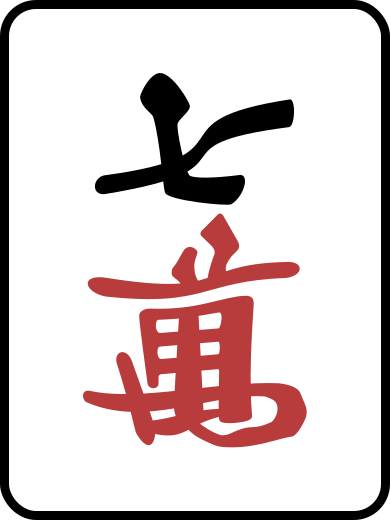
Ryanmen (両面), 0 fu. The two-sided wait. Two tiles in a row, here the 7 and 8 man, wait on either neighbor: the 6 or the 9. It's the most common wait.
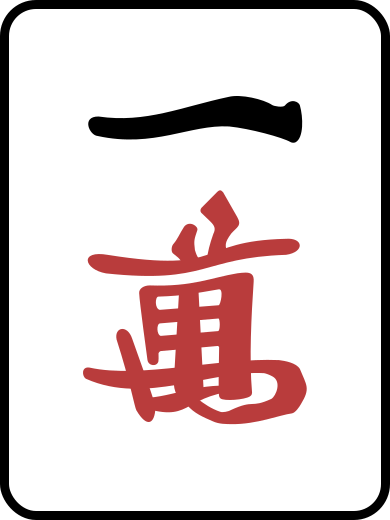
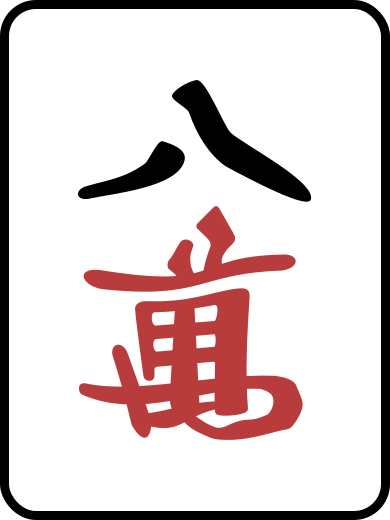
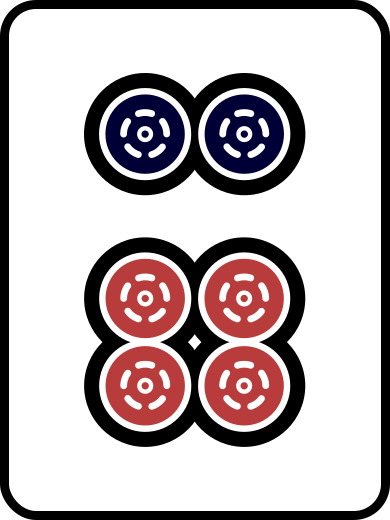
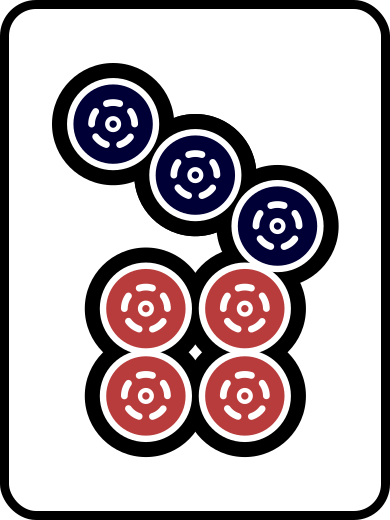
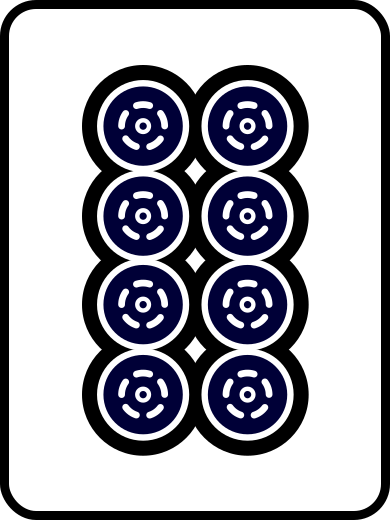
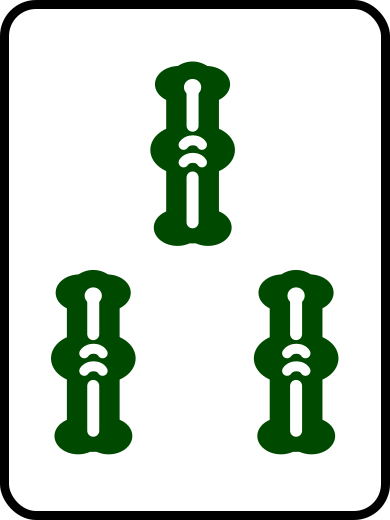
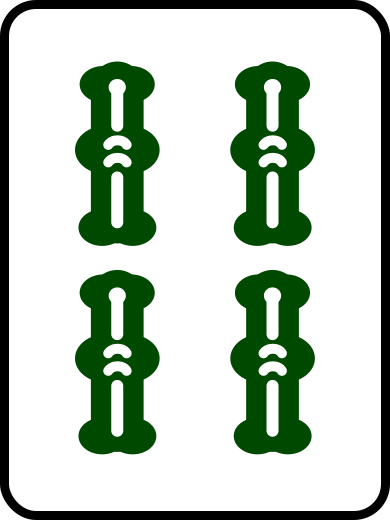
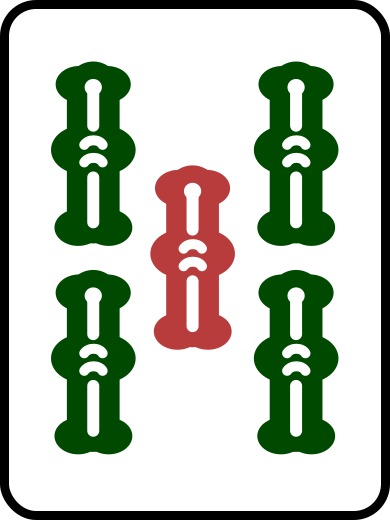
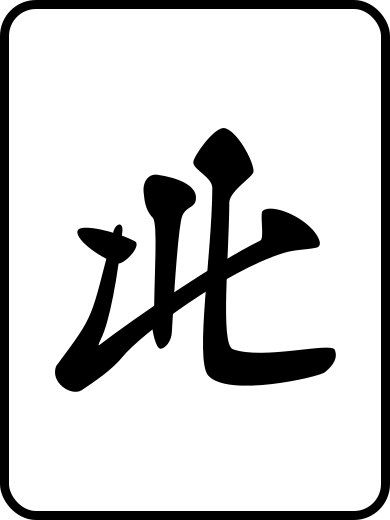
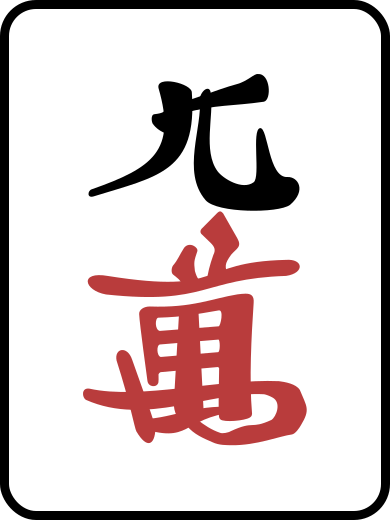
Shanpon (双碰), 0 fu. The wait on two pairs. You have three complete melds and two pairs. You win with either tile that turns one of the pairs into a triplet: here the 1 man or the 1 sou.
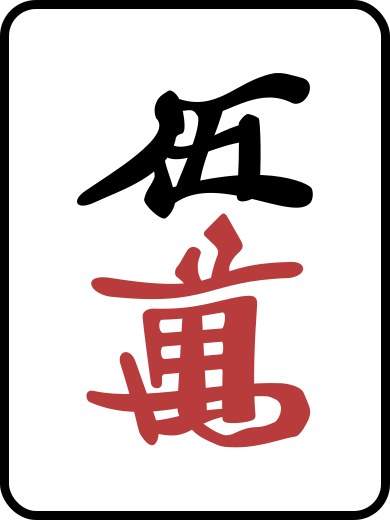
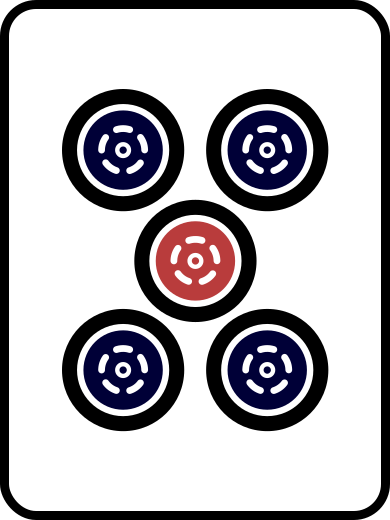
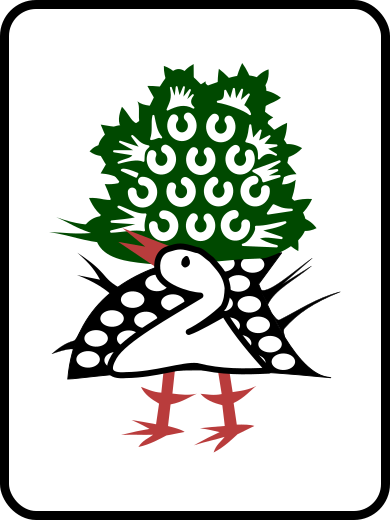
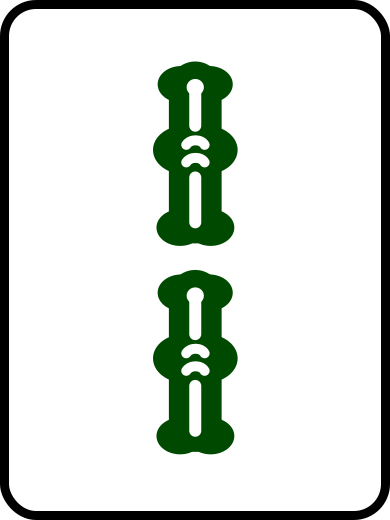
Kanchan (嵌張), 2 fu. The middle wait. The center tile of a sequence is missing: here the 3 sou, between the 2 and the 4.
Penchan (辺張), 2 fu. The edge wait. A 1-2 that only a 3 can finish, or an 8-9 that only a 7 can finish.
Tanki (単騎), 2 fu. The pair wait. You have four melds and one loose tile, and you wait for its match: here North.
Special cases
One hand can read more than one way. Sometimes the winning tile completes the hand as a ryanmen or as a kanchan or penchan, depending on how you group the tiles. You score the reading that pays most (高点法 koutenhou). If the ryanmen reading gives the hand pinfu, it counts as a ryanmen. If not, it counts as the kanchan or penchan, for the 2 fu.
Pinfu by ron is always 30 fu: 20 of fuutei and 10 of menzen kafu.
Pinfu by tsumo is always 20 fu: it doesn't add the 2 tsumo fu, but it does get the han for menzen tsumo (門前清自摸和).
Rinshan kaihou (嶺上開花) is a tsumo win and adds the 2 tsumo fu like any other. If the hand is closed, it's also worth menzen tsumo.
Put all this together and no hand can be 1 han 20 fu. Exactly 20 fu only happens with pinfu by tsumo, which already has 2 han.
Base points
You know how to count han (in the yaku chapter) and fu. Put them together and you get the base points formula:
base points = fu x 2(2 + han)
Then multiply the base points by what each player owes (x 4, x 6, x 2, or x 1, depending on who wins and how, as above). Each payment rounds up to the next 100, on its own.
That's why, with the same han and fu, a tsumo sometimes collects a little more than a ron. Each of the three payments rounds separately. The difference is 0, 100, or 200 points, and the tsumo never collects less. For example, a non-dealer with 1 han 40 fu collects 1,300 on a ron, and 400 + 400 + 700 = 1,500 on a tsumo.
Result
Basic points: 30 × 25 = 960
- The discarder pays
- 3,900
- Honba included in the payments
- +0
- Riichi sticks you collect
- +0
- Total you collect
- 3,900
The site's score calculator does the same with honba and riichi sticks added, and its fu helper counts a hand's fu line by line.
Worked examples
A tsumo on a pair wait
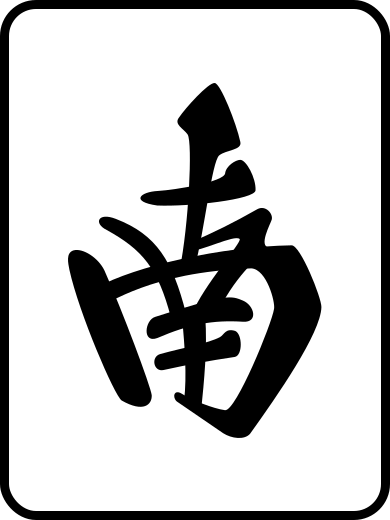

Round: East. Your seat: South. You win by: tsumo.
You're the player to the dealer's right. The hand is closed. You have a closed triplet of South, your seat wind, and you're waiting for the white dragon to make your pair.
The yaku are menzen tsumo (1 han) and yakuhai (役牌) for South (1 han): 2 han in all.
The fu:
- 20 of fuutei.
- 0 for the three sequences.
- 8 for the closed honor triplet.
- 2 for the dragon pair.
- 2 for the tanki wait.
- 2 for the tsumo.
That's 34 fu, which rounds up to 40. The base points are 40 x 2(2 + 2) = 640.
The dealer pays 640 x 2 = 1,280, rounded up to 1,300. Each of the other two pays 640, rounded up to 700. You collect 2,700 in all. You call it as "Tsumo. 700, 1,300."
The same hand by ron
Now you win the same hand by ron, on a discard from the player to your right. With no tsumo there's no menzen tsumo, so you're left with 1 han of yakuhai.
The fu: 20 of fuutei, 10 of menzen kafu, 8 for the closed honor triplet, 2 for the dragon pair, and 2 for the tanki wait. That's 42 fu, which rounds up to 50.
The base points are 50 x 2(2 + 1) = 400. The discarder pays 400 x 4 = 1,600. The other two pay nothing.
In the South round, South would also be the round wind and the triplet would be worth 2 han of yakuhai. The hand would become 2 han 50 fu: 3,200. Do the math to check it. One more han doubled the value.
The score tables
Working out every hand from scratch is slow. That's what the table of common values is for. It's worth memorizing, and with practice it sticks on its own.
Find your hand's han and fu: each cell gives the ron payment and the tsumo payment. In a non-dealer tsumo, the first number is what each non-dealer pays and the second is the dealer's share. Combinations no hand can have show no payment. The site's scoring guide has the same tables with more worked hands.
| Fu | 1 han | 2 han | 3 han | 4 han |
|---|---|---|---|---|
| 20 | Ron: not possibleTsumo: not possible | Ron: not possible400/700 | Ron: not possible700/1,300 | Ron: not possible1,300/2,600 |
| 25 | Ron: not possibleTsumo: not possible | 1,600Tsumo: not possible | 3,200800/1,600 | 6,4001,600/3,200 |
| 30 | 1,000300/500 | 2,000500/1,000 | 3,9001,000/2,000 | 7,700† mangan with kiriage2,000/3,900 |
| 40 | 1,300400/700 | 2,600700/1,300 | 5,2001,300/2,600 | Mangan |
| 50 | 1,600400/800 | 3,200800/1,600 | 6,4001,600/3,200 | Mangan |
| 60 | 2,000500/1,000 | 3,9001,000/2,000 | 7,700† mangan with kiriage2,000/3,900 | Mangan |
| 70 | 2,300600/1,200 | 4,5001,200/2,300 | Mangan | Mangan |
| 80 | 2,600700/1,300 | 5,2001,300/2,600 | Mangan | Mangan |
| 90 | 2,900800/1,500 | 5,8001,500/2,900 | Mangan | Mangan |
| 100 | 3,200800/1,600 | 6,4001,600/3,200 | Mangan | Mangan |
| 110 | 3,600Tsumo: not possible | 7,1001,800/3,600 | Mangan | Mangan |
| Limit | Han | Ron | Tsumo |
|---|---|---|---|
| Mangan 満貫 | 5 | 8,000 | 2,000/4,000 |
| Haneman 跳満 | 6–7 | 12,000 | 3,000/6,000 |
| Baiman 倍満 | 8–10 | 16,000 | 4,000/8,000 |
| Sanbaiman 三倍満 | 11–12 | 24,000 | 6,000/12,000 |
| Yakuman 役満 | 13+ | 32,000 | 8,000/16,000 |
| Fu | 1 han | 2 han | 3 han | 4 han |
|---|---|---|---|---|
| 20 | Ron: not possibleTsumo: not possible | Ron: not possible700 all | Ron: not possible1,300 all | Ron: not possible2,600 all |
| 25 | Ron: not possibleTsumo: not possible | 2,400Tsumo: not possible | 4,8001,600 all | 9,6003,200 all |
| 30 | 1,500500 all | 2,9001,000 all | 5,8002,000 all | 11,600† mangan with kiriage3,900 all |
| 40 | 2,000700 all | 3,9001,300 all | 7,7002,600 all | Mangan |
| 50 | 2,400800 all | 4,8001,600 all | 9,6003,200 all | Mangan |
| 60 | 2,9001,000 all | 5,8002,000 all | 11,600† mangan with kiriage3,900 all | Mangan |
| 70 | 3,4001,200 all | 6,8002,300 all | Mangan | Mangan |
| 80 | 3,9001,300 all | 7,7002,600 all | Mangan | Mangan |
| 90 | 4,4001,500 all | 8,7002,900 all | Mangan | Mangan |
| 100 | 4,8001,600 all | 9,6003,200 all | Mangan | Mangan |
| 110 | 5,300Tsumo: not possible | 10,6003,600 all | Mangan | Mangan |
| Limit | Han | Ron | Tsumo |
|---|---|---|---|
| Mangan 満貫 | 5 | 12,000 | 4,000 all |
| Haneman 跳満 | 6–7 | 18,000 | 6,000 all |
| Baiman 倍満 | 8–10 | 24,000 | 8,000 all |
| Sanbaiman 三倍満 | 11–12 | 36,000 | 12,000 all |
| Yakuman 役満 | 13+ | 48,000 | 16,000 all |
When a hand reaches mangan
A hand is a mangan as soon as its base points reach 2,000:
- 4 han 40 fu is already a mangan: 40 x 2(2 + 4) = 2,560.
- 3 han 70 fu is already a mangan: 70 x 2(2 + 3) = 2,240.
- 5 han is always a mangan, whatever the fu: even at 20 fu, 20 x 2(2 + 5) = 2,560.
4 han 30 fu and 3 han 60 fu fall just short: 1,920 base points. They pay 7,700 to a non-dealer and 11,600 to the dealer.
At the top end, 110 fu is the most that matters. A hand of 120 fu or more with fewer than 5 han always has sankantsu (三槓子) plus sanankou or toitoi: that's 4 han already, and at 4 han 40 fu the hand is a mangan. So:
- A 1 han hand never reaches mangan: 110 x 2(2 + 1) = 880.
- A 2 han hand never reaches mangan: 110 x 2(2 + 2) = 1,760.
Chiitoitsu
Chiitoitsu has its own shape, so it's always 25 fu and always at least 2 han.
- 2 han: non-dealer 1,600; dealer 2,400. Ron only.
- 3 han: non-dealer 3,200 (800/1,600); dealer 4,800 (1,600 all).
- 4 han: non-dealer 6,400 (1,600/3,200); dealer 9,600 (3,200 all).
The first number is the ron, with the tsumo in parentheses. A chiitoitsu won by tsumo always has at least 3 han, because the hand is closed and adds menzen tsumo. That's why there's no 2 han tsumo.
Notice that 2 han 25 fu pays the same as 1 han 50 fu. Below the limits, taking away one han and doubling the fu leaves the value unchanged. The same goes for 1 han 60 fu and 2 han 30 fu, or 3 han 40 fu and 2 han 80 fu.
1 han 110 fu
A 1 han hand can reach 110 fu. That's the most fu a 1 han hand can have. Here's one:
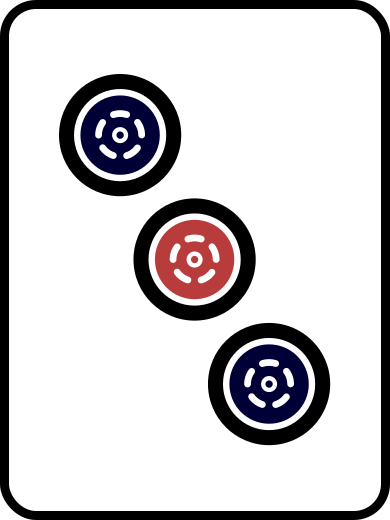
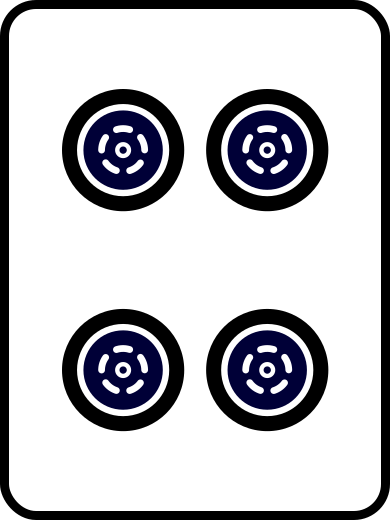
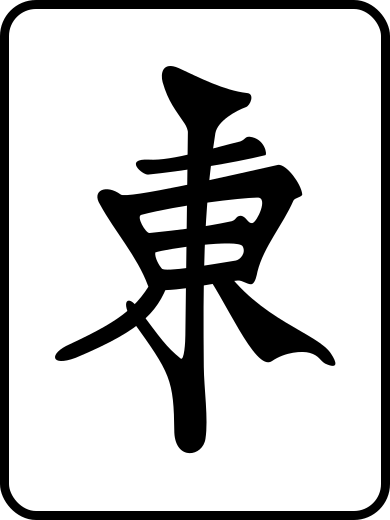
Round: East. Your seat: East. You win by: ron.
You're the dealer. You have two closed quads, of 1 man and 1 sou, and a shanpon wait on East or the white dragon. The white dragon comes in by ron. Its triplet gives you the only han: yakuhai.
The fu:
- 20 of fuutei.
- 10 of menzen kafu.
- 32 for the closed quad of 1 man, a terminal.
- 32 for the closed quad of 1 sou.
- 4 for the white dragon triplet. The ron completed it on a shanpon wait, so it counts as an open triplet.
- 4 for the pair of East, which is both your seat wind and the round wind.
That's 102 fu, which rounds up to 110. As the dealer, you collect 880 x 6 = 5,280, rounded up to 5,300.
This hand only exists as a ron. On a tsumo, the white triplet would stay closed: it would add sanankou and menzen tsumo, and the hand would no longer be 1 han. If East came in by ron instead, the East triplet would be worth 2 han of yakuhai, and again the hand wouldn't be 1 han. And if your rules pay 2 fu for a double-wind pair, the same hand counts 100 fu, and that becomes the most a 1 han hand can reach.
Honba and riichi sticks
Two things add to the payment for a hand. You met them in the chapter on the end of a hand.
- Each honba (本場) adds 300 points. On a ron, the discarder pays all of it. On a tsumo, each paying player adds 100.
- The winner takes every riichi stick (1,000 each) on the table, their own included.
Say a non-dealer wins a 3 han 30 fu hand with two honba and one riichi stick on the table. On a ron, the discarder pays 3,900 + 600 = 4,500, and with the stick you collect 5,500. On a tsumo, each non-dealer pays 1,000 + 200 = 1,200 and the dealer pays 2,000 + 200 = 2,200. With the stick you collect 5,600.
Final game scores
When the game ends, each player's points turn into a simpler result, in thousands of points. This is where the return, the oka, and the uma come in, which you saw in rules and penalties. Here I use the standard rule: everyone starts on 25,000, the return is 30,000 (三万点返し sanmanten-gaeshi), the uma is +20/+10/−10/−20 (ワンツー wantsuu), and the oka of 20 goes to first place.
If the last hand ends in an exhaustive draw, riichi sticks can be left on the table. The player in first place takes them, so the total stays at 100,000.
Here's the result of a real game, with each player's final points and result:
- Player A: 60,600 points, +70.6.
- Player B: 20,400 points, +0.4.
- Player C: 19,600 points, −20.4.
- Player D: −600 points, −50.6.
This game ended early. Player D dropped below 0, and under the tobi (飛び) rule, also called dobon (ドボン), the game stopped there. At exactly 0, play goes on.
The final points add up to 100,000 and the results add up to 0. Do the math right and they always will. The steps:
- Subtract the return, 30,000, from each player: 30,600, −9,600, −10,400, and −30,600.
- Convert to thousands, with one decimal: +30.6, −9.6, −10.4, and −30.6.
- Add the uma by placement: +20 for first, +10 for second, −10 for third, and −20 for last. That gives +50.6, +0.4, −20.4, and −50.6.
- Give the oka to first place. Each player started on 25,000 but had 30,000 taken off: 5,000 too many, times four players, is 20,000, or 20. First place ends on +70.6.
| Player | Place | Result |
|---|---|---|
| South42,300 | 1 | +52.3+12.3 +20.0 uma +20.0 oka |
| East28,700 | 2 | +8.7-1.3 +10.0 uma |
| North19,500 | 3 | -20.5-10.5 -10.0 uma |
| West9,500 | 4 | -40.5-20.5 -20.0 uma |
The four scores add up to 100,000. The results add up to 0.0.
Result = (points − return) / 1,000 + uma, and the oka to first place. On equal points, the player who sat closer to the first dealer places higher.