
Draw and discard
The dealer starts with 14 tiles and makes the first discard. Then the player on their right plays: they draw a tile from the wall and discard one from their hand. And so on, player to player, counterclockwise.
Drawing from the wall is ツモる tsumoru, or 自摸 tsumo. Discarding is 切る kiru ("to cut") or 捨てる suteru ("to throw away").
Between turns you always hold 13 tiles. When you draw, you hold 14 for a moment, then discard one to get back to 13. You have to draw and discard: you can't pass. The only time you skip the draw is when you call another player's discard, as you'll see in calls.
The hand goes on like this until someone wins or the live wall runs out.
Which tile to discard
Mahjong, like poker, is a game of incomplete information. At the start you only see your own 13 or 14 tiles and the dora indicator. Every discard and every call from the others tells you a little more.
As a rule, discard the tile that does the least for you. A classic beginner mistake is throwing the tile you just drew because it's in your fingers, when a worse one sits in your hand.
Look at which tiles can still come, too. Say three red dragons are already in the discards and you hold the fourth. You draw a white dragon: you have no other, and none has shown up yet. Which one goes? The red. It can't make a pair or a triplet for you anymore, and the white still can.
The river
In Chinese mahjong everyone discards into the middle of the table. In Japanese mahjong each player lines up their discards in front of them, in order. That personal discard pond is the river (河 kawa).
The river does two jobs. First, it drives the furiten rule: you can't win by ron on a tile you've already discarded. That's in rules and penalties, and the furiten guide has more examples. Second, it lets you read the other players. A player who hasn't thrown a single sou all hand is probably collecting them. If they suddenly throw one after many turns, they may be one tile from winning.
Discards go in rows of six, left to right. The seventh discard starts the second row, and the thirteenth the third. The third row runs as long as it needs to.

A hand lasts at most 18 go-arounds (巡 jun). With no calls, the dealer and South discard 18 times, and West and North 17. That's why three rows of six almost always do.
Each river belongs to its player. Nobody touches someone else's river, except to call a tile that was just discarded.
Live tiles and dead tiles
A dead tile is one whose copies are all, or nearly all, already visible on the table, in the rivers or in open melds. Nobody can build much with it.
A tile with no copy seen yet is a shonpai (生牌). Late in a hand, throwing a shonpai is riskier than throwing a tile that has already shown up several times: someone may be waiting on it. A tile that could hand another player the win is a dangerous tile (危険牌 kikenhai).
Sets
Remember the shape of a complete hand: four sets and a pair. Each set has exactly three tiles:
- A sequence (順子 shuntsu): three numbers in a row in the same suit, like 1-2-3 or 4-5-6. Always three: 1-2-3-4 or 2-3-4-5-6 isn't a set.
- A triplet (刻子 koutsu): three identical tiles.
The pair (雀頭 jantou, also 頭 atama, "head") is two identical tiles. Any pair is a 対子 toitsu; the one in a complete hand is the jantou.
The exception to "three tiles" is the quad (槓子 kantsu): four identical tiles, declared. It counts as one set.
Sets are also called melds (面子 mentsu). This book uses both words.
A set you build with someone else's discard is open, and it goes face up on the table: minshuntsu (明順子), minkou (明刻), or minkan (明槓). One you build only from your own tiles is concealed: anshuntsu (暗順子), ankou (暗刻), or ankan (暗槓). Almost nobody uses these words at the table. People say "a chi", "a pon", "a kan".
Calls
If you could only draw from the wall, the game would lean heavily on luck. So you can take the tile another player just discarded to complete a set. That's a call (鳴き naki).
To call, you need the rest of the set in your hand. Say the call out loud, show your tiles, take the discard, and put the set face up on your right, on your side of the table. It stays in view until the end of the hand.
When you call, the turn jumps to you. You don't draw: you discard a tile to get back to 13, and play continues with the player on your right. Anyone between the discarder and you loses their turn.
| Called from | Kamichaleft | Toimenmiddle | Shimocharight |
|---|---|---|---|
| Chi | Not allowed | Not allowed | |
| Pon | |||
| Open kan |
Pon
You hold two identical tiles and any player discards the third. Before the next player draws, say "pon", show your pair, take the discard, and make the triplet.
The called tile goes sideways, on the side of the player who threw it: on the left if it came from your left, in the middle if it came from across, on the right if it came from your right. The figure above shows all three.
Chi
You hold two tiles of a sequence (1-3, 1-2, 2-3...) and your kamicha, the player on your left, discards the missing one. Say "chi" (some books and apps write it chii), show your two tiles, and make the sequence.
The called tile goes sideways on the left, because it always comes from your left.
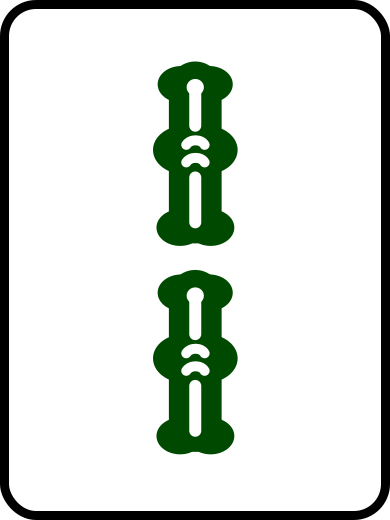
Pon from anyone. Chi only from the player on your left.
Turning the called tile is more than habit. It shows where each tile came from, and that helps everyone track furiten and read each player's discards. Always do it right.
Kan
With four identical tiles you can declare a kan. You show it, it counts as one set, and you draw a replacement tile from the dead wall so your hand can still make four sets and a pair. A new dora indicator turns over too. You saw where in the dead wall.
There are three kinds of kan.
Closed kan (ankan). All four tiles are in your hand. On your turn, after you draw, say "kan", show all four, and turn two face down, usually the two on the ends. It's the only call that doesn't open your hand.
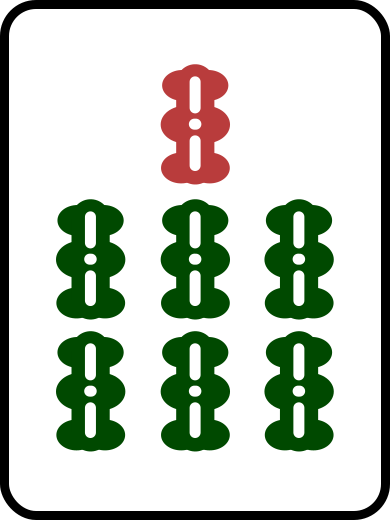
You can only declare it on your own turn, after drawing from the wall or drawing a replacement tile. Never on a turn where you've just called chi or pon.
Open kan (大明槓 daiminkan). You hold three identical tiles and any player discards the fourth. Say "kan" and lay it out like a pon, with the called tile turned toward the player who threw it, as in the calls figure. If it came from across, turn the second tile or the third: both are in use.
Added kan (加槓 kakan, also 小明槓 shouminkan). You already have an open pon and the fourth tile is in your hand, just drawn or held from earlier. On your turn, say "kan" and set it on top of the pon's sideways tile. If another player discards the fourth tile, you can't call it to add it.
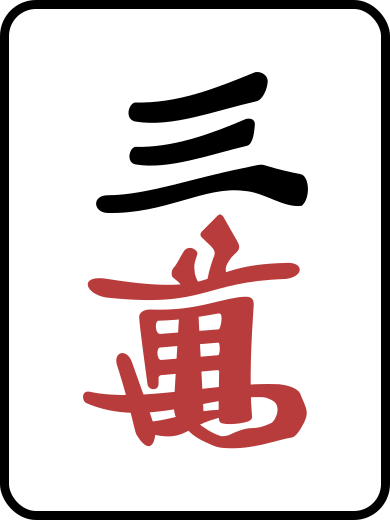
Robbing a kan: chankan
When you add a tile to your pon, another player can win on that tile if they were waiting on it. That's chankan (槍槓), a yaku you'll meet in the yaku chapter. Your kan doesn't go through. A player in furiten can't rob it. That includes a player who already has that tile in their river.
You can't rob a closed kan, except with kokushi musou under some rules. You'll see that with chankan.
After a kan
After any kan you draw the replacement tile (嶺上牌 rinshanpai). If it completes your hand, you win by tsumo and add the yaku rinshan kaihou (嶺上開花, "flower on the mountain"), the one the anime Saki made famous. If not, you discard and play goes on.
Every kan turns over a new dora indicator. On Tenhou and Mahjong Soul:
- With a closed kan, the indicator turns over right away.
- With an open or added kan, it turns over after you discard. If you make another kan before discarding, it turns over just before you draw the new replacement tile.
A few limits:
- Every kan makes the hand end one tile sooner, because the dead wall always keeps 14 tiles.
- You can't declare a kan on the last tile of the wall.
- A hand has at most four kans. What happens with the fourth is in abortive draws.
For yaku, a kan counts as a triplet: a closed kan is a concealed triplet, and an open or added kan an open one. It's worth more fu than a triplet, and several kans can make a yaku of their own. All of that is in the yaku and scoring chapters.
Four tiles, no kan
You don't have to declare the kan. Four identical tiles can play other roles in a hand:
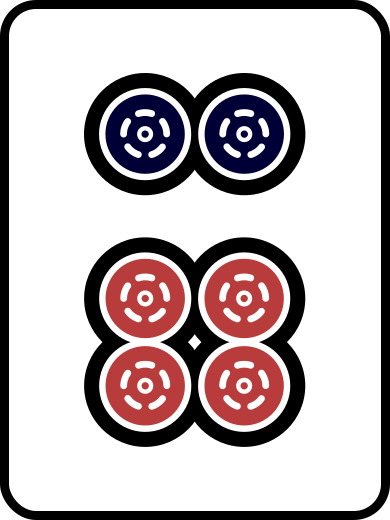
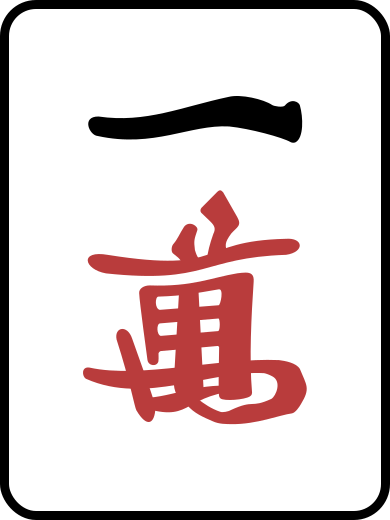
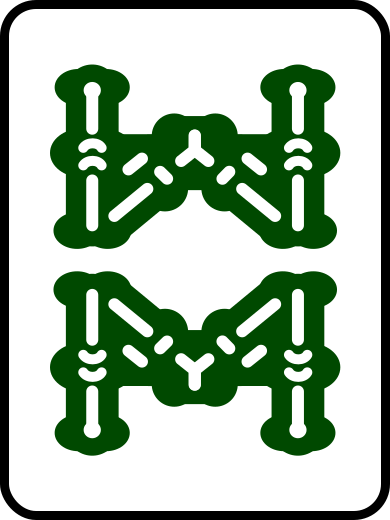
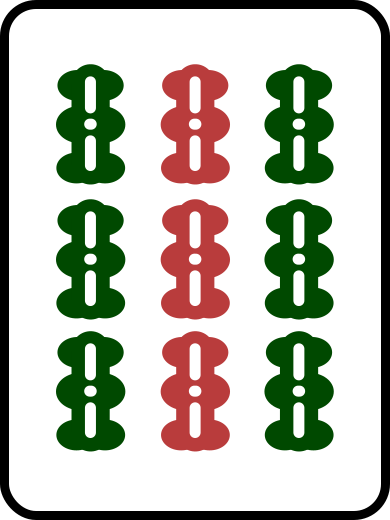
In these hands the four tiles don't count as a kan, for two reasons. A kan only exists once you declare it. And in a complete hand every tile plays one role: it's part of a sequence, a triplet, or the pair, never two at once.
While you build your hand, one tile can serve several possible shapes. When you win, you settle which is which. If the hand reads more than one way, you score the reading worth the most points (高点法 koutenhou). That's why a hand never has both pinfu and toitoi, or both chiitoitsu and ryanpeikou: they're different readings of the same tiles.
Who gets priority
Sometimes two players want the same discard. The order is:
- Ron: winning on that discard beats any call.
- Pon and kan.
- Chi.
At a real table, pon and kan only beat chi when the calls come at about the same time. A pon called clearly after someone else's chi is too late, and the chi stands. The WRC and EMA 2025 rules both say so. Online the game asks everyone at once, so the order above is all there is.
You can't call chi, pon, or kan on the last discard of the hand, once the live wall is empty. The only thing you can do with it is win by ron.
Open and closed hands
Calling makes your hand faster. So why not call every time? Because it changes what kind of hand you have.
An open hand has called at least one discard with chi, pon, or an open kan. The tile you win on by ron doesn't count: winning by ron doesn't open your hand.
A closed hand (門前 menzen) hasn't called any discard. A closed kan keeps it closed. It's harder to build, and that's why it gets perks:
- Only a closed hand can declare riichi.
- Win by tsumo with a closed hand and you add the yaku menzen tsumo: 1 more han.
- Several yaku only count with a closed hand, and others lose 1 han when the hand is open.
You'll see them all in the yaku chapter. And remember that an open hand needs a yaku to win too.
Winning the hand
When you complete your hand, you declare it. In Japanese, winning is agari (和了り) or houra (和了). There are only two ways to declare it: tsumo and ron.
To win you need a complete hand and at least one yaku. A triplet of red dragons, for example, is already a yaku.
Tsumo
You win by tsumo (自摸和 tsumohou) when you draw your winning tile on your own turn, from the wall or as a kan's replacement tile. Nobody can stop it, except with a call that skips your turn.
Don't put the tile in your hand. Show it apart, say "tsumo", and lay your hand face up, pushing the tiles forward a little.
With a closed hand, the tsumo gives you the yaku menzen tsumo on its own. With an open hand you can still win by tsumo, as long as you have another yaku.
Ron
You win by ron (栄和 ronhou) when another player discards your winning tile, or adds it to their pon for an added kan (that's chankan). Right then, say "ron" out loud and lay down your hand.
You can't ron if you're in furiten or if your hand has no yaku. Check both before you say ron. A mistaken ron carries a penalty, from a dead hand up to chonbo. They're in fouls and penalties.
An example
This hand is one tile from winning:
You have the pair, a yaku from the three red dragons, and three sets. The 7-8 sou waits on two tiles: the 6 (for 6-7-8) or the 9 (for 7-8-9).
An opponent discards the 6 sou. You say "ron" and win:
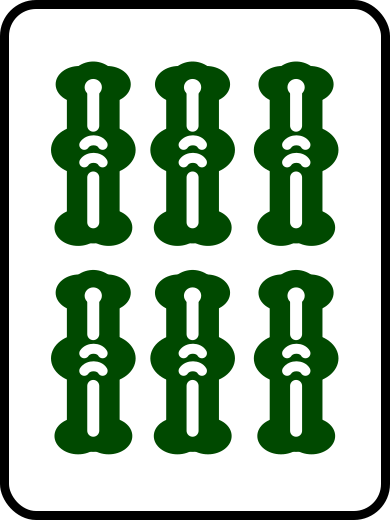
If you draw the 9 sou from the wall instead, show it and say "tsumo". Your hand is closed, so you add menzen tsumo to the red dragons.
Passing on a win
You can choose not to declare a win, for example if you're waiting for a tile that makes your hand worth more. But let another player's winning tile go by and you're in temporary furiten: no ron until your next turn. If you've already declared riichi, the furiten lasts until the end of the hand. All three kinds of furiten are in rules and penalties.
Who pays
When you win by ron, the player who discarded your winning tile pays it all. That's the price of feeding you the tile: in Japanese, houjuu (放銃) or furikomi (振り込み), dealing in. They pay 300 more for each honba on the table.
When you win by tsumo, all three pay. If a non-dealer wins, the dealer pays the biggest share. If the dealer wins, all three pay the same. For each honba, each of them pays 100 more: 300 in all.
The dealer collects more on a win and pays more when someone else wins by tsumo. The winner also takes any riichi sticks on the table. The exact amounts are in the scoring chapter, and honba and riichi sticks in the end of a hand.