
Not the solitaire game
Search "mahjong" on your phone and the first thing you'll find is a solitaire game: a heap of tiles you clear by picking off matching pairs. That game isn't mahjong. It's a computer game from 1981, later sold as Shanghai and as Taipei, and it only borrowed the pictures on the tiles.
It's still a fine place to start. If you've played it, you've seen the tiles, and the first thing mahjong asks of you is to recognize them one by one. Next you'll learn to see them in groups: how they combine and how they relate to each other.
Where it comes from
Mahjong took shape in China in the mid-19th century, out of older Chinese card games. From the early 20th century on it spread to other countries and cultures, and it kept changing in each one. Today it's part of daily life across much of Asia, the way poker or rummy is elsewhere. Not everyone plays, but almost everyone knows it.
In Mandarin Chinese it's called 麻将 (májiàng) today. The older name was 麻雀 (máquè, "sparrow"), and that's the spelling Japanese kept: 麻雀, read maajan.
With that many years and that many places, the game branched out. China alone has many regional styles, such as Hong Kong mahjong, Taiwanese mahjong (with 16-tile hands), or Sichuan mahjong. There's also an official competition rulebook, published in 1998, known as MCR or Guobiao (国标麻将).
Japanese mahjong
Japan added rules of its own. The best known are riichi (立直), the declaration that your closed hand is one tile from winning, and dora (ドラ), bonus tiles that raise a hand's value. Riichi gave the Japanese style its name in English: riichi mahjong, sometimes reach mahjong. It's the game this book teaches.
Riichi doesn't have a single rulebook either:
- The European Mahjong Association (EMA) publishes one, with editions in 2008, 2012, 2016, and 2025. Most European tournaments follow it.
- The World Riichi Championship (WRC) has its own, now in its 2025 edition.
- Japan has several professional organizations: the 日本プロ麻雀協会 (Nihon Pro Mahjong Kyoukai, which I belong to), the 日本プロ麻雀連盟, and the 最高位戦日本プロ麻雀協会, among others. The M-League, Japan's professional team league, plays its own rules.
Each one plays slightly different rules, but the differences are in the details. The game is the same.
This book started in 2010 for the Club Argentino de Mahjong (CAM), which played its own house rules. This edition teaches the standard that Mahjong Soul, Tenhou, and Japanese parlors share today. When another rule set changes something, you'll find it in a rule variants box.
Riichi takes a short time to learn and years to master. It tests your head and your instincts, and it mixes luck with good decisions. No book can cover all of it, so this one sticks to what you need at the table.
How you win a hand
Riichi is a four-player game. Each player tries to finish the game with more points than the other three. At the end, the players rank first to fourth, and that placement adds or takes away a bonus (uma).
You play with tiles. The full set is called janpai (雀牌, short for maajan pai, "mahjong tiles"). You don't need any Japanese names yet. For now, "tiles" is enough.
With the tiles you build a hand, much as in rummy or poker. Each turn you draw one tile and discard another. Tiles go together in pairs, triplets, quads (kan, four of a kind), and sequences, which is what rummy calls a run. So far, it all sounds familiar.
Your hand holds 13 tiles, and you win with a 14th tile that completes it. A complete hand has four sets of three tiles (each set is a triplet or a sequence) and a pair of matching tiles, called the "head." For example:

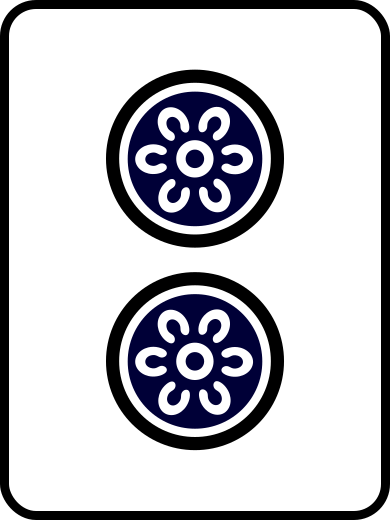
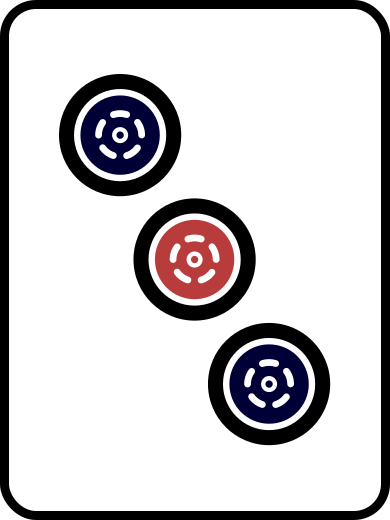
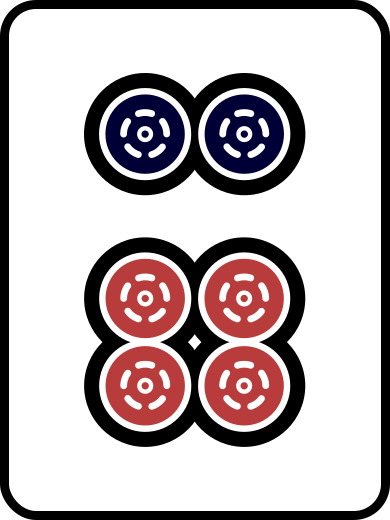
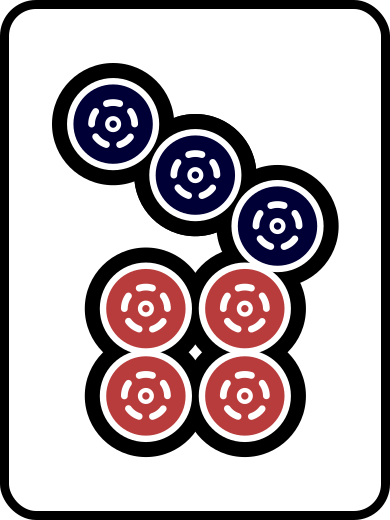
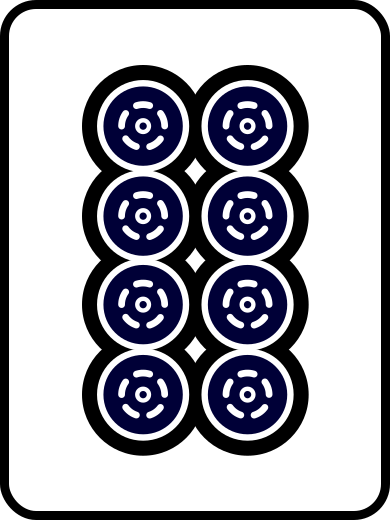
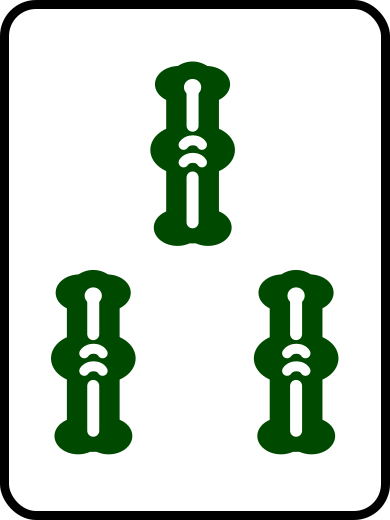
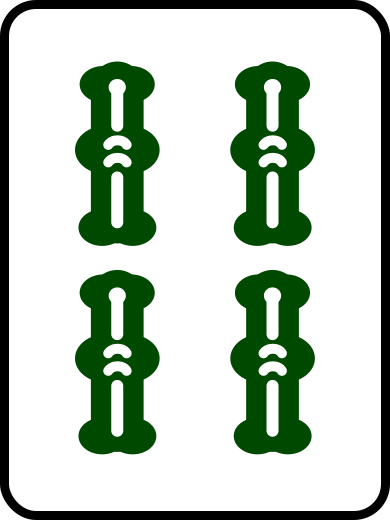
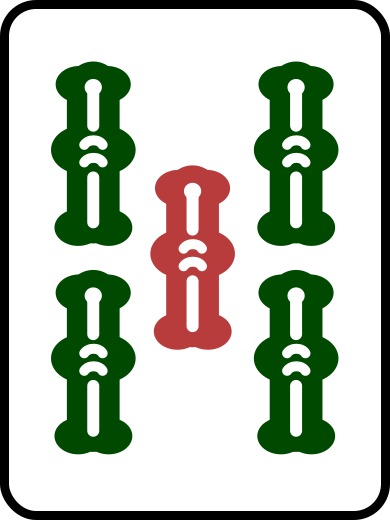
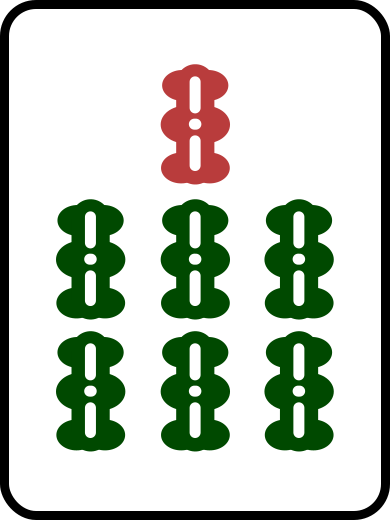
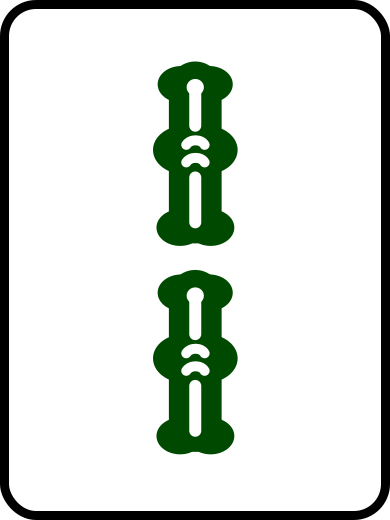
The two suits here are circles and bamboo, which this book calls by their Japanese names, pin and sou. You'll meet all the tiles in the next chapter. You hold thirteen tiles, plus the winning one. The four sets are:
- a 1-2-3 sequence in pin;
- a 6-7-8 sequence in pin;
- a 3-4-5 sequence in sou;
- a triplet of 7 sou.
That leaves a lone 2 sou, waiting for another 2 sou to make the pair. When it arrives, the hand is complete: that's an agari (和了), a win. Some English rulebooks call a winning hand "a mahjong." At a riichi table nobody says that. To win, you say ron or tsumo.
If you noticed this hand also wins on a 5 sou, you're doing well. With the 5, the 2-3-4 sou becomes the sequence and the two 5s make the pair:
There's a third winning tile, too: the 6 sou. Take one 7 out of the triplet, and the sou tiles split into 2-3-4, 5-6-7, and a pair of 7s. This hand waits on three different tiles: the 2, 5, and 6 sou. Spotting every tile that completes a hand is a skill of its own, and the wait quiz trains it.
The tile that completes your hand can come from two places. You can draw it yourself from the wall (山, yama), the stack everyone draws from, like drawing a card from the deck. That's winning by tsumo. Or you can take the tile another player has discarded: that's winning by ron. Which one it is changes the score, but the idea is the same.
That's the whole cycle: draw a tile, discard a tile, every turn, until your hand is complete.
Yaku, han, and fu
Completing the hand isn't enough. In mahjong, the hard part isn't putting together four sets and a pair. It's doing it while meeting certain conditions. Those conditions are called yaku (役).
Each yaku gives one or more han (飜), and han work as multipliers: every extra han doubles the hand's value, up to the limits. Some yaku are worth one han, some two, some three or more, the same way some poker hands beat others. On top of that come fu (符), or minipoints, which depend on the shape of the hand and how you won it. Han and fu together set the hand's value. You'll see how in the scoring chapter.
The rule that matters from day one: to win, your hand needs at least one yaku. Dora add han, but they aren't yaku. A complete hand with no yaku can't be declared a win, however many dora it holds.
The example hand shows how this works. As it stands, it has no yaku. If your hand is closed and you draw the winning tile yourself, you win with menzen tsumo (門前清自摸和), a 1 han yaku. If you declared riichi earlier, riichi is a yaku too. But if another player discards the 2, the 5, or the 6 and you haven't declared riichi, you can't win on that tile. Yaku get their own chapter.
It looks like a lot at first. You don't need to master it to start playing. A friend who can keep score is enough. Online or at an automatic table, the score is counted for you, and the site's score calculator does the same for any hand you want to check.
How long a game lasts
A standard game, the hanchan (半荘), has two rounds, East and South, of at least four hands each: eight hands at minimum. It can run longer when the dealer keeps the deal, or end early when someone drops below zero points. The short game, with the East round only, is called tonpuusen (東風戦).
Points are kept with point sticks (tenbou, 点棒). Each value has its own markings, like poker chips but long and thin. Every player starts with 25,000 points, and points never come out of nowhere: during the game they only move from one player to another. When the last hand ends, the player with the most points wins.
Where people play today
Most people learn online. Mahjong Soul (雀魂) and Tenhou (天鳳) are the best-known riichi platforms, and both keep score for you. Japan has parlors with automatic tables that shuffle the tiles and build the wall on their own. The M-League streams professional games every season.
Before you get to the yaku, you need to know the tiles well. They're at the center of every game, and they're the subject of the next chapter.