
Tiles instead of cards
The tiles, or janpai (雀牌), are the only thing you can't play without. Dice, wind markers, even the table come second. Before the rules, get to know the tiles one by one.
Think of the tiles as cards for a moment. It's not a stretch: mahjong descends from old Chinese card games, and mahjong playing cards still exist today. Like a deck of cards, the tiles have suits and numbers.
The three suits
There are three suits: man, pin, and sou, or characters, circles, and bamboo. In Japanese they're written 萬子, 筒子, and 索子, read manzu, pinzu, and souzu. Each suit is also called a 色 (iro, "color"). That's where the yaku sanshoku (三色, "three colors") gets its name.
These are the easy tiles, because they carry a number, like the cards in any deck. But instead of running from 1 to 10 or up to a king, they run from 1 to 9. And every tile comes in four identical copies: four 1 pin, four 2 pin, and so on up to 9, in every suit.
Together they make up the number tiles, suupai (数牌). With them you build sequences of three consecutive numbers in one suit, and pairs or triplets of matching tiles. A sequence doesn't wrap around: 8-9-1 isn't a sequence.
This book calls the suits man, pin, and sou, the most common names and the shortest. Each suit has plenty of other names, and you'll want to recognize them in other books and apps:
- man: characters, cracks or craks, wan;
- pin: circles, dots, coins, wheels, balls;
- sou (rhymes with "go"): bamboo, bams, sticks, strings.
The three suits come from old Chinese money cards. Pin is a coin, sou is the string that held coins together for carrying, and man is the amount: ten thousand coins.
Man (characters)
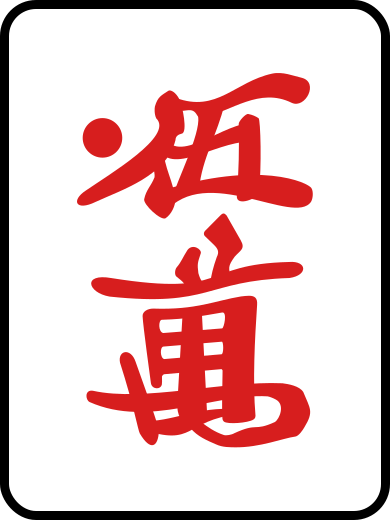
Man is the showiest suit of the three. Each tile carries two Chinese characters. The top one is the number, 1 to 9. The bottom one is 萬, "ten thousand": man is its Japanese reading and wàn its Chinese one. The 1 man stands for 10,000, the 2 man for 20,000, and so on. In ancient Chinese writing, 萬 was a drawing of a scorpion, and over time it came to stand for the number.
Chinese numerals take some getting used to. Some sets print an Arabic numeral in the corner of the harder tiles, but you're better off learning them. The end of this chapter has tricks to help.
Pin (circles)
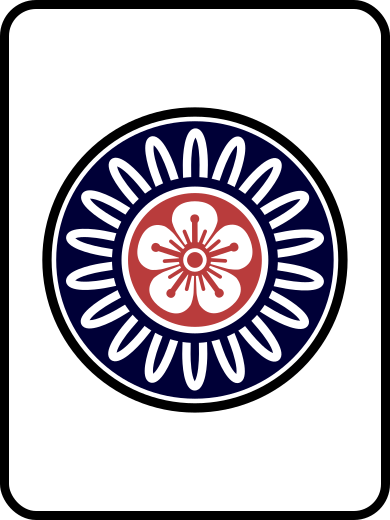
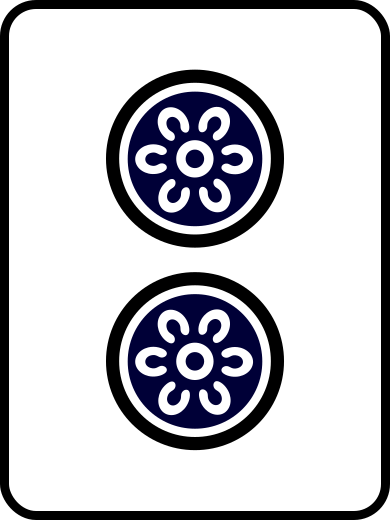
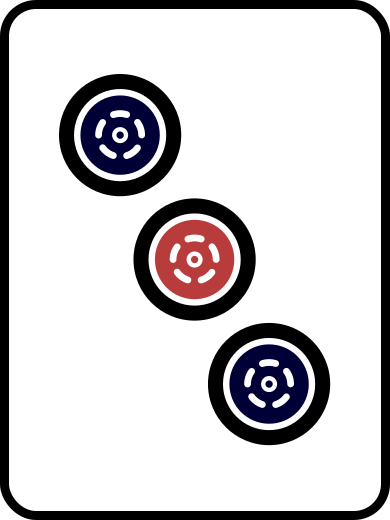
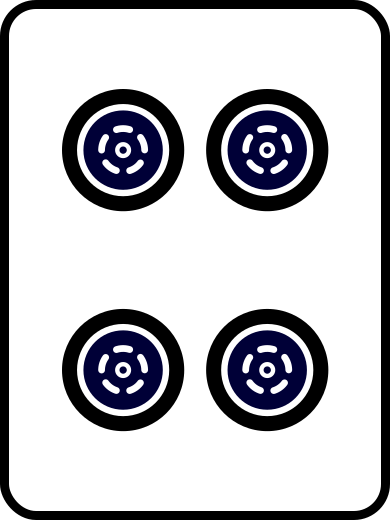
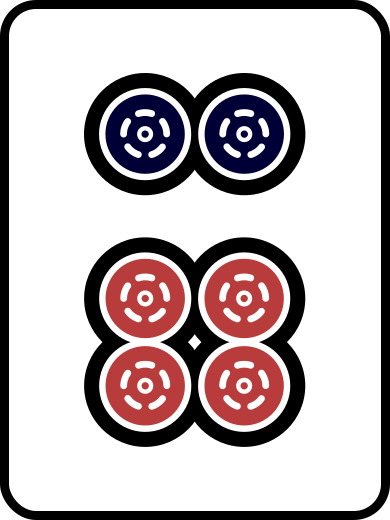
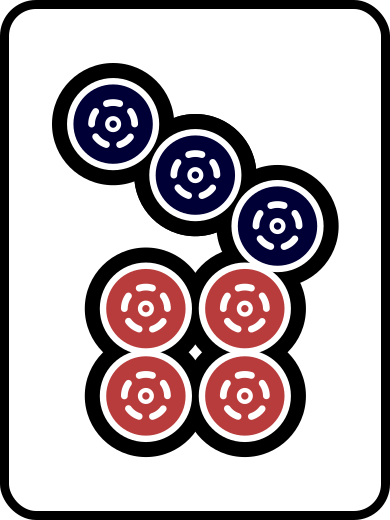
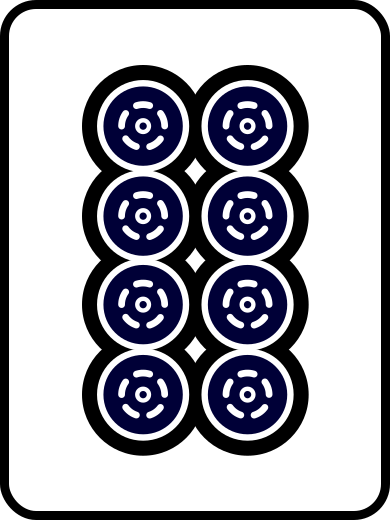
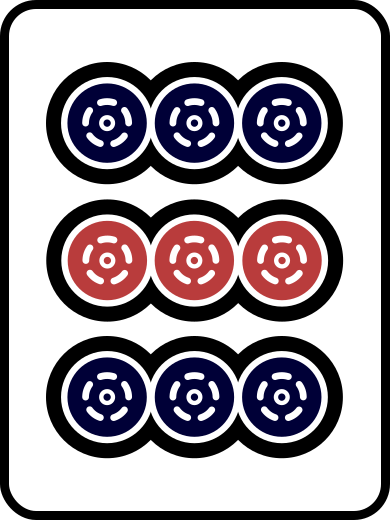
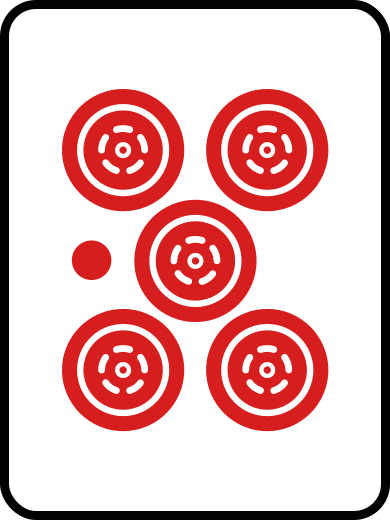
Pin is a coin: wealth and good fortune, like diamonds in a deck of cards. It's the most iconic suit in mahjong, simple and good-looking. Some people see wheels, suns, or lanterns lighting up the dark in its designs. To read a pin tile, count the circles.
Sou (bamboo)
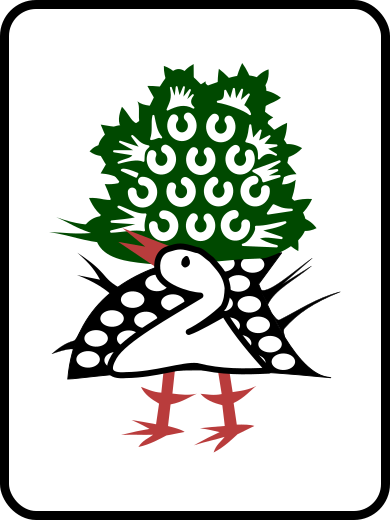
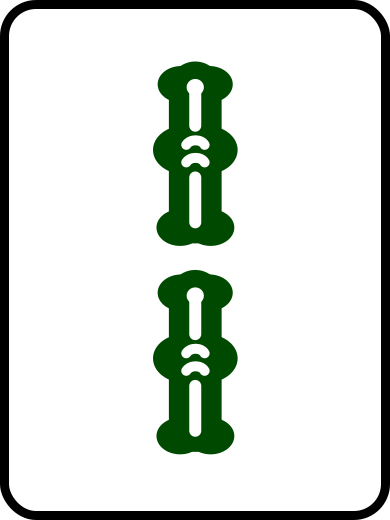
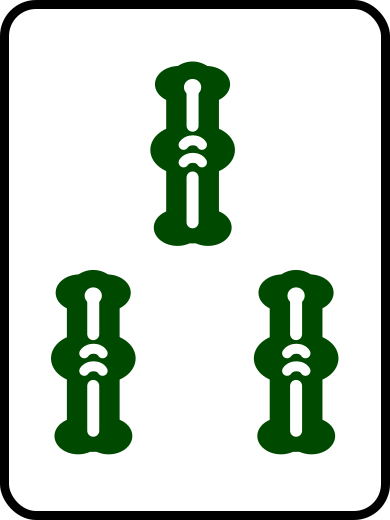
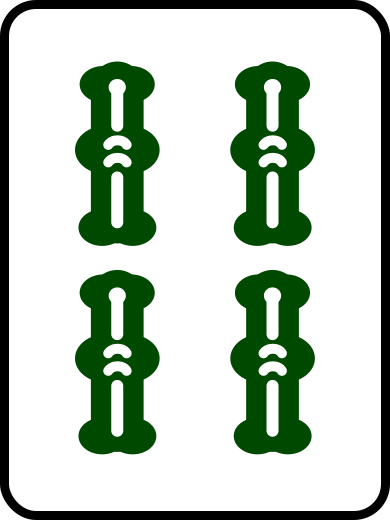
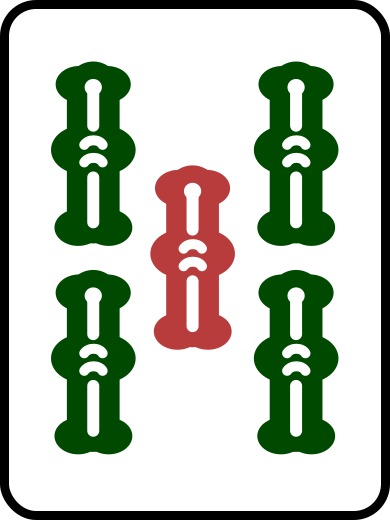
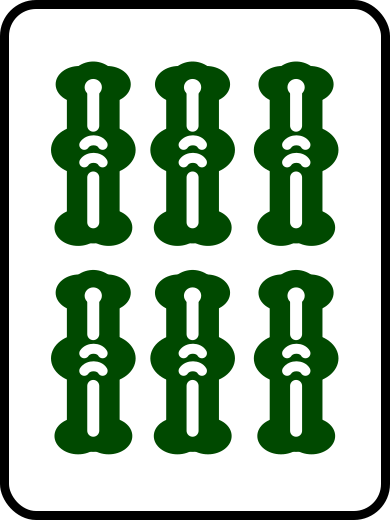
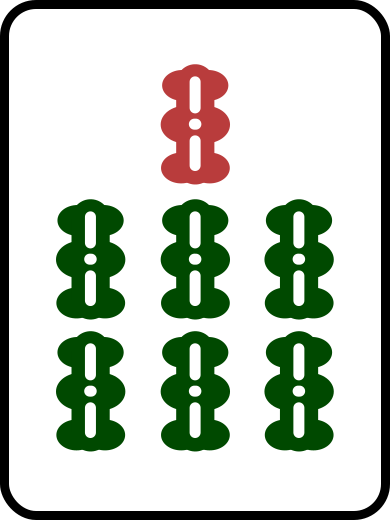
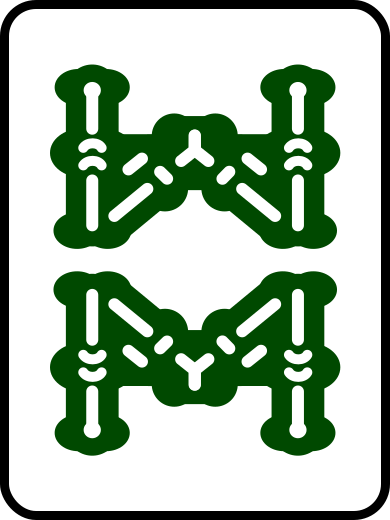
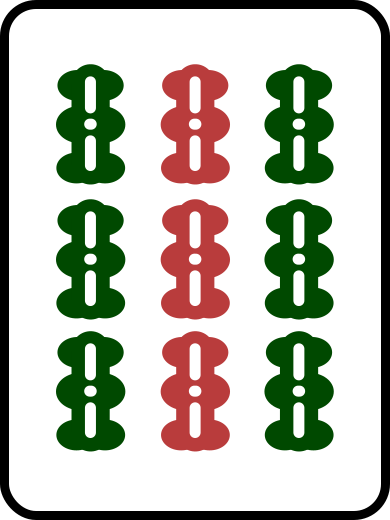
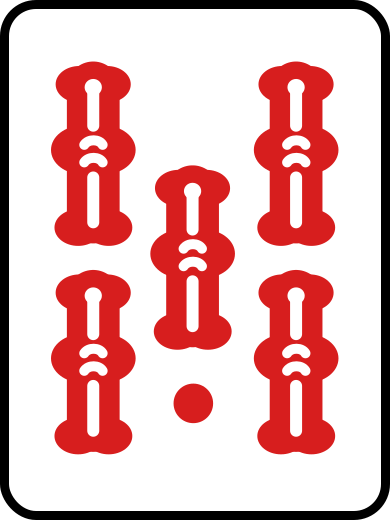
Sou is the green suit: the strings that held the coins. From 2 to 9, each tile shows that many bamboo sticks. The 1 is different. Instead of a stick it shows a bird. In Japanese sets it's usually a peacock, and in others it can be another bird, often a sparrow. Chinese sets also change some colors and designs.
These three suits make up most of the set: 108 of its 136 tiles.
Terminals and simples
The number tiles split into two groups, and that split matters for many yaku. It's easy to remember:
- Terminals are the tiles at the edges: the 1 and 9 of each suit. In Japanese, routouhai (老頭牌).
- Simples are everything in between: 2 through 8 of each suit. In Japanese, chunchanpai (中張牌). A hand made only of simples is the yaku tanyao.
Honor tiles
Besides the number suits, there are tiles with characters instead of numbers: the jihai (字牌, literally "letter tiles"), which this book calls honor tiles. They come in two kinds: three dragons and four winds. Each has four copies, like every other tile.
Honor tiles have no number, so they can't form sequences. They only make pairs, triplets, and quads.
The three dragons
The dragons as a group are called sangenpai (三元牌). The name "dragons" is Western. The first English rulebooks gave it to them in the 1920s, and it doesn't translate anything in Chinese or Japanese.
- White dragon: 白, haku, "white." In Chinese, 白板 (báibǎn, "white board").
- Green dragon: 發 (also 発), hatsu. It comes from 發財 (fācái, "to prosper," "to get rich").
- Red dragon: 中, chun, "center." In Chinese, 紅中 (hóngzhōng).
The order never changes: white, green, red.
In Japanese sets, on Tenhou, and on Mahjong Soul, the white dragon is a blank tile with no design. Many Chinese sets and some modern ones give it a frame or its own character in black. Blank or framed, that tile is the white dragon.
A popular legend, with no historical basis, credits Confucius with inventing mahjong and says the three dragons stand for his virtues: benevolence, sincerity, and filial piety.
The four winds
The winds are kazehai or fonpai (風牌): East, South, West, and North. Each tile carries the Chinese character for its direction.
- East: 東, ton.
- South: 南, nan.
- West: 西, shaa.
- North: 北, pei.
The Japanese names imitate Chinese pronunciation, though closer to older and southern dialects than to modern Mandarin (dōng, nán, xī, běi). The order is always E, S, W, N.
That's also the order of the seats, counterclockwise around the table. Draw the table with North at the top, like a map, and East lands on the left and West on the right: the reverse of a compass. It's a convention of the game, so don't look for logic in it. The seating figure in Setting up the table shows it.
Winds work like dragons, with one extra detail: every hand has a round wind, and every player has a seat wind.
Value tiles
The three dragons, the round wind, and your seat wind are value tiles (yakuhai, 役牌): a triplet or quad of any of them is a yaku on its own. That's why the same wind isn't worth the same to every player at the table. Full guide: yakuhai.
Terminals and honors
Terminals and honor tiles together are called yaochuuhai (么九牌). That's 13 different tiles, and several yaku and rules depend on them.
The full set
A mahjong set has three suits from 1 to 9, four winds, and three dragons: 34 different tiles. Each one appears four times, so the set holds 136 tiles.
Some sets come with extra tiles: flowers, seasons, or jokers. Riichi doesn't use them, so you can leave them in the box.
What you will see are red fives (赤ドラ, akadora): a 5 painted red in each suit. Each one replaces one of the four fives of its suit and adds one han to the hand that holds it. Like every dora, it isn't a yaku. Mahjong Soul, Tenhou, Japanese parlors, and the M-League play with three, one per suit. You'll see them in more detail next to the dora, in Setting up the table, and the dora guide covers how each rule set handles them.
Tricks to remember them
If you already know each character at a glance, skip this section. If Chinese characters look like scribbles you'll never remember, read on.
The man numerals
1, 2, and 3 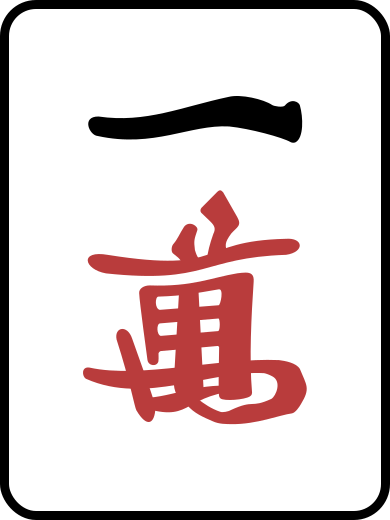
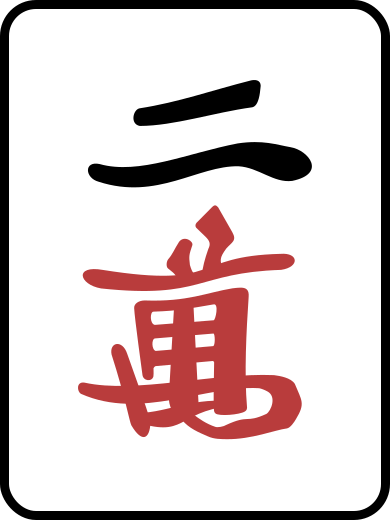
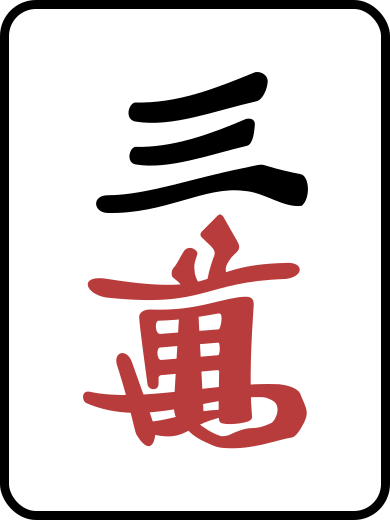 . These are easy: one horizontal line is 1, two lines are 2, three lines are 3.
4 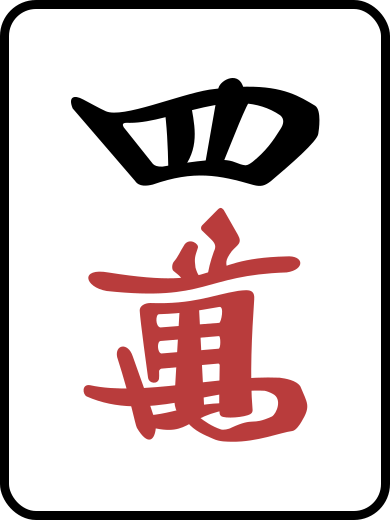 . The character is a box. Ignore what's inside and look at the shape: a box has four sides.
5 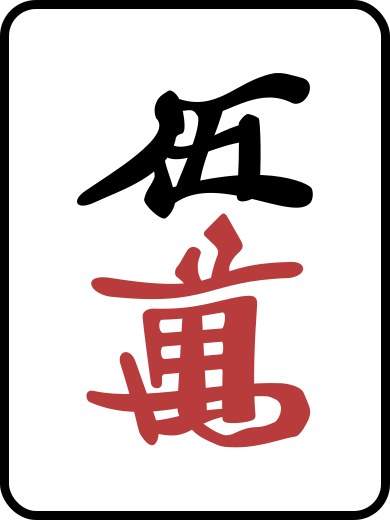 . It looks busy, but trace it stroke by stroke and it's a blocky, straight-lined 5. Some people see a 15 squeezed together. Either way, five.
6 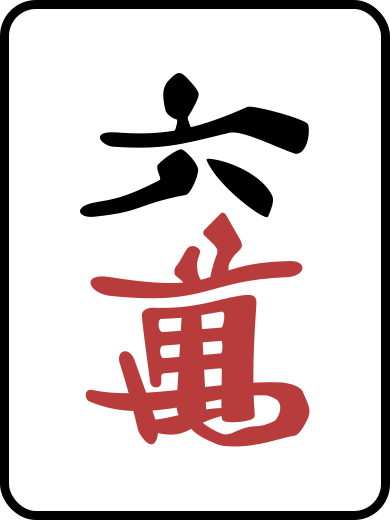 . A cowboy: a hat on top and two legs planted wide, ready to draw his six-shooter.
7 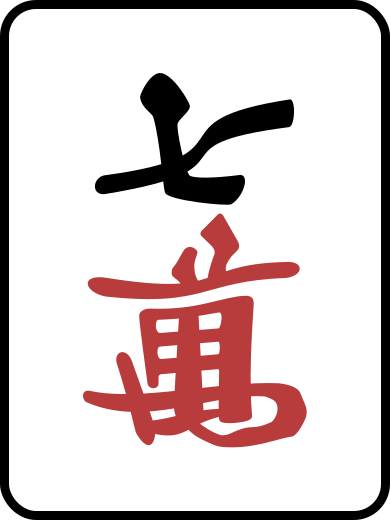 . Turn the tile upside down. The character becomes a 7 with a bar through it, the way much of Europe writes a seven.
8 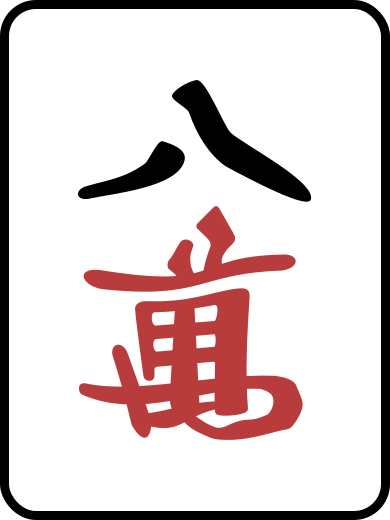 . The cowboy from the 6, minus his hat. He lost it on a bet and had to eat it. He ate it: eight.
9 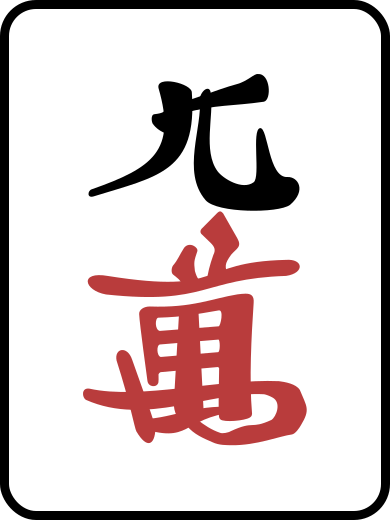 . Elegant, with a long sweeping tail, like the nine-tailed fox.
The dragons
You don't need their names, only the colors, in order: white, green, red 
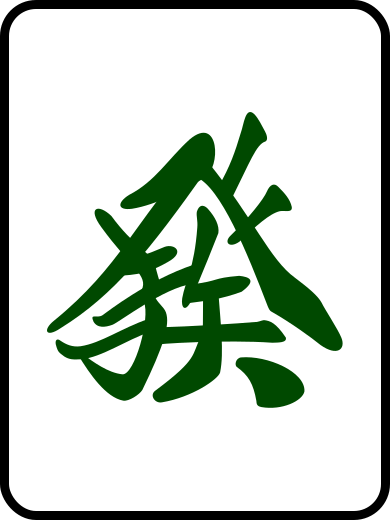
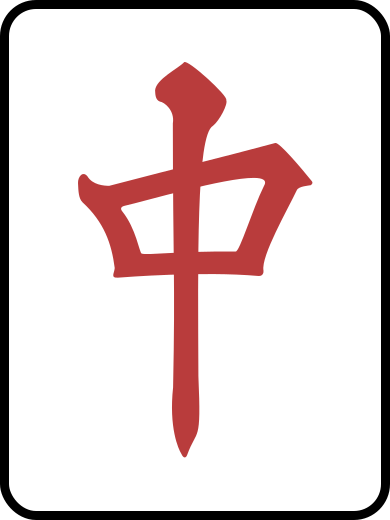 . In Japanese, haku, hatsu, chun.
The winds
East 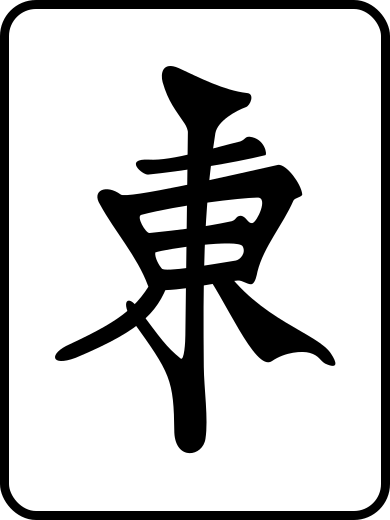 . The wind you'll see most: the East round is half of a hanchan, and all of a tonpuusen. Look for a sun behind the branches of a tree. The sun rises in the east. Or picture laundry on a line, flapping in the east wind. It'll stick fast.
South 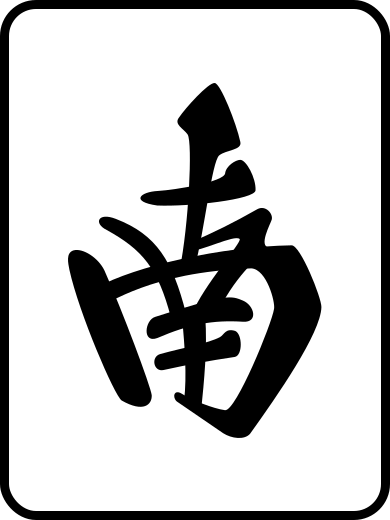 . You'll see this one often too. If it won't stay put, picture a tank, or a ship seen head-on, sailing south.
West 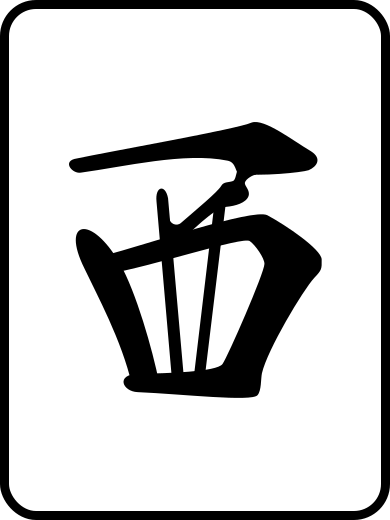 . A box under a roof, propped up by two posts: a saloon in the Wild West.
North 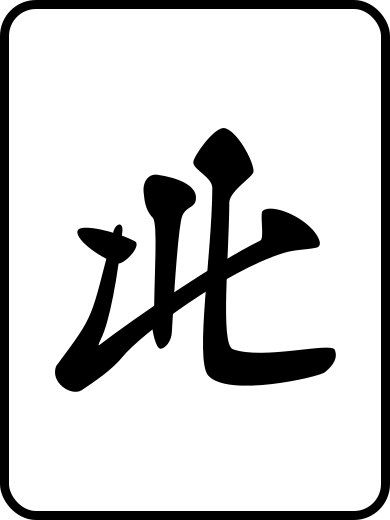 . In many sets it looks like an N, more than any of the other three do. N for North.
And the order, always: E, S, W, N. Eat Some Warm Noodles.
Pin and sou
Everything else, you read by counting the pictures on each tile. Watch for three things. The 1 sou is a bird, not a stick. The 6 and 8 sou get mixed up: the 6 has two rows of three straight sticks, and the 8 has slanted sticks, like a W over an M. And every set looks a little different, depending on the artist, where it was made, and what it was made for.
Test your eye
Name each tile until it comes without thinking. You'll do it hundreds of times in every game.
Drill
Name that tile
Right 0/0Streak 0
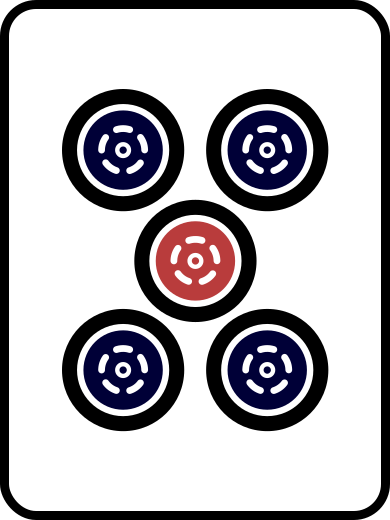
Pick this tile's name.
Tap an answer.