
What a yakuman is
The biggest hands in mahjong are the yakuman (役満), short for yaku mangan (役満貫). A yakuman pays the highest limit on the score table, the same as a 13 han hand, whatever else the hand holds. Dora and ordinary yaku add nothing to it.
| How you win | Non-dealer | Dealer |
|---|---|---|
| Ron | 32,000 | 48,000 |
| Tsumo | 8,000 from each non-dealer and 16,000 from the dealer | 16,000 from each player |
You build them with the same logic as yaku, but they take a lot more luck, skill, and persistence. The standard yakuman, the ones Tenhou, Mahjong Soul, M-League, WRC, and EMA all recognize, number twelve: tenhou, chiihou, kokushi musou, chuuren poutou, suuankou, daisangen, shousuushii, daisuushii, tsuuiisou, chinroutou, ryuuiisou, and suukantsu. Some rules add kazoe yakuman on top. The local yakuman, which you won't find on the big platforms, close out the chapter.
Full guide: yakuman.
Double and stacked yakuman
If a hand meets two yakuman at once (複合役満, fukugou yakuman; some texts say kasane yakuman), such as daisangen and suuankou, Tenhou, Mahjong Soul, M-League, and WRC pay both. A double yakuman pays a non-dealer 64,000 on a ron, and the dealer 96,000. Every line of the table doubles, or triples with three.
Kazoe yakuman
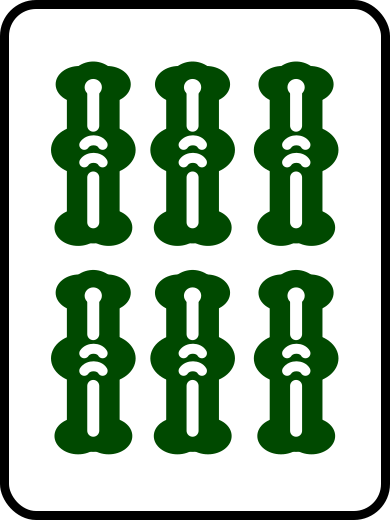
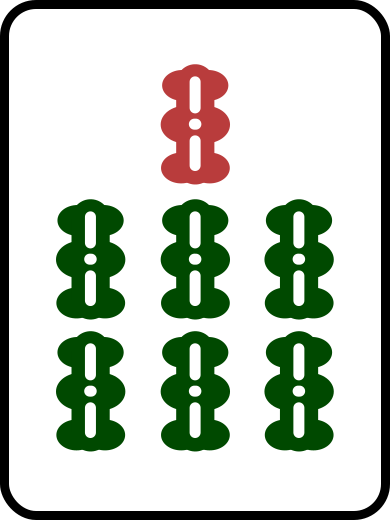
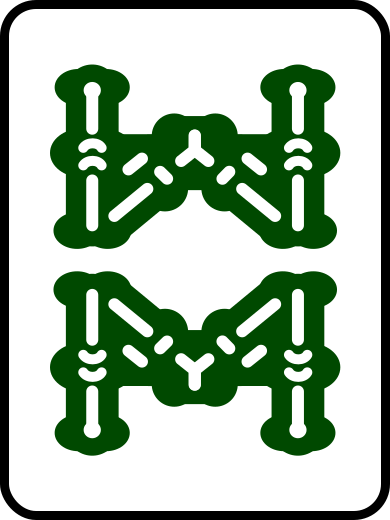
Kazoe yakuman means "counted yakuman". Any hand that reaches 13 han or more, counting yaku and dora, pays as a yakuman. Usually that's several yaku with a good pile of dora, or a loaded one-suit hand like the example.
A kazoe yakuman never adds to a real yakuman and never becomes a double: however many han it has, it pays one.
Closed-hand yakuman
These yakuman count only on a closed hand.
Tenhou
Tenhou, "blessing of heaven", is a yakuman for the dealer alone. If the dealer's 14 starting tiles already make a complete hand, the dealer declares tenhou, shows the hand, and collects a yakuman. It sounds the same as Tenhou, the online mahjong server, which is written with different kanji (天鳳).
Any complete hand works. It doesn't need another yaku. A closed kan before the first discard cancels it. If the starting hand is also another yakuman, such as suuankou, Tenhou and Mahjong Soul pay both.
Chiihou
Chiihou, "blessing of earth", is the non-dealer's version. If you complete your hand by tsumo on your first draw, and nobody has called chi, pon, or kan before it (a closed kan included), you collect a yakuman. Any complete hand works. As with tenhou, if the hand holds another yakuman, that one counts too.
The ron version, renhou, is a local rule. You'll find it at the end of the chapter.
Full guide: tenhou and chiihou.
Kokushi musou
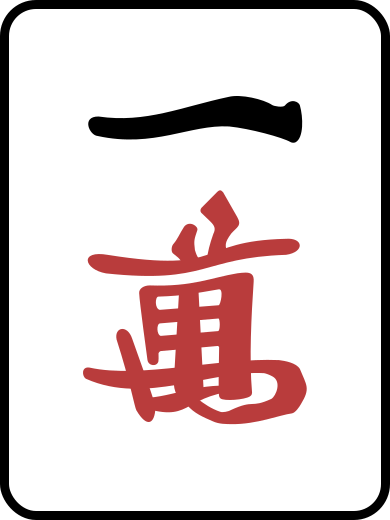
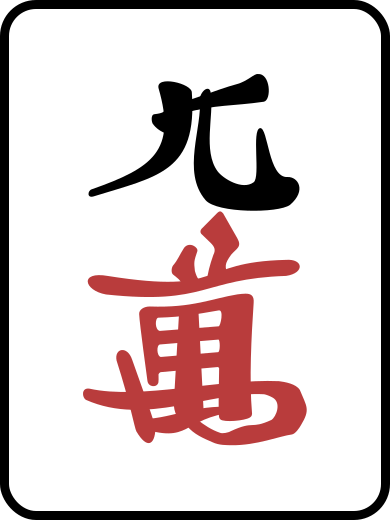

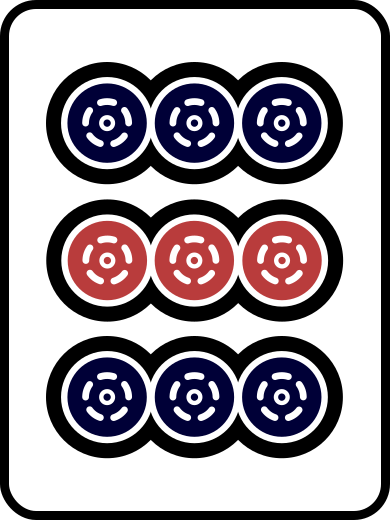
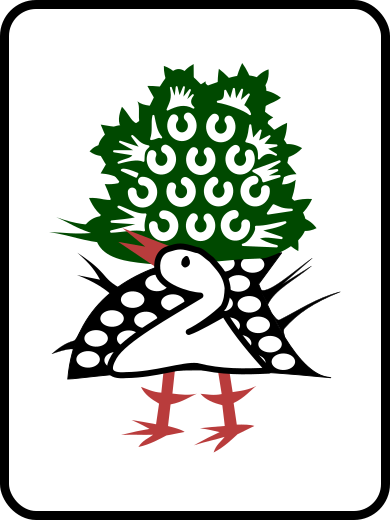
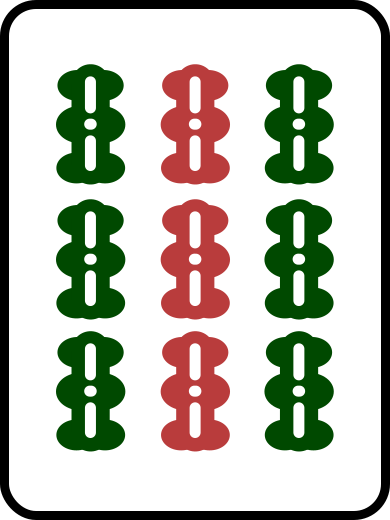

国士無双 is a classical Chinese phrase from the Shiji, about the general Han Xin: "the peerless man of the whole country". In English the hand is thirteen orphans. It's another exception to the normal hand shape: one of each terminal and honor (13 different tiles), with one of them doubled as the pair.
There are two ways to reach tenpai:
- Hold all thirteen kinds and wait for the pair. Any of the thirteen tiles completes the hand: that's the 13-sided wait (十三面待ち, juusanmen machi), the one in the example.
- Hold the pair already and wait for the missing kind: a single tile.
A player going for kokushi gives it away in the discards: lots of middle tiles, from several suits. Once they start discarding terminals or honors, suspect tenpai. It's one of the game's signature yakuman and one of the most reachable. But it forces you to throw a lot of middle tiles, often the most dangerous ones, and if you abandon the plan the hand is close to unsalvageable. Unless you start with plenty of terminals and honors, you'll most likely fail.
Full guide: thirteen orphans.
Chuuren poutou
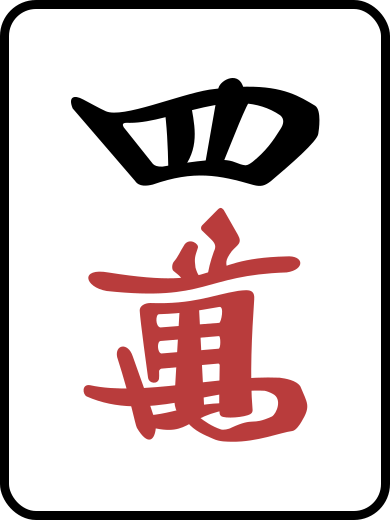
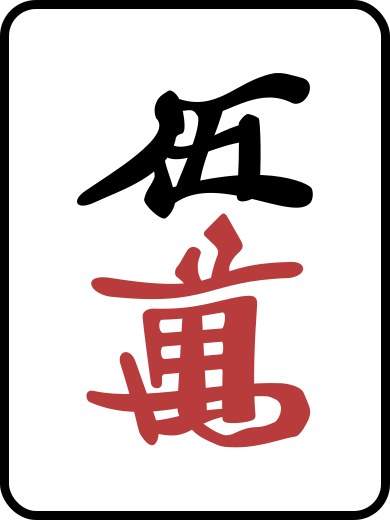
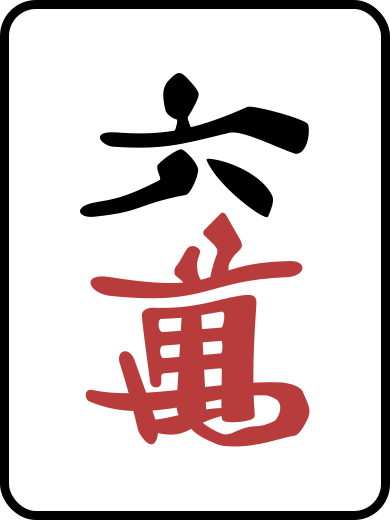
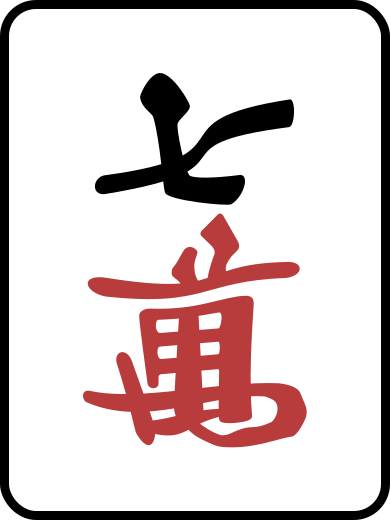
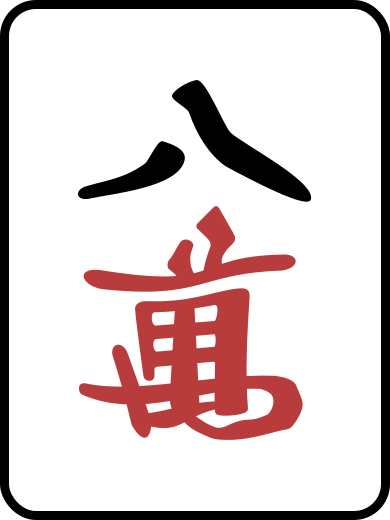
The name evokes "the nine precious lotus lanterns". In English it's nine gates. The structure is 1-1-1, 2-3-4-5-6-7-8, 9-9-9 in one suit, plus any other tile of that suit. There are two ways to reach tenpai:
- The nine-gates wait. You hold exactly 1-1-1-2-3-4-5-6-7-8-9-9-9 and wait on any tile from 1 to 9 of that suit. This is junsei chuuren poutou (純正九蓮宝燈, pure nine gates), and it gives the yakuman its name: the hand completes nine different ways. Take the time to check them one by one. It's also the form where the waits are easiest to see.
- The single wait. You already hold the extra tile and you're missing one from the structure. You wait on one tile, and that version is much harder to see and to build.
The hand has to be closed and can't hold a kan. While you build it, the others think you're going for chinitsu. Furiten applies as usual: if one of your nine waits is in your river, you can't win by ron.
Full guide: chuuren poutou.
Suuankou
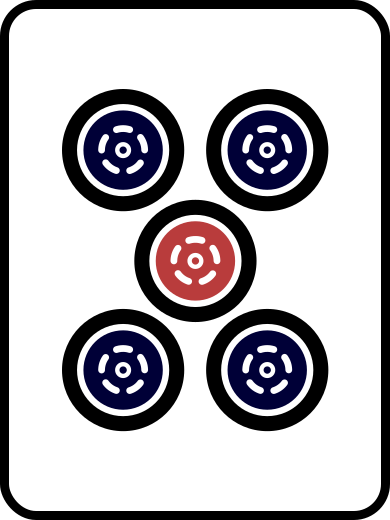
Suuankou is sanankou taken to four: four concealed triplets. By definition, it only works on a closed hand. There are two ways to reach tenpai:
- Four triplets, waiting on the pair. You can win by ron or tsumo. This is suuankou tanki (四暗刻単騎).
- Three triplets and two pairs, waiting to complete the last triplet, as in the example. Here you have to win by tsumo. A triplet completed by ron doesn't count as concealed: it's an open triplet (minkou). On a ron, the hand is worth sanankou and toitoi.
It's a valuable yakuman and a hard one to spot, because the discards follow no special pattern.
Full guide: suuankou.
Yakuman that allow calls
These yakuman are worth the same open or closed.
Daisangen
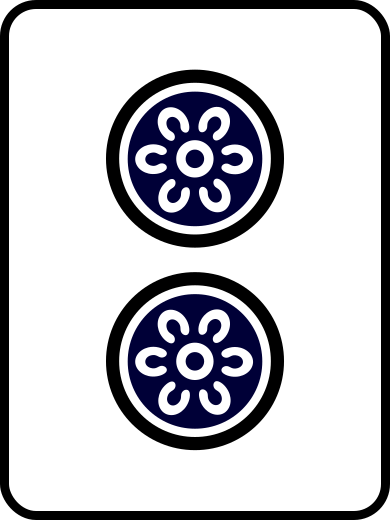
Daisangen, "big three elements" or big three dragons, takes shousangen one step further: three dragon triplets. It can be open or closed.
It carries a liability rule, pao (責任払い, sekinin barai). If a player already shows two dragon triplets, called or as closed kans, and you give them the third by pon or kan, you become liable. You pay the whole yakuman if they win by tsumo, or half of it if they win by ron off someone else's discard. The details are in rules and penalties.
It stacks with other yakuman: daisangen with suuankou is a double yakuman, and on a pair wait it can go higher.
Along with suuankou and kokushi, it's one of the yakuman you'll see most. It's also easier to stop: once someone has called two dragons, the whole table notices.
Full guide: daisangen.
Shousuushii
Shousuushii means "little four joys". It's also called little four winds: triplets of three different winds and a pair of the remaining wind, on an open or closed hand. Don't confuse it with daisuushii.
Daisuushii
Daisuushii means "big four joys", or big four winds: four wind triplets, one of each, and any pair. It counts open or closed.
It has pao, the same as daisangen: if a player already shows three wind triplets and you give them the fourth by pon or kan, you're liable for the payment.
Full guide: shousuushii and daisuushii.
Tsuuiisou
Tsuuiisou means "all letters": honors are the lettered tiles (字牌). The hand holds nothing but honors. It counts open or closed, in the triplet shape or as chiitoitsu. It's the counterpart of chinroutou.
It stacks with other yakuman. Put tsuuiisou, daisuushii, suuankou on a pair wait, and chiihou in one hand, and Tenhou or M-League pay four yakuman. Mahjong Soul counts daisuushii and the pair wait double, so it pays six. That hand lives in theory, not at the table.
Full guide: tsuuiisou.
Chinroutou
Chinroutou is a hand made only of terminals: ones and nines. It counts open or closed. You can't build it as chiitoitsu, because there are only six kinds of terminal: it's always four triplets and a pair.
Full guide: chinroutou.
Ryuuiisou
Ryuuiisou, "all green", is a hand made only of the green tiles in the usual Japanese design: the 2, 3, 4, 6, and 8 sou and the green dragon. The other sou tiles have red details that break the green.
It counts open or closed. You can't build it as chiitoitsu: there are only six kinds of green tile. It stacks with other yakuman: with suuankou on a pair wait it reaches a triple yakuman on Mahjong Soul, and a double on Tenhou.
Full guide: ryuuiisou.
Suukantsu
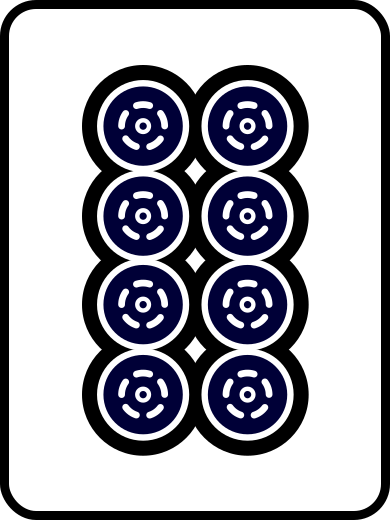
Suukantsu is the yakuman for completing four kans, whether open, closed, or added. It's sankantsu taken to four. After the fourth kan you have one tile left in your hand, so you always win on a pair wait.
If one player makes all four kans, the hand isn't aborted. The four-kan abortive draw only happens when the kans are split between two or more players. It's one of the rarest yakuman.
Full guide: suukantsu.
Local yaku and yakuman
Besides the standard yaku there are local yaku (ローカル役). People used to call them "unofficial", but Japanese mahjong has no single official rulebook: every league, platform, and club has its own. None of the yaku in this section is played on Tenhou, in Mahjong Soul ranked games, or in M-League. Many have fallen out of use, but you'll still hear about them. If a club plays them, check their value before you sit down.
The table sums up which rules each platform uses in 2026, including the ones from this chapter and the last.
| Rule | Tenhou | Mahjong Soul | M-League | WRC 2025 | EMA 2025 |
|---|---|---|---|---|---|
| Open riichi | no | no | no | no | no |
| Nagashi mangan | yes, as a draw | yes, as a draw | no | no | no |
| Renhou | no | no | no | mangan | mangan |
| The other yaku in this section | no | no | no | no | no |
| Kazoe yakuman | yes | yes | no (sanbaiman) | pays as a yakuman, doesn't stack | no (sanbaiman) |
| Double yakuman for the wait, and double daisuushii | no | yes | no | no | no |
| Yakuman stack | yes | yes | yes | yes | no |
| Kokushi can rob a closed kan | no | yes | no | no | yes |
| Pao on daisangen and daisuushii | yes | yes | yes | yes | yes |
| Pao on suukantsu | no | no | yes | yes | no |
| Pao on rinshan after an open kan | no | no | no | no | no |
| Abortive draws | yes | yes | no | no | no |
Sanshoku shoudoukou
Sanshoku shoudoukou (三色小同刻) is the little version of sanshoku doukou: triplets of the same number in two suits and a pair of that number in the third. Its value depends on the local rule, usually 1 or 2 han.
Sanrenkou
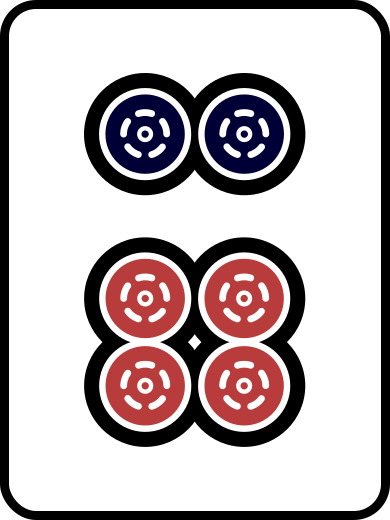
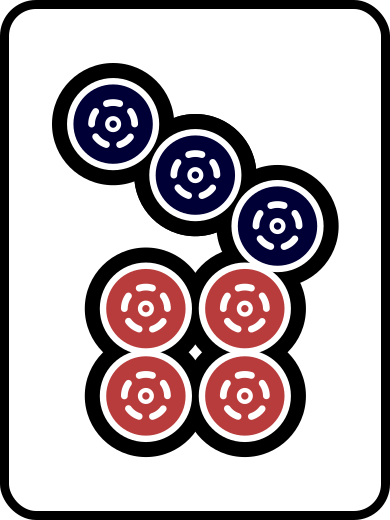
Sanrenkou (三連刻, also 三連碰, sanrenpon) is three triplets of consecutive numbers in one suit. "San" is the Chinese numeral for "three". Where it's played, it's usually 2 han, though the value varies and some tables make it kuisagari. Four consecutive triplets are suurenkou, another local yakuman.
Iishoku sanjun
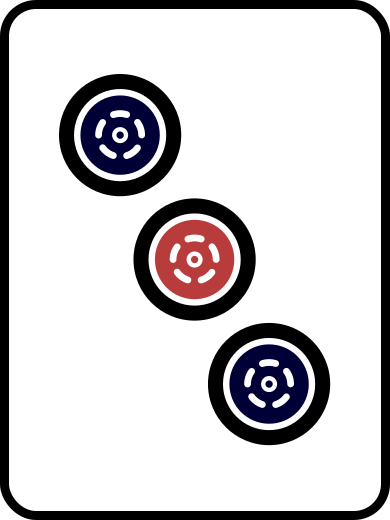
Iishoku sanjun (一色三順, "one color, three sequences") is three identical sequences in one suit, such as 1-2-3 pin three times. It's kuisagari: 2 han closed and 1 open, though like almost every local yaku, its value can change.
Suurenkou
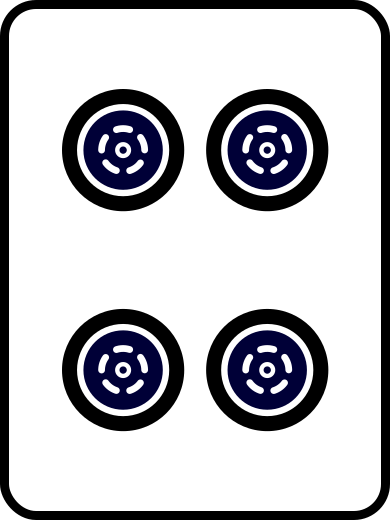
Suurenkou (四連刻, "four consecutive triplets") is a local yakuman: four triplets of consecutive numbers in one suit, open or closed. It's sanrenkou taken to four. Where nobody plays it, the example hand is toitoi. Closed, it would be suuankou as well.
Iishoku suujun
Iishoku suujun (一色四順, "one color, four sequences") is a local yakuman: four identical sequences in one suit, open or closed. Where nobody plays it, the closed hand is worth at least ryanpeikou.
Daisharin
Daisharin (大車輪) means "the great wheel". In English it's big wheels. It's a local yakuman that's almost extinct today: two tiles of each number from 2 to 8 in pin, on a closed hand.
It's pin only because the name refers to the wheels drawn on those tiles. Players at the table tell another story, about symmetry: man has chuuren poutou, sou has ryuuiisou, and pin has daisharin. Some local rules have versions in man (daisuurin, 大数隣) and in sou (daichikurin, 大竹林).
Where nobody plays it, the hand is worth chinitsu, ryanpeikou, tanyao, and, on a two-sided wait, pinfu: 11 han, a sanbaiman. With riichi and tsumo it reaches 13. It's the same shape, in another suit, as the kazoe yakuman example.
Shiisanpuutaa
Shiisanpuutaa (十三不塔, also shiisan budou and other names) means "thirteen broken". You score it when, on your first draw and with no calls before it, no tile in your hand connects to another to form a meld, apart from a single pair. It's a local rule and its value varies: often mangan, sometimes yakuman.
Renhou
Renhou (人和), "blessing of man", completes the set with tenhou and chiihou. A non-dealer wins by ron before their first draw, and nobody has called chi, pon, or kan before it (a closed kan included). Its value depends on the rules: it doesn't exist on Tenhou, Mahjong Soul, or M-League. WRC and EMA pay it as a mangan, with no other yaku or dora added. Some local rules pay it as a baiman or a yakuman.
Full guide: renhou.
Paarenchan
Paarenchan (八連荘) means "eight renchan". Under this rule, a dealer who wins eight hands in a row collects a yakuman. Tenpai draws usually don't count. The conditions come in many variants. Hardly anyone plays it today: it isn't on Tenhou, Mahjong Soul, M-League, WRC, or EMA. People still talk about it a lot.